New Video on India/Bangladesh Exchange Initiative!

We would like to take this opportunity to forward some news in relation to

Image Copyright: International Accountability Project,

the  India/Bangladesh exchange initiative. Our very trustworthy friends at the International Accountability Project (IAP) were working on this initiative with some admirable videographers at Mediafire for the last several months. With thanks to IAP and some very devoted film makers, we have the pleasure to let you know that their film is now ready for you to available online!

You are most welcome to view the film and to share with your colleagues and friends.

Download link for Bangla version:
http://www.mediafire.com/watch/k8fzgpg73gl24r3/PHULBARI_DEBO_NA_Bangla_version.mp4

Download Link for Hindi version with English subtitles:
http://www.mediafire.com/watch/2uxo41al490619q/PHULBARI_DEBO_NA_Hindi_.mp4

MediaFire says that  anyone can access using these links. I’ve just tried and they seem to be working fine.  However, if you do have problems with these links, let us know.

In the meantime, may I ask you to share the film with your friends/colleagues and as many people as possible please. Feel free to put the link on your blog, FB page, and twitter.
Further details on the India/Bangladesh Exchange Initiative can be found on the IAP website here at:  accprojectlive.radicaldesigns.org/article.php?id=742

‘Prime Minister Sheikh Hasina has directed the energy ministry to wait for ‘new technology’ before going for coal extraction’

‘Prime Minister Sheikh Hasina has directed the energy ministry to wait for ‘new technology’ before going for coal extraction’

Wait for ‘new technology’: PM

Stressing the need to protect arable land, Prime Minister Sheikh Hasina has directed the energy ministry to wait for ‘new technology’ before going for coal extraction.

She also outlined the ministry’s future challenges and ways to tackle them.

State Minister Nasrul Hamid Bipu briefed journalists on Thursday after her first visit to the ministry in two-and-a-half-years.

“The Prime Minister told ministry officials that new technology to extract coal may become available soon. We will wait for it,” he said quoting the Prime Minister.

Hasina’s directive comes amid controversies on whether Bangladesh should go for open-pit mining along with importing coal to meet increasing power demands.

Hamid was, however, silent on coal extraction issues. He also did not explain how thermal power production could be raised while waiting for ‘new technology’.

He said the Prime Minister wanted protection of farmers’ land first and coal extraction to be left to the future.

Hamid said Hasina, who also holds the energy portfolio, had ordered the stepping up of coal extraction research.

State-run oil, gas and mineral resources corporation Petrobangla claims Bangladesh has five coal mines with an estimated combined reserve of 3.1 billion tonnes.

Currently, an estimated 1.65 million tonnes of coal is produced annually from one of the mines through underground mining.

A group of experts, environmentalists, various Leftist fronts oppose open-pit mining which pollutes the environment, lays waste to arable land and displaces the habitants.

Despite a matter of high priority, the government has failed to formulate a coal policy in the past decade.

About 75 percent of Bangladesh’s power comes from gas while coal is used to produce less than 3 percent.

The government claims electricity generation increased nearly 5,000MW over the past five years. A ‘Festival of Light’ was held in Dhaka last year to mark the production of 10,000MW, hitting a new milestone in the country. It also plans to raise power production to 30,000MW by 2030, half of which would come from coal.

However, according to information presented in Parliament last June, around 40 percent people still do not have access to electricity.

Bipu said the Prime Minister had directed the setting up of a coal-fired power plant near the Paira Port in southern Patuakhali.

The government recently faced a wave of protests when it decided to go ahead with a 1,320MW thermal power plant at Rampal, near the Sunderbans.

Full article – bdnews24.com/bangladesh/2014/02/06/wait-for-new-technology-pm


PM’s strategy on coal: Asia Energy’s future with Phulbari bleak

Reported by: UNBconnect
Reported on: February 8th, 2014 12:02:55 am

Dhaka, Feb 7 (UNB) – The future of Phulbari coal mine project of UK-based Asia Energy, since renamed as Global Coal Management (GCM), has become bleak following the Prime Minister’s recent distinct statement on coal mining in the country.


While holding meeting with Power and Energy Ministry’s top officials on Thursday (February 6), Prime Minister Sheikh Hasina said: “Right now, we want to leave the issue of coal extraction to the future technology as food security and protecting the land of the farmers is the first priority.”


The Asia Energy entered Bangladesh in 2003 buying a contract from Australian company BHP to explore coal in Phulbari of Dinajour district. But when Asia Energy moved to execute its project as an open-pit mining, it faced tremendous opposition from local community and environmentalists.


The major protests took place on August 30 in 2006, where six protesters were shot dead, allegedly by paramilitary forces, and 300 were injured when a crowd of 30,000 people stormed the local offices of Asia Energy in Dinajpur.


The incident forced the government to announce postponement of the operation of Asia Energy’s Phulbari project. The Asia Energy was renamed as Global Coal Management (GCM) in 2007.


Recently, different activities of Asia Energy or GCM have been suggesting that the company is planning to come back in a new way to implement its project. Particularly, the GCM, a listed company with London Stock Exchange showing Phulbari coal mine as its project, became active in the country’s northern region where it recently launched some campaigns to garner local public support in its favour.


The GCM’s campaign raised serious concern among the anti-Phulbari activists who also threaten to reactivate their protest to resist the UK-company’s move.


Meantime, GCM reconstituted its board of directors and brought major changes in its Dhaka as well as London office by putting some new directors and staffs which also suggests the company is really coming up with new enthusiasm.


Sources said the company also recast its strategy to win the deal for exploration of the proposed Phulbari coal mine.


As part of the new strategy, the company has inducted a young Malaysian tycoon as a Non-Executive Director, removing a Briton from the Board of Directors.


With the announcement, Malaysian tycoon Dato’ Md Wira Dani Bin Abdul Daim has replaced British entrepreneur Neil Lindsey Herbert from the board of directors of GCM.


“Under the leadership of Malaysian business tycoon, the GCM was eyeing to rearrange its strategy in winning a deal for commercial exploration of the proposed Phulbari coalmine district,” said a source.


The GCM appointed Mettiz, an investment company with significant corporate and financial experience in natural resources, power generation, manufacturing and real estate, a lobbyist in Bangladesh last year to get approval of the government for commercial exploration of the Phulbari coalmine.


But, energy industry insiders thought the Prime Minister’s statement has made it clear that the project is unlikely to be executed in near future.


Quoting the Prime Minister, State Minister for Power and Energy Nasrul Hamid said she has given us a directive regarding coal extraction saying that “first of all we need” food security and land use.


“Only after ensuring food security and protecting farmers’ land, we’ll decide which technology we’ll use to extract coal,” he told reporters following the PM’s meeting.


Asia Energy Bangladesh’s CEO Gary Lye, however, said Phulbari Coal Project uses the land for mining temporarily. Land is immediately rehabilitated and returned to agriculture after extracting the coal which is a far greater benefit for the country.


He said Asia Energy is concerned to ensure food security and the company’s agriculture improvement plan will increase the food production from the area as well as allow coal extraction and jobs.


“We (will) welcome the opportunity to brief the Prime Minister on these plans and show how she can deliver for the people and country coal, major power and food security. People from the area want the coal mining and development benefits it’ll bring to them and their region which is one of the Bangladesh poorest regions.”   


Bangladesh has five coal fields with an estimated reserve of some 3.0 billion tonnes, industry insiders said. Of the five coal fields, only one in Barapukuria is now in operation.

– See more at: http://unbconnect.com/pm-coal-ld/#&panel1-2

PM’s strategy on coal: Asia Energy’s future with Phulbari bleak

Reported by: UNBconnect
Reported on: February 8th, 2014 12:02:55 am

Dhaka, Feb 7 (UNB) – The future of Phulbari coal mine project of UK-based Asia Energy, since renamed as Global Coal Management (GCM), has become bleak following the Prime Minister’s recent distinct statement on coal mining in the country.


While holding meeting with Power and Energy Ministry’s top officials on Thursday (February 6), Prime Minister Sheikh Hasina said: “Right now, we want to leave the issue of coal extraction to the future technology as food security and protecting the land of the farmers is the first priority.”


The Asia Energy entered Bangladesh in 2003 buying a contract from Australian company BHP to explore coal in Phulbari of Dinajour district. But when Asia Energy moved to execute its project as an open-pit mining, it faced tremendous opposition from local community and environmentalists.


The major protests took place on August 30 in 2006, where six protesters were shot dead, allegedly by paramilitary forces, and 300 were injured when a crowd of 30,000 people stormed the local offices of Asia Energy in Dinajpur.


The incident forced the government to announce postponement of the operation of Asia Energy’s Phulbari project. The Asia Energy was renamed as Global Coal Management (GCM) in 2007.


Recently, different activities of Asia Energy or GCM have been suggesting that the company is planning to come back in a new way to implement its project. Particularly, the GCM, a listed company with London Stock Exchange showing Phulbari coal mine as its project, became active in the country’s northern region where it recently launched some campaigns to garner local public support in its favour.


The GCM’s campaign raised serious concern among the anti-Phulbari activists who also threaten to reactivate their protest to resist the UK-company’s move.


Meantime, GCM reconstituted its board of directors and brought major changes in its Dhaka as well as London office by putting some new directors and staffs which also suggests the company is really coming up with new enthusiasm.


Sources said the company also recast its strategy to win the deal for exploration of the proposed Phulbari coal mine.


As part of the new strategy, the company has inducted a young Malaysian tycoon as a Non-Executive Director, removing a Briton from the Board of Directors.


With the announcement, Malaysian tycoon Dato’ Md Wira Dani Bin Abdul Daim has replaced British entrepreneur Neil Lindsey Herbert from the board of directors of GCM.


“Under the leadership of Malaysian business tycoon, the GCM was eyeing to rearrange its strategy in winning a deal for commercial exploration of the proposed Phulbari coalmine district,” said a source.


The GCM appointed Mettiz, an investment company with significant corporate and financial experience in natural resources, power generation, manufacturing and real estate, a lobbyist in Bangladesh last year to get approval of the government for commercial exploration of the Phulbari coalmine.


But, energy industry insiders thought the Prime Minister’s statement has made it clear that the project is unlikely to be executed in near future.


Quoting the Prime Minister, State Minister for Power and Energy Nasrul Hamid said she has given us a directive regarding coal extraction saying that “first of all we need” food security and land use.


“Only after ensuring food security and protecting farmers’ land, we’ll decide which technology we’ll use to extract coal,” he told reporters following the PM’s meeting.


Asia Energy Bangladesh’s CEO Gary Lye, however, said Phulbari Coal Project uses the land for mining temporarily. Land is immediately rehabilitated and returned to agriculture after extracting the coal which is a far greater benefit for the country.


He said Asia Energy is concerned to ensure food security and the company’s agriculture improvement plan will increase the food production from the area as well as allow coal extraction and jobs.


“We (will) welcome the opportunity to brief the Prime Minister on these plans and show how she can deliver for the people and country coal, major power and food security. People from the area want the coal mining and development benefits it’ll bring to them and their region which is one of the Bangladesh poorest regions.”   


Bangladesh has five coal fields with an estimated reserve of some 3.0 billion tonnes, industry insiders said. Of the five coal fields, only one in Barapukuria is now in operation.

– See more at: http://unbconnect.com/pm-coal-ld/#&panel1-2

Mining and Human Rights News (weekly)

  • “(Kampala) – Uganda’s nascent mining industry could do more harm than good for indigenous people unless the government makes reforms and mining companies start respecting rights, Human Rights Watch said in a report released today. Uganda’s government has promoted private investment in mining in the remote northeastern Karamoja region to bring economic development, but should implement reforms to respect the rights of indigenous people to determine how their lands are used.”

    tags: mining

Posted from Diigo. The rest of my favorite links are here.

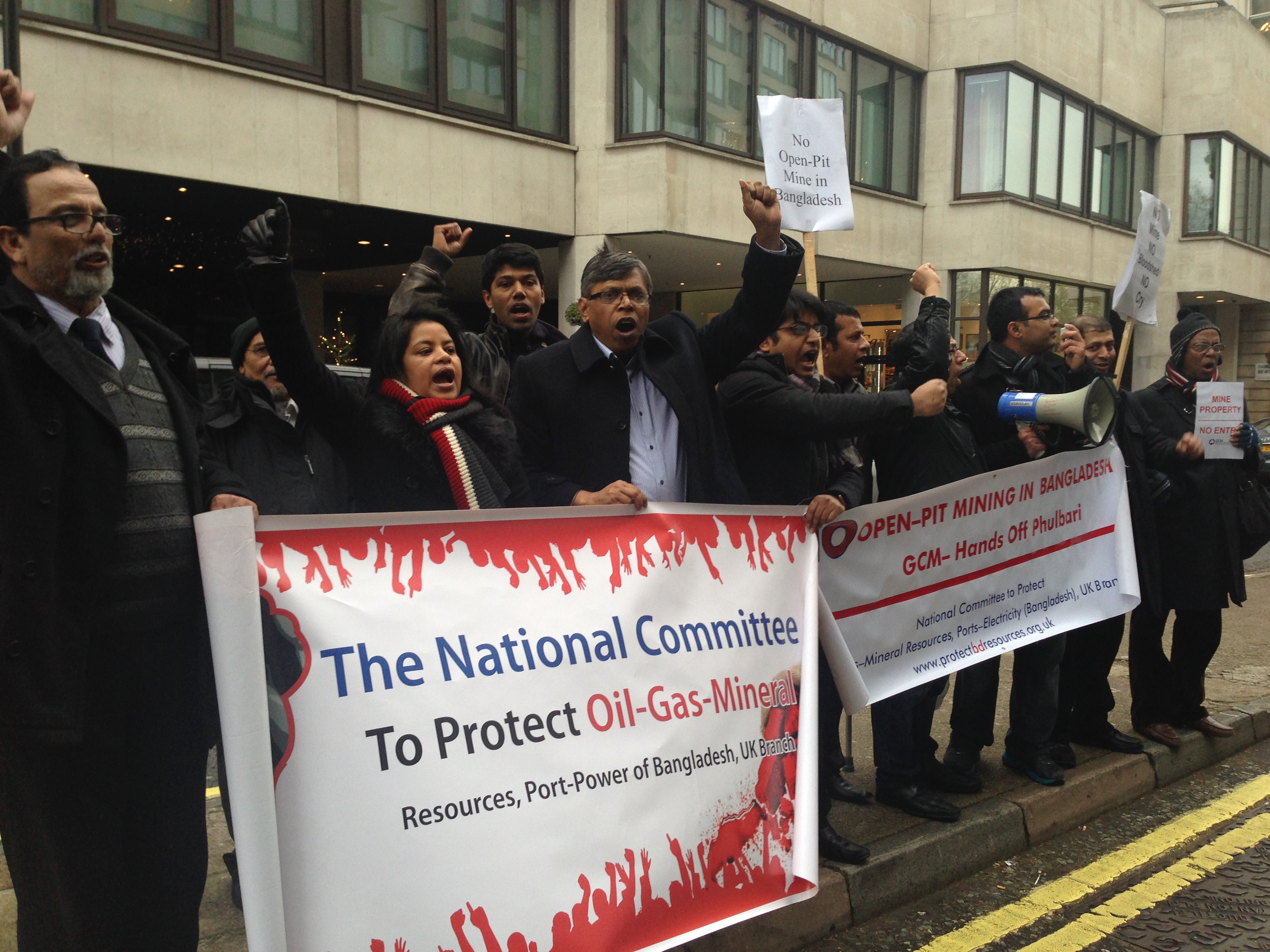
Protests at GCM Resources AGM over Phulbari coal mine

Reporting from the Noise-demo held on 4 December

By Raaj Manik, 5 December 2013

A noisy and powerful protest was held outside the AGM of London-listed mining company GCM Resources, on 4 December, over the company’s proposed Phulbari coal mine in Bangladesh, which if it goes ahead will immidiately displace an estimated 130,000 people and plunder 94 percent water resources in the region. It will pose threats to the Sundarbans, one of the world’s largest remaining mangrove forests and a UNESCO World Heritage site.

demo5

The British mining company GCM Resources is currently under investigation by the UK government following a complaint by the World Development Movement and the International Accountability Project. The complaint claims the mine would breach OECD rules by violating the human rights of the people who would be forcibly displaced and impoverished by the project.

The project will destroy over 14,660 hectares of fertile agricultural land that produce three food crops annually, threatening to increase hunger in a country in which nearly one third of all people currently live below the nutrition poverty line. The project threatens to destroy the homes, lands, and water sources of as many as 220,000 people over the course of 30 years mining, and forcibly evict an estimated 130,000 people immidiately. The mine would violate the rights of 50 thousands indigenous people living in the area.

The Phulbari coal project has been on hold since 2006 due to intense local and national opposition. Three young people were killed and many more injured when paramilitary officers opened fire on a protest against the mine in August 2006.The project has generated grave concern at national and international levels including the United Nations and the UK government’s National Contact Point.

The UK government’s investigation will evaluate whether GCM Resources has breached obligations to ensure meaningful and adequate consultation about the project, or to carry out appropriate due diligence to ensure that its project does not violate people’s human rights.

demo

The company has admitted that most of the people living in the area affected by the mine “will become landless”. Yet the company wants to move forward with its plans of forced – displacement and destruction in north – west of Bangladesh. Yesterday, the company has reassured the shareholder that it has plans to persuade the future government of Bangladesh to approve the destructive project soon after the election. Gary Lye, the company’s unwanted CEO, who had to leave Phulbari amidst protests by villagers earlier this year, told the shareholders that he is keeping contacts with government of Bangladesh through his confidential sources.

But the protesters told this correspondent that GCM will never go Demo2back to Bangladesh.This company had to leave Phulbari on people’s verdict in 2006.

Yesterday’s protest was held by members of the UK Committee to Protect Oil, Gas, Mineral Resources, Port and Power in Bangladesh, the Phulbari Solidarity Group, the World Development Movement and the London Mining Network and other Bangladeshi activist groups.

See further details at:


London protest held at GCM Resources AGM over Open Pit Mining in  Phulbari


Protests at GCM Resources AGM over Bangladesh coal mine


Chairman of GCM Resources offered Jobseeker’s Allowance claim form by concerned shareholder

UK government accepts complaint over Proposed GCM Coal Mine in Phulbari

The Organisation for Economic Cooperation and Development (OECD) has agreed to consider complaints regarding severe human rights violations associated with the proposal by GCM Resources, a British-based company,  to establish an open-pit coal mine in the Phulbari region of north-west Bangladesh.  The proposed mine threatens to displace in the region of 220,000 people whilst also posing a significant threat to the natural environment of the region, which incorporates the Sundarbans, one of the world’s largest remaining mangrove forests and a UNESCO World Heritage site.

The complaint by the International Accountability Project and the World Development Movement claims that the mine planned by the AIM-listed company would breach OECD Guidelines for Multinational Enterprises. It would violate the human rights of indigenous people from 23 different tribal groups, and destroy nearly 12,000 acres of Bangladesh’s most fertile and productive farmland.
(Source: www.wdm.org.uk/news/uk-government-accepts-complaint-over-gcm-resources%E2%80%99-bangladesh-coal-mine#sthash.psPU0A0d.dpuf).

Full details of the OECD’s UK National Contact Point response can be found in the following official policy paper which is accompanied by an initial assessment of the original complaint as submitted by the International Accountability Project and World Development Movement.

The official Policy Paper published on the UK Goverment website – UK NCP initial assessment: complaint from the International Accountability Project and the World Development Movement against GCM Resources Plc in Bangladesh.

The full Document highlighted in this press release can be detailed as follows:

Initial assessment by the UK national contact point for the OECD guidelines for multinational enterprises: complaint from the International Accountability Project and the World Development Movement against GCM Resources Plc in Bangladesh

UK National Contact Point accepts for further consideration a complaint against a UK company developing plans for coal mining in Bangladesh.

Ref: BIS/13/929 PDF, 163KB, 12 pages

World Development Movement Statement – UK government accepts complaint over GCM Resources’ Bangladesh coal mine

‘The acceptance of the complaints by OECD for investigation into the alleged human rights violation at Phulbari coalmine site dealt a serious blow to GCM, which has been struggling since late 1990s to get government approval for exploration of the coalmine with an estimated reserve of 572 million tonnes of high-quality bituminous coal’, reports the pro-GCM newspaper the Financial Express.  The London-based Global Coal Management (GCM) Resources Plc (formerly Asia Energy) has announced formation of a new board of directors headed by Polo Resources Limited Managing Director Michael Tang, according to Financial Express. Read more here.


Protests prevent British mining company GCM visiting mine site in Bangladesh – director resigns

Article reproduced from the World Development Movement website:

Protests prevent British mining company GCM visiting mine site in Bangladesh – director resigns

By Miriam Ross, 4 February 2013

DSC07961Massive protests against British mining company GCM Resources prevented the company’s CEO visiting the site of its proposed open-pit coal mine in Bangladesh last week. One of the company’s directors resigned the following day.

CEO Gary Lye was due to visit Phulbari on 29 January, where GCM wants to open a mine that would displace up to 220,000 people. Mr Lye had planned to distribute blankets to people living in the area, according to the local press. Thousands of people joined protests against the mine, and Lye abandoned his visit on official advice.

One of GCM’s directors, Graham Taggart, resigned on Wednesday. The company’s largest shareholder, Polo Resources, has announced that it is considering selling its 29.77 per cent stake in the company.

A Bangladeshi parliamentary committee has also spoken out against GCM, claiming that that the company does not have a valid agreement with the Bangladeshi government to proceed with the mine.

The British mining company has faced sustained opposition to its planned mine. Three people were killed and around 200 injured when paramilitary officers opened fire on protestors in 2006.
The mine in the northwest of Bangladesh is projected to extract 572 million tons of coal over at least 36 years. Eighty per cent of the coal would be exported. As well as displacing up to 220,000 people, it threatens to destroy a major food-producing agricultural region, and pollute of the world’s largest remaining mangrove forest, the Sundarban Reserve Forest, a UNESCO-protected World Heritage site.

GCM’s London AGM ended in chaos in December when a protestor dressed as Santa Claus presented chairman Gerard Holden with a Christmas stocking full of coal.

World Development Movement campaigner Christine Haigh said today:

The Phulbari mine would devastate hundreds of thousands of lives, destroying valuable agricultural land and causing irreparable environmental damage. It’s high time GCM listened to the massive sustained opposition in Bangladesh and abandoned the project.

Further Links:

London Mining Network (06/02/2013): Protests prevent British mining company GCM visiting mine site in Bangladesh – director resigns

World Development Movement (04/02/2013): Protests prevent British mining company GCM visiting mine site in Bangladesh – director resigns

Coal Guru (05/02/2013):  Future of the Phulbari coal project of GCM in Bangladesh in doubt

The Manufacturer (04/02/2013): Mining CEO resigns after Bangladeshi protests

The Daily Star (30/01/2013): Top Asia Energy official’s visit sparks protest in Dinajpur

The Daily Telegraph (30/01/2013): Tough at the Polo coalface (scroll down)

Santa evicted after dumping coal at GCM’s boss’s desk – Updated Videos from GCM demo in December 2012

A surprised Father Christmas was thrown out of a multinational corporation’s AGM in London today after presenting the Chairman with a stocking full of coal.

Santa Claus was frogmarched out by irate security at the prestigious meeting of GCM Resources, a controversial multinational corporation whose coal mine plans suffered angry condemnation by UN Special Rapporteurs this February. UN experts warned of “irreversible damage” to ecosystems and 50,000 evictions of indigenous people at the coal mine site in Phulbari, Bangladesh.

St Nicholas, dressed in red and white, entered the elite Insitute of Directors in Pall Mall and dumped a Christmas stocking stuffed with coal on the desk Gerard Holden, GCM’s Chairman, in front of shareholders. Father Christmas said “Ho, ho, ho, you’ve been naughty this year. You threatened to evict 130,000 people so you could profit from polluting the climate. Your stocking’s full of coal; next year maybe you should be a good little boy!”

Livid security pulled Santa from the stage and threw him out of the Insitute of Directors. Santa was last seen looking flustered with his beard at an angle, running haphazardly away from the AGM to a bicycle to make his getaway. It is not known whether Father Christmas will recover in time for the yearly gift-giving on Christmas Eve.

For more information on how to save Phulbari, seehttp://londonminingnetwork.org/

See Video:

See also:

Bangladesh mine activists dump coal outside GCM meeting in London

News – Polo Resources Limited: Update on GCM Holding

Source: Business Wire

Polo Resources Limited: Update on GCM Holding

TORONTO–(BUSINESS WIRE)–Polo Resources Limited (AIM and TSX: POL) (“Polo” or the “Company”), announces that it has held discussions with interested parties over the last year regarding the sale of its 29.77 per cent stake in GCM Resources plc (“GCM”). Discussions are ongoing and at a very early stage and there can be no certainty that an offer for some or all of its interest will be forthcoming.

As at today’s date, Polo holds 15,220,985 ordinary shares in GCM, representing approximately 29.77 per cent of the issued ordinary share capital of GCM.

About the Company
Polo Resources is a natural resources investment company focused on investing in undervalued companies and projects with strong fundamentals and attractive growth prospects. For further details on Polo Resources please see our website: www.poloresources.com.

CAUTIONARY STATEMENT

The AIM Market of London Stock Exchange plc does not accept responsibility for the adequacy or accuracy of this release. No stock exchange, securities commission or other regulatory authority has approved or disapproved the information contained herein. All statements, other than statements of historical fact, in this news release are forward-looking statements that involve various risks and uncertainties, including, without limitation, statements regarding potential values, the future plans and objectives of Polo Resources Limited. There can be no assurance that such statements will prove to be accurate, achievable or recognizable in the near term.

Actual results and future events could differ materially from those anticipated in such statements. These and all subsequent written and oral forward-looking statements are based on the estimates and opinions of management on the dates they are made and are expressly qualified in their entirety by this notice. Polo Resources Limited assumes no obligation to update forward-looking statements should circumstances or management’s estimates or opinions change.

Source: Reuters

BRIEF-Polo Resources says held talks about sale of GCM stake

Jan 22 (Reuters) – Polo Resources Ltd : * Has held discussions with interested parties regarding the sale of its 29.77

per cent stake in GCM Resources Plc * Talks are ongoing and at a very early stage and can be no certainty that an

offer will be forthcoming.


Deal with Asia Energy on Phulbari coalmine invalid

Reproduced from the London Mining Network news story:

London-listed GCM Resources’ subsidiary Asia Energy has been accused by a Bangladesh parliamentary committee of having no valid deal since 2006 with the government for any exploration or mining in Phulbari.

The parliamentary standing committee on power, energy and mineral resources ministry has recommended that the Government’s Energy and Mineral Resources Division take action against GCM Resources Plc, the mother company of the AEC, for doing business on the London Stock Exchange showing the Phulbari coalfield project as its own resources.

See http://www.daily-sun.com/index.php?view=details&archiev=yes&arch_date=21-01-2013&type=Deal-with-Asia-Energy-on-Phulbari-coalmine-invalid&pub_no=386&cat_id=1&menu_id=2&news_type_id=1&index=2.

The original article from the Daily Sun:

Asia Energy Corporation (Bangladesh) Pty Ltd has no valid deal since 2006 with the government for any exploration or mining in Phulbari coalmine in Dinajpur.

The parliamentary standing committee on power, energy and mineral resources ministry has recommended that Energy and Mineral Resources Division take action against GCM Resources, Plc, the mother company of the AEC, for doing business on London stock market showing Phulbari coalfield project as its own resources.

Asia Energy got an exploration licence, but it expired on January 27, 2006 as the then government allowed the British company to conduct only feasibility study for two years from January 28, 2004.

In March 2004, Asia Energy also received approval from then state minister for power and energy AKM Mosharraf Hossain to get an exploration licence for ten years.

Later, the Prime Minister’s Office asked the energy and mineral resources division to take action against those who granted exploration licence to Asia Energy for 10 years. But the investigation findings have not yet come to light.

EMRD is now investigating why the then government asked for depositing only two percent royalty for Phulbari coal project, although it fixed six percent royalty for the project.

While visiting the GCM, Plc website, this correspondent found that Asia Energy got exploration licence for 30 years and it is now doing business with the coalfield project.

According to the mines and minerals act of Bangladesh, any company is allowed for open-pit mining for ten years while for underground mining for 20 years subject to approval from the prime minister.

Late last year, the parliamentary watchdog recommended taking action against the GCM for continuing their business on London Stock Exchange showing Phulbari Coalfield project.

“We have recommended that EMRD take action against the GCM as it has claimed that Phulbari Coalfield project is its own resources,” Subid Ali Bhuiyan, chairman of the standing committee on power, energy and mineral resources ministry, told daily sun on Sunday.

He said the committee members at a meeting on January 6, 2013 expressed satisfaction after the GCM had removed its claims on Phulbari coal project from its website. “We have advised the EMRD to be alert as no one can illegally claim the country’s mineral resources as its own,” he said.

Prof Anu Muhammad said the government should claim compensation from GCM Plc. “The government will have to force the company out of the country by March 29. If it fails, the national committee will stage huge demonstrations at Phulbari on March 30.”

In reply to a query about recent controversy over the activities of Asia Energy at Phulbari coalmine, Prime Minister’s Adviser Tawfiq-e-Elahi Chowdhury said the company had received a licence only to conduct a survey.

He said Asia Energy is yet to get a coal-mining licence for Phulbari. The government would not sign any mining deal without determining underground water in the country’s northern region, he added.

In an official letter on October 14 last year, the home ministry informed the local administration that the company (Asia Energy) is keen to carry out survey in Nawabganj, Parbatipur, Birampur and Phulbari areas for possible coalmine developments.

The officials concerned were disappointed at the decision as energy division is the legal authority to allow any company to do such work.

Asia Energy Corporation (Bangladesh), a subsidiary of GCM plc, had earlier proposed implementing Phulbari coal project with an estimated investment of $2 billion.


“De-list Vedanta!” protest at FSA headquarters

From the Foil Vedanta website:

In London today activists from Foil Vedanta and other grassroots groups held a silent symbolic demonstration outside the Financial Services Authority headquarters in Canary Wharf, calling for the new Financial Conduct Authority to de-list Vedanta from the London Stock Exchange for poor corporate governance and human rights crimes in Niyamgiri and elsewhere. They handed over documentation and arranged to meet FCA officials in future.

Simultaneously the Indian Supreme Court held another hearing on Vedanta’s planned mega-mine which threatens the Dongria Kond tribe who live in the Niyamgiri hills. If permission to mine is denied Vedanta is likely to close its Lanjigarh refinery due to lack of bauxite costing them billions.

See the video of today’s demonstration at the FCA, and also the new video of our previous demonstration at Vedanta Headquarters.

Protesters in London today added their voice to recent pressure for Vedanta to be de-listed from the London Stock Exchange for its poor corporate governance, illegal operations and major human rights violations.(1) Most recently MP John McDonnell raised a debate in the House of Commons calling for the Financial Conduct Authority to use its powers to investigate and de-list companies guilty of major human rights violations such as Vedanta(2). Other parliamentarians, financiers and the former CBI Director Richard Lambert have also highlighted how Vedanta’s listing is used for legal immunity to hide their corporate crimes.(3)

Chris Hamilton (FSA) receives documentation from Foil Vedanta members

The protesters met with a representative of the FSA (FCA) to deliver key documentation about Vedanta’s chequered ethical record and request a formal investigation into the company. The documents included the Norwegian Ethics Council’s damning report on Vedanta which led them to pull out their substantial shares, and a report by the London Mining Network calling for stricter regulation of nominally London listed mining companies like Vedanta. Lord Adair Turner (head of the Financial Services Authority also graced the demonstration with his presence on his way into the building. They also drew attention to Vedanta’s violations of the UN Declaration on the Rights of Indigenous Peoples at the proposed Niyamgiri mine(4).

The demonstration was almost called off as Security Managers from Canary Wharf Estates claimed that protest was not allowed anywhere on the entire property. Canary Wharf (the central banking district of London) is owned by a private consortium of banks and investors. This means members of the public are technically trespassing if they walk through the area, and any protest can be challenged as ‘aggravated trespass’. Foil Vedanta’s Miriam Rose stated at the demonstration:

It is outrageous that a public body like the FSA who are supposed to work for the British people, are hiding behind the private property of private corporations and banks where they cannot be held to account by protest.”

Lord Adair Turner – FSA head – checks out the demo

At the last hearing of the Niyamgiri case on 11th January lawyers for Vedanta dwelled on the ongoing demonstrations in London, asking why people are protesting there, and claiming that India is suffering because of this. Judges noted that this is not relevant to the case and pointed out that people have a right to protest. Foil Vedanta’s spokesperson reacted:

Vedanta is a London listed company and profits from this affiliation. It is typical of Vedanta to assume they are above the law and above public accountability. We will continue to draw attention to their corporate crimes here in London”.

The project has been racked with controversy from the start, as a spate of recent coverage points out: The Lanjigarh refinery built to process the bauxite from the hills was illegally constructed, the court case presided over by a judge with shares in the company, and the refinery should never have been given permission without including the associated mega mine in impact assessments1.

Cover of Open Magazine on Vedanta’s collusion with Indian government

A cover story in major Indian glossy Open Magazine in December details evidence of corruption and collusion between Vedanta and the Odisha state government, local officials, judges and the police to force the project through2. Meanwhile Vedanta’s chairman and 56.7% owner Anil Agarwal has launched a rare PR crusade claiming that Vedanta ‘have not cut one tree’ and respects and preserves the rights of the protesting indigenous tribe living on the threatened mountain. He sets out his extractive philosophy for India – suggesting that exploration should be drastically increased and regulation decreased to provide for the domestic market for metals and oil. 34

If Vedanta lose the Supreme Court case to allow state owned company Orissa Mining Corporation to mine the mountain on their behalf they may have to close the dependent Lanjigarh refinery costing them billions. Under enormous pressure from Vedanta the Odisha government has suggested alternative bauxite supplies from a deposit located in a major wildlife sanctuary and tribal area at Karlapat arousing anger and opposition from grassroots groups.(5)

The final court decision rests on whether the Green Bench of India’s Supreme Court rules the rights of forest dwellers to be ‘inalienable or compensatory’5. In view of this India’s Tribal Affairs Minister V Kishore Chandra Deo has asked the Environment Minister to ensure the rights of forest dwellers is protected in the spirit of the Forest Dwellers act.6 (7)

Speaking about the verdict Dongria Kond activist Lado Sikaka states:

“We will continue our fight even if Vedanta gets permission. Are these Judges above the Law? In effect, they act as if they are. Niyamgiri belongs to us. We are fighting because We are part of it. Our women are harassed and we are called by the police and threatened not to go to rallies. Last month they have been working like Vedanta’s servants.7

Foil Vedanta’s Samarendra Das says:

Vedanta is not the only mining company that should be de-listed for their corporate crimes. Infamous London listed offenders Lonmin in South Africa, Monterrico in Peru, GCM in Phulbari and Bumi in Indonesia should also be investigated for extensive human rights atrocities.”


Ends.

Coverage:

See the video of today’s protest here.

The Hindu ‘Activists hold protest against Vedanta in London’

Demotix  ‘Activists call for FCA to delist Vedanta PLC’

Times of India ‘Green, tribal ministries’ stand on Vedanta case in SC to determine other projects’ fate’

 The India Links, ‘Activists hold protest against Vedanta in London’

The demonstration was also covered on Orissa TV and MBCTV in India.