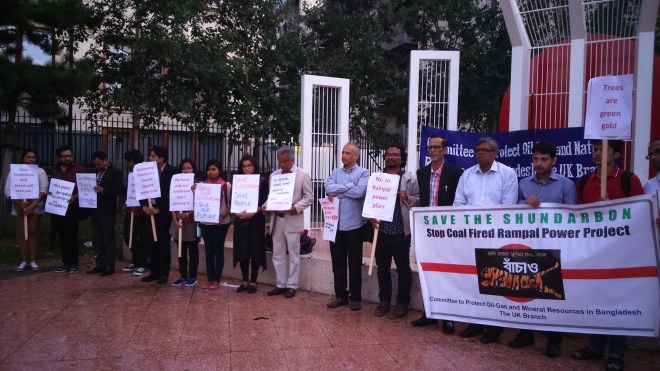
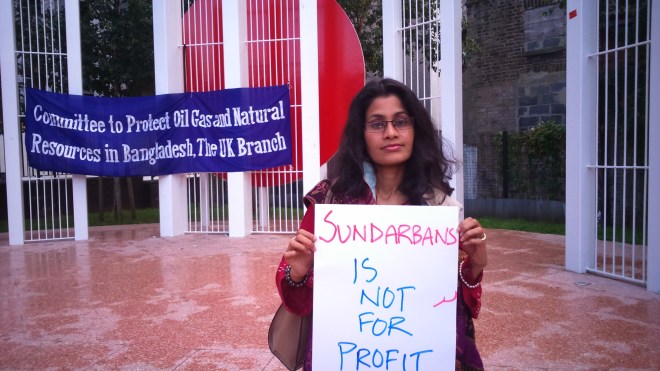
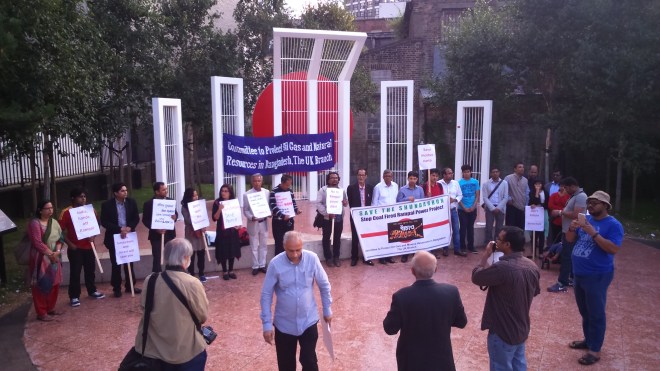
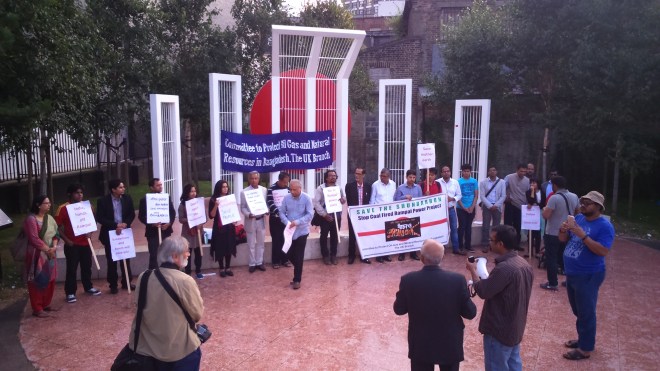
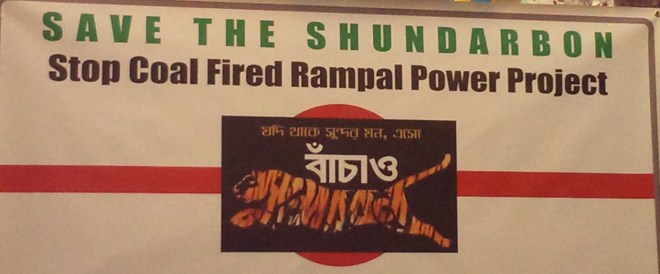
Scrap the Rampal Power Plant project, Save the Sundarbans

As the government of Bangladesh suggests that the destructive deal with India cannot be scrapped due to delicate conditions of the contract, the National Committee to Protect Oil, Gas, Mineral Resources, Power and Port in Bangladesh has written the following open letter to Indian Prime Minister. We believe that the Prime Minister of India can and should act promptly to halt Rampal Coal Power Plant.

 

anup-kundus-photo-28-jan-2015-copy Stop-rampal-coal-power-plant-poster-by-Rudro Rothi-on-1-august-2016


October 18, 2016

Scrap the Rampal power plant project, Save the Sundarbans

Open Letter to the Prime Minister of India


The Honourable Prime Minister,

We respectfully address you with grave concern and anxiety. The people of Bangladesh today is sternly worried over the future of the Sundarbans, which not only happens to be the only protection barrage of the southern belt of Bangladesh, but also the largest Mangrove Forest of the world, as well as the most valuable ecological habitat of the country and the World Heritage Site. The joint venture of both India and Bangladesh to build a 1320 MW capacity coal-fired power plant has caused much worry among the people of Bangladesh.

We have already written to the Honourable Prime Minister of Bangladesh regarding this. As India is the major partner of this project, we believe, as the head of the Indian government, it is fundamentally important for us to address also to you in this regard, mainly for two reasons. The Rampal Power Plant, officially known as the Maitree Super Thermal Power Project, is a joint venture project of BPDB of Bangladesh and NTPC Limited of India. As per the joint venture agreement signed between Bangladesh and India, NTPC is responsible for planning, building and operating the plant. Bharat Heavy Electricals Limited (BHEL) is now officially responsible for engineering, procurement and construction (EPC) of the Rampal Power Plant. Exim Bank, a state bank of India, has been officially selected for financing this project, whereas Coal India Limited, most probably, is going to be appointed for supplying of necessary coal.

Secondly, if the Sundarbans, adjacent to the Bangladesh part is damaged, it would have a massive spillover effect on the Indian portion as well, affecting the lives and livelihood of the people of India living near Sundarban.

Based on studied opinion of a significantly large number of local and international experts, it is obvious that this particular coal-fired power plant would bring extensive destruction to the forest. It is also worth noting that, following the decision of building a power plant in Rampal, a range of influential business groups and commercial projects have pierced into the same area. It is predicted that the cumulative effect of such commercial aggression would ultimately cause fatal destruction to the Sundarbans.

It is important to note that around 3 to 4 million people including forest and fishing folks are dependent on the Sundarbans and the adjacent water bodies for their natural livelihood. Around 40 million people live in the southern coastal belt of Bangladesh. The power plant is ringing an alarm to the entire coastal community. Moreover, the damage would not be merely restricted to the Bangladesh portion of the Sundarbans. Around 5 million people living near to the Indian portion of the Sudnarbans would be put into grave danger too. Eventually, future generations from both nations would have to bear the deadly impact of the plant.

Obviously, we do not deny ‘development’. Power grids are also vital to modern lives. However, what is not acceptable is the implementation of some environmentally deadly projects which would merely profit the vested interest groups at the cost of the people and environment.

You must be aware of the fact that  this project has drawn huge criticism from both India and Bangladesh, and around the world. The UNESCO, the Ramsar Authority, the South Asian Human Rights Forum led by IK Gujral of India, along with other 150 various organizations have also opposed to the plant and demanded to scrap the deal. The Norwegian Council of Ethics has already withdrawn their fund from this controversial project.

Even the Minister of Finance of Bangladesh has admitted that inevitable environmental damage will be there, nevertheless the project must go on (15 February, 2016)1. We do not want to believe that it is the Government of India who is insisting on the project. Rather, we believe that the Government of India can play a vital role in saving the world’s largest Mangrove Forest by scrapping this controversial project.

Honourable Prime Minister,

The plant site is located on North of the Sundarbans, only 14 kilometers away from its boundary and within merely 4 kilometers of the Ecologically Critical Area (ECA).This site is only 2 meters above the sea level. It obviously holds a key financial and operating risk given the fact that it falls within a tidal delta region which experienced a tidal surge with the height of 5 meters. EIA study itself further notes that the Rampal plant would be in the “wind risk zone” of Bangladesh. It is worthy noting that this particular zone witnessed 16 cyclones in the past 25 years. We are deeply worried that the site’s location and elevation will be at extreme risk should sea levels rise or should an extreme weather event occur. In such events, the ash ponds – located near the Possur River – could easily be washed away putting the river at a serious ecological risk. The river is, in fact, one of the vital water bodies that provides fresh water flow to the world’s largest mangrove forest.

The Indian EIA guideline 2010 itself disallows setting up of similar projects within 25 kilometers of ecologically sensitive areas of India, including forests, rivers, and sanctuaries.2 You must have been aware of the fact that due to such environmental consciousness of the Indian Government, a number of coal-fired plant and coal mining project has been called off by the Green Tribunal and the Ministry of Environment of India3. We would like to call for your attention that while moving forward with this project, the Indian company has violated all environmental rules and regulations of the Indian government itself.

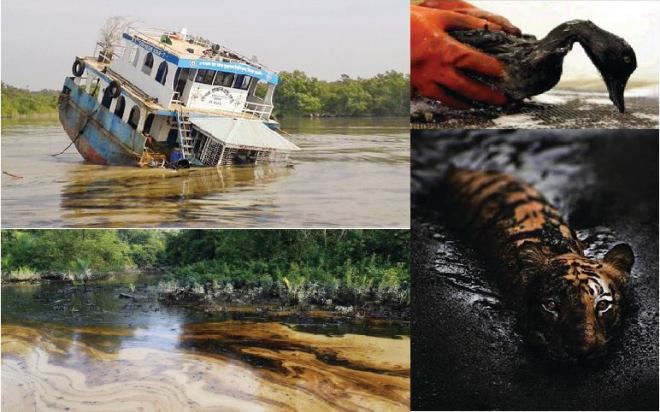
For the production of electricity, the plant will annually consume 4.72 million tons of coal.4  The coal and other toxic and chemical materials required for the construction and operation of the power plant will be transported to the project site through the waterways of the Sundarbans. The transportation of coal (nearly 13 thousand tons per day) through the waterways of the Sundarbans holds dire prospect of coal spillage, ballast water, bilge water, oil spillage, lubricant, and garbage. For the next 30 years, the transportation of cargo and lighter vessels, and the loading and unloading of coal will indeed bring extensive damage to the ecology of the forest and the wildlife habitats.

To run the Power Plant, water of the Possur River will be withdrawn (at the rate of 9,150 m3/hour) and discharged (at the rate of 5,150 m3/hour) into it again after use with a varying temperature5. This will reduce the oxygen of the water and damage the fish stocks of the Possur River. The rising temperature, company admits at least 2C6, will also affect the entire ecosystem and biodiversity of the forest, including the Zooplankton, the Phytoplankton, and the marine ecology. If it continues for the next 25 to 30 years, the marine ecology and the biodiversity of the Possur River would be destroyed, as well as the hydrological characteristics of the river including its salinity front, salinity level, sedimentation pattern, and tidal behavior. Discharged water will also contain huge amount of Mercury if coal-washing is done as confirmed by the Authority.


The zoologists have shown concern that the toxic substances emitted from the coal-fired power plant including arsenic, lead, mercury, nickel, vanadium, beryllium, barium, cadmium, chromium, selenium, and radium are capable of contaminating the air and water to such an extent that it could harm the reproductive health system of the wild life animals and the species of the Sundarbans. The bird scientists are concerned that the coal-fired pollution may hamper the existence of at least 3 rare species of bird, which shelter in the Sundarbans.

The experts and engineers have long suggested that Ultra Super Critical Technology itself is only capable of reducing pollution only at a rate of 8 to 10 percent. Even if other pollutant reducing technology should be used, no record suggests that risk of pollution could be entirely eliminated.  For instance, the installation of FGD may reduce the risk of SO2 pollution, while increasing the chances of water pollution through the release of heavy chemical materials including Arsenic, Mercury, Selenium and Boron7. If low NOX Burner should be used, pollution could be reduced up to 40 to 60 percent, nevertheless, the rest of the toxin chemicals would remain hazardous enough to spoil the environment8. Though the authority has assured the use of FGD and ESP, the combined application of all such technology is capable of dropping the contamination level merely up to 48 percent9. On the other hand, the risk of release of an extensive amount of Mercury still persists, as there is no mention of applying any technology in tender document that regulates or controls the release of Mercury into the forestry and water10.

In the last few years, a number of accidents in the water routes, including deadly oil spill had left its long term footprints on the sensitive forest lives. The current transportation system on the Sundarbans area itself is creating severe sound and water pollution around the forest ecology. Lately, some sensitive locations around the forest have been announced as ‘endangered’ for the Irrawaddy Dolphins by the Government of Bangladesh. The Prime Minister of Bangladesh previously suggested bringing a complete halt to the transportation routes in the Shela River. However, the attempt failed. In these circumstances, we simply cannot take further risk by allowing a 1320 MW capacity of coal-fired plant on the backyard of the Sundarbans. Our experience with institutional capability is also frustrating11.

A coastal belt, in general, survives on the resistant capacity of the mangrove swamps. For instance, extensive commercial establishments in the coastal bodies of the New Orleans state of the USA have ultimately damaged the natural flow of Mississippi river. Due to the vulnerability of these coastal belt areas, Hurricane Katrina could make unprecedented damage to the coastal areas of New Orleans. In Bangladesh, during Hurricane Sidr and Aila, the Sundarbans has largely protected the people and resources of the southern coast. If the Sundarbans is damaged, the people and the species of the entire coastal belt will be practically unprotected.

We would like to stress on the point that no deadly experiement should be taken when the Sundarbans is concerned. Rather we demand to cancel the project, along with every other pollution enhancing projects and commercial activities around the Sundarbans. We also demand to bring a halt to the transportation of hazardous commodities around the Sudarbans. As Rampal power plant is not only a risk by itself, but also has consistently attracted a range of commercial ventures into the area; by scrapping the deal, the Indian government could play a crucial role in protecting the Sundarbans from all kind of forest damaging ventures.

The Sundarbans to us is not a subject of negotiation. Meanwhile, alternative locations and technology is available for power generation. Lately, the Srilankan government had cancelled a similar power plant deal with India (May 18, 2016)12. If Srilanka and India could scrap it, why not Bangladesh to prevent much bigger disaster?

Honourable Prime Minister,

We gratefully remember the contribution of India during the time of our liberation war in 1971. The people of Bangladesh have not forgotten the safe shelter that was provided by the people of India in a time of despair and misery. Nevertheless, it is also observed that the people of Bangladesh also hold much resentment towards the state of India due to its consistent measures of oppressive and humiliating policies. The Farakka dam, the upcoming dams along with the Indian river linking projects, border killing, the building of border fence, unfair trade agreements and loan terms, and the one sided transit deal are few Indian policies which have generated discontent in the minds of people of Bangladesh. And now it is the destructive power plant project.

We would like to stress on the point that people still expect solution of all earlier disputes, but if Sundarban is affected, the damage would be irrecoverable and there would be no turning back. The resentment and anger would stay for ever, the ‘friendship’ company will turn into permanent ‘source’ of hostility. We certainly do not want to create a condition as such. Rather we expect, for the sake of the friendship, the project should be called off. We believe, peaceful co-existence of the two nations could only be achieved through mutually respectable agreements and arrangements that would reflect the aspiration of both people in a fair and just manner.

Based on such aspirations, we hope that, you, as the Head of Indian government, along with our Prime Minister, would consider the genuine concerns of the people of Bangladesh and immediately scrap the Rampal Power Plant project.


Sincerely,

On behalf of the National Committee to Protect Oil, Gas, Mineral Resource, Power and Port in Bangladesh


Engineer  Sheikh Muhammad Shahidullah, Convener,           Prof. Anu Muhammad, Member Secretary


#SavetheSundarbans #StopRampalCoalPowerPlant #NOtoRampalCoalPlant


References:

1) ¶wZ n‡jI mi‡e bv ivgcvj we`¨yr ‡K›`«: A_©gš¿x

Ittefak, 15 February, 2016

http://www.ittefaq.com.bd/national/2016/02/15/55597.html

Rampal power plant to be commissioned despite risk to ecology

http://bdnews24.com/bangladesh/2016/02/15/rampal-power-plant-to-be-commissioned-despite-risk-to-ecology

2) “Locations of thermal power stations are avoided within 25 km of the outer periphery of the following:

– metropolitan cities;

– National park and wildlife sanctuaries;

– Ecologically sensitive areas like tropical forest, biosphere reserve, important lake and coastal areas rich in coral formation;”

http://envfor.nic.in/sites/default/files/TGM_Thermal%20Power%20Plants_010910_NK.pdf

3) The need to preserve the Khajuraho temple, famous for its erotic sculptures, as well as nearby tiger and crocodile sanctuaries has prompted a government panel to hold off on clearing a Rs.18,000 crore thermal power plant in Madhya Pradesh.
http://www.livemint.com/Politics/k9O019qiWVwh1r6iyESE0K/Panel-defers-green-clearance-for-NTPCs-Rs18000-crore-plant.html

The National Green Tribunal (NGT) .. .. quashed the environmental clearance for the 3,600-MW thermal power plant proposed by IL&FS Tamil Nadu Power Company Limited in Cuddalore, on the grounds that no proper cumulative impact assessment was done.
http://www.thehindu.com/news/national/tamil-nadu/ngt-quashes-eco-nod-for-cuddalore-power-plant/article6587910.ece

Noting that a thermal power plant near human habitat and on agricultural land was not viable, a Central green panel has refused to give approval to the National Thermal Power Corporation (NTPC) to set up a 1320 MW coal-based project in Madhya Pradesh.

http://www.thehindu.com/news/national/ntpcs-coalbased-project-in-mp-turned-down/article819873.ece

4) Rampal EIA, page 378

http://bifpcl.com/new/wp-content/uploads/2014/06/EIA-Report-Volume-I.pdf

5) Rampal EIA, page 117.

6)“Temperature of discharge water shall never be more than two degree Centigrade (2OC) above river water temperature”- Question To Answer From Rampal Authority

http://energybangla.com/question-to-answer-from-rampal-authority/

7) Cleansing the Air at the Expense of Waterways

http://www.nytimes.com/2009/10/13/us/13water.html?_r=0

8) AN OVERVIEW OF TECHNOLOGIES FOR REDUCTION OF OXIDES OF NITROGEN FROM COMBUSTION FURNACES, page-4

http://www.mpr.com/uploads/news/nox-reduction-coal-fired.pdf

9) https://netl.doe.gov/File%20Library/Research/Coal/ewr/mercury_-FGD-white-paper-Final.pdf

10) State-of-the-art technology for mercury control is sorbent injection in the boiler or in the flue gases followed by capture of the resultant particulates in a bag house. These technologies are simply missing in the tender document.

http://www.thedailystar.net/frontpage/10-questions-authorities-answers-counter-response-1281937

11) “90,000 m3 polluted water flowing into rivers around Dhaka every day”. Banik Barta, 2 April, 2016

https://goo.gl/GEzbpc

12 ) Sri Lanka scraps NTPC’s plan to build coal plant

http://www.thehindu.com/business/sri-lanka-scraps-ntpcs-plan-to-build-coal-plant/article9104518.ece
Indian people’s movements and civil society call upon Modi to withdraw India’s support from Rampal Coal-Power Project


Following the ongoing human rights violation of the National Committee activists and front-line organisers against Rampal coal-fired plant in Bangladesh, many concerned Indian green and human rights organisations have written an open letter to the Prime Minister of India to withdraw support from the Bangladesh-India Friendship Power Company, thereafter the destructive Rampal Power Project.  The letter signed by 43 organisations and many activists is as follows.  


October 18, 2016


An Open Letter to the Prime Minister on Rampal Power Project


Respected Prime Minister,


We, the people’s movements and other civil society organisations in India, draw your urgent attention to the serious issues emerging from the Bangladesh-India Friendship Power Company (Rampal Power Project), being built near the UNESCO World Heritage Site, Sundarbans in Bangladesh.


This project is opposed by people in Bangladesh and India for its monumental social and environmental negative impacts, particularly the irreversible damage to Sundarbans and the fragile ecosystem around it.


40% of the Sundarbans is in India and any damage to that will have devastating impacts on thousands of fishworkers and forest dwellers depending on it, apart from the damage to the natural protection from natural calamities like tsunami and cyclones.


The project is partly owned by NTPC, financed by Indian ExIm Bank, equipment’s supplied by BHEL and PricewaterhouseCoopers Private Limited, India contracted for long term coal sourcing. Hence India’s share in this project is significant.


People in Bangladesh, under the umbrella of National Oil, Gas, Mineral Resource, Power and Port Protection Committee, have been opposing the project with support of movements from different parts, including India. Leader of the National Committee Prof Anu Muhammad has been receiving death threats for the role he is playing for opposing the project.


While we condemn univocally death threats to Prof Anu Muhammad, we would urge you to request the Bangladesh government to ensure the safety of political activists there.


Further, we urge you to look at the colossal damage this project is causing to people and environment in India and Bangladesh and withdraw India’s support to the project.


Signed by:

Ashok Chowdhury & Roma Malik, All India Union of Forest Working People

Madhuresh Kumar, National Alliance of People’s Movements (NAPM)

Narmada Bachao Andolan

Soumya Dutta, Bharat Jan Vigyan Jatha

National Hawker Federation

Abhijit, Lokayat, Pune

Afsar Jafri, Focus on the Global South

All India Forum of Forest Movements

Ashok Shrimali – Secretary General of mm&P

Ayesha DSouza, Centre for Financial Accountability

Bharat Patel, Machimar Adhikar Sangharsh Sangathan

Environics Trust

Environment Support Group – Trust, Bangalore

Equations

Gautam Bandyopadhyay, Nadi Ghati Morcha

Gururaja Budhya, Urban Research Centre, Bangalore, India.

Himanshu Damle, Public Finance Public Accountability Collective (PFPAC)

Himanshu Thakkar. South Asia Network on Dams, Rivers & People. Delhi

Indian Social Action Forum (INSAF)

Indigenous Perspectives

Jiten Yumnam, Secretary, Centre for Research and Advocacy, Manipur

Kiran Shaheen, Aql ki Dhaba,

Krishnakant, Mithi Virdi

Maglin Peter, Teeradesa Mahila Vedi

Mahan Sangarsh Samiti

Manipur Cycle Club

Manshi Asher,  Himdhara Collective, Himachal Pradesh

Muthukrishnan, writer / Activist Madurai

North East Peoples Alliance

Priya Pillai, Greenpeace India

PT George, Intercultural Resources.

Ravi Rebbapragada, Executive Director, Samata India

Samir Mehta, International Rivers South Asia

Shripad Dharmadhikary, Manthan Adhyayan Kendra, Pune/Badwani

Shweta Tripatji, Society for Rural Urban & Tribal Initiative (SRUTI)

Sundarrajan, Sundarrajan, Poovulagin Nanbargal, KKNPP

Tarini Manchanda, filmmaker

The Research Collective

Umesh Babu, Delhi Forum

Vaishali Patil, Forum Against Disastorous Project in Konkan.

Vijay Pratap, South Asian Dialogues on Ecological Democracy (SADED)

Vimalbhai, Matu Jansangthan

Xavier Dias, Khan Kaneej Aur Adhirkar

Protesters Call To DE-LIST Global Coal Management PLC.From London Stock Exchange

Commemoration and celebration go together at London Stock Exchange 26 August 2016 Photocredit Peter Marshall

Commemoration and celebration go together at London Stock Exchange 26 August 2016 Photo credit: Peter Marshall

PHULBARI DAY VIGIL TURNS INTO HEATED DEMO

By Paul Dudman

Friday the 26th August, marked a decade of halt to plans by an AIM-listed British company, Global Coal Resources Management (GCM), who want to build a massive open cast coal mine by forcibly displacing 130,000 people in Phulbari, northwest Bangladesh. A four day long Commemoration for victims of Phulbari outburst, where three protesters were shot dead by police in 2006, was held in Dkaka, Dinajpur, Phulbari, London and Germany.

On the final day of remembrance, on 30th August, the National Committee to Protect Oil, Gas, Mineral Resources, Power and Ports in Bangladesh has declared a fresh programme in Phulbari to kick GCM out of Bangladesh as the CEO of the company has recently filed multiple arbitrary charges against indigenous farmers, small businessmen and local leaders who opposed the mine.


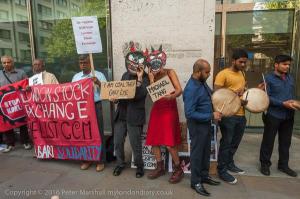
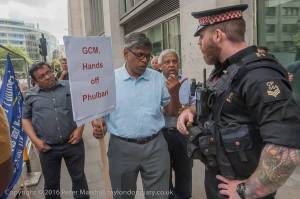
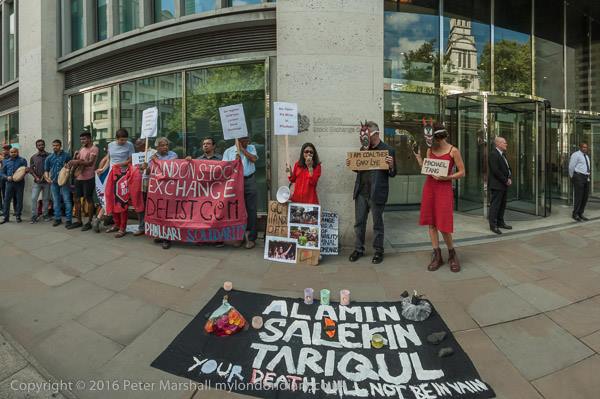
In London Bangladeshi and South Asian community activists under the banner of Phulbari Solidarity Group held a colourful and powerful commemoration rally outside the London Stock Exchange , calling for the de-listing of the company from London’ share market. Despite heavy securitization and repeated attempts of interruptions by British police, angry protesters blocked the pavement of the entrance of London Stock Exchange for two hours and demanded immediate de-registration of GCM for its unethical business, deceitful marketing of Phullbari project, and for human rights abuse in Dinajpur and Phulbari.

Of what was meant to be a Red Vigil for Victims of Phulbari has turned into a commemoration come noise demo as the CEO of London Stock Exchange, Xavier Rolet KBE, failed to respond to the protesters’ call for de-listing of GCM.  Priorhand, the Phulbari Solidarity Group has contacted the CEO of London Stock Exchange and submitted evidence of unethical business of the company. But the CEO did not respond to their request for an appointment, said Rumana Hashem of Phulbari Solidarity Group. 


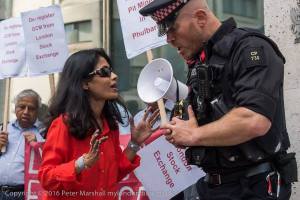
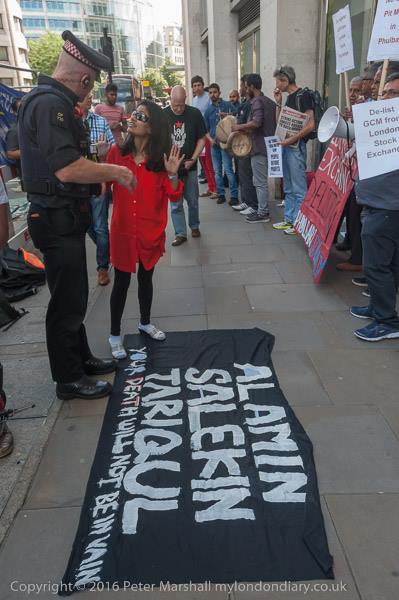
Police objects to PSG Founder Rumana Hashem to remove the banner from the pavement copyright Peter Marshall

Police objects to the blockade of LSE pavement but  PSG Founder Rumana Hashem says:” the banner for the victims will not be removed.” Photo credit: Peter Marshall

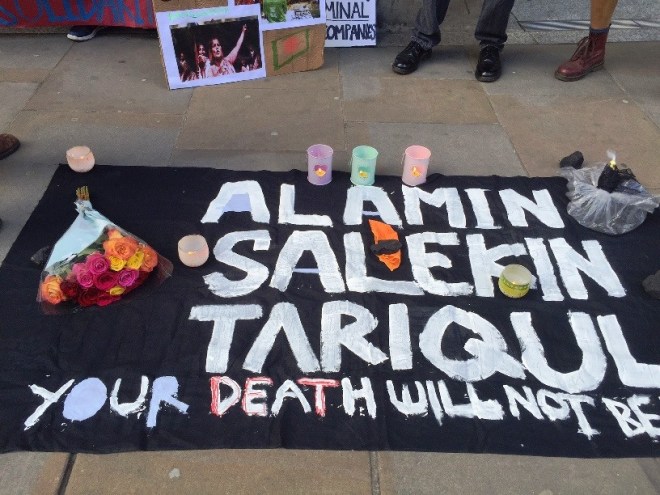
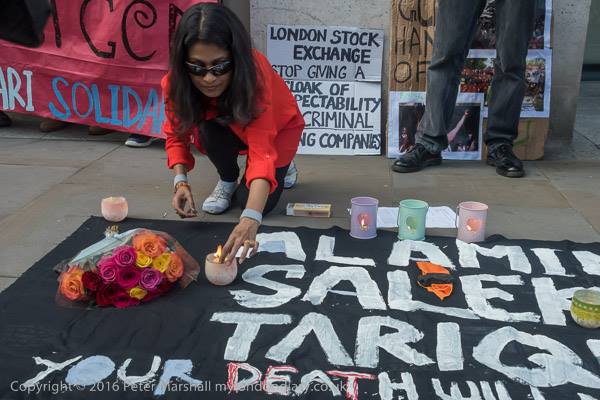
A remembrance vigil was held, followed by an angry demo with Santal and Tamil drumming, and ended with tribute being paid by laying wreaths, flowers and lighting candles for the three people who were killed by paramilitary force, allegedly paid by the company, in Phulbari on 26 August in 2006.

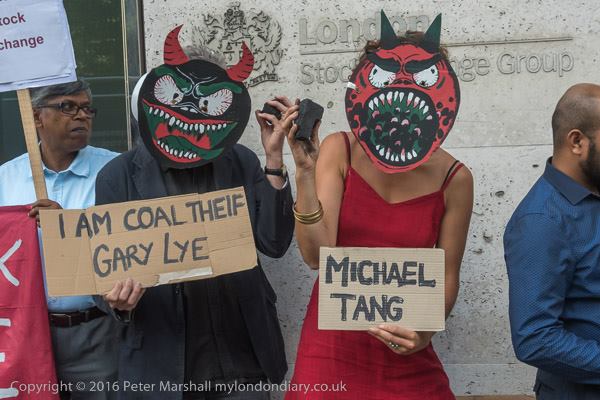
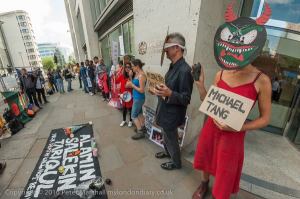
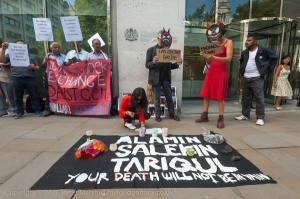
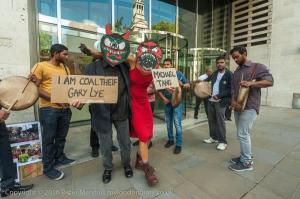
Wearing masks of Gary Lye (CEO of GCM) and Michael Tang (the Chairman of the company), the protesters sang Phulbari jingles against coal mine. The protest observed a three-minute silence for the three victims, Al Amin, Mohammad Salekin, and Tarikul Islam, who died in the Phulbari shooting. Dressed in red, blue and black, protesters laid down a banner for victims, stating “YOUR DEATH WILL NOT BE IN VAIN”, on the pavement of the London Stock Exchange.

Protesters from Bangladesh were joined by international and British environmental campaigners, and advocates for human rights, anti-mining movement and workers rights.

Shameless Gary Lye and Blatant lyer Michael Tang dance with coal over deadbodies Photocredit Peter Marshall

GCM CEO Gary Lye and company Chairman Michael Tang stood as numb and blatant guilty copyright Peter Marhsall

GCM CEO Gary Lye and company Chairman Michael Tang stood as numb and blatant guilty. Photocredit: Peter Marhsall

Dressed in red, blue and black protesters outside the London Stock Exchange paid a two-hour homage to the victims. A banner, stating “YOUR DEATH WILL NOT BE IN VAIN” was laid on the pavement of the London Stock Exchange Group’s Headquarter for International Trading.

Hand-painted banner for victims of Phulbari shooting. Photocredit: Peter Marshall

Hand-painted banner for victims of Phulbari shooting. Photocredit: Peter Marshall

Protesters from Bangladesh were joined by international and British environmental campaigners, and advocates for human rights, anti-mining and workers rights. Among others, Foil Vedanta, European Action for Climate, London Mining Network, Global Justice Campaign, the Socialist Party of England and Wales, Tamil Solidarity, UK Commitee to Protect Resources of Bangladesh, and Voice of Freedom have made it explicit that they will stand with Phulbari people in their struggle.

The sound of compassion, sadness, empowerment and resistance echoed in the protest, and the firm speeches by passionate activists and outrageous crimes by British multinational companies overseas was heard by the entire Paternoster Square on Friday – although none from London Stock Exchange seemed concerned about these crimes.

Simultaneously, tributes were paid to the victims of Phulbari at National Martyrs Monument in Dhaka, and red vigil and cultural events took place in Phulbari under the banner of National Committee to Protect Oil, Gas, Mineral Resources, Power and Port in Bangladesh (NCBD in short). In the four-day commemoration events (26-30 August) and celebration of the halt, they demanded the ban of the company in Bangladesh for its ongoing abuse of activists in Phulbari and increasing corruption in Bangladesh.


Christine Hague of Global Justice told how partially OECD complaint agaisnt GCM was treated by UK NCP Photocredit Peter Marshall

Christine Hague of Global Justice Now told about how partially OECD complaint against GCM was treated by UK NCP. Photo credit: Peter Marshall

The company has been allegedly involved in various forms of abuse and harassment of local activists and opponents of the proposed Phulbari mine. Media report on the brutal death of Nasrin Huq , the former executive director of Action Aid in Dhaka, revealed that in 2005 Huq was killed brutally in her car park for her opposition to the project. A report to which the company was unable to respond was published in the Observer.[i]  Later in 2006 three people were shot dead and two hundred injured in a demonstration of 80,000 people who marched against plans by the company. Local organisers have reported that the company has bribed the paramilitary personnel and forced them to open fire against the decision of the Police Magistrate on duty who stated that there was no permission for shooting on people. There were over 200 people injured and many abused on the same day. The day has been called Phulbari Day since, and powerful resistance in the aftermath of the shooting against open-cast mine in Phulbari has put a decade long halt to the project. Government has cancelled the company’s license. But the company has been pushing the government to give them a go ahead.

Shameless Gary Lye and Michael Tang dance with coal over deadbodies Photocredit Peter MarshallThe company’s CEO, Gary N Lye, has been allegedly harassing opponents of the project and the company has been extremely abusive to indigenous farmers, local organisers of Phulbari outburst, and small business entrepreneurs who demanded the company’s ban in Phulbari. After the shooting and deaths of three people on 26 August in 2006, Gary Lye stated that he is businessman and he understands nothing but coal. In a live interview with Farzana Rupa on ATN Bangla TV, Lye said: “I am a businessman , my business is to extract coal. It is not my business to know who dies and who cries” (ATN Bangla News, 26 August 2006).  Locals have declared that this CEO is unwanted in Phulbari and when he attempted to re-enter Phulbari town he was resisted by locals in November 2014.

Background

Last month, a day before the International Mangrove Action Day when Bangladeshis was focused on the controversial deal on Rampal power plant, the company has filed multiple cases against 26 key indigenous organisers and local leaders, farmers, small scale business entrepreneurs, and students who opposed the mine in Phulbari. The arbitrary charges formed on 25 July, 2016, at Dinajpur Magistrate Court appeared as extremely abusive and the next hearing on 7 September will be a crucial day for all those fighting the fraught.

The NCBD has declared a fresh programme on Phulbari Day to fight GCM and ban the Phulbari project. This includes rally demanding a ban of the company in Phulbari on 25 October, blockade of the Dinajpur District Commissioner’s Office on 21 November and half-day strike in Phulbari on 21 December. If demands are unfulfilled by December, intense and unending strike would start. Phulbari Solidarity Group believes that that this will not be needed as activists in London will hold the company to account and will ensure a ban of GCM from London Stock Exchange before the end of this year.

Paying tribute to the victms of Phulbari with flowers and by lighting candles on 26 Aug 2006 at London Stock Exchange

 Protesters is paying tribute to the victms of Phulbari with flowers and by lighting candles on 26 Aug 2006 at London Stock Exchange. Photo credit: Kerima Mohiuddin

Although GCM does not have a valid contract with Bangladesh, they are selling shares in the name of Phulbari project. The company has changed its name from Asia Energy to Global Coal Management in 2010, and continued lobbying for Phulbari coal mine in Bangladesh. If the mine is built, 130,000 families of farmers in Phulbari would be forcibly displaced. It would destroy 14,600 hectares of highly cultivable land, would pose threats to clean water resources and would leave devastative impact on one of the world’s largest mangrove forests and UNESCO heritage site, the Sunderbans.  Despite grave concerns at national and international level, and declaration made by seven UN rapporteurs, GCM is pushing the government to give it a go ahead.

Arguments with Police who prohibited Rumana Hashem to display the banner for the victims on the pavement Copyright Peter Marshall Gary Lye and Michael Tang shamelessly danced with coal over deadbodies Photocredit Peter Marshall

Arguments with Police - a community leader tells Police not to interfere with demonstrators. Photocredit: Peter Marshall

Arguments with Police – a community leader tells Police not to interfere with demonstrators. Photo credit: Peter Marshall

Phulbari Solidairty Group Founder and an eye witness to the shooting in 2006 lights a cnadle for the victims of Phulbari on 26 August 2006 at London Stock Exchange. Photocredit : Peter Marshall

Phulbari Solidairty Group’s Founder and an eye witness to the shooting in 2006, Dr Rumana Hashem, lights a candle for the victims of Phulbari at the entrance of London Stock Exchange. Photo credit : Peter Marshall

Contact for further information:  07714288221, 07956260791.

Further news, photos and videos:

Ten years of Resistance to Phulbari Open Cast Mine: Peter Marshall’s Mylondondiary.co.uk

A video of the noise-demo to de-list GCM from London Stock Exchange (by Pete Mason of Socialist Party of England and Wales): https://youtu.be/-_cKiRWt9NI

London Stock Exchange targeted by Bangladeshi activists: Foil Vedanta report

Phulbari Day protest outside London Stock Exchange: Begum24.com by Ansar Ahemd Ullah

[i]  The mystery death of Nasrin Huq –a report to which the company was not able to respond to, was derived from http://www.guardian.co.uk/world/2006/sep/03/bangladesh, last cited on 01. 01. 2013

An Eye Witness of the shooting and outburst in Phulbari: Keeping Coal Resources under the Ground with Blood, A Different Revolution

New Programme to Kick GCM out of Bangladesh declared on Phulbari Day: BNP is Not our Friend 

Mark the Decade of Resistance, Mark Phulbari Day!

Celebrating 10 years of Halt to Open Cast Mining, Commemorating the lives of brave Villagers

What? RED Vigil at London Stock Exchange

 When? 11am to 1pm on Friday, 26 August 2016

Where? London Stock Exchange HQ for International Trading , 10 Paternoster Square, London EC4M 7LS  (nearest tube station: St Paul’s)

Find Map

Phulbari 2014


Friday, the 26th of August marks a decade of the Phulbari outburst. In 2006 three people were shot dead and two hundred injured in a demonstration of 80,000 people who marched against plans by an AIM-listed British company, Global Coal Resources Management , who wants to build a massive open cast coal mine in Phulbari, a location in northwest Bangladesh. The day has been called Phulbari Day since, and powerful resistance in the aftermath of the shooting against open-cast mine in Phulbari has put a decade long halt to the project. Government has cancelled the company’s license. Although GCM does not have a valid contract with Bangladesh, they are selling shares in the name of Phulbari project. The company has changed its name from Asia Energy to Global Coal Management in 2010, and continued its dodgy deals and lobbying for Phulbari coal mine in Bangladesh.

If the mine is built, 130,000 families of farmers in Phulbari would be forcibly displaced. It would destroy 14,600 hectares of highly cultivable land, would pose threats to clean water resources and would leave devastative impact on one of the world’s largest mangrove forests and UNESCO heritage site, the Sunderbans.  Despite grave concerns at national and international level, and declaration made by seven UN rapporteurs, GCM is pushing the government to give it a go ahead.

The National Committee to Protect Oil, Gas, Port-Power and Mineral Resources in Bangladesh has called upon national and global environmentalists to observe 10th anniversary of Phulbari outburst and to protest against GCM’s dodgy business and to mark the decade of Phulbari Resistance.  In conjunction with the Committee to Protect Oil, Gas, Port-Power and Mineral Resources, we will celebrate the decade-long struggle in London.

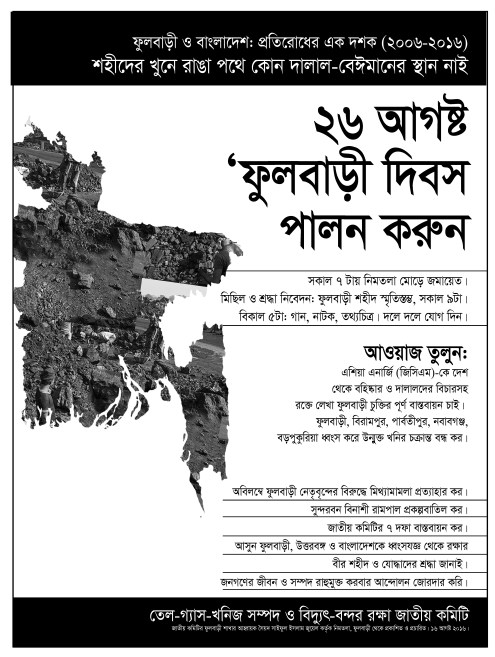
Phulbari Day POster by NCBD 2016

We will hold a Red Vigil for Victims of Phulbari outside the London Stock Exchange at 11am next Friday. We will ask London Stock Exchange to De-list GCM Plc and to show cause Gary Lye’s gang for selling fake shares. We will commemorate for the lost lives by rallying against GCM. We will celebrate our decade-long resistance by turning the commemoration event into a powerful rally against dark coal business.

JOIN US at London Stock Exchange (nearest tube station: St Paul’s).

Bring your organisation’s banner, noisy/music instruments and flowers for the victims if you can. Wear Red, Black or Blue as symbols of Resistance, Anguish and Celebration of struggle!

Please confirm participation via Facebook: https://www.facebook.com/events/641147849383562/

Contact for further information:  07714288221, 07956260791, 07861686036

Email: nationalcommittee.uk@gmail.com , phulbarisolidaritygroup@gmail.com

Committee to Protect Resources of Bangladesh, UK branch     Phulbari Solidarity Group

Download Mark the Decade of Halt, Observe Phulbari Day Flyer August 2016

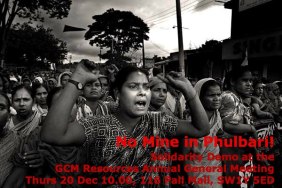
LMN call out for Phulbari Solidarity demo in London on 19 dec 2012

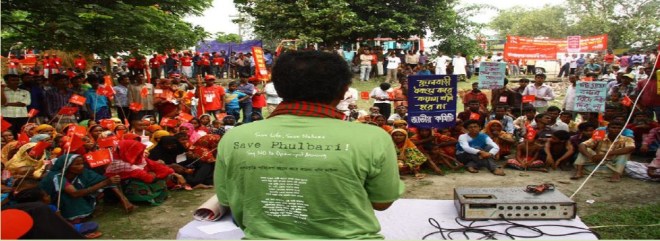
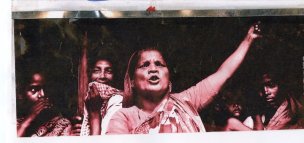
Local women, men and children cried out to save their homes, lands and lives in Phulbari in the aftermath of the GCM-provoked shooting in Phulbari. Photo: 28 August 2006

Mothers, sisters, wives and all the effected women vowed to protect  Phulbari through outburst after the shooting on 26 August 2006. Copyright: PSG


Be There! We Are Coming to Your Door This Saturday!

Sundarbans, the World’s Largest Mangrove Forest is Under Attack. Save the Sundarbans and Stop Coal Fired Rampal Power Plant.

Recently, the Government of Bangladesh has signed an agreement with India’s state run Bharat Heavy Electrical Ltd to set up a coal fired 1320 MW power plant on the edge of the world’s biggest heritage-listed mangrove forest, the Sundarbans. Rampal power plant will emit huge amount of carbon, sulphur, toxic gases, smoke and ashes which will destroy the forest.

Pollution from Ash and Smoke: – Annually, around 0.94 million tons of ash will be generated from the plant, of which 80% will be dry fly ash and the rest of the 20% will be bottom ash. This ash will contain many heavy metals, including arsenic, lead, mercury, nickel, vanadium, beryllium, barium, cadmigreen cultural activists at samageet brought in a a procession with a royal bengal tiget on Bangla New year 2016um, chromium, selenium and, radium, which are dangerous if released into environment. Toxic ash and smoke from burnt coal will pollute the air, land and water bodies and will endanger plant and wildlife.


Water Contamination: Water will be contaminated due to toxic ash, oil and coal spillage from the coal carrying vessels and other waste discharge.


Noise Pollution: There will be a lot of noise pollution from coal power plant itself, from transportation of coal carrying vessels and loading and unloading of coal.  Noise pollution will endanger wildlife.


Destruction of the Forest:

All the above mentioned disadvantages will results in destruction of Sundarbans, wildlife, flora and fauna, ecology and the environment.

Friends, please join us to stop this poisonous coal fired Rampal power plant and save Sundarbans!

Say NO to DESTRUCTIVE #RAMPALCOALPOWERPLANT

National Committee to Protect Oil Gas and Mineral Resources in Bangladesh, The UK branch

Contact 07714288221/ 07956260791/ 07506709691. Email: nationalcommittee.uk@gmail.com


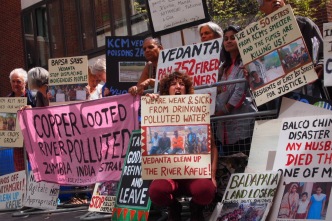
When will Vedanta be ashamed for their misdeeds?

A personal reflection on notorious Vedanta’s Annual General Meeting (AGM) 2016

Rumana Hashem

Last Friday we saw fantastic global actions against a British mining company, called the Vedanta Resources, who attempted to hold their Annual General Meeting in London but ended up being interrogated by dissident shareholders. The British mining company, Vedanta Resources, is known as notorious for abuse and destruction in the name of development overseas. According to Foil Vedanta report (2016), Vedanta is controlled and 69.6% owned by Brit Anil Agarwal and his family through a series of tax havens and holding companies. It was launched on the London Stock Exchange in 2003 with the assistance of the UK’s Department for International Development (DfID) and Department of Trade and Industry (DTI), who continue with their support for the company. I witnessed their misery in the AGM on Friday the 5th August.

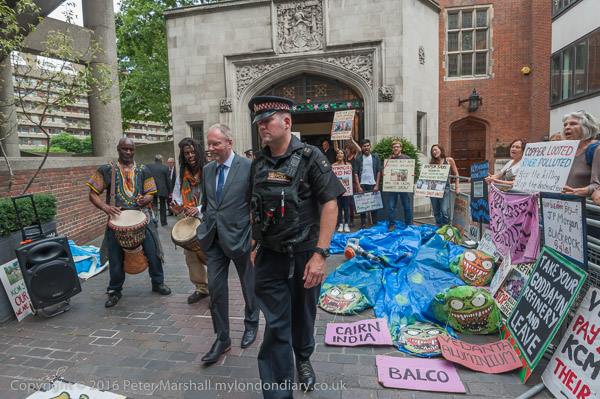
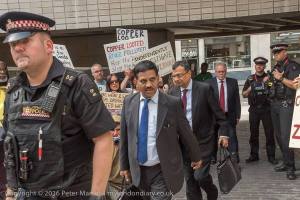
A board member - Anil Agarwals family member needed to be escorted by British police as protesters were angry against Agarwal family for destroying communities . Photocredit: Peter Marshall across the south Photo by Peter Marshall

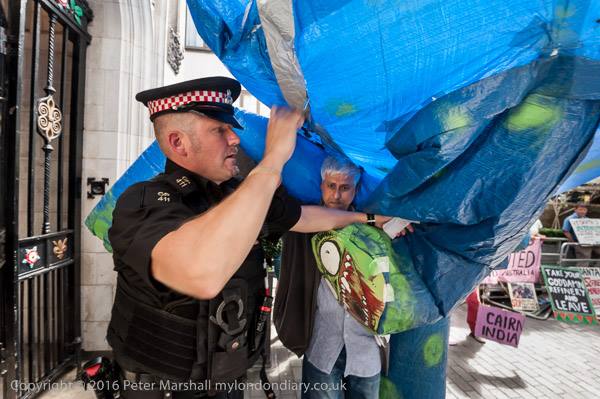
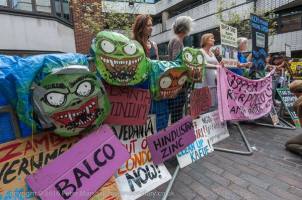
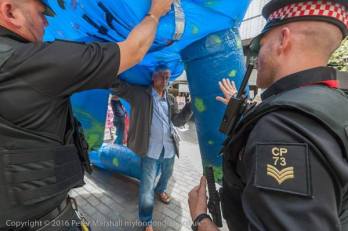
Foil Vedanta demo shows how British Police was caught by the Vedanta monster on Friday at Ironmongers Hall  by Peter Marshall

A Police was caught by the Vedanta monster on Friday at Ironmongers Hall. Photocredit: Peter Marshall


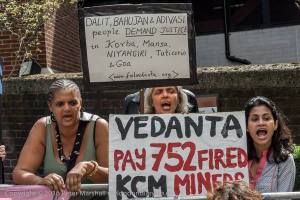
Like every year, protests have been held in India, London and Zambia during the AGM of Vedanta Resources’ at Ironmongers Hall, Barbican, London. A loud protest outside the meeting was organised by Foil Vedanta and was joined by many southern grassroots organisations and community activists from India, Indonesia, Namibia, South Afrika and Zambia. Protesters demanded that Vedanta subsidiary Konkola Copper Mines publish its hitherto secret annual accounts in Zambia. Community activists accused the company of pollution, human rights abuses and financial mismanagement in India and Afrika.

At Vedanta’s AGM activists from Foil Vedanta , Phulbari Solidarity Group, London Mining Network and Mines and Communities interrupted the meeting by asking incisive questions to the board. I joined the meeting with dissident shareholders who raised questions on Vedanta’s pollution in Zambia, and human rights abuses and worker’s deaths in India. We asked questions on behalf of the Zambian Copperbelt villagers living downstream of Vedanta’s Konkola Copper Mines (KCM), who have been demanding an end to twelve years of pollution by KCM, which has turned the Kafue into a ‘river of acid‘ and left them with no access to clean water.


We asked why KCM has never submitted annual accounts in Zambia in accordance with national laws, and whether Vedanta’s deliberately obstructive approach to compensation cases as revealed in a recent London judgement was company policy. With regard to the serious safety conditions at Bodai Daldali dissident shareholders asked, “whether the mine is one of the certified 48 mines.” Independent and senior researchers who visited the area in India said that seven years ago he had asked about bauxite operations in Chhattisgarh, including the fact that children were working in the mine, which still await answer. Why had researchers and journalists been stopped at the entrance to the site? How can Vedanta make claims in their CSR reports and not even be bothered to share the report with  villagers? Most of our questions received no clear answer from the board. Vedanta board, led by Anil Agarlwal, appeared perniciously barefaced in the AGM, and failed to answer important questions concerning the abuse and destruction that the company has been doing to the communities across the south. Instead of engaging with our questions, Anil Agarwal ended up flattering us as ‘ladies first’, ‘I like girls’, ‘I am fond of Bangladesh’ so on and so forth.

Foil Vedanta demo at AGM  5 August 2016. Photocredit: Peter Marshall

Foil Vedanta demo at AGM 5 August 2016. Photocredit: Peter Marshall

The meeting began by a rather long introduction by Deepak Kumar, who went into immense detail for around ten minutes over the instructions for use of the handset provided for voting. It followed by the company Chairman, Anil Agarwal’s long speech followed by Vedanta CEO, Tom Albanese’s ever bizarre presentations. In their “sustainable development” report both Mr. Agarwal and Tom Albanese stated that “the priority is”, on the one hand, to focus on “zero harm” and “to ensure zero discharge and waste”, on the other hand. Note this is a mining company that is known as notorious for abuse in India and Zambia. Agarwal insists, even if the company has been causing colossal problems which has landed them in the court, ‘there will be incremental technical improvements that will make things alright eventually’. As Andy Whitmore notes correctly, ‘his slumber is assured by the promise of “zero harm” which is the most peculiar fashion distressing large extractive corporations, or those financing them. But question is: how can a company displacing people to rip up the earth on a vast scale do “zero harm”?

After Tom Albanese presentation, Chairman Agarwal then invited questions from the floor – and there were lots of them. A dissident shareholder from Afrikan communities raised the first question. As he waved his hand to Anil Agarwal and stood up to ask a question, which he drafted on his notebook and intended to read out for the board, Anil Agarlwal interfered, impatiently, and said: ‘you can speak for yourself, we want to hear your voice’. The dissident shareholder, Cecil Gutzmore,  replied, with mild smile: ‘my voice is here. My voice is on the microphone. Do you hear?’

He continued: The 27th May judgement by Justice Coulson in the case Domonic Liswaniso Lungowe verses Vedanta Resources and Konkola Copper Mines gave 1800 Zambian villagers the right to sue Vedanta and KCM in London for loss to their livelihood and health due to KCM’s pollution since 2004. In the judgement Justice Coulson indicted KCM for financial secrecy, historic dishonesty and attempts to pervert the course of justice, and on p.5, paragraph 18, quoted a 2014 London judgement against KCM for failing to pay a contractor – U&M mining. In that case Judges Eder, Cooke and Teare JJ called KCM (and I quote):


‘…an entity which has employees willing to give untrue evidence, to cause unnecessary harm, to be obstructive of the arbitration process and to take untenable points with a view to delaying enforcement…a party willing to do all it can to prevent the other party from enforcing its legal rights.’

Cecil continued and said that in paragraph 19 Justice Coulson further stated:

‘there was a revealing statement in those proceedings by the executive director of the mine who said that, although KCM acknowledged that they had failed to pay sums that were due to the claimants in that case, they “would hold on to the money to the end of the dispute, which it would fight bitterly, no matter how long it took, including in Zambia where proceedings would take many years.’


He noted further: this attitude is not limited to KCM alone and claimants who have been granted compensation in Talwindi Sabo, Tuticorin and Jharsuguda are also still awaiting payment. Can the board confirm whether obstructing legal procedures and delaying payments is a company policy?


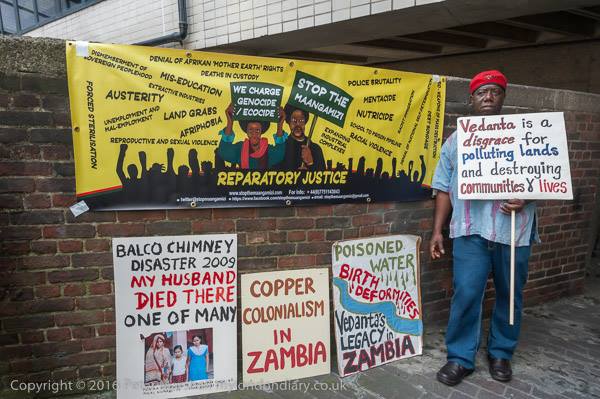
An affected community member holds placard and say why he wants to stop Vedanta. Photocredit: Peter Marshall

An affected community member holds placard and say why he wants to stop Vedanta. Photocredit: Peter Marshall

Anil Agarwal and Tom Albanese hardly answered the question. Tom Albanese replied that he had a lot of respect for legal processes (just as well!) so he took Cecil’s comments seriously. He said that the 2014 case referred to was a commercial case which was settled amicably last year. In the process of the resolution of any commercial litigation tensions develop which have to be worked through, and it is the job of management and the board to solve problems and Vedanta satisfied the other party. In Zambia, the case was currently being heard in the UK and Zambia. The company had to recognise that the court will go through its own process but the case will be appealed and heard next year. Vedanta’s position is that the Zambian courts are fully capable of hearing a case like this.

Albanese said that Cecil had referred to a judgement against KCM, which was related to a 2006 spill, a case which Vedanta recognises went against it. He said that ‘not many people have come forward on this’ (it was not clear to me quite what he meant by that) and it ‘shows that the Zambian courts work’. He said that Vedanta should be respecting the courts in the countries where it operates. Vedanta reports transparently and if people want to know KCM’s financial details, they are in the newspaper. KCM has not been making money recently and has been requiring investment from Vedanta to ensure it is still in a position to hire Zambian employees and contractors. The government has conducted forensic audits and nothing has come out. Albanese said he was confident that the company is fully disclosing its Zambian accounts. From time to time there are commercial disputes. Sometimes they can resolve these things and sometimes they cannot, but they respect court proceedings in Zambia.

Cecil drew the CEO’s attention once more to the 1800 Zambian villagers who had recently been given the right to sue the company in London. There was a conversation between Cecil and Albanese about the extent to which Albanese had, or had not, answered Cecil’s questions. Cecil was not convinced that he was being told the truth. That is a suspicion fairly widely held among activists attending Vedanta AGMs.

Anil Agarawal concluded the matter by stating, ‘We will follow all the procedures. The matter is sub judice. We are absolutely transparent and whatever judgement comes in we will follow it.’ That would certainly be welcome. As our friend Simon noted later in the AGM, there are questions over the extent to which Vedanta has respected previous court judgements.


So the shareholder commented, twice, that he was not convinced that they were telling him the truth. He said that the answers to his questions were partial and that Agarwal did not engage with his questions to the extent that he should have. I did wave my hands at that time but was not given the microphone, probably because they did not consider me as important as male shareholders. The board was, however, populated by male heads. Except one woman (Katya) who never spoke and appeared as a token representative of female members, all 10 heads out of 11 board members were male. Indeed, we had to put up with a gendered corporate board for nearly three hours. Microphone therefore went to someone else. The speaker, representing campaigning organisation ShareAction, asked how the company reports on risks from waste management. But he was frustrated by the answer of the CEO, Tom Albanese, with no surprise.


This is when I spoke up and said that I am working closely with community activists and groups from India, Zambia and South Africa who have gathered outside Ironmongers Hall and told me a different version of what Vedanta’s annual report was claiming. I then asked, by thanking the board for trying to present a report and for producing an annual report even if it was a partial one, that:


Mr Chairman, both you and your CEO have said that you are committed to ‘zero harm’ and ‘zero damage’ to people, but these people and communities are saying that they are at great loss by the harms and damages that you and your company have done to them. Your company has been destroying many communities. When I was entering the building for this AGM, I have seen community representatives from Orissa, Zambia, South Africa, Indonesia, Namibia and all India were crying outside the AGM that their people have been abused and faced with great loss by the undertakings of your company.  I am sure you have seen people’s outcry outside the AGM, too, when you entered the building. What is your response to these people that are protesting outside the AGM?

Foil Vedanta demo on 5 August 2016.  A Protester from affected community holds a placard. Photocredit: Peter Marshall

Foil Vedanta demo on 5 August 2016. A Protester from affected community holds a placard. Photocredit: Peter Marshall

I asked, again to Tom Albanese that I am glad that you have taken the effort to produce a report for the shareholders but I have to say that I am appalled at your presentation because of the level of fraught and misinformation this report involved. I am shocked by the way you have totally overlooked the issues that the May 27th judgement in the case of Dominic Liswaniso Lungowe versus Vedanta Resources  and KCM in London which Cecil has just mentioned. This May 27th judgement by Justice Coulson has been a major challenge against Vedanta’s ongoing abuse and misconducts across Zambia, and a big news for the company which the shareholders should be made aware of . I have been reading about this judgement for the last two months as this became important news in London. How was it possible for you to overlook the matter in your whole 30 minutes long presentation?

Is this how you can prevent from doing harm and abuse to communities? I would appreciate to have your straightforward and a clear answer to this question. Now I have a second question to both of you (Anil Agarwal and Tom Albanese) in relation to the judgement and the question that my dissident shareholder, Cecil has asked before. May I continue?


The board kept silent and Anil Agarwal, Tom Albanese, Katya and Deepak Kumar looked at me in their eyes, with clear discomfort. Anil Agarwal seemed most uncomfortable (or perhaps angry inside) but did not stop me from continuing. So I continued and said that:


Justice Coulson’s recent UK judgement on the right of Zambian villagers to sue KCM and Vedanta in London for loss of livelihood and health, revealed that KCM has never filed annual accounts in accordance with the Zambian Companies Act. Meanwhile an UNCTAD report published in July 2016 found ‘systematic export under-invoicing’ of copper from Zambia starting in 2005, the year after Vedanta took over KCM (which is Zambia’s biggest copper exporter). Why have you been keeping your finances secret? What exactly are you hiding from the Zambian government?

Foil Vedabta demo against Vedanta AGM at Barbican Aug 5th 2016. Photocredit: Peter MarshallFoil Vedabta demo London Barbican Aug 5th 2016

Tom Albanese replied that when he made a public statement he was making a statement on behalf of the board and is personally liable for it under the law in both the UK and Zambia. He continued, ‘What I say, I say with assurance: we produce and provide transparent financial reports for our operations in Zambia and submit them to the Ministry of Mines and publish a summary in the newspaper, and if you want to see them you can apply to the government and they will send them.’ He said that the other shareholder in KCM’s operations is government-owned ZCCM, so on the board of KCM there are people who represent ZCCM and the government of Zambia. Everything is disclosed. He said he is under a requirement to comply with the law and tell truth about what the company is doing.

I asked again whether he really thought the company was doing zero harm.

This time Anil Agarwal replied, by saying that: ‘What we say we believe, and we do it. You can believe what you want to believe. KCM involves the government and public as well as us. KCM has its own legal team and what we do, we do with proper governance and transparency. There is strong law and nobody is allowed to do anything that is not right.’

Tom Albanese added that he believed in his heart that KCM is a better company and a better employer than it was when it was controlled by the government, which had under-invested since Zambian independence as it did not have the money. Vedanta’s chairman himself had funded improvements. There had been no water pollution control at the time Vedanta took over. The company had put in the most modern sulphur capture equipment at the smelter. ‘We have not arrived at zero harm,’ he said, ‘but we are going in that direction.’

Both Tom Alabanese and Anil Agarwal claimed that they had no wish to hide anything and that there was no hidden finance that they have avoided to report. Tom Albanese said that he knows of nothing more than what he has already presented in his report. Anil Agarwal supported him and said that they did their best to keep everything transparent and open to shareholders. He then added:

‘Yes, I have seen people were playing music and making noise outside the AGM. I don’t know why they are doing so. If you don’t believe me, I can only advise you, you need to visit the areas yourself and then tell me what you have found there. You cannot know what is happening there without paying a visit to the communities. If you do not believe my words, I cannot do anything about this. I can only say what I know about. It is upto you whom you will believe.  There is nothing that I can do if you say that I am wrong. It is your liberty to believe whom you like to believe. If you want to believe the other version of the story, you can do. I can only say that we are committed to do no harm. We are working on the issues and some damages that have happened. I am confident that we can reach to our ‘zero harm’ promise in five to ten years time.’


I picked up the point and answered without microphone: ‘Mr Chariman I appreciate your wish to do no harm but you are aware that you have already done harms to people. You are saying that you want to reach zero harm after doing so much damage and abuse to people. You are saying that you want to stay for another five years but people don’t want you for another year, they don’t even want you for a day there. You have seen the outcry of people outside the AGM. They are saying that they want to kick Vedanta out today. They don’t want you there because of the harms that you have already done to them.’


Anil Agarwal replied, as fantasised, that ‘we are committed to do zero harm and damage to people but we are not saying that no harm has been done. Despite our continuous effort to avoid damage, we have received reports of some damages which could not be helped. You know that any development projects and technological development involve some risks which could not be totally avoided. But I am committed that our company will work on this and we will overcome these damages in future.’

Tom Albanese added, ‘I see fifty years of efforts to come, and we are keeping the largest employer in Zambia afloat.’

I gave in and wanted to take a break so microphone went to someone else.

OLYMPUS DIGITAL CAMERA via Miriam Rose

Anger over Vedanta at their AGM in London. Photocredit: Peter Marshall

Several other shareholders raised the issue of ongoing abuse of communities by the company. Some have expressed their concerns to the company reputation as situation is not improving for years. One has expressed his frustration over the answers to his questions from the board for several years which, in his views, discouraged him to ask a question. One (company agent) has accused some of us are causing trouble in the AGM.

This shareholder addressed the board as “Sirs” and said that he had been listening to the ‘dialogues’ at the AGM and that these were not really questions and answers. For him, ‘shareholders could have dialogues with the board elsewhere, in “private”‘. People were at the AGM to ask questions on the annual report, and if people were not happy, they should present their views elsewhere, not at the AGM.’ He continued, saying that he had got a fright when the share price went down below £2. He then asked a question about bonuses. During his speech two women shareholders behind me had left the meeting room, and a peer sitting in front of me has smiled while the other peer two rows behind me had nodded off.

There were irritations, frustrations and heated discussions that I do not aim to note word by word here to void killing reader’s time. One community member from Niyamgiri said the the board is doing utter lies to the shareholders. Two of our friends raised questioned in relation to the Buxi. One had asked a long question which in short was as below:

The Buxi Commission report on the Korba Chimney disaster, which found BALCO guilty of negligence causing at least 40 workers deaths, has now been leaked to the public. Why are you still trying to suppress this report? Anil Agarwal and his CEO had totally misinterpreted the question or deliberately denied to pretend that they did answer his question to their level best. At this point two shareholders who had visited mine sites in India and Zambia had illustrated the differences between the reality and the fantasy of the annual report. They have come back to report on what they had seen. They asked, when will you close down Lanjigarh refinery which has now been operating at a loss for too long due to lack of raw material? At one point a questioner noted he ‘had shown the company’s shiny new “sustainable development” [sic] report to villagers who were shocked by its contents, noting that one person quoted in it – fulsomely praising the company – did not exist in the village to which he was attributed.

The board’s primary response was that they would investigate. But this caused more frustration in heated discussions rather than hope, because this was what had been promised before. One shareholder, raising the issue of the appalling lack of health and safety at the Bodai-Daldali mine in the central Indian state of Chhattisgarh noted the issues had been reported before, with promises of investigation, but little seemed to change. Vedanta’s CEO, Tom Albanese, said he was shocked by what he had seen (although the Chair Anil Agarwal seemed to suggest the footage may not be genuine). As was pointed out by the shareholder, it seems head office booked inspection visits in advance; maybe if they really wanted to see what was going on perhaps they should pop along unannounced?


After two hours of heated discussions by dissident shareholders and the failure of the  board to address the issues in relation to Niyamgiri and Zambia, I got the microphone again and followed from an unresolved question. The microphone was given to me after I waited, patiently, for nearly 30 mins. It was finally Anil Agarwal who asked the person with the roving microphone to give the microphone to me. At this stage he was not only fantasising but also attempted to flatter and flirt with us.  Anil Agarwal said to the microphone holder: ‘give it to the girl, this young girl here’!

I said: Thank you for giving me the microphone again!

Anil Agarwal smiled at me and said: ‘you are welcome. I like girls. Girls are good.’

I said: I am not a girl anymore!

Anil Agarwal said: oh, I know. You are not a girl. You are a lady.

I said: Actually, I am a woman. I am quite old!

Anil Agarwal, Tom Albanese and Deepak Kumar laughed. Anil Agarwal said: oh, you are old?

I did not tell him what’s my correct age but I pointed out that if he wished to flirt, he would have to flirt with an old woman.

He changed the topic and said: you are an academic. I like academics’.

I said: I am a researcher and a community activist.

Anil Agarwal said: yes, yes, researcher. Research is good profession.

He was clearly judging my work or me, nevertheless, we let it go. As I wanted to move on to my point, Agarwal interrupted me again and said: You are from Bangladesh, right?

I said: yes, that’s correct.

He said: I love Bangladesh. I am very fond of Bangladesh. Bangladesh is a nice country. It is rich in natural resources. It has gas, oil, coal and other mineral resources.

I said: indeed, yes. But you are not welcome to Bangladesh. I am not inviting you to visit Bangladesh. We don’t want your company to go there to extract our natural resources in Bangladesh. We are rich in natural resources but we don’t want to disturb the soil and the nature by smuggling coals and gas. We don’t want any multinational corporation to exploit us and destroy our natural resources. We have been fighting multinational corporations for years and we have put a decade long halt to a massive open cast coal mine in Bangladesh that you might have heard about. I coordinate a community activist group, called the Phulbari Solidarity Group, which is working to prevent further aggression of multinational companies in Bangladesh. We will be celebrating ten years of resistance in Phulbari and in London on 26th August this year. You can come to our London protest to be held on 26 August, if you like. You can also come to visit my home in the UK, and I can cook for you if you wish to have a Bengali dinner. But you are not welcome to Bangladesh.


Anil Agarwal and his board members looked terribly Foil Vedanta demo by pic by Peter Marshalluncomfortable. Agarwal lost words as being embarrassed. He only nodded head by indicating that he got the message.
Then I continued, and said: my question is related to my dissident shareholder Samarendra Das who has given us some extremely important information which I found immensely useful. Unlike you, I was not bored. I am rather grateful to him for providing us those useful information that enriched my knowledge on the subject. You said to Mr Das that you don’t have anything to do with Niyamgiri. My question is: will you do a fresh press statement by clarifying that Vedanta will never go back to Niyamgiri in future? Can you put on an official statement on your website by stating what you have just said to Samarendra Das?  Can you confirm that it is not in your interest and there will be no future interference from Vedanta in Niyamagiri?


I continued and said that my second question is also in relation to Niyamgiri: You have claimed that you will respect the decision of the people who rejected the mine, yet new Mines Minister Piyush Goyal has been making statements about pushing the project through. What are your intentions regarding the Niyamgiri mine? Are you still lobbying the Odisha government to overrule the democratic decision and force the mine through?


I continued and said that these two were my main questions though I would love to respond to a shareholder who appeared to have been advocating for an ill process to be practised in the annual general meeting of the company.  The shareholder behind me had asked the board to prohibit people to raise open questions. He asked people to stop spending time by raising issues around how the company made its money, and only to talk about the returns to investors and financial issues. Yet he then proceeded to do at great length. In his opinion, we should only raise questions based on the annual report produced and distributed by the company executives. He suggested that we should not comment on anything else, and that any discussion beyond the annual report should be discussed outside the AGM and in private. He thought that we were having a dialogue with the board which he suggested to do in private. He also claimed that dissident shareholders were bored by many questions that some of us have been raising in the AGM today.

We entered the AGM  to represent communities inside the AGM during loud protest outside. Photocredit: Peter Marshall

We entered the AGM to represent communities inside the AGM during loud protest outside. Photocredit: Peter Marshall


I objected to his suggestions and said that ‘we should develop appropriate ethos that enables an environment to discuss complicated issues and complex truth openly. Multinational corporations must practice transparency and the Vedanta board should be accountable to all shareholders rather than only producing an annual report distributed to us. The company should follow “good” corporate “ethics” which would allow space for any discussion related to the company to take place in the same room where the AGM is taking place so that all shareholders and people involved in the company can be aware of what is happening in reality.’


‘The shareholder who found our questions and comments are “dialogues” between you (the board) and us (as community representatives) is wrong. We are not here for a dialogue with you. We are here to report the abuse that your company has done to people in various countries. We are here to place oral complaints on behalf of the communities. We are here to question you about why you are overlooking these important issues. There is nothing to get bored about. The shareholder who complained that other shareholders have left the room because they were bored by our allegations against the company did not notice that two people behind me left the meeting during his speech. I have an eye witness here [indicating the security guard/peer who sat in front of me] who noticed this and exchanged a smile with me as the shareholder appeared mistaken.

‘People can leave a meeting room for many reasons. Sometimes they might be busy and may have other commitments and appointments that make them leave the room. Other times they might be bored. It is possible that people were bored by the senior shareholder’s speech. It is also possible that some people did not like what we are discussing here. But we have to continue raising all of these issues right here.’


The shareholder who complained about our interrogation and addressed the board members as ‘Sirs’ appeared as an academic at LSE, got furious to me at this point and attempted to interfere during my objection to his deliberate allegation against us. He stood up in the midst of my speech and shouted, despite request of the board to wait, pointing at me disapprovingly. He was asked by board members to allow me to finish my remarks. He raised his two pointing fingers to me and swore by words that I couldn’t hear as I was on the microphone. I continued with my speech and told him that I hardly bothered his unexpected ill-manner and threats. I said that I was there to represent large number of effected communities who cannot be silenced by his masculinity and ill manner. I said that I would continue to speak with all of the shareholders in the room, and not only to the board.

I told: ‘Put your fingers down now. I have the right to speak about everything that is related to the company.  We ought to do the interrogation right in the AGM, not outside the room. I do not want to have a private meeting about these general issues which all other shareholders have the right to know. I am here to not only speak to the board members but also to share information with shareholders present in the room. I will speak to all shareholders on behalf of the communities in Odisha and Zambia, and I will speak with permission of the board.’

The entire meeting room was silent during my speech, and some nodded heads in support of what I said to the misbehaving shareholder from LSE. The board looked truly anxious as they feared further disruption. After my last comments, Tom Albanese and Anil Agarwal told that they want to continue the practice of discussing things openly in the AGM. Albanese said: ‘we encourage people to speak openly and ask questions about anything that the shareholders are concerned about.’ Anil Agarwal repeated the words that People have the freedom to discuss all matters that they like to discuss in the AGM. ‘We believe in democracy and freedom of speech. Everybody has the liberty to talk about any aspect of the company. We believe in liberty’, he said.


The meeting had quickly wrapped up by Anil Agarwal’s call for votes.  Outside the AGM protesters chanted and drummed for four hours accosting executives of the company as they entered and left the AGM. When Agarwal and other board members had come out of the venue, the protesters surrounded them. But Anil Agarwarl smiled shamelessly, and his gangs left blatant.  We don’t know if they will ever feel ashamed for their continuous misdeeds and abuse to communities.

The above is my personal account on what happened at the Vedanta AGM on 5 August in 2016. For further details, feel free to have a look at the detailed accounts of other dissident shareholders here .

This is how the Vednata board members enter amidst protest and under the shadow of a monster on Friday Phto Peter Marshall This is how the Vedanta investors enter the AGM amidst loud protest and under UK Police protection at Barbican London on 5 August 2016


Copyright of all of the images used in this report remains to Peter Marshall. No commercial use o the photos without permission is expected. Thank you!

Further details of protests and actions inside and outside the Vedanta AGM can be accessed from the following url links:

India, Zambia, London protest Vedanta’s AGM

A tale of two worlds – Vedanta AGM 2016

Further coverage in The Mining Journal,  the New International, and Reuters.


Fascist attack on peaceful march in Bangladesh, Solidarity from London and across the earth to save the Sunderbans

  • 200 mangrove marchers brutally charged by police in Dhaka
  • 16 unarmed protesters seriously injured
  • Six frontline defenders and NCBD leaders imprisoned
  • Cops foiled public statement to cancel dark deal over world’s largest mangrove

By Rumana Hashem and Raj Manik

As you might have awaited update from Thursday’s public march against the destructive Rampal coal-power plant, we are in the process of doing a detailed and analytical report on the attack on peaceful marchers and the fascism of Bangladeshi police. For now, note that the Dhaka protest was attacked by state law enforcement force, and the Prime Minister shamefully denied to meet with the concerned citizens of Bangladesh who wanted to handover a statement to their Prime Minister.

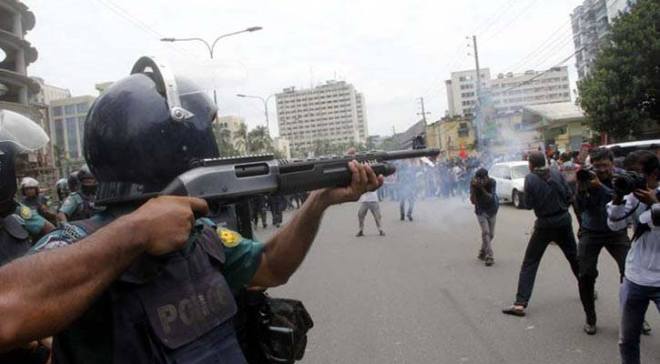
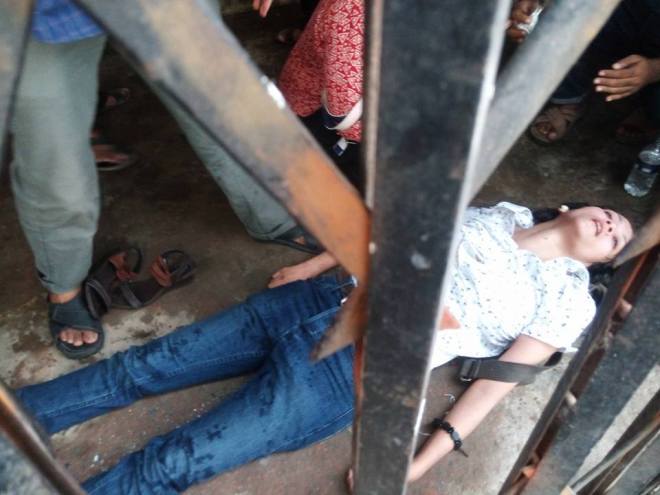
Police opens fire on NCBD marchers in Dhaka 28 July 2016 The masculine male police beaten her so badly the female left activist went unconcious on 28 July 2016 NCBD march against Rampal deal to handover statement to PM of Bangladesh in Dhaka 28 July 2016 Dhaka March to Save the Sunderbans on 28 July 2016. copy right @NCBD Dhaka

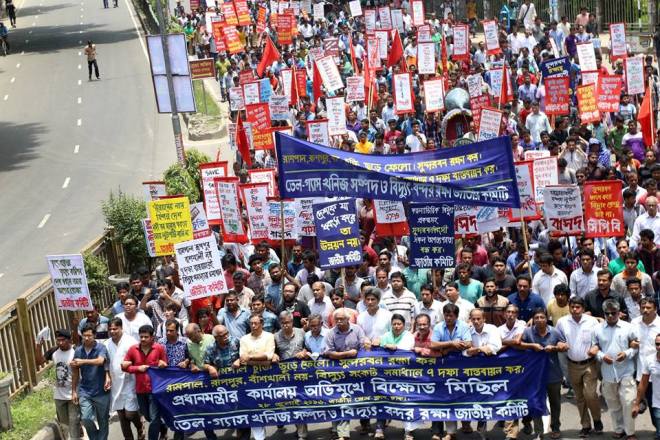
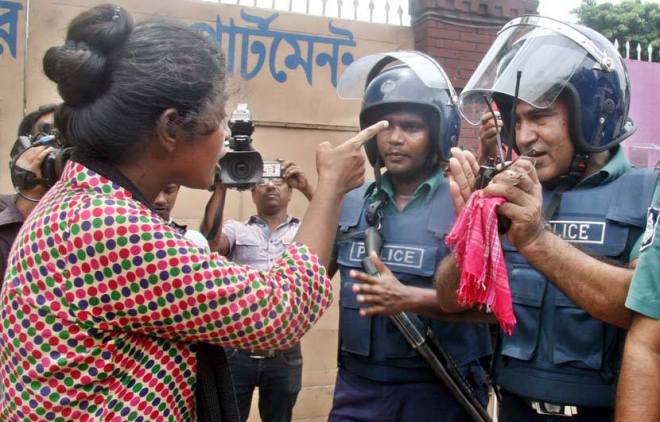
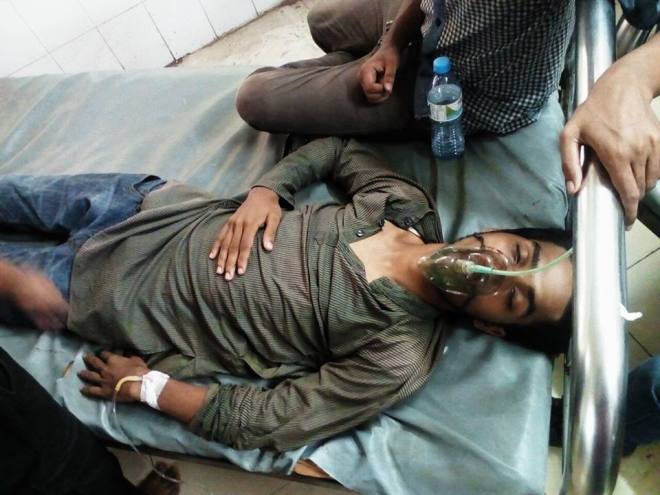
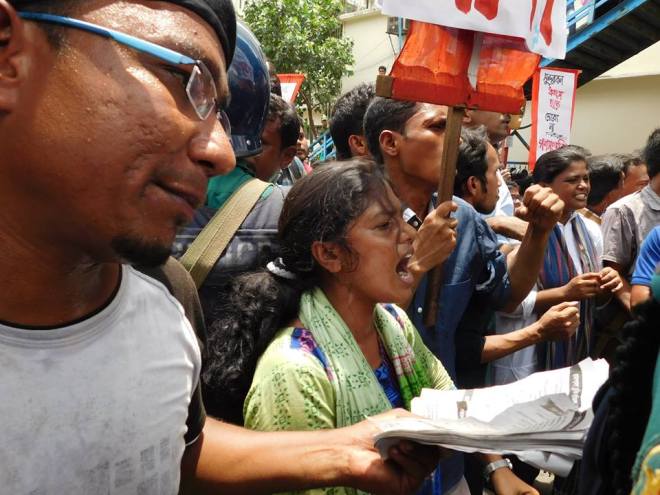
When the marchers walked towards the Prime Minister’s office to submit a statement to save the Sunderbans, police unleashed violence on peaceful marchers, threw tear shells over a march of 200 protesters who sought to handover a public statement against the dark Rampal deal that would destroy the world’s largest mangrove, the Sunderbans. Many of our activists, including the Member Secretary of NCBD, Professor Anu Muhammad, were severely injured as beaten up by fascist police force who acted on behalf of a fascist government.  Students and women-environmentalists were beaten to such that several of them were taken to hospital in critical condition.

The leaders of National Committee and frontline organisers of the march were abused and six front-line protesters, including Anu Muhammad, were detained on arbitrary charges. Police did not only abuse and charge activists but also foiled the well-written public statement, which demanded the immediate cancellation of the destructive Rampal coal-fired plant, to symbolise that commons and citizens do not have the right to express opinion on natural and national resources in Bangladesh.

In a nutshell, we have seen a fascist face of the government of Bangladesh in the month of Mangrove Action. We have witnessed how a so called pro-independence government deployed fascist police to dismiss people’s urge to preserve national sovereignty. The state-law enforcement force had foiled demands to conserve the world’s largest mangrove forest just a day after the International Mangrove Action Day. This is shocking and sickening.

So proud of our women activists taking on frontline to defend environment and mangrove in Bangladesh 28 July 2016 environmental activist tortured by facist police in Dhaka on 28 July 2016

Dhaka March to PM office on 28 July 2016

Dhaka March to PM office on 28 July 2016. Copyright @NCBD

Although media coverage of this heinous attack on peaceful marchers was poor, we have heard the sound of angers, condemnation and protests across the earth on Thursday.  In London, the Bangladeshi community rallied under the banner of protect resources of Bangladesh, the UK branch, and unreservedly condemned the attacked on environmentalists and progressive activists in Dhaka.

protest against rampal in london on 28 July 2016 PROTEST at Altabl Ali Park on 28 July 2016 protest at altabl ali park in london on 28 july 2016

London protest against destructive Rampal power plant on 28 July 2016

London protest against destructive Rampal power plant on 28 July 2016. Photo credit: Shefa Ahmed and Rumana Hashem

Despite miserable weather and a week day afternoon, there was a great turn up of saddened Bengalese at Altab Ali Park at Aldgate East. Speakers include Bangladesh Socialist Party leader, Mostofa Kamal, European-Bangladesh Climate Change, Ansar Ahmed Ullah, Communist party leader, Dr Mohammad Ali Khan Jinnah, Photo journalist Peter Marshall, Worker’s party leader Ishaque Kajole, Dr Mokhlesur Rahman of NCBD UK , Dr Rumana Hashem of PSG and other community organisers. We were, of course, present at the rally from Phulbari Solidairty Group. But the question is: does the Bangladesh government care for what we think and say about our national environment and national resources?

We will be updating you on further development on this via twitter, blog and mailing lists.

What you can do to help us:

  • We would appreciate it if you can re-tweet our news and if you can tweet @PSG-BD
  • Please do your own outreach by using hashtag #Rampal and #SavetheSunderbans
  • We would appreciate it if you can avoid asking for money/donation from people for this mangrove action. Any sort of donation based campaign can undermine our cause and would let down the movement to save the Sunderbans.
  • If you need help, please do contact us for connecting on how to organise in your own locality and how to express solidarity with the protesters back home. You can email us: phulbarisolidaritygroup@gmail.com and rabbani.enpolicy@gmail.com

#SavetheSunderbans #StopRampalCoalFiredPlant

Further news:

Police foiled march: The daily Star report http://www.thedailystar.net/city/demo-sundarbans-foiled-10-held-1260748


Protest against Destructive Rampal Power Plant this Thursday

By Rumana Hashem

Despite nationwide protests and international campaigns against the controversial coal power plant in Rampal, Bangladeshi government has approved India‘s NTPC proposed Rampal power plant which, if implemented, will destroy the world’s largest mangrove, the Sundarbans. Bangladeshi and Indian governments have signed a destructive deal in July, the month of International Mangrove Action, when the world is supposed to celebrate International Mangrove Day.

On 13 July, Bangladesh and India have signed an agreement which enables India’s state run Bharat Heavy Electrical Ltd. to implement the Rampal thermal power plant. The proposed plant would be built in 14 kilometres to the Sundarbans, a treasured ecosystem along Bangladesh’s coast.

It is outrageous that the governments of the two neighbouring states, Bangladesh and India, have disregarded the global calls and conspired to abandon people’s urge to prevent the construction of disparaging coal-power plant in Rampal from happening. They let Bangladesh’s only mangrove forest, Sundarbans, to be destroyed for self-interests. This deal has been signed at a time when Bangladesh has been undergoing political turmoil and religious genocide. The nation was focused on Gulshan attack when the two governments have approved the destructive deal.

The National Committee to Protect Oil, Gas, Port-Power and Mineral Resources in Bangladesh (NCBD) will march to the Prime Minister’s Office this Thursday, 28th July, to protest against the deal.


2

In solidarity with the protesters in Bangladesh, the UK branch of NCBD will rally against the destructive deal at 6.30pm on the same day at Altab Ali Park in East London.

Please join us along with your friends and raise your voice against this destructive project. Our outcry can protect the world’s largest mangrove forest, the local environment in Bangladesh, its ecology and species. #SavetheSundarbans


Read further news here:

A new power plant could devastate the world’s largest mangrove forest

Bangladesh, India sign Rampal power plant construction agreement

Additional information and news:

1.“Bangladesh Sticks With Coal Power Plant Project Despite Major Backlash,” Mongabay, February 16, 2016,
http://news.mongabay.com/2016/02/bangladesh-sticks-with-coal-power-plant-project-despite-major-backlash/

2. Anu Muhammad & Sheikh Muhammad Shaheedullah, “Manipulating Rampal,” Dhaka Tribune, March 31, 2016,
http://www.dhakatribune.com/op-ed/2016/mar/31/manipulating-rampal

  1. Dr. Abdullah Harun Chowdhury, “Environmental Impact of Coal Based Power Plant of Rampal on the Sundarbans and Surrounding Areas,” Khulna University, http://bagerhatsociety.com/apanel/admin/download/tdwn2573136.pdf
  2. “Ganges River Dolphin,” World Wildlife Foundation,http://www.worldwildlife.org/species/ganges-river-dolphin
  3. “Orion Signs Deals for Generators for its 660MW Power Plant,” The Daily Star, May 11, 2014, http://www.thedailystar.net/orion-signs-deals-for-generators-for-its-660mw-power-plant-23556
  4. Sönke Kreft, David Eckstein, Lukas Dorsch, and Livia Fischer, “Global Climate Risk Index 2016,” GermanWatch, November 2015, http://germanwatch.org/fr/download/13503.pdf

Mining is in Rapid Fall

People, climate change and future of the industry

By Raaj Manik

An international workshop on mining in South Asia was organised by Activists and Academia Network, called, the Centre for World Environmental History (CWEH) at University of Sussex in which Phulbari Solidarity Group made a robust contribution. On Wednesday 11 May 2016, a remarkable delegation of activists from the global South has shared their anti-mining community activism, and engaged with experienced colleagues in the global North working to expose the brutality of northern extractive companies in the South.

Speakers included Gladson Dungdung, who was offloaded from the Air India flight on his way to the workshop, was due to report on threats to Saranda Forest in Jharkhand, human rights abuses and the destruction of the environment by iron ore mining companies. Also front-line environmentalists and researchers from Bangladesh and India, including Malvika Gupta from University of Delhi, Rumana Hashem of Phulbari Solidarity Group, Roger Moody of Nostromo Research, and Miriam Rose of Foil Vedanta delivered insightful work and narratives of excellent grassroots struggles against mining and corporations.

Vedanta demo London 2015

Vedanta demo London 2015

Phulbari outburst on 26 August 2006.

Phulbari outburst on 26 August 2006.


PSG founder and eye-witness to Phulbari carnage in 2006, Rumana Hashem, has delivered a talk,titled “Translating Phulbari Resistance and anti-coal struggles in Bangladesh: A bottom up approach to social movement to protect environment and indigenous rights from corporate excess”. Hashem advocates for and showed how a bottom up, informal and non-bureaucratic approach to anti-mining and environmental movement have become tremendously powerful and successful in north-Bangladesh.   

The drastic increase of privatisation and multinational corporations has not only caused environmental damage and energy injustice but also induced forced-displacement, destitution of indigenous people and farmers in southern countries, such as, Bangladesh. But resistance to extractive corporations and dodgy deals involving government sponsored companies across the South is in the rise. While Bangladesh has been taken hostage for oil, gas and coal by US, China, Indian, Russian and UK corporations, grassroots activism and people’s resistance across the country are remarkable, notes Hashem.

On 26 August in 2006, three people were shot dead at an anti-open cast coal mining outburst of 80, 000 people in northwest Bangladesh but locals were able to form powerful resistance to fight back the miners for decades. Hashem’s talk analyse anti-coal power struggles and social movements for environment and agriculture-based livelihood in Phulbari, and argued that a bottom up approach to environmental and anti-imperialist struggle has been successful in the northwest of Bangladesh.

Hashem illustrated a three-level socio-political movement, called the Phulbari Resistance, against an UK-listed company GCM Resources, formerly known as Asia Energy, that prevented the implementation of a massive open-cast coal mine in the town of Phulbari which would be destroyed by greedy corporate plans. If the mine is built, it would lead to forced-displacement of up to 230, 000 people over the course (30 years) of the project. It would increase poverty and crisis of food production in a country which struggled to provide food supply to nearly one third of its population in 2006-2010. The project would further cause water pollution and would plunder 94 percent of agricultural land in the region.  It would leave devastating impact on environment.

Hashem’s talk revealed how local farmers and indigenous people formed powerful resistance in Phulbari under the umbrella of an open platform of left-environmentalists, called the National Committee of Bangladesh, and fought a dirty extractive company, GCM Resources, in Bangladesh.  Her report exhibited that the impact of Phulbari resistance on grassroots mobilisation across Bangladesh is so that it led several other social and political movements including Save the Sundarbans, Bashkhali anti-coal plant outburst, and movement against onshore and offshore gas blocks.

Hashem insists that “it is possible to prevent forced-displacement and livelihood from increasing corporate excess only if we followed a bottom up approach to balance power at local, national and international levels, and only if a true solidarity and consensus between the northern and southern grassroots activism has been formed.”

The illuminating talk by Hashem was followed by a researcher and advocate for indigenous rights, Malvika Gupta from University of Delhi, who illustrated how indigenous kids are manipulated and re-colonised by the colonial language and English education in India. The narratives of oppression of indigenous communities by British corporation in India and Zambia were explored and discussed by Miriam Rose of Foil Vedanta, and Roger Moody of Mines and Communities and Nostromo Research, UK.

All speakers have robustly argued that mining is in rapid fall. Despite pernicious oppression and abuse by multinational corporations in the global south, extractive companies and mining across the world have been facing their downfall.

The day-long conference at the Centre for World Environmental History (CWEH) has ended with a hope that mining will continue to fall. The director of the centre, Dr Vinita Damodaran  given a vote of thanks to the superb speakers and activists who brought in new hopes to the conference room that extractive companies are likely to be vanished in near future so long as we continue to fight consistently.

The event was facilitated by Zuky Serper, an Activist and Artist in Residence, and chaired by Dr Vinita Damodaran at CWEH at University of Sussex.

‘The Sundarbans Declaration 2016’ by the National Committee of Bangladesh

Translated By Tanmoy Karmokar


Following a three-day nationwide long march to the Sundarbans, held between 10th to 13th March, 2016 by demanding a capping of all breeds of devastative – mischeivious activities surrounding the Sundarbans, including the Rampal and Orion coal-based power projects, the National Committee to Protect Oil, Gas, Mineral resources, Port and Power in Bangladesh has declared the following ‘Sundarbans Declaration 2016’. The declaration is a demand for the enactment of 7-points programmes in order to resolve the country’s power crisis. The declaration was agreed by the protesters and marchers who joined the three-day long march to protest the coal based Rampal power plant. It was signed by the central leaders of National Committee and was read out at Kantakhali on 13th March, 2016.

banner Sundarbans 2016 2

We, the people on the march, have reached Katakhali, adjacent to the Sundarbans, on 13th March noon, by crossing 400 kilometers in 4 days after the long march has started on the 10th March. Starting on 10th March, 2016 at the Press Club in Dhaka, we have marched to Katakhali via Manikganj, Rajbari, Faridpur, Magura, Jhinaidaha, Kaliganj, Jessore, Nowapara, Fultola, Doulatpur, Khulna and Bagherhat. Hundreds of thousands of community folks have expressed their solidarity with us in the course of progression of this long march and during the time of preparation focusing the 7-point demands and to protect the Sundarbans. People of Bangladesh from all walks of life have participated here. Some of the many organisations are: leftist progressive democratic political parties, farmers-day labours-women-students-youth-science organisations, music groups, theater groups, film organisations, study circle groups, little magazine groups and many more. Along with the political activists and leaders, there are participants from academics, school and college teachers, students, scientists, engineers, professionals, artists, writers, journalists, filmmakers, farmers, workers, housewives, and community women and men. During the long march, several solidarity demonstrations and public meetings were also held in London, Amsterdam and Paris.

During our long march in Bangladesh, we had been faced with administrative threats and harassment by Police when our long march tried to enter the district of Jessore. They attempted to downfall the long march by rescinding approval of a pre-scheduled demonstration in the final phase. Not only revocation but also had they tried to obstruct the program by menacing when entering Jessore and during our stay inside the city. But the Sundarbans long march had entered the district of Jessore by passing all the stumbling blocks, and successfully completed its journey by organising protest-rallies and processions. From today’s meeting, we, once again, strongly protest the odious conspiracy of the government and administration.

This long march has been organized with a view to voicing the ‘7-point demands’ to mitigate energy crisis, including immediate annulment of the  Rampal and Orion power projects, and to avert destruction of the Sundarbans. While the government is leading the violent invasion of the profiteers on the Sundarbans by wreck, ravage and appropriation in the name of power generation and development, people at the same time by virtue of their sovereign rights are forming a domain of resistance. This long march is part of that long-term resistance.

The Sundarbans is not just some flora and faunas but a splendid mangrove forest that offers much more than one sees. It is the noble sum of myriad lives, a peerless ecosystem and natural safety net as an extraordinary resorvour of biodiversity and a renowned world heritage. This mangrove forest does not only provide the livelihood of millions of inhabitants but also saves the life and belongings of about 40 million people from natural catastrophes like Sidr and Aila. The vast coastline area alongside the country’s geographical border and outside the border is in effect allied with the existence of the Sundarbans.

The agreement signed between the National Thermal Power Corporation  of India and the Power Development Board of Bangladesh is totally unequal, one-sided and against the national interest of Bangladesh. Likewise the Orion Company of Bangladesh- it was given permission to set up coal-based power plant by turning a blind eye to all kinds of laws and rules. Apart from the irreplaceable destruction of mankind and nature, Bangladesh will suffer from huge financial loss if this project is executed. Earlier land acquisition by abnegating the codes of environmental assessment, persecution and eviction of local inhabitants, rejection of the High Court ruling and late formulation of a self-contradictory, flawed, incomplete, and preposterous environmental assessment – all emphasised that the local and international groups are frenzied to establish these power plants. However, independent studies on and investigations about the Sundanbans implied that our forest will face a catastrophe once the power plants are established and the entire Bangladesh will be susceptible.

Long-term research by the environmental and climate scientists show that the Rampal coal-based power plant will annually generate 52 thousand tons of toxic Sulfur dioxide, 30 thousand tons of Nitrogen dioxide, 0.75 million tons of fly ash and 2 hundred thousands of bottom ash. Further, water withdrawal from the River of Pashur at a rate of 9150 cubic meter per hour, subsequent colossal discharge of the polluted water into the river, and temperature of the discharged water and various toxic elements dissolved in the water will damage the natural water flow of the river, its ability to carry sediment and the life cycle of fishes, plants and other living beings. Indeed, what we see is that ultimately aquatic ecology of the Sundarbans will be destroyed by those coal based projects. Coal transportation through the Sundarbans, liquid and solid toxic wastes from the ships, oil spillage, flood lights will be devastative for normal life cycle and biodiversity of the Sundarbans. In addition, the pollution will take on its worst form if the 565 MW Orion plant and another 1320 MW unit in Rampal will be established.

As it seems now all arrangements to assassin the Sundarbans are in full swing. The massive shelter of life by establishing Rampal and Orion power projects on the one hand, by ignoring all forms of protests from the people and rejecting expert opinions on the dire consequences, and on the other hand, various projects in the name of power plant are being undertaken for the interests of land-grabbers. The forest is getting damaged everyday by the aggression of the profiteers. Various commercial and illicit activities like shipyards, silos and cement factories are on the rise. While the country, especially the coastal areas, are facing climate change threats, many indiscreet projects along the coastal line, such as, Rampal and Madarbari are simply worsening the situation and posing new dangers to our climate and livelihood. A nuclear power plant in Rooppur is also under process of construction, posing grave threats to our environment and communities.

We want to declare firmly that sustainable solution to country’s power crisis can only be found in the implementation of the 7-point programmes of the National Committee. Sustainable development or solution to energy crisis cannot be found in destructive projects like Rampal, Rooppur or Moheshkhali power plants.

For the last one and a half decades, one of the leading issues that National Committee has been working on is how to ensure a sustainable system of constant power supply. We said:

  • If the primary fuel for energy production remains under national ownership,
  • if a ban on export of mineral resources can be legally adopted,
  • if the renewable and non-renewable fuel-based segments of power generation can be expanded,
  • if the growth of national capability can be prioritized in all these aspects, Bangladesh can very soon attain its level of self-dependency.
  • It is very much possible to deliver power in every household and a major change is agro-economy is also probable. But the power sector remains with crises and it has become increasingly expensive and aid-dependent for the government is engaged in nourishing the local and foreign plunderers instead of adopting the right path as per continuation of the previous governments. What the government has adopted in the name of energy-crisis mitigation is actually serving the local and international looters. Terrible burdens of aid along with newer threats of environmental dangers are being imposed upon people. This is why this public-march is strongly demanding the execution of the 7-point demands of the National Committee, including immediate annulment of PSC agreement, immediate cessation of handing of oil and gas resources of the Bay of Bengal over to the foreign companies without any tender process, and complete enactment of Phulbari agreement and legal ban on export of mineral resources.

We have been constantly illustrating examples that there are many choices for power generation, but there is no substitute to the Sundarbans. This mangrove forest along with the country is now bearing the bruises due to adoption of wrong governmental policies, corruptions and invasions slanted towards profits, over and over. We showed with evidence that the Rampal and Orion power plants will be the death blow. We will not let the Sundarbans, the part of our existence to be destroyed for the sake of span-less profit of some Indian Company. We will not let the local land grabbers go uninterrupted. We cannot allow our Bangladesh go in the hands of occupant pillagers – regardless of whether it is India, China, the USA or Russia. We cannot let our Bangladesh emerging from the freedom fight drag into some imperial ploy.

In order to save the Sundarbans, situated alongside both the borders of Bangladesh and India,  and to prevent our existence from being destroyed by a coal-based project, this is a timely call to join our hands with our Indian activists and community people. We are demanding the Indian government to repeal this project and also urging the people of India to join the fight. It is also a juncture when we need to interconnect the fight of the people across the world. Many have already expressed their solidarity with us, whom we would like to thank and congratulate as timely comrades.

We demand the Bangladesh government to immediately stop all kinds of vindictive activities against the Sundarbans. We also demand an immediate constitution and implementation of ‘The Sundarbans Policy’ to help the forest develop in a healthy and regenerative way. We are demanding from the long march that, Rampal, Orion and all other harmful projects around the vicinity of the Sundanbans must be turned around within 15th of May. If necessary, we urge the government to come to an open discussion or debate with us. And if the government fails to abandon this cataclysmic project within this time line, we with the rank and file of the country will be compelled to declare Dhaka going long march, sit-in, besiege, strike, blockade and other programs to trigger a larger movement.

We urge scientists, engineers, academics, writers, artists, day-workers, farmers, students, teachers and community women and men at all levels of the society to strengthen the national defense by collective and active participation. It is this Sundarbans that protected us from dangers in many ways. To protect these beautiful and kind forests is our national obligation. We all have to come forward with this obligation. We shall in no way let our noble and motherly icon Sundarbans be a victim to profits of the local and international extortionists.


Kantakhali. 13th March, 2016

#SAVEtheSUNDARBANS   #StopRAMPALPowerPlant  #NOCOALbasedPOWERPLANT