Statement by National Committee to Protect Oil, Gas, Natural Resources, Power, Port
By Rumana Hashem
In response to the latest statement issued by Bangladesh-India Friendship Power Company regarding Rampal Power Plant, the Convener of National Committee to Protect Oil, Gas, Natural Resources, Power and Port, Engr. Sheikh Muhammad Shahidullah and Member Secretary Prof. Anu Muhammad jointly issued a statement. It was published on national committee website on 22 October. We are reproducing the statement with their permission below.
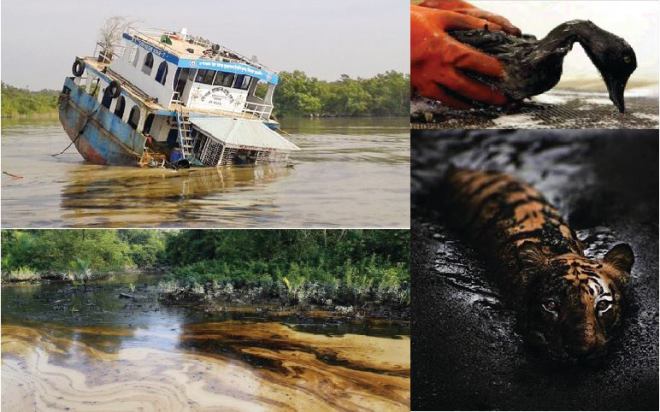
Rare animals and wild bird died by oil spill in the Sundarbans. If the Rampal power plant will be built, many more beautiful and rare animals would face the same fate! Photo credit: Anup Kundus 28 Jan 2015.
‘BIFPC, the Bangladesh-India Friendship Power Company, formed jointly by NTPC, India and BPDB, Bangladesh, in a statement published in newspapers on October 21, harshly criticized the ongoing movement to Save Sundarbans and presented some forged information regarding the Rampal power plant project. They stated, ‘a handful person and organizations are spreading misconceptions regarding Rampal power plant only to create a bar against the current development process of the country’. They also claimed that, ‘This plant will not impose any threat to ecology, environment, and local people’.
However, it is well known fact that this alleged ‘handful of persons and organizations’ who are opposing this plant include various organizations working with National Committee, experts from national and international arena, teachers, writers, artists, environmentalists and of course the general people of the country. Even UNESCO, Ramsar, South Asian Human Rights Forum, and Council of Ethics of Norway are also part of these few ‘persons and organizations’ who, according to them, are trying to ‘destabilize the country’s ongoing growth’! Meanwhile, UNESCO has already expressed their concern over this issue and a possibility arises that it might even consider withdrawing the status of Sundarbans from the list of World Heritage sites.
‘We would like to stress on the fact that except for few vested interest groups most others have taken a strong position against this plant. Even the Department of Environment and Forestry in Bangladesh opposed this plant in the very beginning. We have mentioned it many times that the conditions of Rampal Power plant largely violates International law. Indian environment law itself disallows such plant to set up within 25km of any ecologically sensitive area.
‘The Ongoing Save Sundarbans movement is based on various authentic research and analysis which confirms the destructive effect of the plant on Sundarbans. This plant has raised additional questions due to the lack of transparency, rule of law, and coercive role of the state. The company has claimed in the statement that ‘the plant will not cause pollution, and no amount of polluted or hot water will be released in the water bodies’. However, such pollution is obvious and even the government led EIA report had to admit the severe environmental adverse effects of the project.
‘In the statement, the company also stated that the power plant will crate job opportunities for the local people. This is a misleading piece of information as we all know a power plant is capable of employing only an insignificant number of people. Moreover, due to the dangerous impact of the plant on the water bodies and the forestry of nearby areas, nearly a million people, depending on the forest for their sustainable livelihood, would have no other choice but to become environmental refugees.
‘Interestingly, the company has blamed the farmers and the fishing community for the gradual decline of Sundarban’s. This is as well a well-planned propaganda against the marginalized communities of Sundarbans. It is very clear that the Sundarban is in danger not because of the communities living around it, but due to the powerful land grabbers and the ecologically disastrous industrial and ‘development’ projects. In addition, if the power plant is constructed, not only the Sundarbans will be affected, the communities of the southern belt of the country will become completely unprotected before increasing natural disasters.
‘The company has also claimed that the prime Minister of Bangladesh has recently received the ‘Champion of the Earth’ award, and thus it is out of question for the prime minister to promote any project that impacts the environment negatively. In response to this claim, we would like to remind that after the award, the Prime minister has bigger responsibility now. We expect that by canceling the dangerous project, our prime minister will do justice to her award, and will prove herself as a genuine defender of environment. Otherwise she will be remembered in the history for her flawed policies that is the biggest threat for survival of Sundarban, therefore responsible for the most dangerous environmental destruction of our time.’
Noise-Demo, Drumming, Coal Play and Interrogation at GCM’s AGM
AGM Disrupted by Protesters’ Interrogation
Protesters Demand Arrest of Gary Lye and De-listing of GCM from London AIM
by Raaj Manik, 10 December 2014
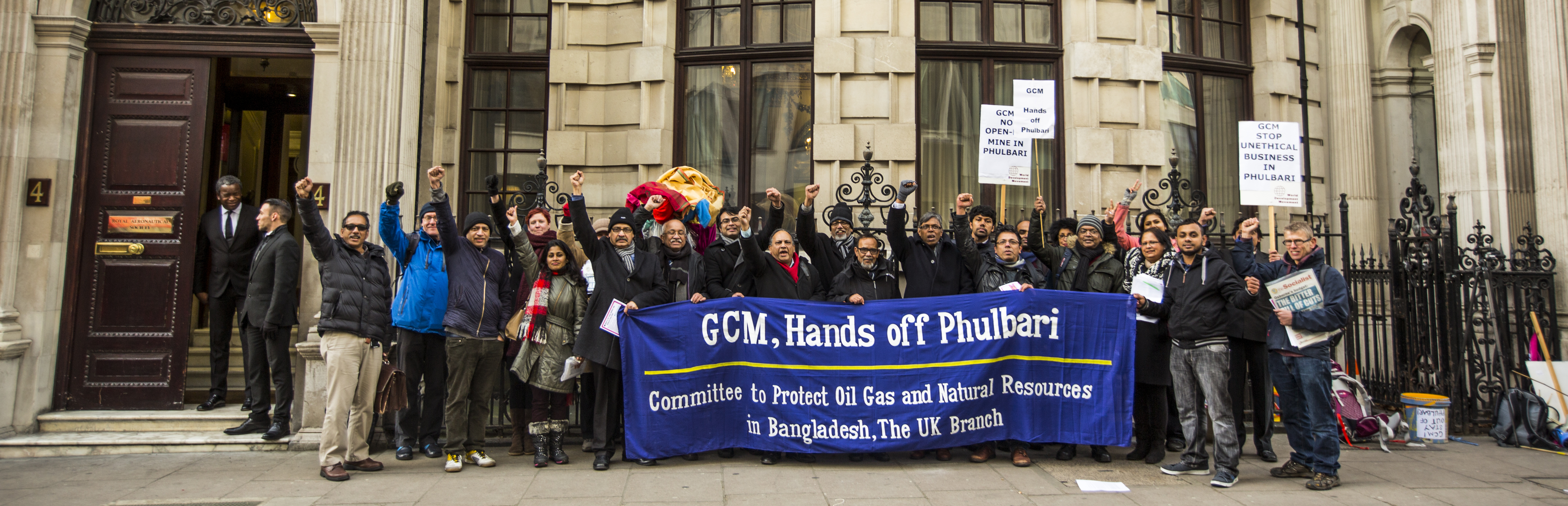
Protesters pledge GCM will be de-listed from London AIM soon. Photo: Paul V Dudman
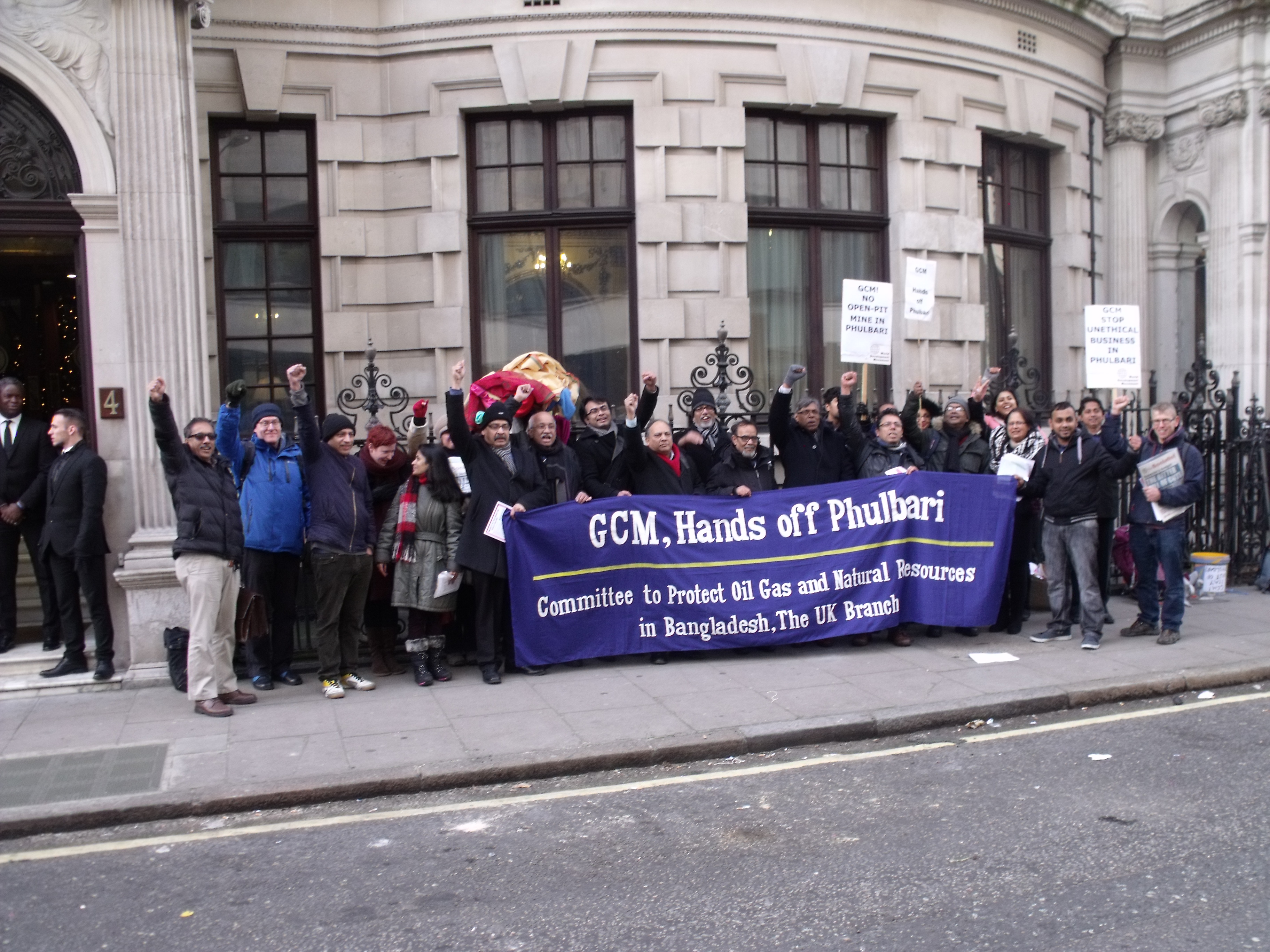
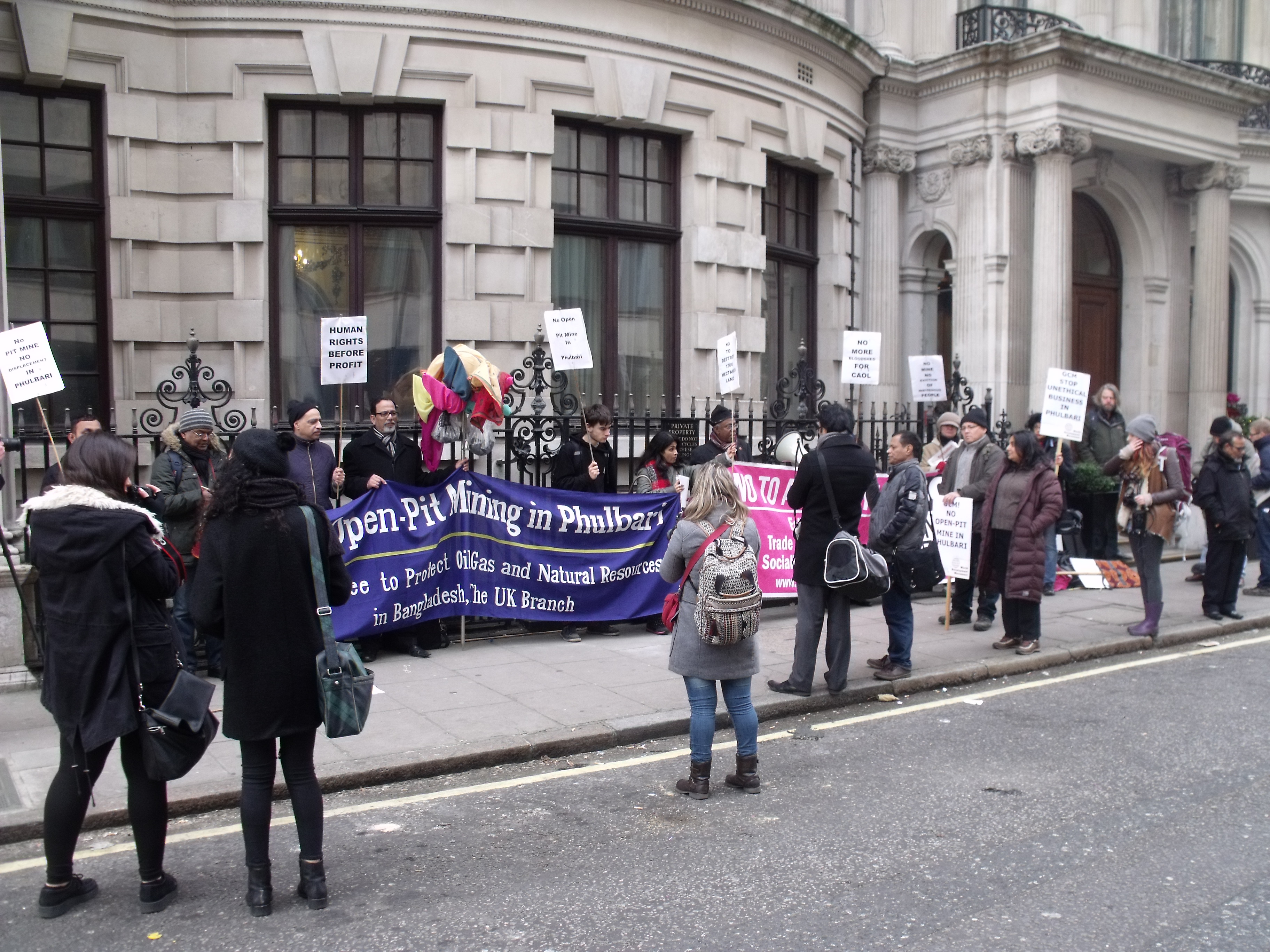
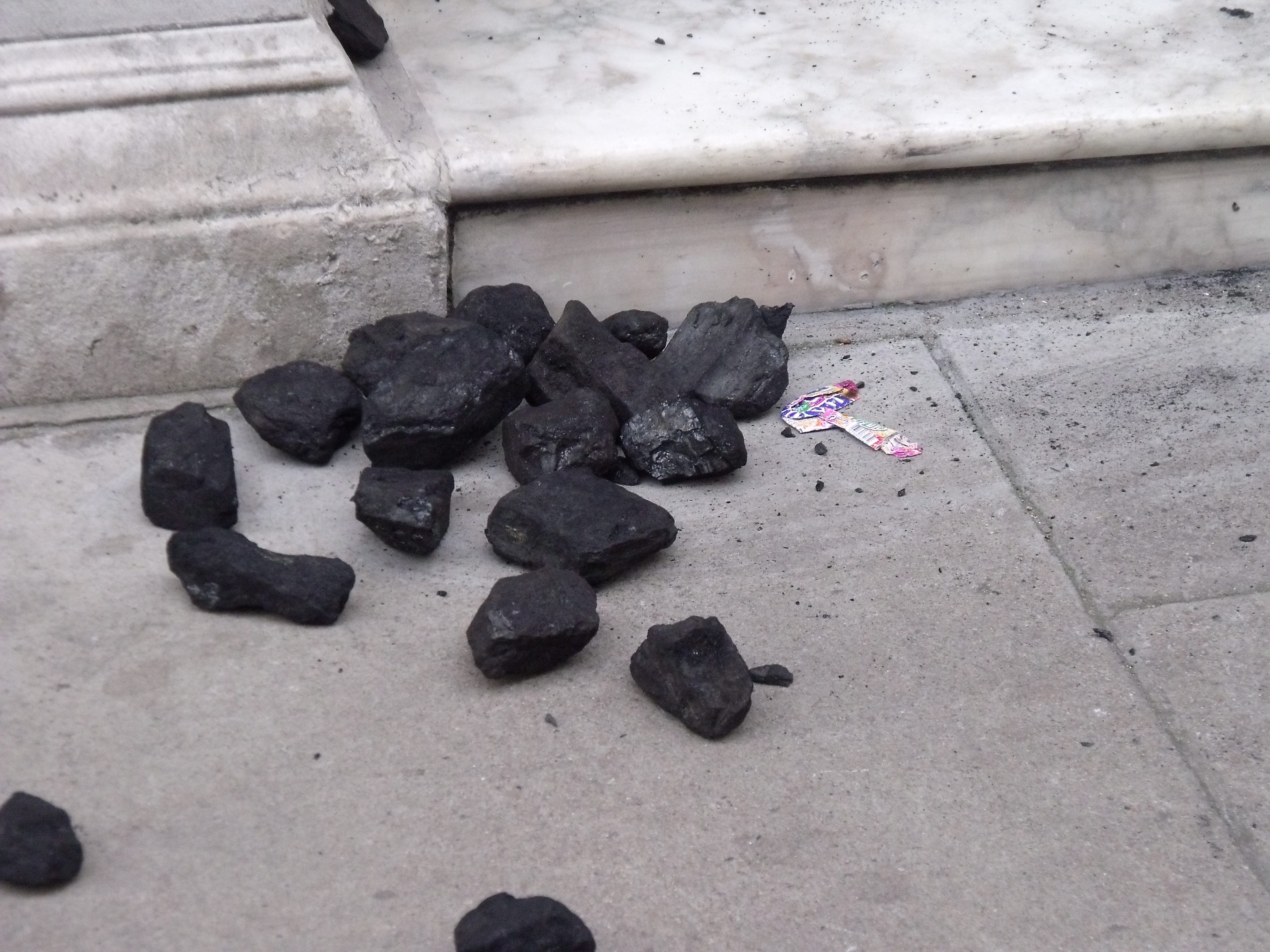
Yesterday, Bangladeshi activists in conjunction with a diverse group of environmental and left political activists in London, heckled the investors of Global Coal Management Resources by their noise demo and coal play. Activists blocked the entrance to the Aeronautical Society by dumping coal in the doorway. They surrounded GCMs’ CEO Gary Lye and his fellows who are aggressively moving ahead to implement a massive open-pit mine in Phulbari, the northwest region of Bangladesh.
At the same time a delegation of protesters disrupted the AGM of GCM by questioning the investors inside the AGM about their fraudulent business in London’s Alternative Share Market (AIM).
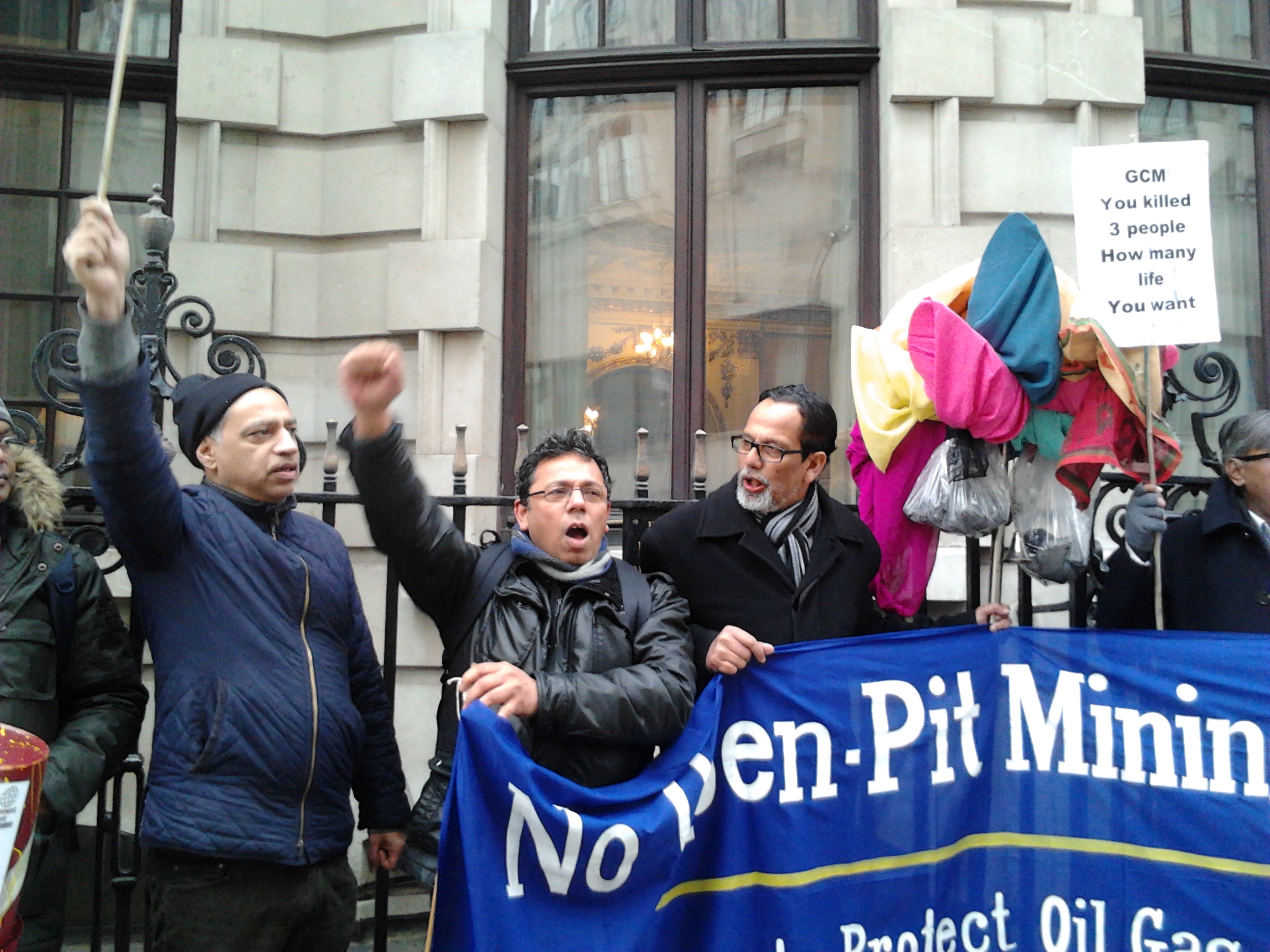
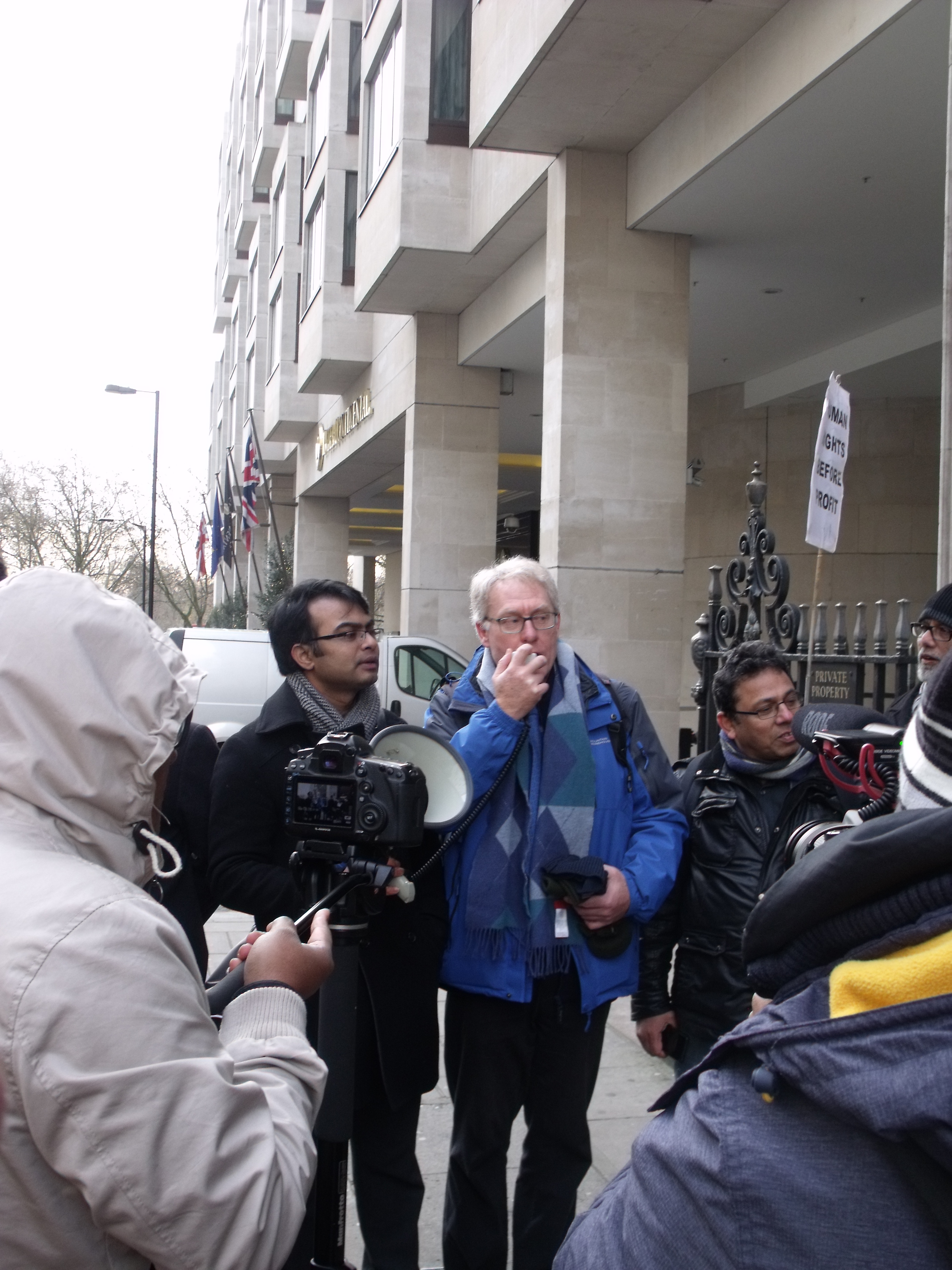
Community activists (from left) of Swadhinota Trust, Bangladesh Workers Party (UK branch), and the UK branch of National Committee chanted slogans defying the company’s CEO Gary Lye’s pervasive propaganda about the protesters in Phulbari. Photo: Paul V. Dudman
The demo was organised by Phulbari Solidarity Group and the UK branch of the National Committee to Protect Oil- Gas-Mineral Resources and Port-Power in Bangladesh, in conjunction with other community groups and London Mining Network.
The event was endorsed by Socialist Party of England and Wales, World Development Movement, Occupy London, Foil Vedanta, European Action Group of Climate Change in Bangladesh, Trade Unionist and Socialist Coalition, UK, and several community organisations including Nari Diganta, Swadhinota Trust, Udichi Shilpi Gosthi, Jubo Union, Friends of Chatro Union, Bangladesh Workers Party (UK branch), Bangladesh Communist Party (UK branch), and Bangladesh Socialist Party (UK branch).
The Sculpture in Tangail and Silk Sari, held three sacks of coals, symbolising the livelihood, culture, struggle, and resistance of Phulbari people. Photo: Stephen Vince
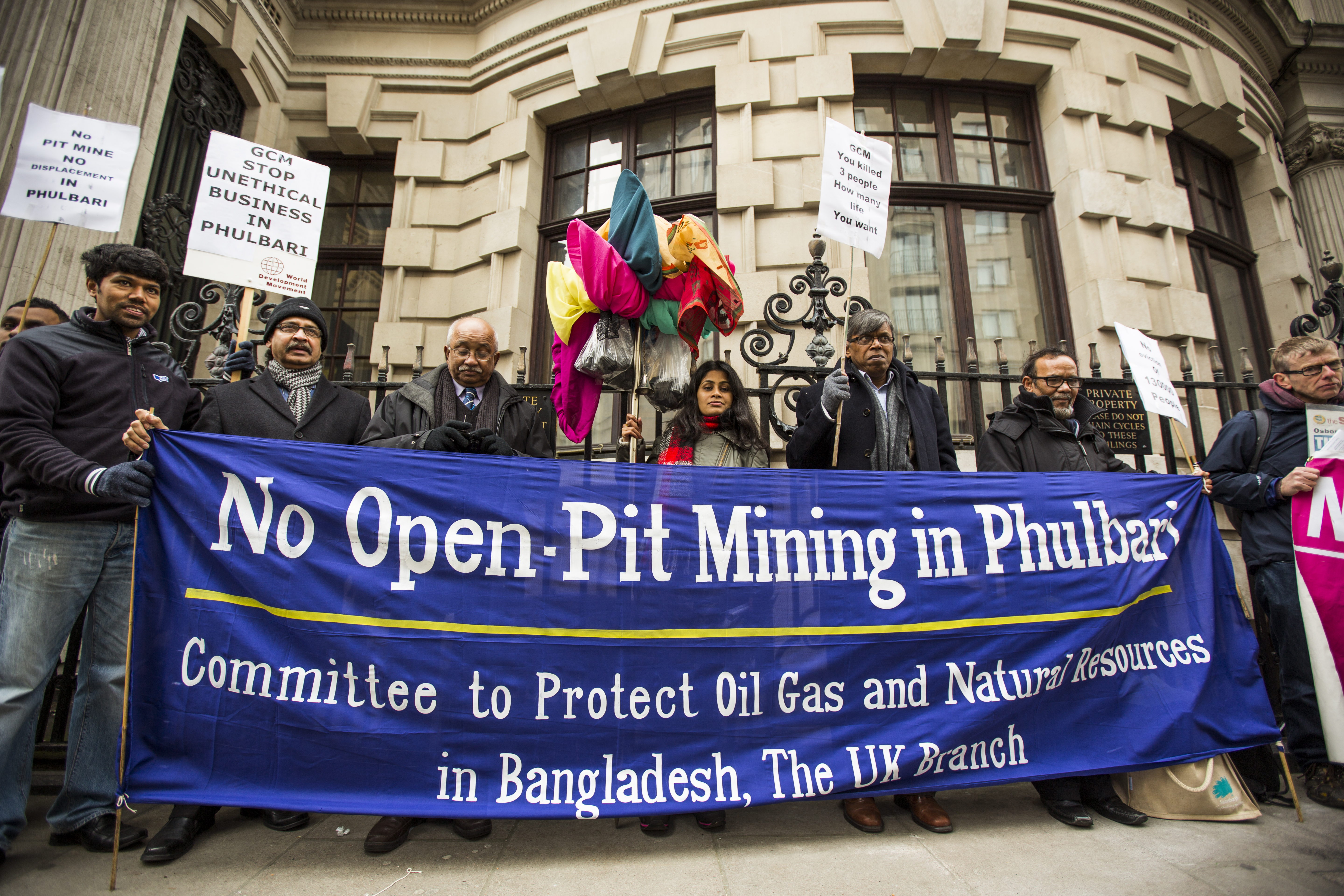
The event kicks in with the launch of artist Stephen Vince’s beautiful sculpture, symbolising the protest against the miners and the livelihood, culture, struggle, and resistance of Phulbari people. The sculpture, wearing a Tangail and Silk Sari, held three sacks of coals to symbolise the significance of the number three and a tribute to the three people who were killed in the dirty coal game of GCM in Phulbari.
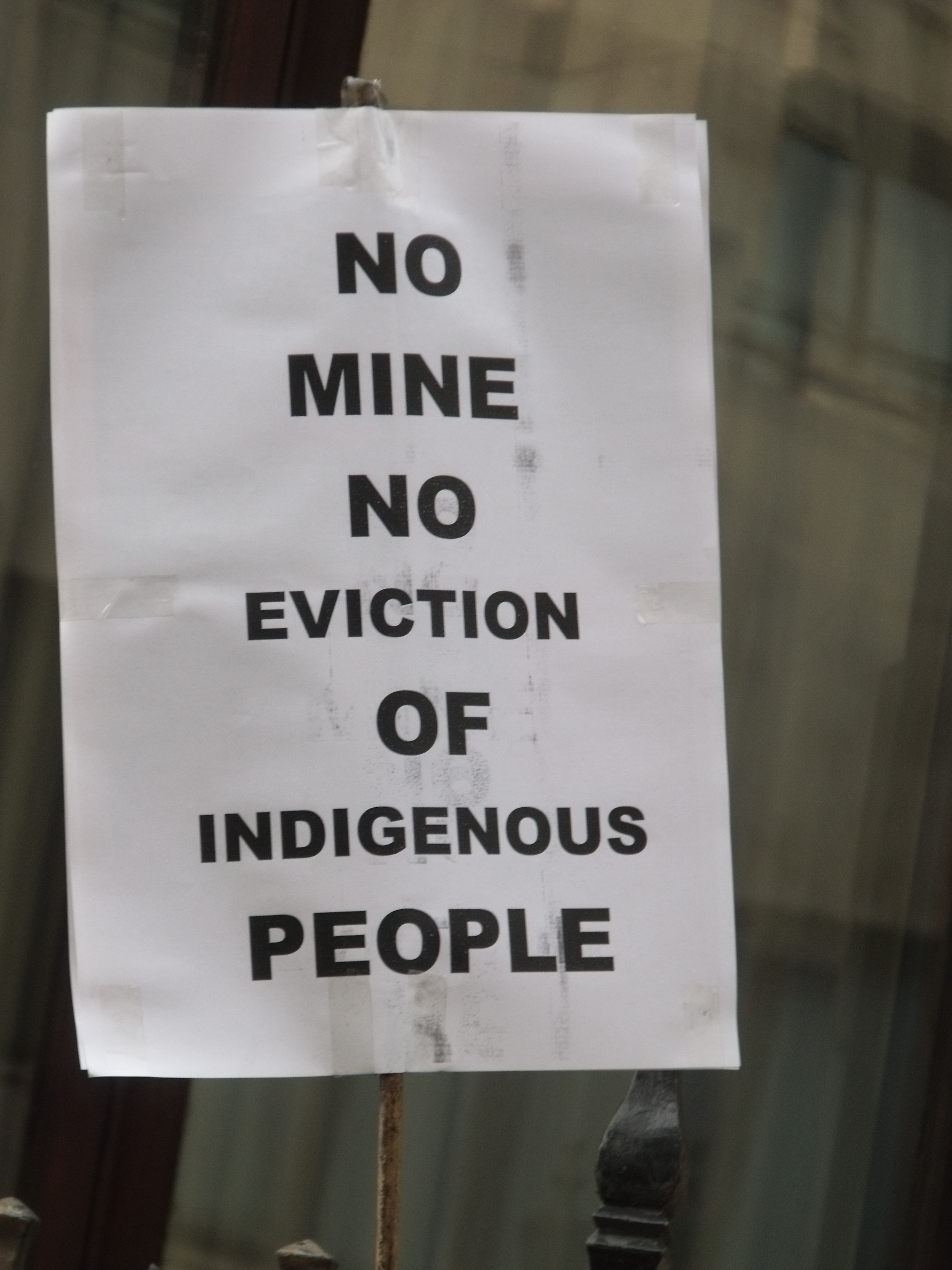
Bangladeshi activists, carrying the sculpture and holding a banner saying – GCM hands off Phulbari, No open pit mine in Bangladesh- started to chant slogans and sing ‘tomar bari amar bari, Phulbari Phulbari’. Some protesters played drum and samba when Rumana Hashem and Shahriar Ali gave vocals, deriving slogans from Phulbari in Bangla basat vita dhongsho kore koila khoni hobena [destroying homes and land, no mine no mine]. Others attempted to enter the block calling the investors to come out of AGM and to apologise for their misdeeds and abuse in Bangladesh. Loud protesters were repeatedly warned about potential arrest by the authorities of Aeronautical Society (AS) who did not call police but appeared as racist.
Coal dumped on the front door and stairs of Aeronautical Society. Photo: Ansar Ahmed Ullah
Angry protesters dumped coal on the front door and stairs of AS, as they were prevented from taking out Gary Lye. Protesters said that they would not leave the venue before the interrogation of Gary Lye and his fellows was over. Meanwhile, a group of protesters went to check the investors’ vehicles and took over the car park as part of the blockade against Gary Lye, the company’s manipulative CEO, who was expelled from Phulnari for a 3rd time this year, on 26 November, but still continues to abuse Bangladesh government and Phulbari people.
When protesters outside the AGM were checking investor’s vehicles, a delegation of dissident climate justice activists attending the AGM challenged Gary Lye and the board inside the AGM about GCM’s unethical business in London and abusive activities in Bangladesh. Bangladeshi activists rattled the investors to an extent that the Chair was “fade up” and it was Gary Lye who ended up facing the questions about the paperless contract and propaganda of GCM. Phulbari activists challenged that GCM does not have valid contract with Bangladesh.
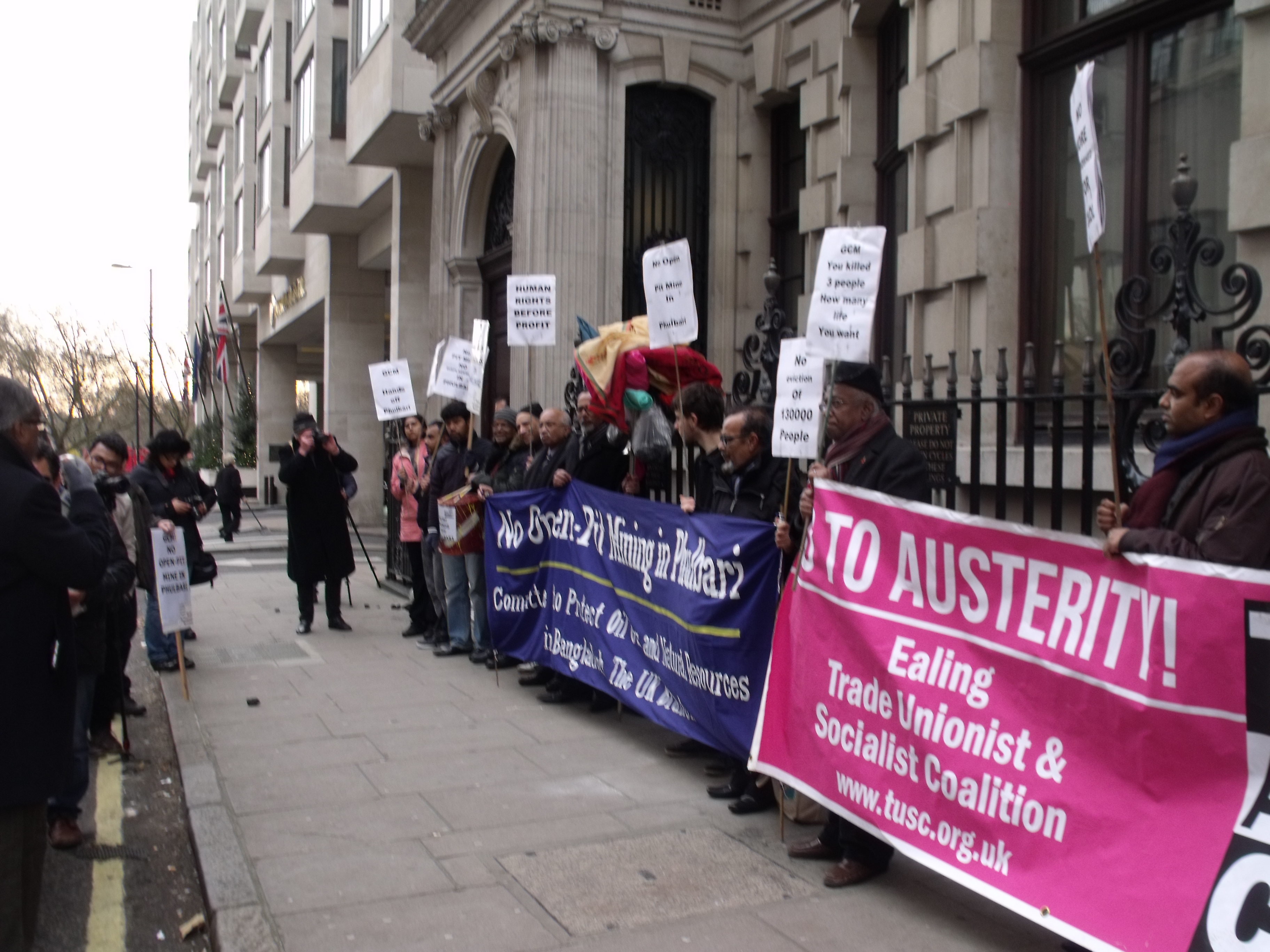
Diverse group of climate activists and protesters holding placards and listening to speeches by community leaders. Photo: Paul V Dudman
Climate activists of World Development Movement and London Mining Network supported Phulbari Solidarity activists, and asked numerous questions about the highly contentious Phulbari project, its huge human rights impacts and the OECD Guidelines as GCM has breached 2011 Guidelines, which do apply to the planned conduct of an enterprise in terms of prospective impacts on human rights. Activists said that ‘the company was illegitimate, the project illegitimate and the annual general meeting of GCM was illegitimate’.
The meeting broke up unceremoniously and the shareholders broken up into two groups.
Richard Solly of London Mining Network is briefing the demonstrators about the interrogation inside the AGM and the failure of GCM board to answer the questions of Bangladeshi activists. Photo: P V Dudman
The delegation of climate activists came out of the AGM and joined the protesters outside where Golam Mostofa, Richard Solly, Zahanara Rahman and Sam Sender updated the demonstrators that Gary Lye and his fellows have failed to answer the questions of Bangladeshi activists. ‘They are even lying about national media and the government in Bangladesh’, said Mrs Zahanara.
Protesters chanted slogans ‘Gary Lye is a Lier, Shame on Gary Lye’, GCM and Asia Energy, hushiar sabdhan [be aware of peoples’ power]’. One angry protester attempted to walk into the building with a sack of coal to dump on Gary Lye’s chair, but was prevented from entering the meeting room by the AS’s equally racist authority who received the coal on behalf of the investors.
Speakers in the demo asserted that there is no hope for Asia Energy and GCM in relation to coal business in Bangladesh when the government including the Prime Minister, Energy Minister and Energy Secretary of the country have reaffirmed that Bangladesh will not go for open pit mine in Phulbari. Speakers include Akhter Sobhan Khan, Abed Ali, Ahmed Zaman, Ansar Ahmed Ullah, Effie Jordan, Ishak Kajol, Mostofa Farook, Nurul Islam, Peter Mason, Syed Enam, Shah Enam, Julie Begum, and many more.
The Masters of the event were Shahriar Ali and Rumana Hashem. The event was volunteered by a number of left activists and professional photographers including artist Stephen Vince, Golam Rabbani of Diamond Studios, Nicole Meedrum, Patrick, Chris and many more. The chairperson of National Committee’s UK branch, Dr Mokhlesur Rahman, thanked everybody for coming along and for taking on important theatrical roles.
Diverse group of climate activists kept coming and joining the demo which they found extraordinary in London. Photo: Paul V Dudman
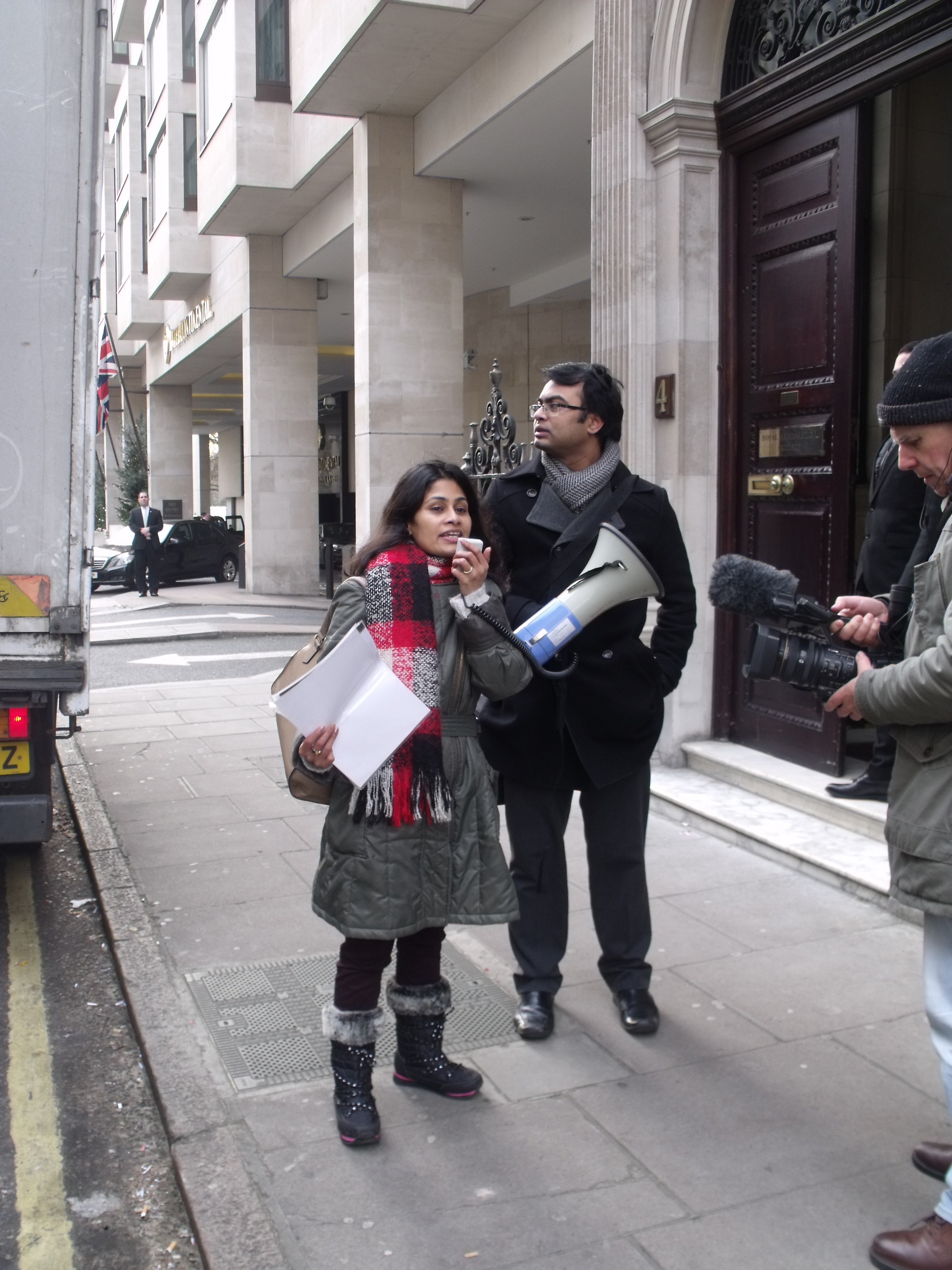
The demo ended with a manifesto calling out GCM for an end of GCM’s dodgy deals on Phulbari coal project, and by criticising the UK NCP’s controversial recommendations to the company. The founder and coordinator of Phulbari Solidarity Group, Rumana Hashem, read out the manifesto of the demo and called the London’s AIM to de-list GCM.
The manifesto concludes by expressing full solidarity with the Phulbari people’s struggle and by condemning the UK government for failing to hold the UK-based company accountable.
Dr Rumana Hashem reads out the statement of the demo. Photo: Paul V Dudman
Miners GCM Resources is the subject of a complaint to the Organisation for Co-operation and Development over the controversial coal mine. They have only one active project, the Phulbari coal project, which awaits permission from the Government of Bangladesh to go ahead. But the people in Phulbari want to put the company out of Bangladesh, ban the Phulbari project and to take the company and its investors to public court for their abusive and fraudulent activities.
Phulbari, the town in upheaval in northwest Bangladesh where three people were shot dead during the protest against immense open pit mine in 2006, has become volatile again since, the Chief Executive Officer (CEO) of the AIM-listed British company, Gary N Lye, attempted to conduct consultation with locals in the town centre. There were two days long blockade in Dinajpur-Dhaka highway, and over a thousand people braved cold to raise their protest at Gary Lye’s visit last month.
Phulbari demo and protest in London ends with a pledge that there will be no mine in Phulbari. Photo: Paul V Dudman
On 26 November, locals in Phulbari surrounded Lye and GCM’s Bangladesh subsidiary Asia Energy‘s local office, and the CEO had to leave Phulbari and Dinajpur in police protection. Violent protests erupted where 2 were injured. Protesters have demanded Gary Lye’s immediate arrest and expulsion from Bangladesh. A month-long programme including nation-wide protests have followed. Protesters will not go back home until their demands are full-filled.
Manifesto of the Demo against the Dirty Coal Miners of Asia Energy/GCM 2014
Tuesday, 9 December, 2014. London
Today we, the activists from Bangladesh, East London, the Borough of Tower Hamlets, and London’s environmental organisations, have gathered to call upon the AIM-listed London-based multinational company, GCM Resources Plc, to end its unethical business. The company, GCM Resources, is desperately moving to implement an immense open pit coal mine in northwest Bangladesh, forcibly displacing an estimated 130, 000 people and destroying the homes, lands, and water sources of as many as 220,000 people. If the project is implemented, it will destroy over 14,660 acres of fertile agricultural land that produce three food crops annually, threatening to increase hunger in a country in which over a third of all children and nearly 17 percent of the entire population are undernourished.
GCM’s planned Phulbari coal mine has provoked repeated protests by local people. Three people were killed and over 200 injured when paramilitary officers opened fire on a protest against the project in August 2006. Protests in 2013 forced the company’s CEO, Gary Lye, to abandon a visit to the area.
The project has generated grave concern at national and international levels including the United Nations. On 28 February, 2012, seven UN human rights experts have called for an immediate halt to the project, citing threats to fundamental human rights, including the rights to water, food, adequate housing, freedom from extreme poverty and the rights of indigenous peoples. But GCM is aggressively moving ahead to implement this project.They are selling fraudulent shares in London’s Alternative Investors Market (AIM) without any valid contract with Bangladesh Government.
The situation in Phulbari has become tense and volatile again since Tuesday the 25th November, when the company’s Chief Executive Officer (CEO), Gary N Lye, attempted to visit Phulbari. Gary Lye is the man who called the protesters outsiders in 2006, and commented, after the death of three people shot by police at a demonstration, that “I am a businessman, [ …] I will continue my business in Phulbari’ regardless of whether there was a bloodshed or not. Therefore, people in Phulbari braved cold to raise their protest at Gary Lye’s attempted visit. Over a thousand people blocked the Dinajpur-Dhaka highway for five hours, demanding Lye’s arrest and expulsion from Bangladesh. In Phulbari there were two days long protests outside GCM’s Bangladesh subsidiary Asia Energy’s local office. Violent protests erupted where 2 were injured.
On Wednesday, 26 November, the company’s CEO, Gary Lye, attempted to conduct consultation with locals in Phulbari following advice of the UK government which was released on Thursday, 20 November. The UK government’s statement follows an investigation into GCM’s activities in Phulbari, and it concluded that the company had breached the OECD Guidelines on Multinational Enterprises by failing to “foster confidence and mutual trust” with the people who would be affected by the mine. We welcome the Board’s affirmation that the 2011 Guidelines on human rights do apply to the planned conduct of an enterprise and its prospective impacts on human rights (para 6). We welcome also the finding that the 2011 Guidelines would apply if GCM “continued to be “actively involved in the project” (para 19).
But we are hurt by the ambiguous conclusion of the investigation. The investigation does not ask the company to pull off from the devastating project. Its recommendations are reduced to re-evaluation of the risks and impact. It asked the company to foster communication with the locals following a narrow approach. The final-published investigation failed to consider how the mine would affect the people of Phulbari if it were built, and its conclusions were limited to GCM’s record in the planning phase of the project to date. Although an internal review of the investigation affirmed that the OECD guidelines do apply to human rights abuses that would occur if the project went ahead, the final report failed to address the concerns of the internal review and did not correct the decision to exclude all potential impacts of the project from the investigation. We condemn the UK government for failing to hold their businessmen to account. We condemn the UK National Contact Point for failing to cite the extremely important first-hand accounts from Phulbari. We believe that it is the chair of the NCP, Liz Napier, who played a dirty game in this whole OECD investigation.
Liz Napier and her team at the Department for Business, Innovation and Skills have overlooked many of our first-hand accounts, allowing the dirty coal miners of GCM Resources, Gary Lye, to go back to Phulbari for an unexpected re-evaluation of the situation. The visit of dirty miner, Gary Lye, has sparked protests leading to fresh violence in one of Bangladesh’s most peaceful town, Phulbari. We demand that Liz Napier and her team at UK National Contact Point must take the responsibility for the recent turmoil in Phulbari. We call for a suspension of Liz Napier from her current post at UK’s Department for Business, Innovation and Skills.
The OECD investigation followed a complaint submitted by the World Development Movement and International Accountability Project. We appreciate the initiative of International Accountability Project and World Development Movement (thereafter Global Justice Now) in support of the people in Phulbari. Although the UK government has failed to hold this UK-based company to account, it is clear that the people of Phulbari will resist GCM’s project going ahead. Phulbari people have made it clear by declaring their month long programme in demand of GCM’s CEO’s arrest and expulsion from Bangladesh. We extend our full solidarity to the people in Phulbari.
We will continue to call upon the London AIM to delist the dirty miners, GCM Resources, from London’s Alternative Share Market. Our Secretary of Energy and Mineral Resources Division, Abu Bakar Siddique, reaffirmed that Asia Energy has no valid licence to develop Phulbari coal mine. Miner GCM must stop the propaganda about Phulbari coalmine. Our people do not want to leave their homes and land. Phulbari people will not work in a coal mine. GCM’s propaganda to create 17,000 new jobs in coal mine cannot ensure livelihood for 130,000 people feared to be affected during exploration in open pit method over the next 35 years. We will not let our people to die and our environment to de destroyed by dirty miners of GCM.
The UK Committee (National Committee) to Protect Oil- Gas-Mineral Resources and Port-Power in Bangladesh, in conjunction with Phulbari Solidarity Group, London Mining Network, World Development Movement, Foil Vedanta, Socialist Party of England and Wales, Occupy London, European Action Group of Climate Change in Bangladesh, the Trade Unionist and Socialist Coalition in UK and all our co-worker organisations, will continue to call for the company to be de-listed from the London Alternative Investors Market. We declare, on behalf of the people in Phulbari, this UK based company will never go back to Bangladesh. Asia Energy’s Chief Executive Officer, Gary Lye, and investors of GCM Resources were ousted from Phulbari. They will be resisted and the company will be uprooted from London soon.
Action to Save Lives and to Halt the Devastating Phulbari Coal Project
Tuesday, 9 December 2014 at 10:30am-12pm
Venue: 4 Hamilton Place, London, W1J 7BQ
An AIM-listed London-based multinational company, GCM Resources Plc, is desperately moving to implement an immense open pit coal mine in northwest Bangladesh, forcibly displacing an estimated 130, 000 people and destroying the homes, lands, and water sources of as many as 220,000 people. If the project is implemented, it will destroy over 14,660 acres of fertile agricultural land that produce three food crops annually, threatening to increase hunger in a country in which nearly half of all people currently live below the nutrition poverty line.
Download Flyer
Locals have protested the project for seven years by forming powerful human chains and rallies. On 26 August 2006, three people were killed and over 200 injured when paramilitary troops fired on a massive protest of some 80,000 demonstrators in Phulbari. But people in Phulbari are determined to resist this project and to stop GCM Resources plc. The potential for violence has remained high in this project ever since August 2006. Last year the situation sparked by the CEO’s planned visit to Phulbari. People in Phulbari have given verdict against this project. We have served two eviction notices to the company. On 28 February, 2012, seven Special Rapporteurs of the United Nations issued a joint UN press release, calling for an immediate halt to the project on the grounds that it threatens the fundamental human rights of hundreds of thousands of people, including entire villages of indigenous people, and poses “an immediate threat to safety and standards of living.” Still GCM is aggressively moving on to implement this open pit coal mine ignoring the human rights and environmental degradation the project would leave.
We want to teach GCM to keep its hands off Bangladesh. We will surround the corrupted miners this December at their AGM. Will you join us in surrounding the dirty coal miners? Will you tell GCM to leave this project?
Download PDF of Flyer.
—————————————————————————————————————————- The UK branch of the National Committee to Protect Oil-Gas Mineral Resources and Port-Power in Bangladesh.
The Independent news on Barapukuria reproduced below by Raaj Manik
Wednesday, 19 November 2014
Author / Source: SHAHNAJ BEGUM
The authorities of the Barapukuria Coal Mine Company (BCMC) have rejected the feasibility study report of the Institute of Water Modelling (IWM) on open-pit mining at Barapukuria North, as it did not match the study’s “terms of reference (TOR)”. “The study did not reflect the impact of open-pit mining on the groundwater level as a result of dewatering, irrigation and supply of drinking and industrial water. We need a further detailed report,” a senior IWM official told The Independent on Monday.
With the aim of opening up the northern part of the Barapukuria coalfield on a “small scale”, the energy ministry had launched the initiative 10 years ago. To endorse the plan, it formed different committees and completed two studies, but failed to reach any conclusion. In its third attempt, it engaged the IWM to complete water modelling to preclude any controversy over the method of coal extraction.
“This study is not enough to assess the impact of open-pit mining as it is a highly technical issue. Once again, we want to complete a geo-technical feasibility study before taking any decision on open-pit mining in this area,” Petrobangla’s former chairman Md. Mosharrof Hossain, who is the coordinator of the government monitoring committee that guided the IWM’s survey, told The Independent.
“We can go in for open-pit mining in the northern part of the Barapukuria coalfield, subject to the technical feasibility study on mining issues and the economic viability of water pumping with respect to biodiversity and ecological
stress on food production and their impact on the gross domestic product (GDP). Otherwise, how can we assess the profit and loss of a project? The study has failed to discuss these aspects,” he added.
According to Petrobangla, it was mentioned in the TOR that the study, covering an area of 2.81 sq. km, would assess the impact on the groundwater level as a result of dewatering, irrigation and supply of drinking and industrial water. It would find out possible remedial measures for underground sustainability through different opinion studies and recommend developing mine water management systems. “But the report did not touch on the irrigation and crop issues of the affected areas, which have a great impact on mine design,” an official said.
Though the IWM report said an area of some 560 sq. km of Barapukuria would be impacted if the government decides to open Barapukuria North for open-pit mining and the water table of the areas would go down from seven metres to more than 30 metres at different points, but to make it operational, it would require de-watering from 400 million cubic metres (mmc) to 232 mmc every year.
“The IWM report gave us some sort of relief, as we found the water flow to be almost half of what we had assumed. But a geo-technical issue is a must. After that, we will start the other related task,” Mosharrof Hossain said.
Bangladesh has five coalfields with around 2.55 billion tonnes of reserves, but has been unable to extract the mineral since a national coal policy has not been finalised yet. The Barapukuria coalfield has reserves of around 389 million tonnes, but only 10 to 12 per cent of this can be extracted with the underground method.
The report said over 90 per cent of the total reserves can be extracted through open-pit mining. Underground mining can produce less than 25 per cent. The northern part has estimated reserves of 135 million tonnes of coal.
“The surface of the Barapukuria
coal seam has started at the level of 118 metres. It gradually grows in depth up to 503 metres,” geologist Dr Mushfiqur Rahman told the Independent.
The report of the experts’ committee said the coal seam deposited 200 metres under the surface would be extracted through the open-pit method. The underground mining method would be chosen for those deposits when that depth is more than 200 metres.
Original version of the report can be accessed here
The translated version of the NCBD press statement
by Samina Luthfa
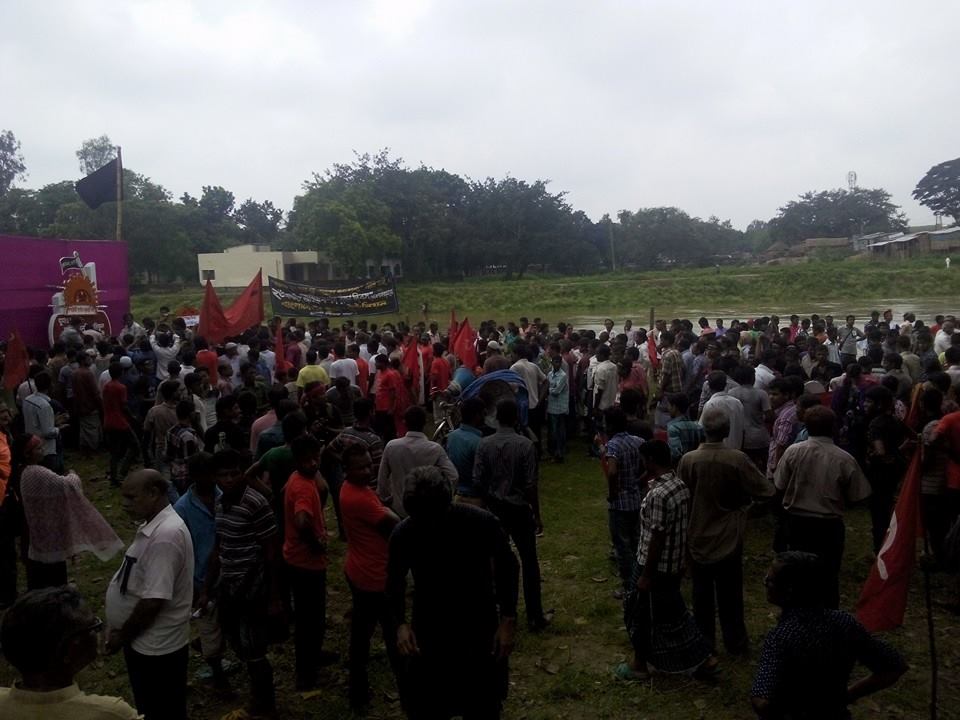
On 26th August 2014, the 8th anniversary of the Phulbari Mass uprising has been observed countrywide with the following slogan: ‘There is no place for the betrayers on the streets of Phulbari drenched with the blood of our martyrs’. Daylong programmes were observed in Phulbari that included mourning procession, wearing black badge, hoisting black flag, rally and cultural activities of resistance.
The day’s programme started at 7 am with placing respect to the Martyrs and wearing of black badges. In remembrance of the martyrs and their sacrifice all shops and businesses were closed that day. Black flags were hoisted in many places.
The Central National committee organized the Mourning procession, and at the end, a minutes’ silence for the fallen was organised. A at the Neemtoli morh fter this, we had a rally expressing our demands that include;
Full implementation of the Phulbari accord
Moving the office of Asia Energy from their town.
Activities around opening up of Boro Pukuria was condemned.
Member secretary of the National Committee Prof Anu Muhammad delivered the welcome address, convener of national committee Engineer Sheikh Shahidullah spoke about the demands, and Saiful Islam Jewel presided the meeting.
Leaders of Jatyo Ganofront, Bangladesh Communist Party, Bangladesh Socialist Party, Bangladesh Workers party, Revolutionary workers’ party, BaSoD convention preparation committee, Democratic Revolutionary party, Gano Shonghoti Andolon, United Communist League, leaders of Phulbari Branch of the national committee spoke in the occasion. Many other local, regional political organization, individuals including Bablu Roy (person injured by the Rana plaza disaster) and university teacher were also present in the program.
In the rally, the speakers remembered the day in 2006 to emphasize how remarkably people of Phulbari defied law enforcers, attended the rally in thousands and after the murder of the three, people here mounted one of the greatest resistance in Bangladesh against the company. As a result, on the 30 August 2006, the then government was forced to sign an accord with the protestors of the company that said there will be no open pit mine and Asia Energy would have to leave. The current Prime minister promised Phulbari people that she would never let this mine start. However, surprisingly, with the same person now as the head of State, we have not seen a transparent step to ban Asia energy.
The rally demanded the full implementation of The Phulbari accord by the 30th November. Failure to do so will incur a huge rally of people on the 1st December. In the afternoon, resistance songs and plays were performed. In the evening, film shows titled, ‘We don’t want a mine’, ‘Fulbari – a Blood flag’ and Indian documentary named ‘Fulbari debona’ were screened.
We would like to take this opportunity to forward some news in relation to
Image Copyright: International Accountability Project,
the India/Bangladesh exchange initiative. Our very trustworthy friends at the International Accountability Project (IAP) were working on this initiative with some admirable videographers at Mediafire for the last several months. With thanks to IAP and some very devoted film makers, we have the pleasure to let you know that their film is now ready for you to available online!
You are most welcome to view the film and to share with your colleagues and friends.
MediaFire says that anyone can access using these links. I’ve just tried and they seem to be working fine. However, if you do have problems with these links, let us know.
In the meantime, may I ask you to share the film with your friends/colleagues and as many people as possible please. Feel free to put the link on your blog, FB page, and twitter.
Stressing the need to protect arable land, Prime Minister Sheikh Hasina has directed the energy ministry to wait for ‘new technology’ before going for coal extraction.
She also outlined the ministry’s future challenges and ways to tackle them.
State Minister Nasrul Hamid Bipu briefed journalists on Thursday after her first visit to the ministry in two-and-a-half-years.
“The Prime Minister told ministry officials that new technology to extract coal may become available soon. We will wait for it,” he said quoting the Prime Minister.
Hasina’s directive comes amid controversies on whether Bangladesh should go for open-pit mining along with importing coal to meet increasing power demands.
Hamid was, however, silent on coal extraction issues. He also did not explain how thermal power production could be raised while waiting for ‘new technology’.
He said the Prime Minister wanted protection of farmers’ land first and coal extraction to be left to the future.
Hamid said Hasina, who also holds the energy portfolio, had ordered the stepping up of coal extraction research.
State-run oil, gas and mineral resources corporation Petrobangla claims Bangladesh has five coal mines with an estimated combined reserve of 3.1 billion tonnes.
Currently, an estimated 1.65 million tonnes of coal is produced annually from one of the mines through underground mining.
A group of experts, environmentalists, various Leftist fronts oppose open-pit mining which pollutes the environment, lays waste to arable land and displaces the habitants.
Despite a matter of high priority, the government has failed to formulate a coal policy in the past decade.
About 75 percent of Bangladesh’s power comes from gas while coal is used to produce less than 3 percent.
The government claims electricity generation increased nearly 5,000MW over the past five years. A ‘Festival of Light’ was held in Dhaka last year to mark the production of 10,000MW, hitting a new milestone in the country. It also plans to raise power production to 30,000MW by 2030, half of which would come from coal.
However, according to information presented in Parliament last June, around 40 percent people still do not have access to electricity.
Bipu said the Prime Minister had directed the setting up of a coal-fired power plant near the Paira Port in southern Patuakhali.
The government recently faced a wave of protests when it decided to go ahead with a 1,320MW thermal power plant at Rampal, near the Sunderbans.
PM’s strategy on coal: Asia Energy’s future with Phulbari bleak
Reported by: UNBconnect
Reported on: February 8th, 2014 12:02:55 am
Dhaka, Feb 7 (UNB) – The future of Phulbari coal mine project of UK-based Asia Energy, since renamed as Global Coal Management (GCM), has become bleak following the Prime Minister’s recent distinct statement on coal mining in the country.
While holding meeting with Power and Energy Ministry’s top officials on Thursday (February 6), Prime Minister Sheikh Hasina said: “Right now, we want to leave the issue of coal extraction to the future technology as food security and protecting the land of the farmers is the first priority.”
The Asia Energy entered Bangladesh in 2003 buying a contract from Australian company BHP to explore coal in Phulbari of Dinajour district. But when Asia Energy moved to execute its project as an open-pit mining, it faced tremendous opposition from local community and environmentalists.
The major protests took place on August 30 in 2006, where six protesters were shot dead, allegedly by paramilitary forces, and 300 were injured when a crowd of 30,000 people stormed the local offices of Asia Energy in Dinajpur.
The incident forced the government to announce postponement of the operation of Asia Energy’s Phulbari project. The Asia Energy was renamed as Global Coal Management (GCM) in 2007.
Recently, different activities of Asia Energy or GCM have been suggesting that the company is planning to come back in a new way to implement its project. Particularly, the GCM, a listed company with London Stock Exchange showing Phulbari coal mine as its project, became active in the country’s northern region where it recently launched some campaigns to garner local public support in its favour.
The GCM’s campaign raised serious concern among the anti-Phulbari activists who also threaten to reactivate their protest to resist the UK-company’s move.
Meantime, GCM reconstituted its board of directors and brought major changes in its Dhaka as well as London office by putting some new directors and staffs which also suggests the company is really coming up with new enthusiasm.
Sources said the company also recast its strategy to win the deal for exploration of the proposed Phulbari coal mine.
As part of the new strategy, the company has inducted a young Malaysian tycoon as a Non-Executive Director, removing a Briton from the Board of Directors.
With the announcement, Malaysian tycoon Dato’ Md Wira Dani Bin Abdul Daim has replaced British entrepreneur Neil Lindsey Herbert from the board of directors of GCM.
“Under the leadership of Malaysian business tycoon, the GCM was eyeing to rearrange its strategy in winning a deal for commercial exploration of the proposed Phulbari coalmine district,” said a source.
The GCM appointed Mettiz, an investment company with significant corporate and financial experience in natural resources, power generation, manufacturing and real estate, a lobbyist in Bangladesh last year to get approval of the government for commercial exploration of the Phulbari coalmine.
But, energy industry insiders thought the Prime Minister’s statement has made it clear that the project is unlikely to be executed in near future.
Quoting the Prime Minister, State Minister for Power and Energy Nasrul Hamid said she has given us a directive regarding coal extraction saying that “first of all we need” food security and land use.
“Only after ensuring food security and protecting farmers’ land, we’ll decide which technology we’ll use to extract coal,” he told reporters following the PM’s meeting.
Asia Energy Bangladesh’s CEO Gary Lye, however, said Phulbari Coal Project uses the land for mining temporarily. Land is immediately rehabilitated and returned to agriculture after extracting the coal which is a far greater benefit for the country.
He said Asia Energy is concerned to ensure food security and the company’s agriculture improvement plan will increase the food production from the area as well as allow coal extraction and jobs.
“We (will) welcome the opportunity to brief the Prime Minister on these plans and show how she can deliver for the people and country coal, major power and food security. People from the area want the coal mining and development benefits it’ll bring to them and their region which is one of the Bangladesh poorest regions.”
Bangladesh has five coal fields with an estimated reserve of some 3.0 billion tonnes, industry insiders said. Of the five coal fields, only one in Barapukuria is now in operation.
PM’s strategy on coal: Asia Energy’s future with Phulbari bleak
Reported by: UNBconnect
Reported on: February 8th, 2014 12:02:55 am
Dhaka, Feb 7 (UNB) – The future of Phulbari coal mine project of UK-based Asia Energy, since renamed as Global Coal Management (GCM), has become bleak following the Prime Minister’s recent distinct statement on coal mining in the country.
While holding meeting with Power and Energy Ministry’s top officials on Thursday (February 6), Prime Minister Sheikh Hasina said: “Right now, we want to leave the issue of coal extraction to the future technology as food security and protecting the land of the farmers is the first priority.”
The Asia Energy entered Bangladesh in 2003 buying a contract from Australian company BHP to explore coal in Phulbari of Dinajour district. But when Asia Energy moved to execute its project as an open-pit mining, it faced tremendous opposition from local community and environmentalists.
The major protests took place on August 30 in 2006, where six protesters were shot dead, allegedly by paramilitary forces, and 300 were injured when a crowd of 30,000 people stormed the local offices of Asia Energy in Dinajpur.
The incident forced the government to announce postponement of the operation of Asia Energy’s Phulbari project. The Asia Energy was renamed as Global Coal Management (GCM) in 2007.
Recently, different activities of Asia Energy or GCM have been suggesting that the company is planning to come back in a new way to implement its project. Particularly, the GCM, a listed company with London Stock Exchange showing Phulbari coal mine as its project, became active in the country’s northern region where it recently launched some campaigns to garner local public support in its favour.
The GCM’s campaign raised serious concern among the anti-Phulbari activists who also threaten to reactivate their protest to resist the UK-company’s move.
Meantime, GCM reconstituted its board of directors and brought major changes in its Dhaka as well as London office by putting some new directors and staffs which also suggests the company is really coming up with new enthusiasm.
Sources said the company also recast its strategy to win the deal for exploration of the proposed Phulbari coal mine.
As part of the new strategy, the company has inducted a young Malaysian tycoon as a Non-Executive Director, removing a Briton from the Board of Directors.
With the announcement, Malaysian tycoon Dato’ Md Wira Dani Bin Abdul Daim has replaced British entrepreneur Neil Lindsey Herbert from the board of directors of GCM.
“Under the leadership of Malaysian business tycoon, the GCM was eyeing to rearrange its strategy in winning a deal for commercial exploration of the proposed Phulbari coalmine district,” said a source.
The GCM appointed Mettiz, an investment company with significant corporate and financial experience in natural resources, power generation, manufacturing and real estate, a lobbyist in Bangladesh last year to get approval of the government for commercial exploration of the Phulbari coalmine.
But, energy industry insiders thought the Prime Minister’s statement has made it clear that the project is unlikely to be executed in near future.
Quoting the Prime Minister, State Minister for Power and Energy Nasrul Hamid said she has given us a directive regarding coal extraction saying that “first of all we need” food security and land use.
“Only after ensuring food security and protecting farmers’ land, we’ll decide which technology we’ll use to extract coal,” he told reporters following the PM’s meeting.
Asia Energy Bangladesh’s CEO Gary Lye, however, said Phulbari Coal Project uses the land for mining temporarily. Land is immediately rehabilitated and returned to agriculture after extracting the coal which is a far greater benefit for the country.
He said Asia Energy is concerned to ensure food security and the company’s agriculture improvement plan will increase the food production from the area as well as allow coal extraction and jobs.
“We (will) welcome the opportunity to brief the Prime Minister on these plans and show how she can deliver for the people and country coal, major power and food security. People from the area want the coal mining and development benefits it’ll bring to them and their region which is one of the Bangladesh poorest regions.”
Bangladesh has five coal fields with an estimated reserve of some 3.0 billion tonnes, industry insiders said. Of the five coal fields, only one in Barapukuria is now in operation.
TORONTO–(BUSINESS WIRE)–Polo Resources Limited (AIM and TSX: POL) (“Polo” or the “Company”), announces that it has held discussions with interested parties over the last year regarding the sale of its 29.77 per cent stake in GCM Resources plc (“GCM”). Discussions are ongoing and at a very early stage and there can be no certainty that an offer for some or all of its interest will be forthcoming.
As at today’s date, Polo holds 15,220,985 ordinary shares in GCM, representing approximately 29.77 per cent of the issued ordinary share capital of GCM.
About the Company
Polo Resources is a natural resources investment company focused on investing in undervalued companies and projects with strong fundamentals and attractive growth prospects. For further details on Polo Resources please see our website: www.poloresources.com.
CAUTIONARY STATEMENT
The AIM Market of London Stock Exchange plc does not accept responsibility for the adequacy or accuracy of this release. No stock exchange, securities commission or other regulatory authority has approved or disapproved the information contained herein. All statements, other than statements of historical fact, in this news release are forward-looking statements that involve various risks and uncertainties, including, without limitation, statements regarding potential values, the future plans and objectives of Polo Resources Limited. There can be no assurance that such statements will prove to be accurate, achievable or recognizable in the near term.
Actual results and future events could differ materially from those anticipated in such statements. These and all subsequent written and oral forward-looking statements are based on the estimates and opinions of management on the dates they are made and are expressly qualified in their entirety by this notice. Polo Resources Limited assumes no obligation to update forward-looking statements should circumstances or management’s estimates or opinions change.
Hear No Evil: Forced Labor and Corporate Responsibility in Eritrea’s Mining Sector
By Human Rights Watch.
The 29-page report describes how mining companies working in Eritrea risk involvement with the government’s widespread exploitation of forced labor. It also documents how Nevsun – the first company to develop an operational mine in Eritrea – initially failed to take those risks seriously, and then struggled to address allegations of abuse connected to its operations.






 The authorities of the Barapukuria Coal Mine Company (BCMC) have rejected the feasibility study report of the Institute of Water Modelling (IWM) on open-pit mining at Barapukuria North, as it did not match the study’s “terms of reference (TOR)”. “The study did not reflect the impact of open-pit mining on the groundwater level as a result of dewatering, irrigation and supply of drinking and industrial water. We need a further detailed report,” a senior IWM official told The Independent on Monday.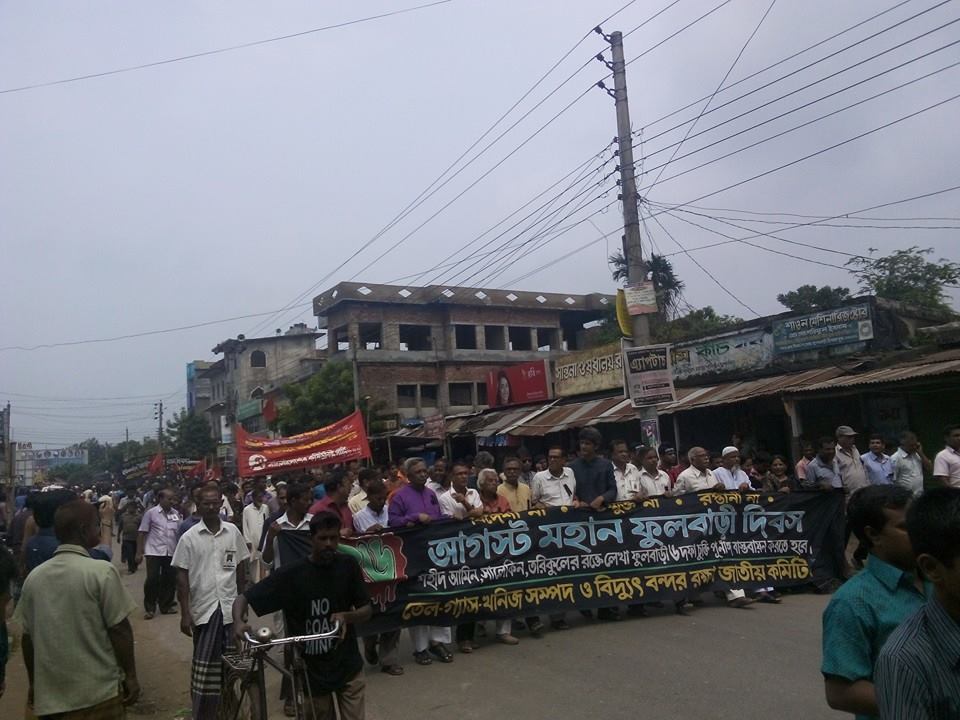


 Phulbari Solidarity Blog
You must be logged in to post a comment.