Demo raged in London at British coal company GCM

  • Noise-Demo, Drumming, Coal Play and Interrogation at GCM’s AGM
  • AGM Disrupted by Protesters’ Interrogation
  • Protesters Demand Arrest of Gary Lye and De-listing of GCM from London AIM

by Raaj Manik, 10 December  2014
Protesters pledge GCM will be de-listed from London AIM soon. Photo: P V Dudman

Protesters pledge GCM will be de-listed from London AIM soon. Photo: Paul V Dudman

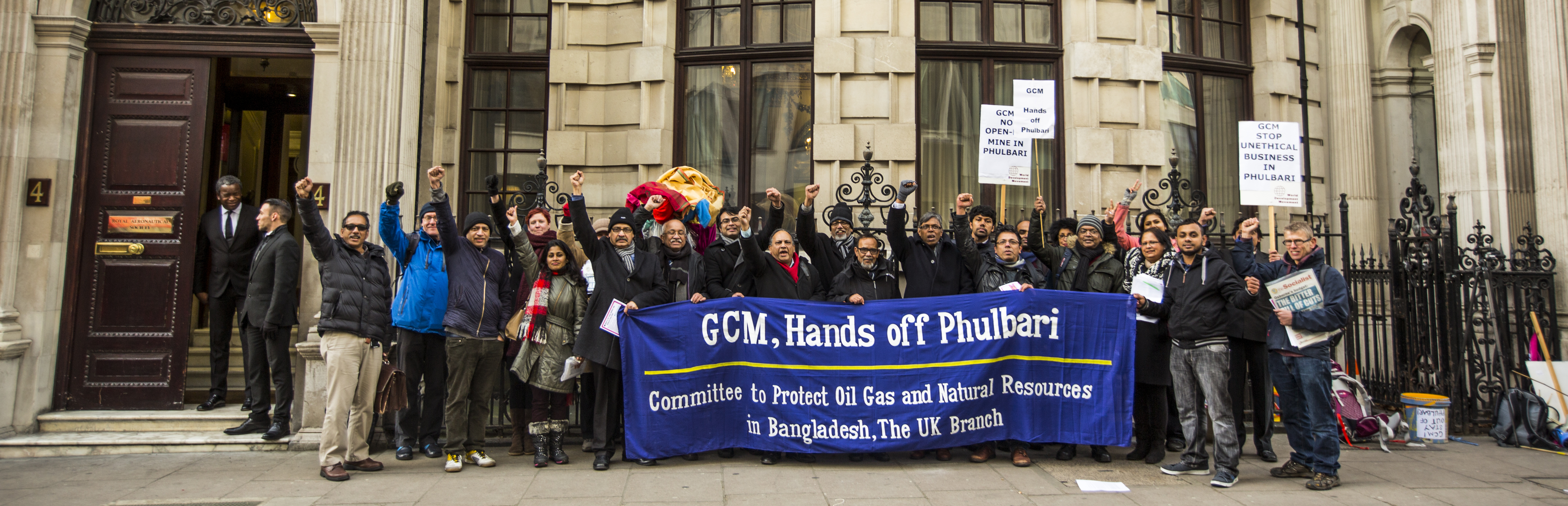
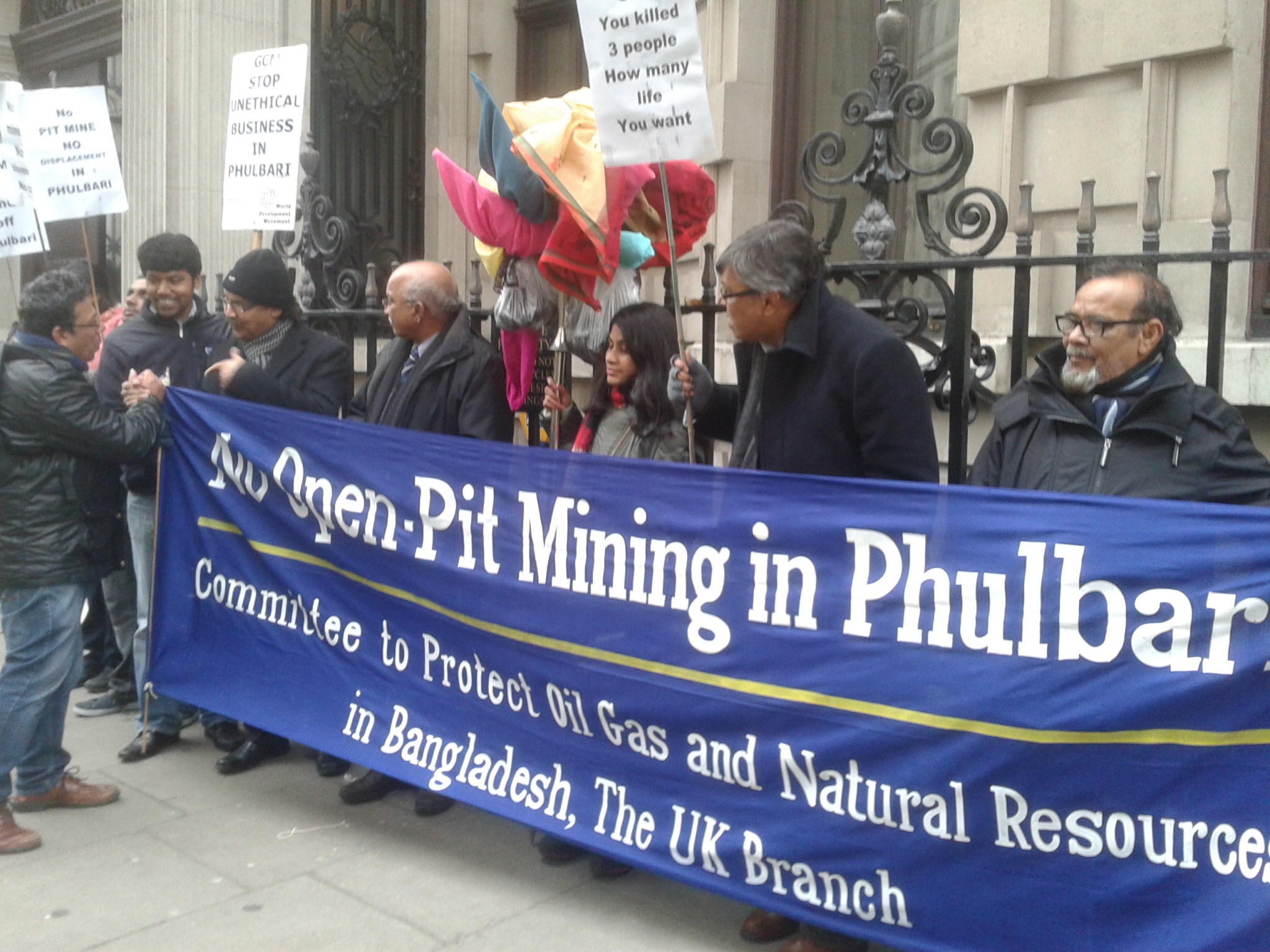
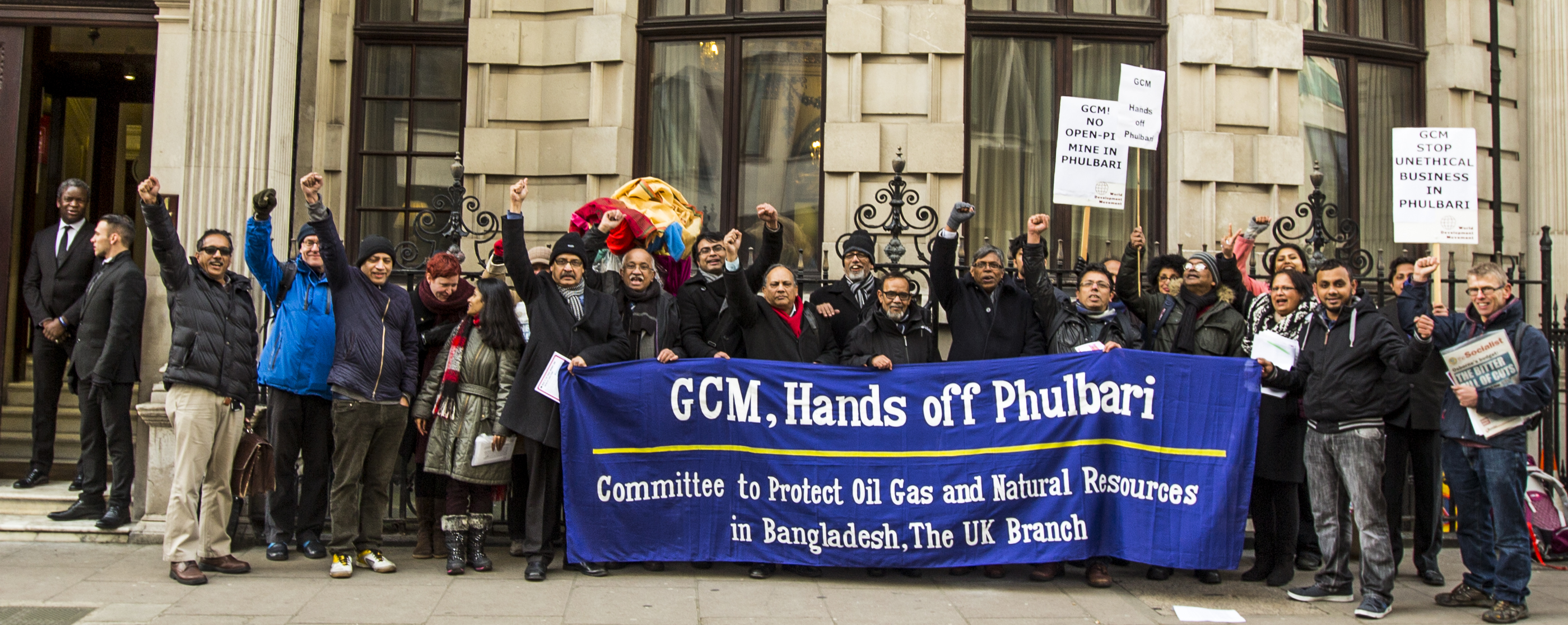
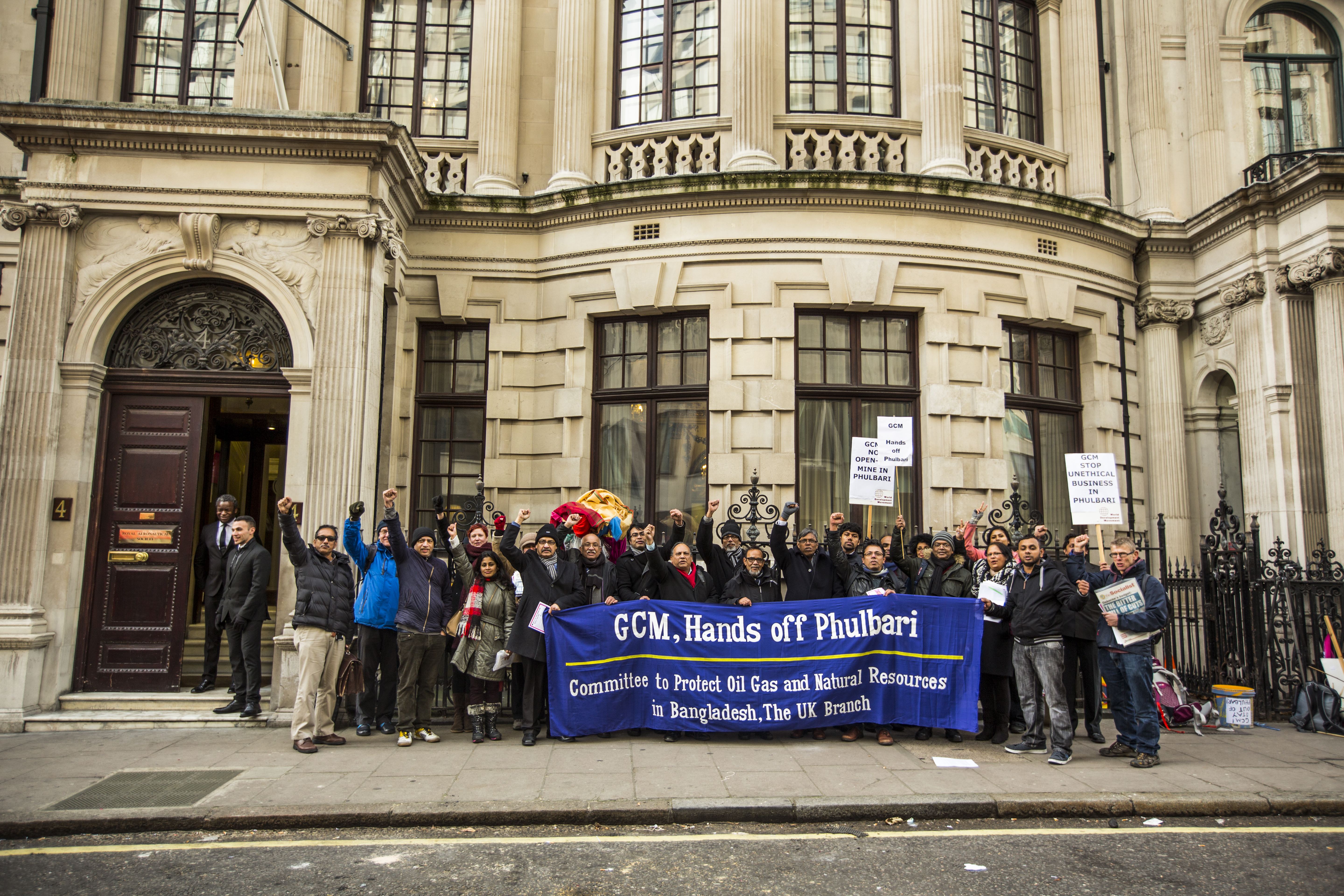
Yesterday, Bangladeshi activists in conjunction with a diverse group of environmental and left political activists in London, heckled the investors of Global Coal Management Resources by their noise demo and coal play. Activists blocked the entrance to the Aeronautical Society by dumping coal in the doorway. They surrounded GCMs’ CEO Gary Lye and his fellows who are aggressively moving ahead to implement a massive open-pit mine in Phulbari, the northwest region of Bangladesh.

At the same time a delegation of protesters disrupted the AGM of GCM by questioning the investors inside the AGM about their fraudulent business in London’s Alternative Share Market (AIM).
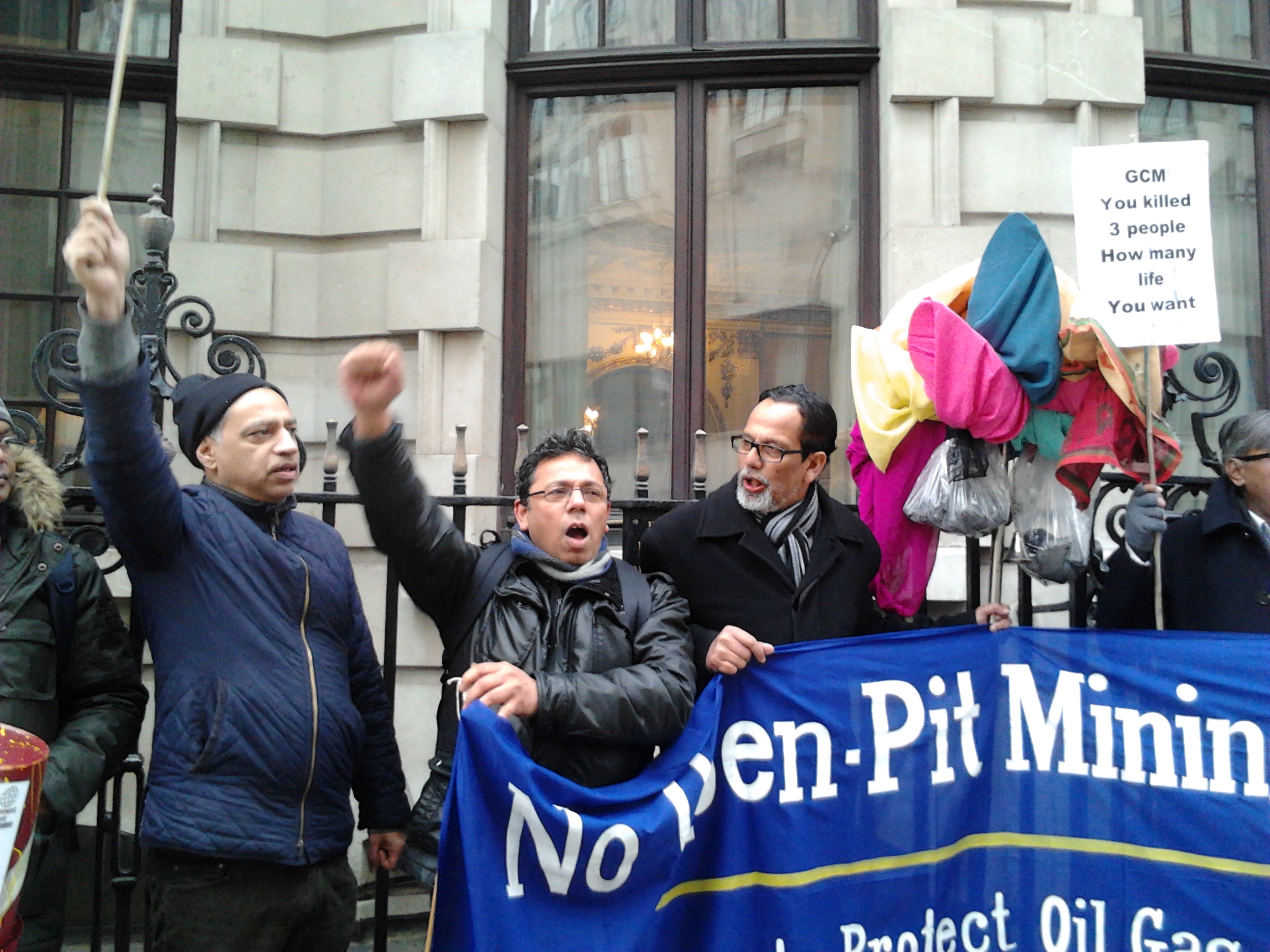
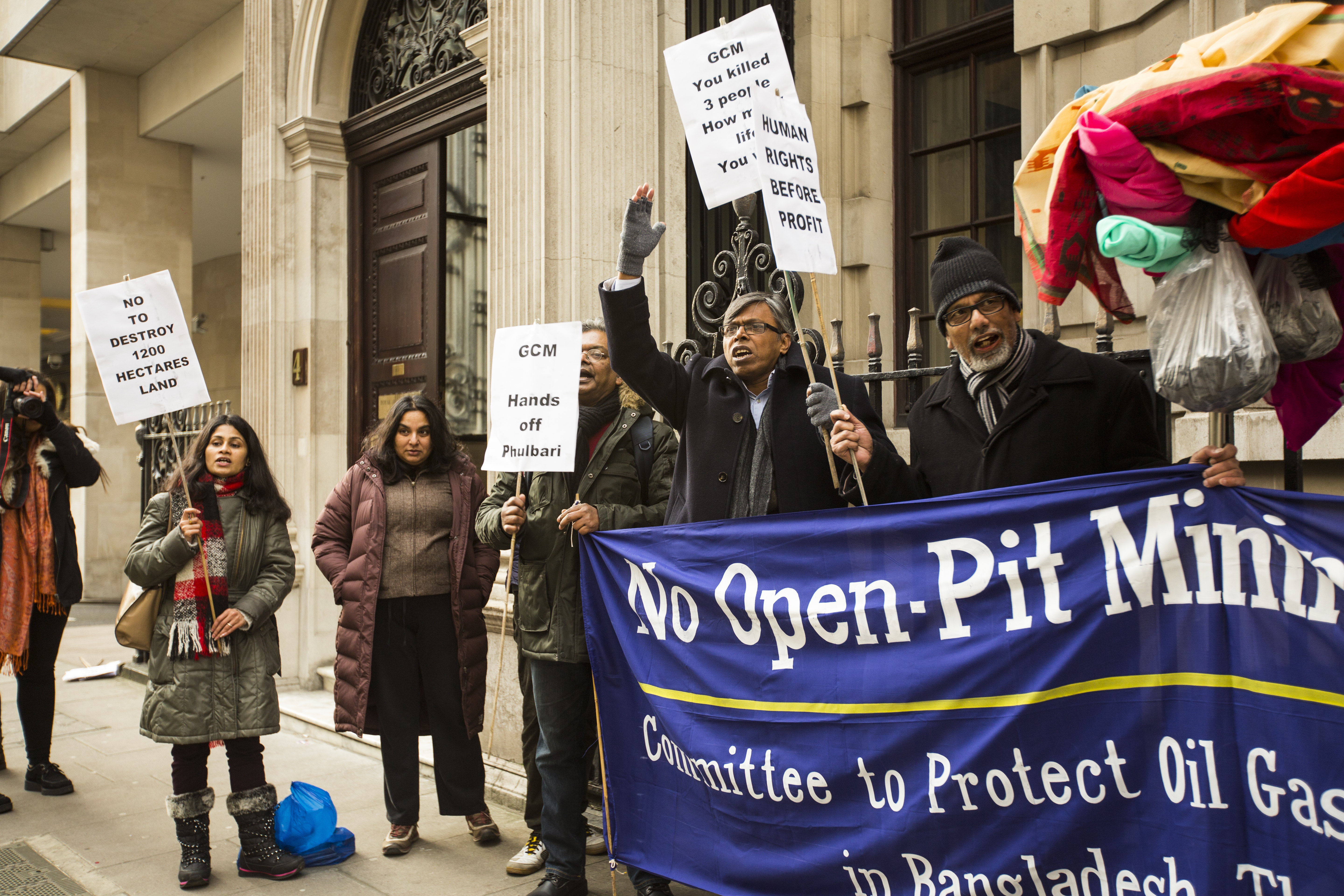
Community activists (from left) of Swadhinota Trust, the UK branch of National Committee and Bangladesh Workers Party (UK branch) chanted slogans defying the company's CEO Gary Lye's pervasive propaganda about the protesters in Phulbari. Photo: P V. Dudman

Community activists (from left) of Swadhinota Trust, Bangladesh Workers Party (UK branch), and the UK branch of National Committee chanted slogans defying the company’s CEO Gary Lye’s pervasive propaganda about the protesters in Phulbari. Photo: Paul V. Dudman

The demo was organised by Phulbari Solidarity Group and the UK branch of the National Committee to Protect Oil- Gas-Mineral Resources and Port-Power in Bangladesh, in conjunction with other community groups and London Mining Network.

The event was endorsed by Socialist Party of England and Wales, World Development Movement, Occupy London, Foil Vedanta, European Action Group of Climate Change in Bangladesh, Trade Unionist and Socialist Coalition, UK, and several community organisations including Nari Diganta, Swadhinota Trust, Udichi Shilpi Gosthi, Jubo Union, Friends of Chatro Union, Bangladesh Workers Party (UK branch), Bangladesh Communist Party (UK branch), and Bangladesh Socialist Party (UK branch).

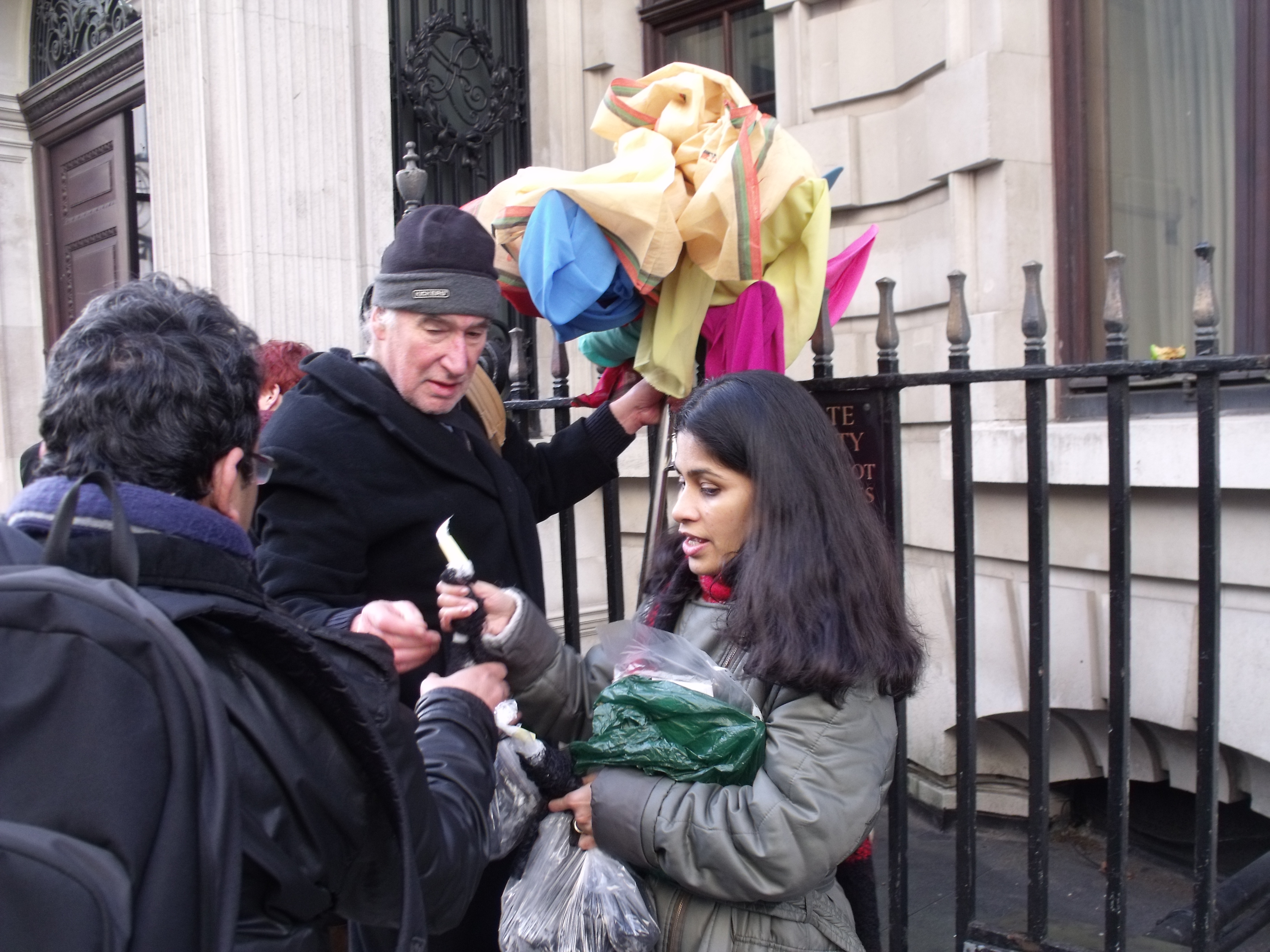
The Sculpture in Tangail and Silk Sari, held three sacks of coals, symbolising the livelihood, culture, struggle, and resistance of Phulbari people. Photo: Stephen Vince

The event kicks in with the launch of artist Stephen Vince’s beautiful sculpture, symbolising the protest against the miners and the livelihood, culture, struggle, and resistance of Phulbari people. The sculpture, wearing a Tangail and Silk Sari, held three sacks of coals to symbolise the significance of the number three and a tribute to the three people who were killed in the dirty coal game of GCM in Phulbari.

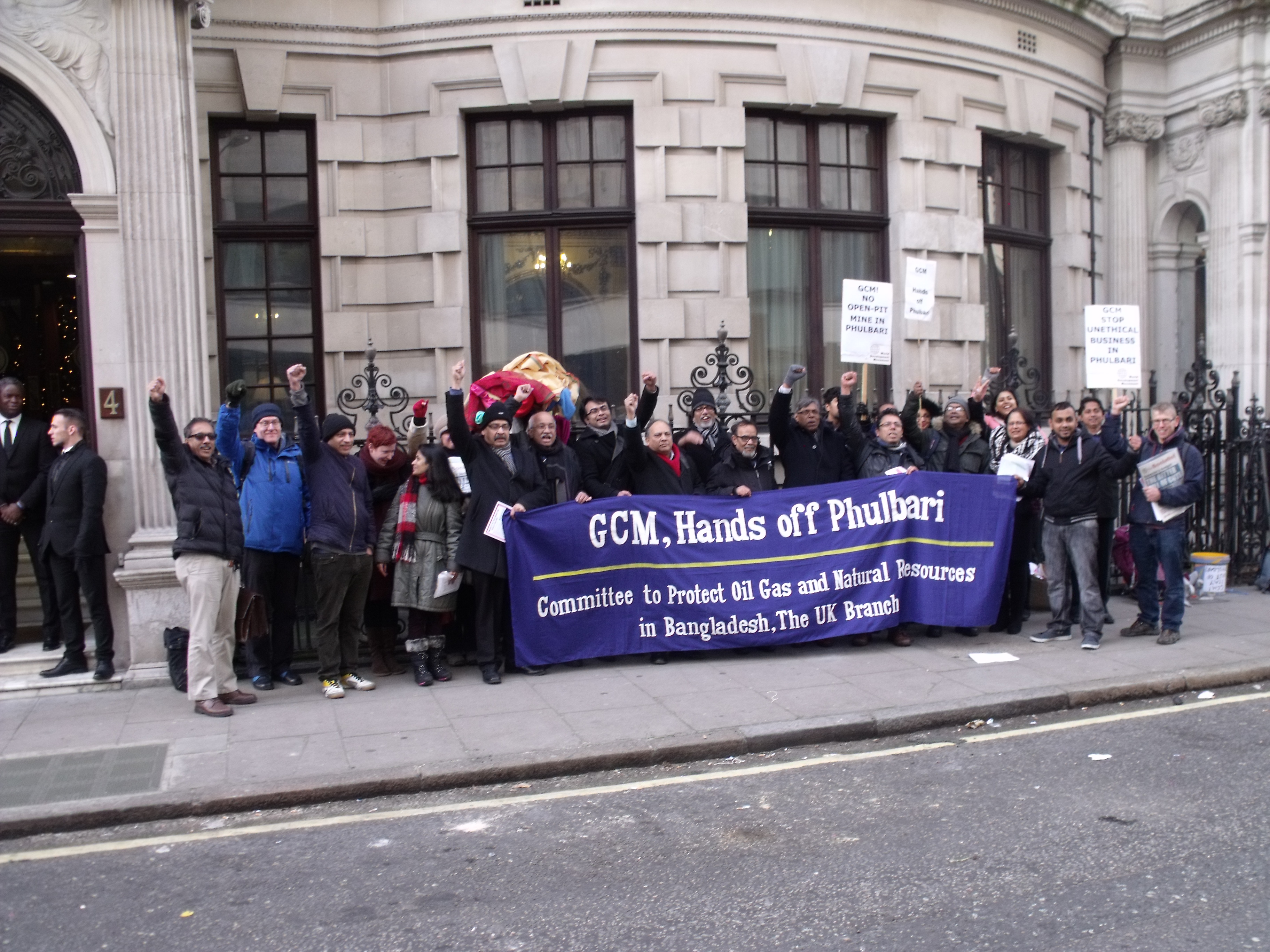
Bangladeshi activists, carrying the sculpture and holding a banner saying – GCM hands off Phulbari, No open pit mine in Bangladesh- started to chant slogans and sing ‘tomar bari amar bari, Phulbari Phulbari’.  Some protesters played drum and samba when Rumana Hashem and Shahriar Ali gave vocals, deriving slogans from Phulbari in Bangla basat vita dhongsho kore koila khoni hobena [destroying homes and land, no mine no mine]. Others attempted to enter the block calling the investors to come out of AGM and to apologise for their misdeeds and abuse in Bangladesh. Loud protesters were repeatedly warned about potential arrest by the authorities of Aeronautical Society (AS) who did not call police but appeared as racist.

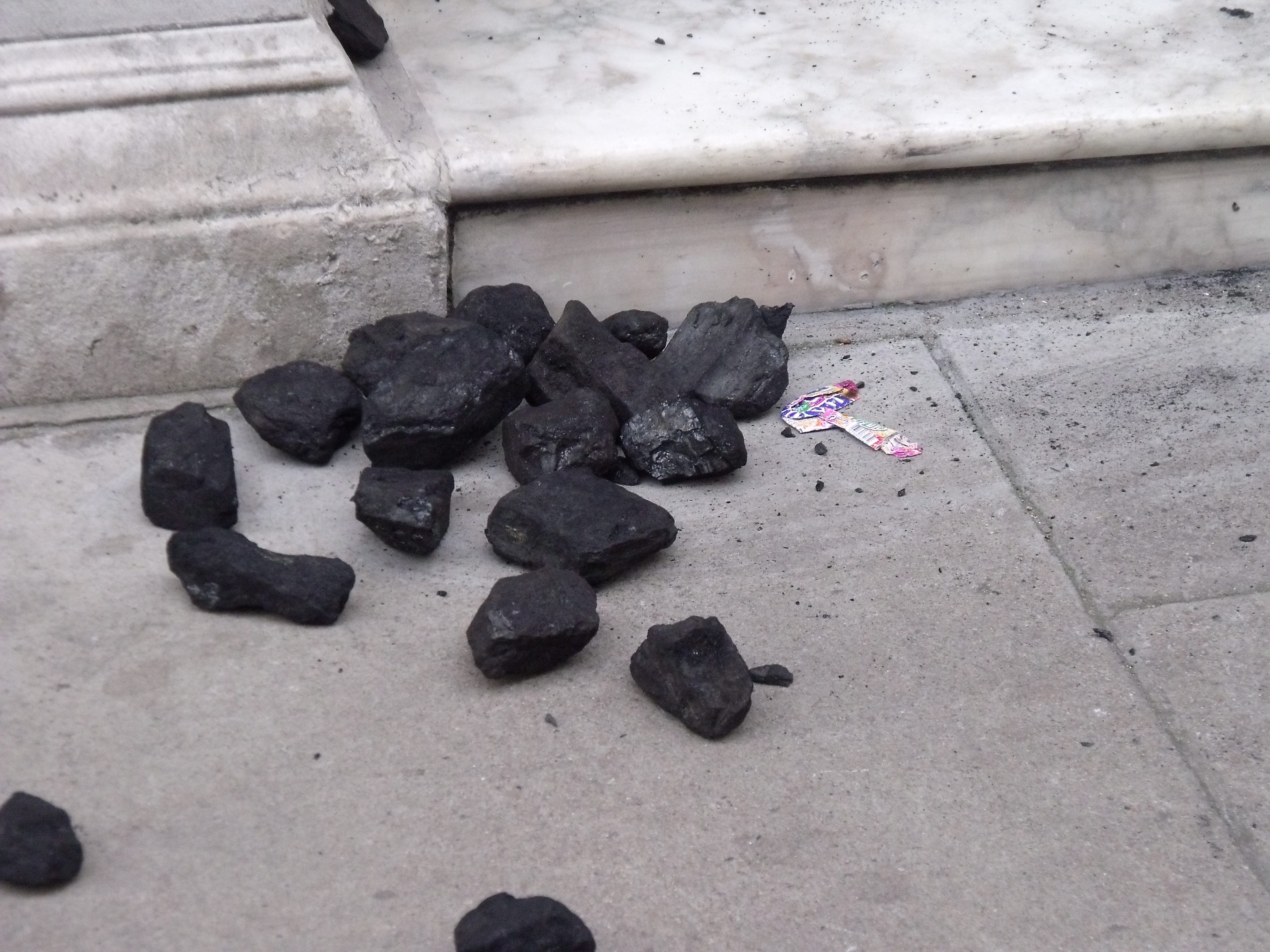
Coal dumped on the front door and stairs of Aeronautical Society. Photo: Ansar Ahmed Ullah

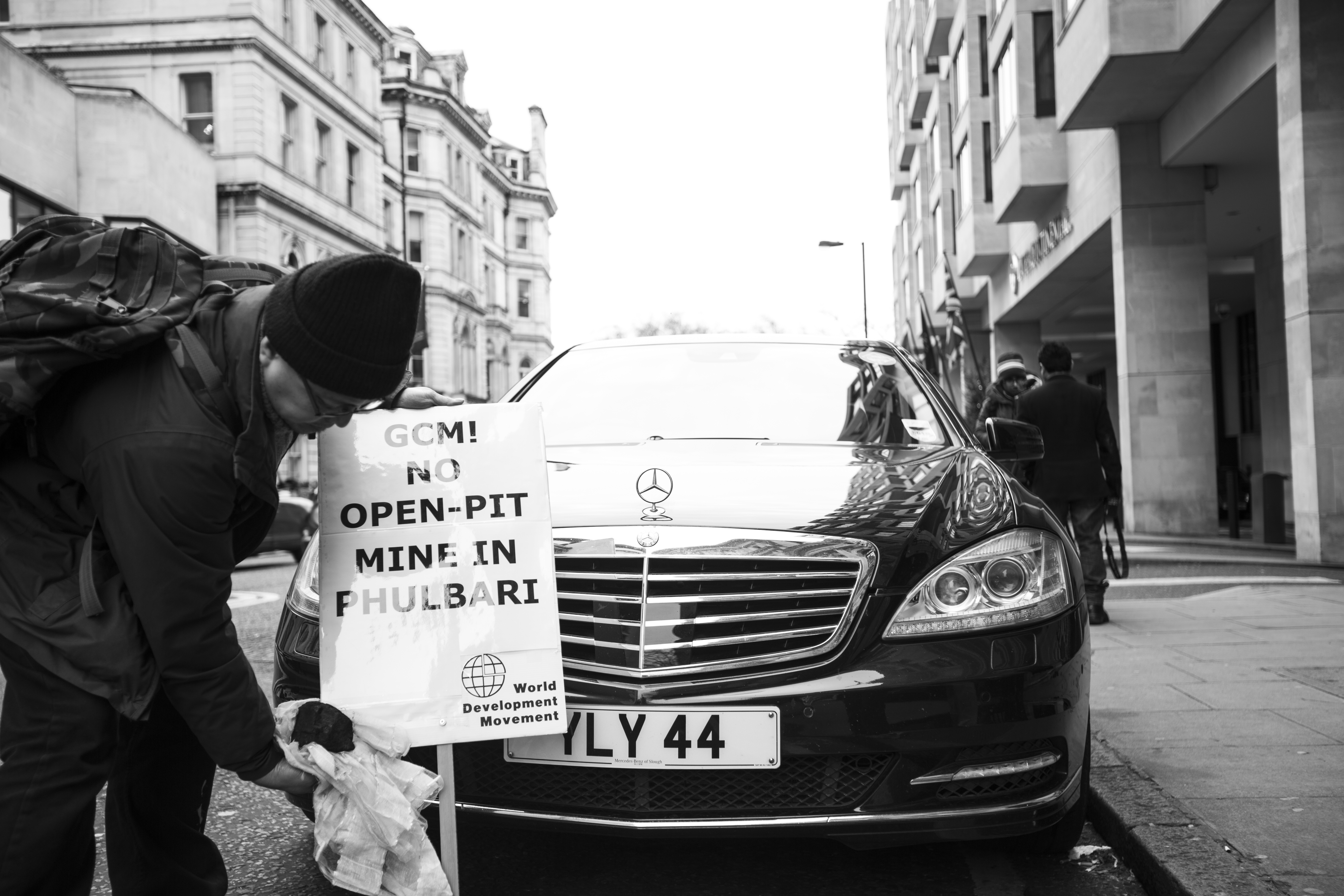
Angry protesters dumped coal on the front door and stairs of AS, as they were prevented from taking out Gary Lye. Protesters said that they would not leave the venue before the interrogation of Gary Lye and his fellows was over. Meanwhile, a group of protesters went to check the investors’ vehicles and took over the car park as part of the blockade against Gary Lye, the company’s manipulative CEO, who was expelled from Phulnari for a 3rd time this year, on 26 November, but still continues to abuse Bangladesh government and Phulbari people.

When protesters outside the AGM were checking investor’s vehicles, a delegation of dissident climate justice activists attending the AGM challenged Gary Lye and the board inside the AGM about GCM’s unethical business in London and abusive activities in Bangladesh. Bangladeshi activists rattled the investors to an extent that the Chair was “fade up” and it was Gary Lye who ended up facing the questions about the paperless contract and propaganda of GCM. Phulbari activists challenged that GCM does not have valid contract with Bangladesh.
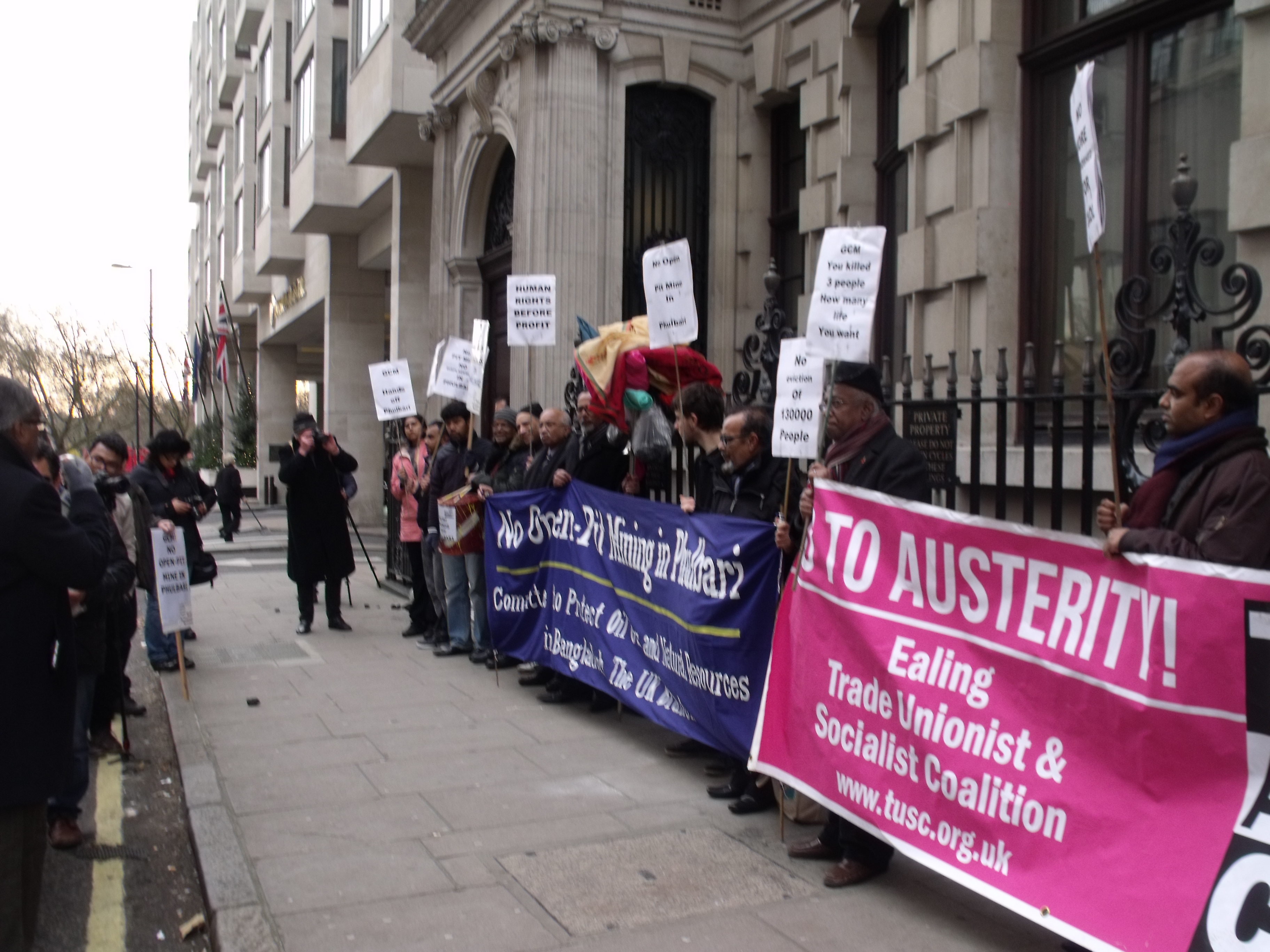
Diverse group of climate activists and protesters holding placards and listening to speeches by community leaders. Photo: Paul V Dudman

Climate activists of World Development Movement and London Mining Network supported Phulbari Solidarity activists, and asked numerous questions about the highly contentious Phulbari project, its huge human rights impacts and the OECD Guidelines as GCM has breached 2011 Guidelines, which do apply to the planned conduct of an enterprise in terms of prospective impacts on human rights. Activists said that ‘the company was illegitimate, the project illegitimate and the annual general meeting of GCM was illegitimate’.

The meeting broke up unceremoniously and the shareholders broken up into two groups.
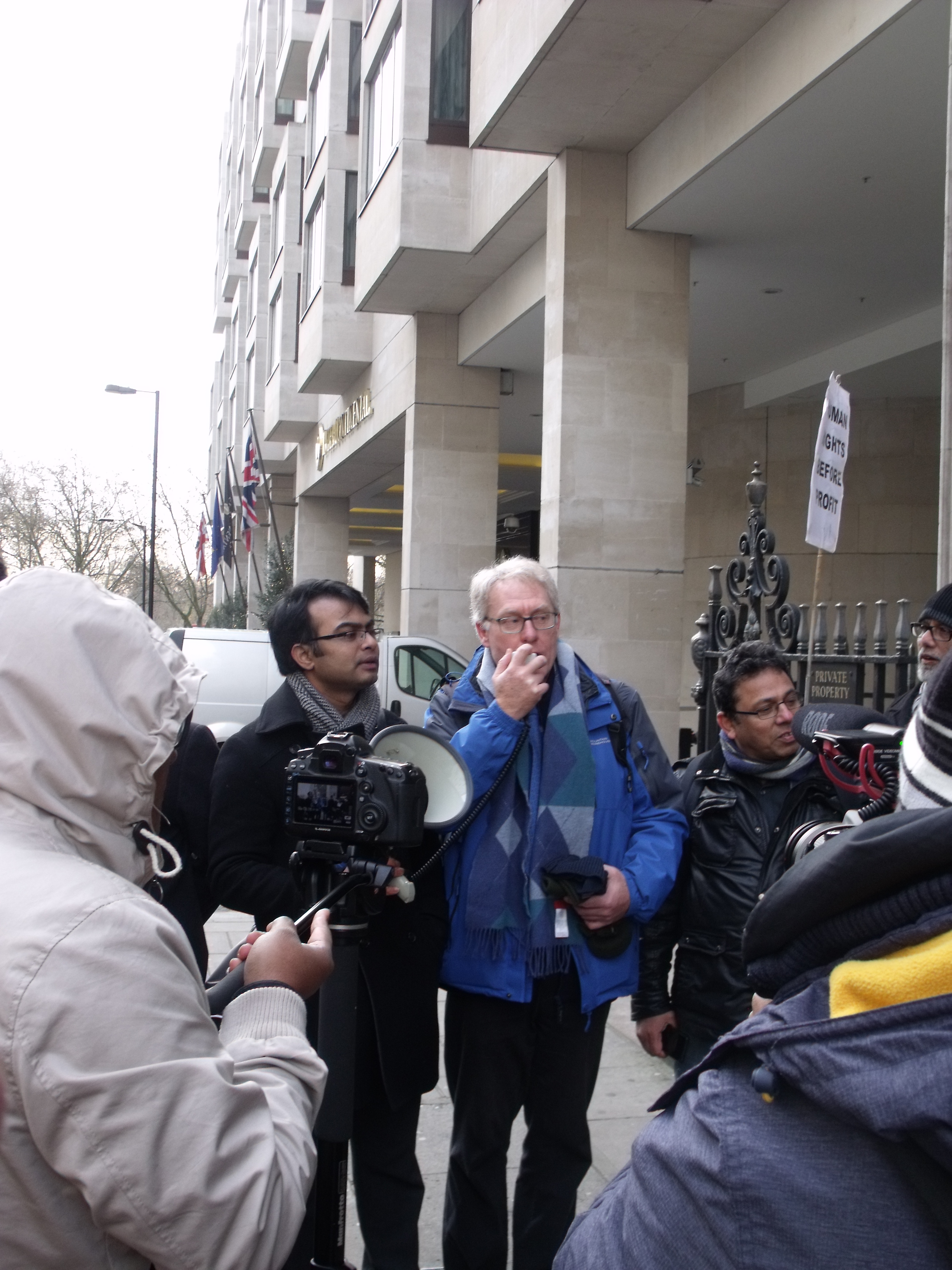
Richard Solly of London Mining Network is briefing the demonstrators about the interrogation inside the AGM and the failure of GCM board to answer the questions of Bangladeshi activists. Photo: P V Dudman

Richard Solly of London Mining Network is briefing the demonstrators about the interrogation inside the AGM and the failure of GCM board to answer the questions of Bangladeshi activists. Photo: P V Dudman

The delegation of climate activists came out of the AGM and joined the protesters outside where Golam Mostofa, Richard Solly, Zahanara Rahman and Sam Sender updated the demonstrators that Gary Lye and his fellows have failed to answer the questions of Bangladeshi activists. ‘They are even lying about national media and the government in Bangladesh’, said Mrs Zahanara.

Protesters chanted slogans ‘Gary Lye is a Lier, Shame on Gary Lye’, GCM and Asia Energy, hushiar sabdhan [be aware of peoples’ power]’. One angry protester attempted to walk into the building with a sack of coal to dump on Gary Lye’s chair, but was prevented from entering the meeting room by the AS’s equally racist authority who received the coal on behalf of the investors.

Speakers in the demo asserted that there is no hope for Asia Energy and GCM in relation to coal business in Bangladesh when the government including the Prime Minister, Energy Minister and Energy Secretary of the country have reaffirmed that Bangladesh will not go for open pit mine in Phulbari. Speakers include  Akhter Sobhan Khan, Abed Ali, Ahmed Zaman, Ansar Ahmed Ullah,  Effie Jordan, Ishak Kajol, Mostofa Farook, Nurul Islam,  Peter Mason, Syed Enam, Shah Enam, Julie Begum, and many more.

The Masters of the event were Shahriar Ali and Rumana Hashem. The event was volunteered by a number of left activists and professional photographers including artist Stephen Vince, Golam Rabbani of Diamond Studios, Nicole Meedrum, Patrick, Chris and many more. The chairperson of National Committee’s UK branch, Dr Mokhlesur Rahman, thanked everybody for coming along and for taking on important theatrical roles.
D

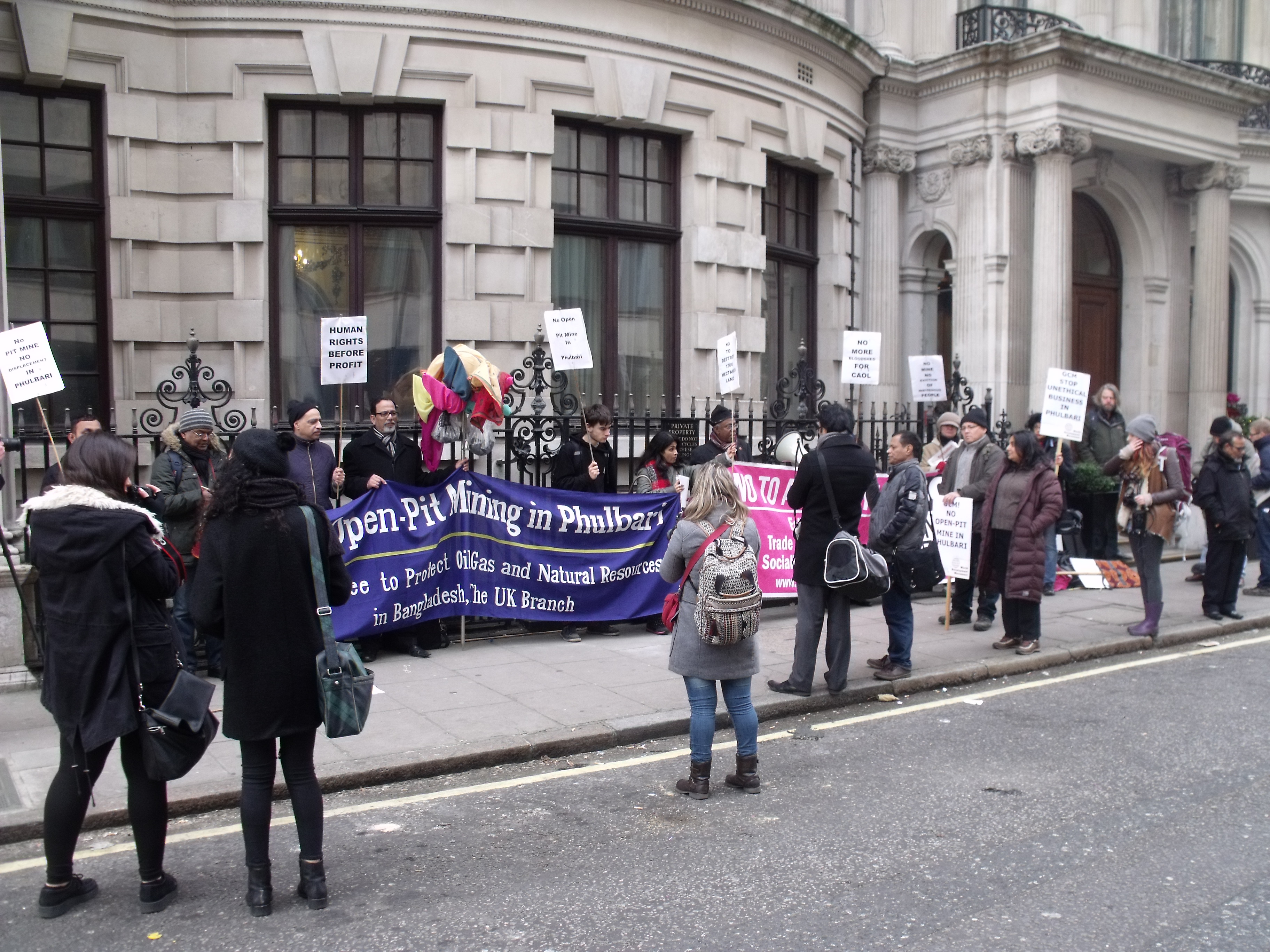
Diverse group of climate activists kept coming and joining the demo which they found extraordinary in London. Photo: Paul V Dudman

The demo ended with a manifesto calling out GCM for an end of GCM’s dodgy deals on Phulbari coal project, and by criticising the UK NCP’s controversial recommendations to the company. The founder and coordinator of Phulbari Solidarity Group, Rumana Hashem, read out the manifesto of the demo and called the London’s AIM to de-list GCM.

The manifesto concludes by expressing full solidarity with the Phulbari people’s struggle and by condemning the UK government for failing to hold the UK-based company accountable.
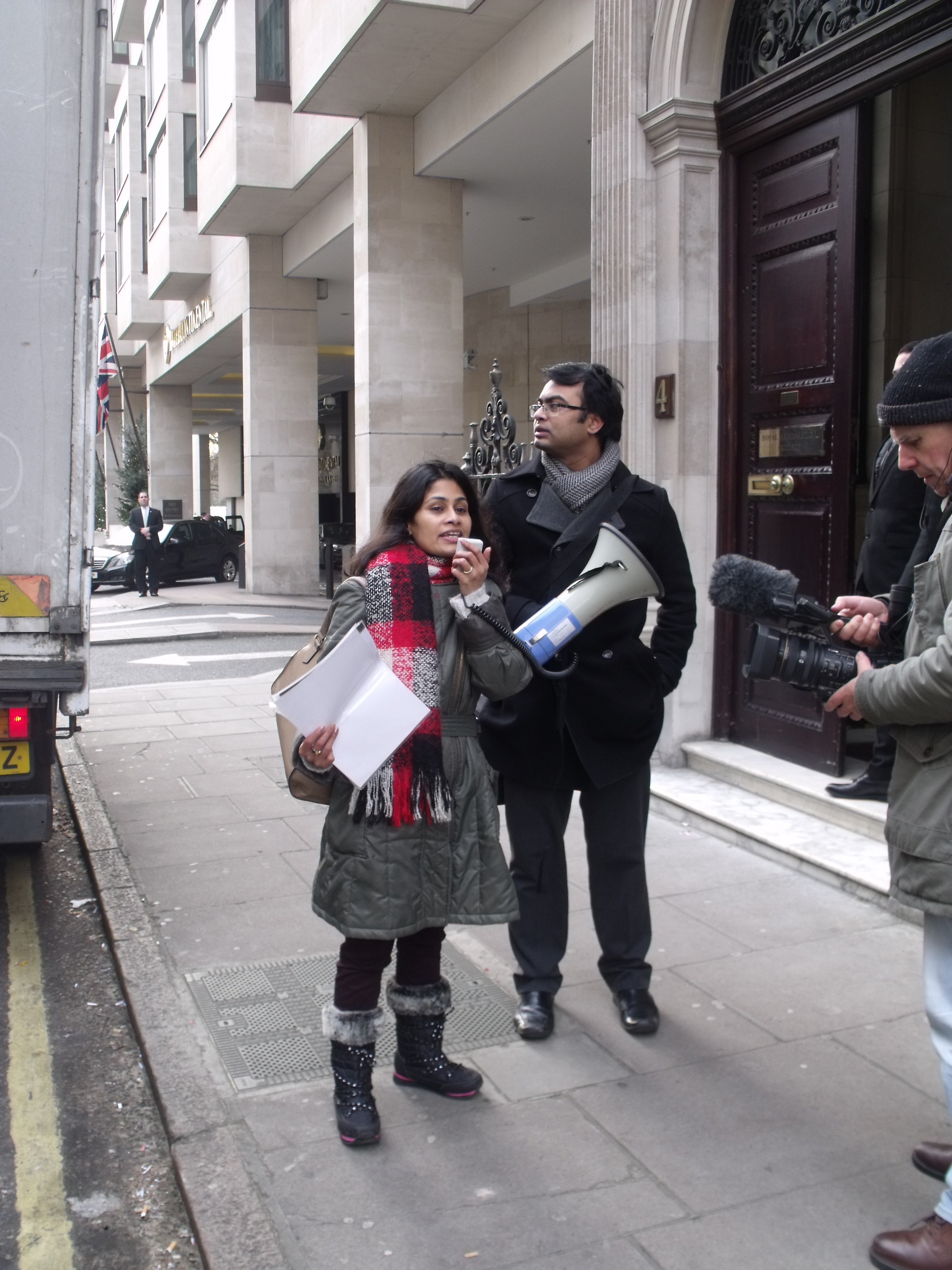
Dr Hashem reads the statement of the demo. Photo: P V Dudman

Dr Rumana Hashem reads out the statement of the demo. Photo: Paul V Dudman

Miners GCM Resources is the subject of a complaint to the Organisation for Co-operation and Development over the controversial coal mine. They have only one active project, the Phulbari coal project, which awaits permission from the Government of Bangladesh to go ahead. But the people in Phulbari want to put the company out of Bangladesh, ban the Phulbari project and to take the company and its investors to public court for their abusive and fraudulent activities.

Phulbari, the town in upheaval in northwest Bangladesh where three people were shot dead during the protest against immense open pit mine in 2006, has become volatile again since, the Chief Executive Officer (CEO) of the AIM-listed British company, Gary N Lye, attempted to conduct consultation with locals in the town centre. There were two days long blockade in Dinajpur-Dhaka highway, and over a thousand people braved cold to raise their protest at Gary Lye’s visit last month.
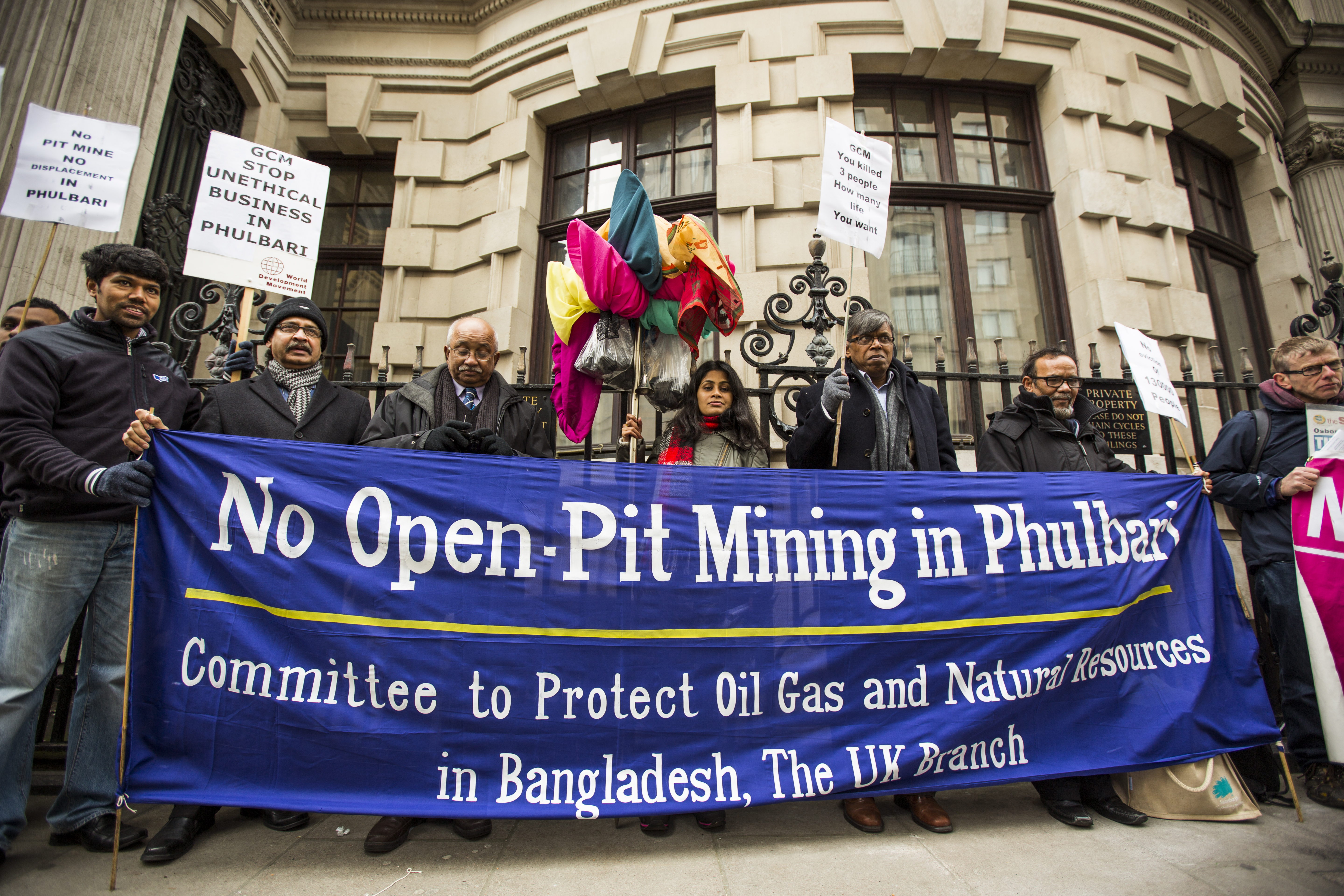
Phulbari demo and protest in London ends with a pledge that there will be no mine in Phulbari. Photo: Paul V Dudman

On 26 November, locals in Phulbari surrounded Lye and GCM’s Bangladesh subsidiary Asia Energy‘s local office, and the CEO had to leave Phulbari and Dinajpur in police protection. Violent protests erupted where 2 were injured. Protesters have demanded Gary Lye’s immediate arrest and expulsion from Bangladesh. A month-long programme including nation-wide protests have followed. Protesters will not go back home until their demands are full-filled.

Read also report of LMN about the AGM of GCM here

Watch demo video by Socialist Party of England and Wales  http://youtu.be/pI2_jfGA5wA

Watch News by Channel24 http://youtu.be/srx80GbFQPs

Check out the Photo gallery here

Read also Foil Vedanta report here

Read Campaigners keep up fight to stop Bangladesh coal

More news can be found here on GB News24.com

Read Bangla news about Phulbari demo in London: Prothom Alo news

More news: http://www.m.banglanews24.com/detailnews.php?nid=348121&cid=1018

More Bangla news can be accessed from Protect Resources of Bangladesh

Read News about GCM’s/Gary Lye’s paperless business in Bangladesh here

Read how Asia energy’s day are ending in Bangladesh

News about Bangladesh government’s latest position about Asia Energy/GCM

News about volatile Phulbari can be accessed here

Surround GCM! Surround the Dirty Coal Miners!

Manifesto of the Demo against the Dirty Coal Miners of Asia Energy/GCM 2014

Tuesday, 9 December, 2014. London

DSCF7379 DSCF7384
Today we, the activists from Bangladesh,  East London, the Borough of Tower Hamlets, and London’s environmental organisations, have gathered to call upon the AIM-listed London-based multinational company, GCM Resources Plc, to end its unethical business. The company, GCM Resources, is desperately moving to implement an immense open pit coal mine in northwest Bangladesh, forcibly displacing an estimated 130, 000 people and destroying the homes, lands, and water sources of as many as 220,000 people. If the project is implemented, it will destroy over 14,660 acres of fertile agricultural land that produce three food crops annually, threatening to increase hunger in a country in which over a third of all children and nearly 17 percent of the entire population are undernourished.

GCM’s planned Phulbari coal mine has provoked repeated protests by local people. Three people were killed and over 200 injured when paramilitary officers opened fire on a protest against the project in August 2006. Protests in 2013 forced the company’s CEO, Gary Lye, to abandon a visit to the area.


The project has generated grave concern at national and international levels including the United Nations. On 28 February, 2012, seven UN human rights experts have called for an immediate halt to the project, citing threats to fundamental human rights, including the rights to water, food, adequate housing, freedom from extreme poverty and the rights of indigenous peoples. But GCM is aggressively moving ahead to implement this project.They are selling fraudulent shares in London’s Alternative Investors Market (AIM) without any valid contract with Bangladesh Government.


The situation in Phulbari has become tense and volatile again since Tuesday the 25th November, when the company’s Chief Executive Officer (CEO), Gary N Lye, attempted to visit Phulbari. Gary Lye is the man who called the protesters outsiders in 2006, and commented, after the death of three people shot by police at a demonstration, that “I am a businessman, [ …] I will continue my business in Phulbari’ regardless of whether there was a bloodshed or not. Therefore, people in Phulbari braved cold to raise their protest at Gary Lye’s attempted visit. Over a thousand people blocked the Dinajpur-Dhaka highway for five hours, demanding Lye’s arrest and expulsion from Bangladesh. In Phulbari there were two days long protests outside GCM’s Bangladesh subsidiary Asia Energy’s local office. Violent protests erupted where 2 were injured.


On Wednesday, 26 November, the company’s CEO, Gary Lye, attempted to conduct consultation with locals in Phulbari following advice of the UK government which was released on Thursday, 20 November. The UK government’s statement follows an investigation into GCM’s activities in Phulbari, and it concluded that the company had breached the OECD Guidelines on Multinational Enterprises by failing to “foster confidence and mutual trust” with the people who would be affected by the mine. We welcome the Board’s affirmation that the 2011 Guidelines on human rights do apply to the planned conduct of an enterprise and its prospective impacts on human rights (para 6).  We welcome also the finding that the 2011 Guidelines would apply if GCM “continued to be “actively involved in the project” (para 19).

 
But we are hurt by the ambiguous conclusion of the investigation. The investigation does not ask the company to pull off from the devastating project. Its recommendations are reduced to re-evaluation of the risks and impact. It asked the company to foster communication with the locals following a narrow approach. The final-published investigation failed to consider how the mine would affect the people of Phulbari if it were built, and its conclusions were limited to GCM’s record in the planning phase of the project to date. Although an internal review of the investigation affirmed that the OECD guidelines do apply to human rights abuses that would occur if the project went ahead, the final report failed to address the concerns of the internal review and did not correct the decision to exclude all potential impacts of the project from the investigation. We condemn the UK government for failing to hold their businessmen to account. We condemn the UK National Contact Point for failing to cite the extremely important first-hand accounts from Phulbari. We believe that it is the chair of the NCP, Liz Napier, who played a dirty game in this whole OECD investigation.


Liz Napier and her team at the Department for Business, Innovation and Skills have overlooked many of our first-hand accounts, allowing the dirty coal miners of GCM Resources, Gary Lye, to go back to Phulbari for an unexpected re-evaluation of the situation. The visit of dirty miner, Gary Lye, has sparked protests leading to fresh violence in one of Bangladesh’s most peaceful town, Phulbari. We demand that Liz Napier and her team at UK National Contact Point must take the responsibility for the recent turmoil in Phulbari. We call for a suspension of Liz Napier from her current post at UK’s Department for Business, Innovation and Skills.


The OECD investigation followed a complaint submitted by the World Development Movement and International Accountability Project. We appreciate the initiative of International Accountability Project and World Development Movement (thereafter Global Justice Now) in support of the people in Phulbari. Although the UK government has failed to hold this UK-based company to account, it is clear that the people of Phulbari will resist GCM’s project going ahead. Phulbari people have made it clear by declaring their month long programme in demand of GCM’s CEO’s arrest and expulsion from Bangladesh. We extend our full solidarity to the people in Phulbari.


We will continue to call upon the London AIM to delist the dirty miners, GCM Resources, from London’s Alternative Share Market. Our Secretary of Energy and Mineral Resources Division,  Abu Bakar Siddique, reaffirmed that Asia Energy has no valid licence to develop Phulbari coal mine. Miner GCM must stop the propaganda about Phulbari coalmine. Our people do not want to leave their homes and land. Phulbari people will not work in a coal mine. GCM’s propaganda to create 17,000 new jobs in coal mine cannot ensure livelihood for 130,000 people feared to be affected during exploration in open pit method over the next 35 years. We will not let our people to die and our environment to de destroyed by dirty miners of GCM.


The UK Committee (National Committee) to Protect Oil- Gas-Mineral Resources and Port-Power in Bangladesh, in conjunction with Phulbari Solidarity Group, London Mining Network, World Development Movement, Foil Vedanta, Socialist Party of England and Wales, Occupy London, European Action Group of Climate Change in Bangladesh, the Trade Unionist and Socialist Coalition in UK and all our co-worker organisations, will continue to call for the company to be de-listed from the London Alternative Investors Market. We declare, on behalf of the people in Phulbari, this UK based company will never go back to Bangladesh. Asia Energy’s Chief Executive Officer, Gary Lye, and investors of GCM Resources were ousted from Phulbari.  They will be resisted and the company will be uprooted from London soon.

_S_L4007 DSCF7409

Let’s Stop the Coal Thieves: Phulbari Demo in London

by Golam Rabbani, 9 December, 2014

In a cold morning on a week day in December, the Bangladeshi community of London in conjunction with a diverse group of environmental and left political activists heckled the investors of Asia Energy (thereafter Global Coal Management Resources) today. In a successful demonstration outside GCM’s Annual General Meeting at London Aeronautical Society, 4 Hamilton Place, W1, London  protesters surrounded GCMs’ CEO, Gary Lye, and his fellows who are doing a fraudulent business in London’s Alternative Share Market (AIM), cheating with people of Bangladesh and UK.

Protesters told that GCM has no contract with the Government of Bangladesh but they are selling illegal shares in the London AIM. Protesters, calling in an end of GCM’s corruption and abusive activities in Bangladesh, demanded the de-listing of GCM from London AIM. They dumped coal at the entrance of the Aeronautical Society, and locked the investors into the building for two and a half hours. A group of demonstrators turned back the investors’ taxis, making the investors to walk.

A delegation of protesters interrogated Gary Lye and his fellows inside the AGM. In the share holder’s meeting Gary was asked by the share holders to present the contract of the Phulbari Project which he was unable to produce. Gary does not have any appropriate answer to justify his position in relation to the impact of open pit mining in Phulbari. Protesters demanded his arrest and expulsion from Bangladesh alongside the de-listing of GCM from London’s Alternative Share Market.

_S_L39262014-12-09 11.56.04_S_L4004_S_L4008Gary Lye's carDSCF7487

Photo Credit: Diamond Studios.

The manifesto of the demo reads that GCM is shamelessly lobbying with a few greedy government officials to get the contract yet they fail to recognise the fact that the people of Phulbari will not give their land, their environment and ecology to dirty coal miners. Local people will ensure that GCM is never going back to Phulbari. They will resist the destructive project of GCM, rather than so called jobs, cash and energy flow.

Protestors have successfully delivered the message to GCM’s dirty coal miners that although Bangladesh is eager for energy,  they will not make the same mistake as the so-called developed world in terms of climate change and environmental degradation. We will ensure that GCM and Gary N Lye’s dirty hands are off the Phulbari coal mine.

Detailed report of the action at GCM’s AGM and the demo outside the AGM will be followed soon.  Meanwhile readers can view photos of our action below.

A photo gallery of the 2014 London Demo Against the dirty coal miners GCM (Photo Credits: Paul Dudman and Julie Begum of Swadhinota Trust):

This slideshow requires JavaScript.

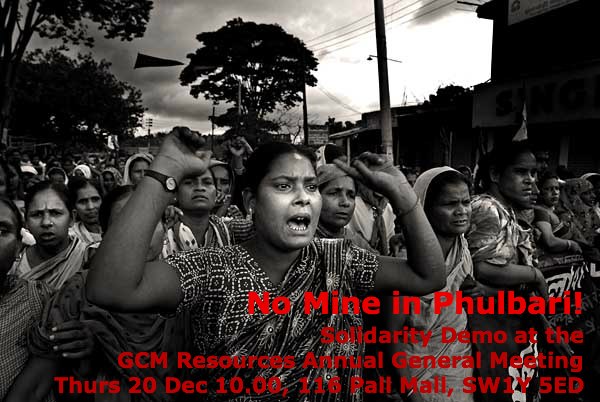
Surround GCM! Surround the Dirty Coal Miners! Flyer for Demo 2014

Surround GCM! Surround the Dirty Coal Miners!

Action to Save Lives and to Halt the Devastating Phulbari Coal Project

Phulbari 2014

Tuesday, 9 December 2014 at 10:30am-12pm

Venue: 4 Hamilton Place, London, W1J 7BQ

An AIM-listed London-based multinational company, GCM Resources Plc, is desperately moving to implement an immense open pit coal mine in northwest Bangladesh, forcibly displacing an estimated 130, 000 people and destroying the homes, lands, and water sources of as many as 220,000 people. If the project is implemented, it will destroy over 14,660 acres of fertile agricultural land that produce three food crops annually, threatening to increase hunger in a country in which nearly half of all people currently live below the nutrition poverty line.

Phulbari Demo Flyer 2014

Download Flyer

Locals have protested the project for seven years by forming powerful human chains and rallies. On 26 August 2006, three people were killed and over 200 injured when paramilitary troops fired on a massive protest of some 80,000 demonstrators in Phulbari. But people in Phulbari are determined to resist this project and to stop GCM Resources plc. The potential for violence has remained high in this project ever since August 2006. Last year the situation sparked by the CEO’s planned visit to Phulbari. People in Phulbari have given verdict against this project. We have served two eviction notices to the company. On 28 February, 2012, seven Special Rapporteurs of the United Nations issued a joint UN press release, calling for an immediate halt to the project on the grounds that it threatens the fundamental human rights of hundreds of thousands of people, including entire villages of indigenous people, and poses “an immediate threat to safety and standards of living.” Still GCM is aggressively moving on to implement this open pit coal mine ignoring the human rights and environmental degradation the project would leave.

We want to teach GCM to keep its hands off Bangladesh. We will surround the corrupted miners this December at their AGM. Will you join us in surrounding the dirty coal miners? Will you tell GCM to leave this project?

For further information contact akhtersk@gmail.com or phulbarisolidaritygroup@gmail.com. Visit https://phulbarisolidaritygroup.wordpress.com/, http://protectbdresources.org.uk,www.ncbd.org

Download PDF of Flyer.
—————————————————————————————————————————-
The UK branch of the National Committee to Protect Oil-Gas Mineral Resources and Port-Power in Bangladesh.

UK urges GCM Resources to assess human rights impact of Bangladesh coal mine

Today, Thursday, 20th Nov 2014, the UK government has urged British company GCM Resources to assess how its planned coal mine in Bangladesh would affect the human rights of local people, and has condemned the company for breaching international guidelines on ethical corporate behaviour. Its findings, released today, state that the project “has aroused considerable opposition in Bangladesh, leading to violent protests, and an even more violent response by the authorities there.”

The UK government statement follows an investigation into GCM’s activities in the Phulbari region of north-west Bangladesh, where it wants to open a massive open-pit coal mine. The investigation concluded that the company had breached the OECD Guidelines on Multinational Enterprises by failing to “foster confidence and mutual trust” with the people who would be affected by the mine.

The investigation failed to consider how the mine would affect the people of Phulbari if it were built, and its conclusions were limited to GCM’s record in the planning phase of the project to date. An internal review of the investigation affirmed that the OECD guidelines do apply to human rights abuses that would occur if the project went ahead. However, the final report failed to address the concrens of the internal review and did not correct the decision to exclude all potential impacts of the project from the investigation.

The investigation followed a complaint submitted by the World Development Movement and International Accountability Project.

Christine Haigh, campaigner at the World Development Movement, said:
“The UK government’s investigation is right in pointing to the company’s failures to date. But by omitting to consider the inevitable effects this mine would have on the region’s population, the investigation does little to ensure that their rights are protected. If it goes ahead, the Phulbari coal mine will be a human rights disaster. Local people have repeatedly made it clear that they don’t want it and GCM should expect continued resistance if it pushes ahead against their wishes.”

 
Kate Hoshour from International Accountability Project said:
“There are grave concerns about the high risk of further violence in Phulbari if GCM persists in its efforts to force this project forward despite massive local opposition. The UK government should be taking all possible action to avert further harm, rather than restricting its assessment to harm that has already been inflicted. The government should also recognize and condemn the ongoing violation of the rights to self-determination and to free, prior, and informed consent for indigenous peoples who have been fighting to halt this project since 2006.”

Rumana Hashem, co-ordinator of Phulbari Solidarity Group and an eye witness to the protests against the project where three people were killed in 2006, said:
“It is good that the UK NCP has recognised the considerable opposition to this project in Bangladesh. But the investigators simply failed to highlight the concerns for human rights violations and the severity of the issues. I have seen how local people died protesting about how the project would rob them of their homes and land, and how the locals have resisted the project so far. I am appalled that after receiving several first-hand accounts from Phulbari, the UK government has reduced its recommendations to this narrow framework.”

Locals cried out to save their homes, lands and lives in Phulbari following the shooting by GCM-provoked shooting by Bangladesh paramilitary. Photo: 27 August 2006

Locals cried out to save their homes, lands and lives in Phulbari following the shooting by GCM-provoked Bangladesh paramilitary. Photo: 27 August 2006

She added: “This report is contradictory. The internal review of the investigation affirmed that the OECD guidelines apply to human rights abuses that would occur if the project went ahead but the final report failed to advise their company to stay away from this devastating project. Despite the failure of the UK government to hold this UK-based company to account, it is clear that the people of Phulbari will resist GCM’s project going ahead.”

GCM’s planned Phulbari coal mine has provoked repeated protests by local people. Three people were killed and many more injured when paramilitary officers opened fire on a protest against the project in 2006. Protests in 2013 forced the company’s then CEO Gary Lye to abandon a visit to the area.

The mine would force up to 220,000 people from their land, destroying their homes and livelihoods, and would threaten the Sundarbans – one of the world’s largest remaining mangrove forests and a UNESCO World Heritage site.

The UK government states that GCM must take into account the UN Declaration on the Rights of Indigenous Peoples, which stipulates that no developments can take place on indigenous peoples’ land without their ‘free, prior and informed consent’. Bangladesh’s National Indigenous Union says the mine would displace or impoverish 50,000 indigenous people from 23 villages.

Seven UN human rights experts have called for an immediate halt to the project, citing threats to fundamental human rights, including the rights to water, food, adequate housing, freedom from extreme poverty and the rights of indigenous peoples.
The original complaint submitted by International Accountability Porject and the World Development Movement

UK NCP final statement: complaint from IAP and WDM against GCM Resources Plc in Bangladesh

Find the press release by World Development Movement here

The Daily Star Report here

The Dhaka Tribune’s bias report here


Feasibility study on Barapukuria open-pit mining sent back

The Independent news on Barapukuria reproduced below  by Raaj Manik

Wednesday, 19 November 2014

Author / Source: SHAHNAJ BEGUM

E-mail Print PDF

The authorities of the Barapukuria Coal Mine Company (BCMC) have rejected the feasibility study report of the Institute of Water Modelling (IWM) on open-pit mining at Barapukuria North, as it did not match the study’s “terms of reference (TOR)”. “The study did not reflect the impact of open-pit mining on the groundwater level as a result of dewatering, irrigation and supply of drinking and industrial water. We need a further detailed report,” a senior IWM official told The Independent on Monday.
With the aim of opening up the northern part of the Barapukuria coalfield on a “small scale”, the energy ministry had launched the initiative 10 years ago. To endorse the plan, it formed different committees and completed two studies, but failed to reach any conclusion. In its third attempt, it engaged the IWM to complete water modelling to preclude any controversy over the method of coal extraction.
“This study is not enough to assess the impact of open-pit mining as it is a highly technical issue. Once again, we want to complete a geo-technical feasibility study before taking any decision on open-pit mining in this area,” Petrobangla’s former chairman Md. Mosharrof Hossain, who is the coordinator of the government monitoring committee that guided the IWM’s survey, told The Independent.
“We can go in for open-pit mining in the northern part of the Barapukuria coalfield, subject to the technical feasibility study on mining issues and the economic viability of water pumping with respect to biodiversity and ecological
stress on food production and their impact on the gross domestic product (GDP). Otherwise, how can we assess the profit and loss of a project? The study has failed to discuss these aspects,” he added.
According to Petrobangla, it was mentioned in the TOR that the study, covering an area of 2.81 sq. km, would assess the impact on the groundwater level as a result of dewatering, irrigation and supply of drinking and industrial water. It would find out possible remedial measures for underground sustainability through different opinion studies and recommend developing mine water management systems. “But the report did not touch on the irrigation and crop issues of the affected areas, which have a great impact on mine design,” an official said.
Though the IWM report said an area of some 560 sq. km of Barapukuria would be impacted if the government decides to open Barapukuria North for open-pit mining and the water table of the areas would go down from seven metres to more than 30 metres at different points, but to make it operational, it would require de-watering from 400 million cubic metres (mmc) to 232 mmc every year.
“The IWM report gave us some sort of relief, as we found the water flow to be almost half of what we had assumed. But a geo-technical issue is a must. After that, we will start the other related task,” Mosharrof Hossain said.
Bangladesh has five coalfields with around 2.55 billion tonnes of reserves, but has been unable to extract the mineral since a national coal policy has not been finalised yet. The Barapukuria coalfield has reserves of around 389 million tonnes, but only 10 to 12 per cent of this can be extracted with the underground method.
The report said over 90 per cent of the total reserves can be extracted through open-pit mining. Underground mining can produce less than 25 per cent. The northern part has estimated reserves of 135 million tonnes of coal.
“The surface of the Barapukuria
coal seam has started at the level of 118 metres. It gradually grows in depth up to 503 metres,” geologist Dr Mushfiqur Rahman told the Independent.
The report of the experts’ committee said the coal seam deposited 200 metres under the surface would be extracted through the open-pit method. The underground mining method would be chosen for those deposits when that depth is more than 200 metres.

Original version of the report can be accessed here

PDF version can be downloaded here feasibility-study-on-barapukuria-open-pit-mining-sent-back 19 Nov 2014

Struggle and Resistance, NOT Submission

Verdict in London meeting about Corporate Plundering of the Energy and Power Sector in Bangladesh

By Raaj Manik

On a sunny Sunday, the 28th of September 2014, the Bangladeshi community organisers and environmental campaigners have made it explicit once again that Bangladeshis will not tolerate any corporate plundering of the Energy and Power Sector in Bangladesh. In a packed meeting at the Montefiore Centre in East London, an estimated 55 transnational activists and community representatives condemned the plundering of Bangladesh by companies such as the UK based Global Coal Management Resources (GCM), and American multinational energy corporations, namely ConcoPhillips, Chevron, and Occidental.

Key note speaker, Prof Anu Muhammad (from left) and the Chairperson of the UK branch of National Committee. Photo credit:  Paul Dudman

Key note speaker, Prof Anu Muhammad (from left), and the Chairperson of the UK branch of National Committee. Photo credit: Paul Dudman

The event kicked in by a key note speech by a distinguished economist and the secretary of the Committee to Protect Oil Gas and Natural Resources in Bangladesh, Professor Anu Muhammad, who was visiting the UK. In his two-hour presentation, Muhammad explored the illegitimate and corrupted activities of various multinational companies in Bangladesh and discussed how these company-aggressions are causing severe threats to Bangladesh’s environment, people’s livelihood and human rights. He highlighted the aggression of a UK based company, GCM Resources, in particular. Despite huge protests and three deaths, GCM is still pressing ahead with a massive open-cast coal mining operation in Phulbari, the north-west Bangladesh, which will displace up to 200,000 people, destroy over 14,660 acres of agricultural land and devastate the water resources of another 220,000 people. If implemented, 94% of the revenue generated by the planned mine will be taken by GCM, leaving only 6% for the government. ‘It is a daylight robbery’, says Anu Muhammad.

But the ‘spirit of resistance is still very active’, he added. Three activists were killed during a mass movement which forced the government to completely withdraw the entire open-cast coal mining operation in Phulbari in 2006, a promise it appears not to be keeping. People’s powerful resistance has forced the GCM’s chief executive, Gary Lye, to cancel his plans to visit Phulbari last year. Due to the ‘volatile situation prevailed at Dinajpur’s Phulbari’ in Bangladesh, Gary left the area, quickly, with the help of the District Commissioner and local police. There were all-day protests against his visit by locals ‘carrying sticks’ and ‘home-made dusting brushes’.

Audience with Anu Muhammad and leaders of UK branch of National Committee. Photo credit: Socialist Party of England and Wales

Audience with Anu Muhammad and leaders of UK branch of National Committee. Photo credit: Socialist Party of England and Wales

Anu Muhammad says, Bangladesh is a fertile country, rich in water and mineral wealth. In the mid-1990s, the World Bank promoted the privatisation of gas, oil and other natural resources in Bangladesh with the promise that it would bring ‘cheap gas and save huge amounts of money for the public exchequer’. But ‘that is the opposite of the case’,  Muhammad explained. Oil and gas companies like ConcoPhillips and Chevron moved in and now the cost of production is anything from 10 to 30 times more than it was in the hands of Petrobangla, the government-owned national oil company of Bangladesh. Muhammad argued that while it costs 1 billion taka to drill an oil well, the cost in the hands of Unocal Bangladesh, bought by Chevron in 2005, was 15 billion. One energy project estimated at 20 billion taka cost 180 billion.
‘Sustainable power solutions are not possible with these greedy corporations’, the Professor stated. He argues, ‘while renewable energy’ has huge potential and a real future’, the government is not considering those sources under heavy pressure of the multinational companies. Meanwhile 5 billion in US dollars (387 billion Bangladesh taka) is owed by US and Canadian corporations in unpaid compensation for accidents and Chevron effectively pays ‘nothing in tax but claims to be the number one taxpayer’. Every penny Chevron pays in tax is refunded by the government through Petrobangla. Professor Muhammad asked, ‘so who is running the country?’

Anu Muhammad’s speech was followed by 12 speakers and campaigners, each of whom expressed their determination to continue the campaign against corporations’ aggression in Bangladesh. Rumana Hashem, the coordinator of Phulbari Solidarity Group and an eye witness to the killing of three people by Asia Energy (thereafter GCM) in Phulbari in 2006, argued that it is not only the corporations but also the governments in UK promote the ruination of Bangladesh by multinational companies. She said that in 2009 the Joint Committee on Human Rights (JCHR) in UK did not consider her eye witness and evidence of human rights violation in Phulbari by the Global Coal Management. ‘But they did consider the company’s dodgy response to our report’, she added.

Rumana Hashem, the Coordinator  of Phulbari Solidarity Group on 28 Sep 2014 . Photo credit:  Paul Dudman

Rumana Hashem, the Coordinator of Phulbari Solidarity Group on 28 Sep 2014 . Photo credit: Paul Dudman

In their published report the JCHR  initially noted that the report, co-authored by Rumana Hashem and Paul Dudman, was not published in order to save printing cost. Later on, while contacted about the reasons for such financial hardship of the UK Parliament, the clerk of the JCHR changed the tone and told that the information which ‘they have provided were too sensitive in nature’. ‘As though it is not insensible when British company killed our people in Phulbari’, Hashem said in pointing out the politics behind this story. She provided a report on how the UK governments are failing to respond to Bangladeshi and transnational environmentalist campaigners’ call for closing down unethical business of British corporations in Bangladesh. She said, ‘a series of FOI requests, carried out by London Mining Network in 2012 and World Development Movement in 2014, suggest further bias of UK government’. Hashem concluded her speech by calling upon the forum to stand up and to prepare for a ‘tough battle’. She said, ‘we stand for struggle and resistance, not submission’.
The forum responded to her call for struggle and resistance by a big clap. Speakers invited to the meeting included World Development Movement, the Socialist Party (England and Wales), the Communist Party of Britain, and the Socialist and Communist Parties of Bangladesh alongside the Phulbari Solidarity Group who are continuing to advocate and campaign to stop the GCM. Despite brief attempts to drown out the discussion by a group of unruly Bangladeshi government supporters who had taken an adjoining room, speakers and campaigners against multinational company aggression in Bangladesh clearly stated their firm position and declared that they are not going to tolerate ruination of Bangladesh.  Effie Jordan of World Development Movement asserted that WDM will continue to work with the people of Bangladesh and will advocate for a permanent halt of the Phulbari project.

Pete Mason of Socialist Party (Tower Hamlets Borough) expresses solidarity to fight multinational company. Photo credit: Paul Dudman

Pete Mason of Socialist Party (Tower Hamlets Borough) expresses solidarity to fight multinational company. Photo credit: Paul Dudman

Pete Mason of Socialist Party emphasised,  ‘the Socialist Party’s demand for public ownership of the UK energy industry – and this would of course include GCM. In addition, the Socialist Party demands that compensation should only be given to the share owners in cases of genuine need’. He called for an ‘ecologically-minded, democratically drawn up socialist plan of production to end the madness of capitalist exploitation of the planet and the dangerous global warming that has resulted. This would end the profit-motivated depredation of Bangladesh by companies like GCM’.

The invited speakers of the UK branch of the Committee to Protect Oil Gas and Natural Resources in Bangladesh expressed their determination to stop multinational companies’ corrupted activities through their ongoing campaigns. The public meeting was organised by the UK branch of the Committee to Protect Oil Gas and Natural Resources in Bangladesh. The meeting started by a welcome speech by Akhter Sobhan Khan Masroor, the Secretary of the Committee, and ended by a vote of thanks by Mokhlesur Rahman, the Chairperson of the Committee. The event was endorsed by the Phulbari Solidarity Group, London Mining Network, World Development Movement, International Accountability Project (USA), Socialist Party (England and Wales), the Communist Party of Britain,  Jubo Union, Friends of Bangladesh Students Union, and several Bangladeshi community organisations in London.

Farzana Majid of Bangladesh Sector Commander Forum  expresses solidarity to the National Committee's campaign against Corporate Plundering in Bangladesh. Photo credit: Paul Dudman

Farzana Majid of Bangladesh Sector Commander Forum expresses solidarity to the National Committee’s campaign against Corporate Plundering in Bangladesh. Photo credit: Paul Dudman

Communist party of UK leader expresses solidarity. Photo credit: Paul Dudman

Communist party of UK leader expresses solidarity. Photo credit: Paul Dudman

Public meeting on the Plundering of the Energy and Power Sector in Bangladesh by British Corporations

The Committee to Protect Oil-Gas- Mineral Resources in Bangladesh, The UK Branch  invites everyone to join a public meeting with a distinguished economist and environmentalist Professor Anu Muhammad, who comes to London from Bangladesh to meet the activists in London this Sunday.

What: Public meeting on Corporate Plundering of the Energy and Power Sector in Bangladesh

When: Sunday the 28th September, at 5 pm.

Where: Montefiore Centre, Hanbury Street, E1 5HZ , London.

Key note speaker: Professor Anu Muhammad, a distinguished  Economist and the Member Secretary of the National Committee to Protect Oil Gas and Natural Resources in Bangladesh. DSC00357

The meeting has been organised by the  Committee to Protect Oil, Gas and Natural Resources in Bangladesh, The UK Branch. In their call out for defending public resources and environment in Bangladesh the Committee notes that:

Multinational corporation such as the UK’s Global Coal Management Resources Plc (GCM), is aggressively moving to undermine Bangladesh through plundering its energy sector and damaging the environment. Through implementing a massive open pit coal mine in the north-west of Bangladesh, the government-backed British company, the GCM, wants to bring in devastating impact on Bangladesh’s environment and human rights. The proposed Phulbari project alone would displace 200,000 people, destroy over 14,660 acres of fertile agricultural land, obliterate water sources of 220,000 people, and lower the ground water by 15-20 meter in the region. It will also damage social and ecological spheres, pollutants will contaminate water bodies, rivers and the entire lower riparian. Bangladesh will get 6% loyalty and 94% revenue will be taken by GCM!

While the communities in the north-west region in Bangladesh is powerfully resisting the proposed coal-mine project,  the governments in Bangladesh and UK remain silent – encouraging the devastation to go ahead and allowing also to set up a coal fired power plant which would affect the Sundarbans, the world’s largest mangrove forest. The proposed  1320 MW Rampal coal fired power plant is an India-Bangladesh joint venture. Sundarbans is under threat as Rampal power plant will emit huge carbon, toxic gases, smoke and ash which will have devastating environmental impact and may destroy the forest as the project area lies only 10 KM away from the forest. In addition, the Government, encouraged by the corporations, are adding on another power plant proposed by Bangladeshi Business Group, Orion, to set up very close to the vicinity of the Sundarbans. Sunday’s public meeting has been organised to address these issues and to find ways to abolish those harmful and devastating interferences of multinational corporations in Bangladesh.

A devastating gas explosion occurred on 14 June 1997 while oil and gas company Occidental was drilling at Magurchara, northeast Moulovibazar district in Bangladesh. The explosion destroyed about 700 acres of reserved forest and 10 tea gardens, damaged environment, ecology and wildlife around. It is estimated that 250 billion cft gas was destroyed in this accident and its value stands nearly $2.5 billion, which must be recognised by the responsible company. They are yet to acknowledge their responsibilities.

Rather, the  world’s multinational corporations are moving aggressively to destroy Bangladesh. Chevron Bangladesh is asking for tariff hike for offshore oil and gas exploration. ConcoPhillips, an American multinational energy corporation, has also demanded offshore gas exploration contact for 80% of loyalty and export facility. All of these companies make Bangladesh as an object of lottery and a source of their fortune by exploitation and corruption.

These evil deals and production share contract (PSC) are working against Bangladesh’s interest. Instead of fixing irregularities and corruption, the government is expanding the authority of local and foreign companies to control energy and power sector, causing more drainage of public money and vulnerability of the country. We can’t allow plundering and destruction of Bangladesh in such a way. We call for global support to stop the deleterious power plant and open pit coal projects. We need your support and solidarity to strengthen local and global fight against corporate plundering.

Professor Anu Muhammad, a distinguished economist from Bangladesh and a key activist against corporate plundering of energy resources in Bangladesh, will be addressing these and related issues. A public meeting will be held on this Sunday, the 28th September, 2014 at 5pm at Montefiore Centre, Hanbury Street, E1 5HZ , London.

This is an opportunity to hear from Anu Mohammad. He has been fighting against open pit coal mine in Phulbari and Rampal coal based power plant for protecting world largest mangrove forest Sudarban and playing a pioneering role to defend oil gas, natural resources, environment and ecology in Bangladesh.

Phulbari Solidarity Group expresses their full solidarity with the aim of the public meeting organised by the UK Committee to Protect Oil, Gas and Natural Resources in Bangladesh. With solidarity to struggle and resistance we invite everybody to come and share our struggle for equality and social justice. Come and join us along with friends! Feel free to share this invite to all who may support our cause!  Do not let the government-backed corporations to undermine human rights, plunder our resources or damage environment!


For further information visits: http://www.protectbdresources.org.uk/

Contact: nationalcommittee.uk@googlemail.com


Phulbari Day 2014 observed in Phulbari

The translated version of the NCBD press statement

by Samina Luthfa

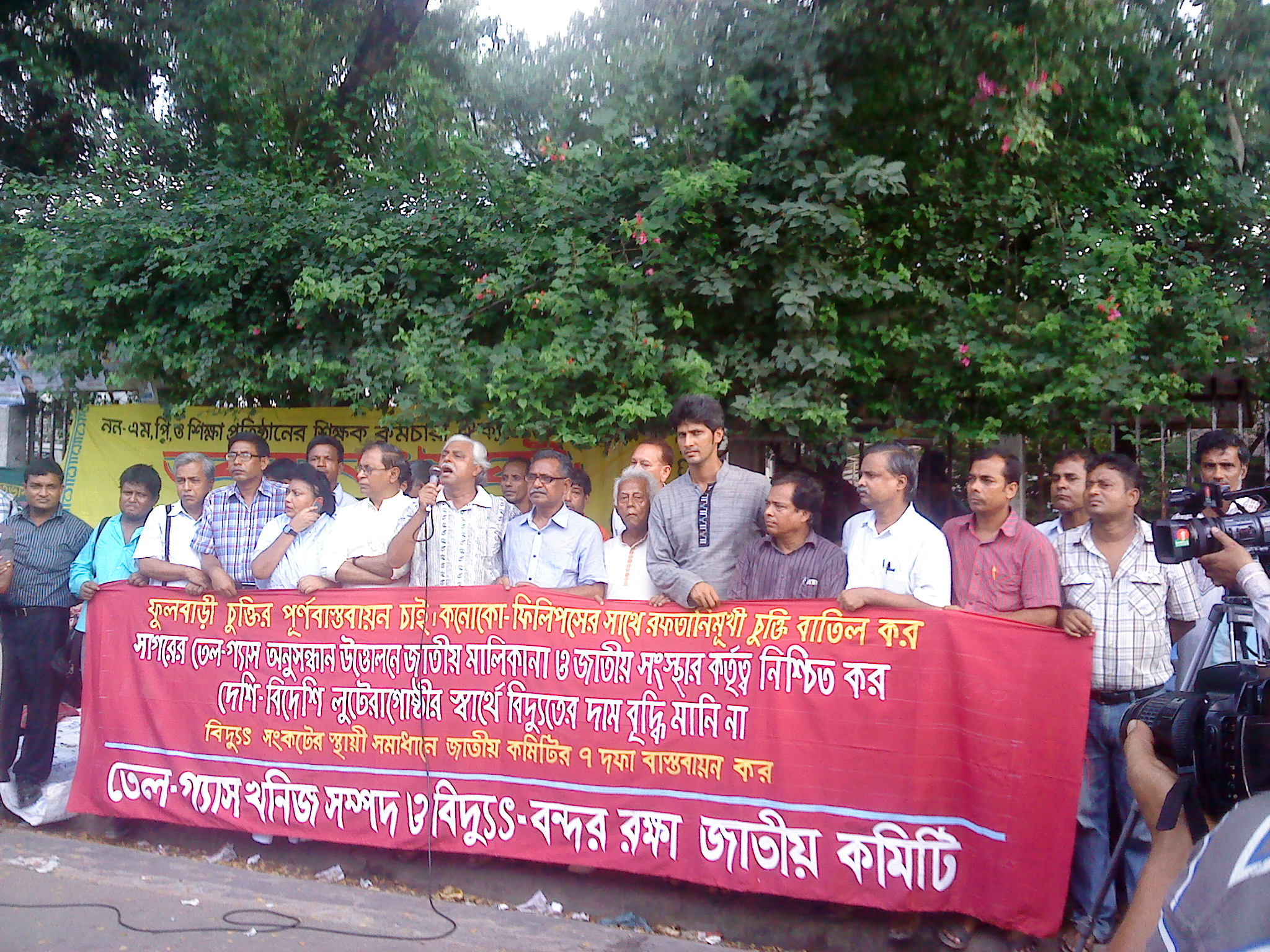
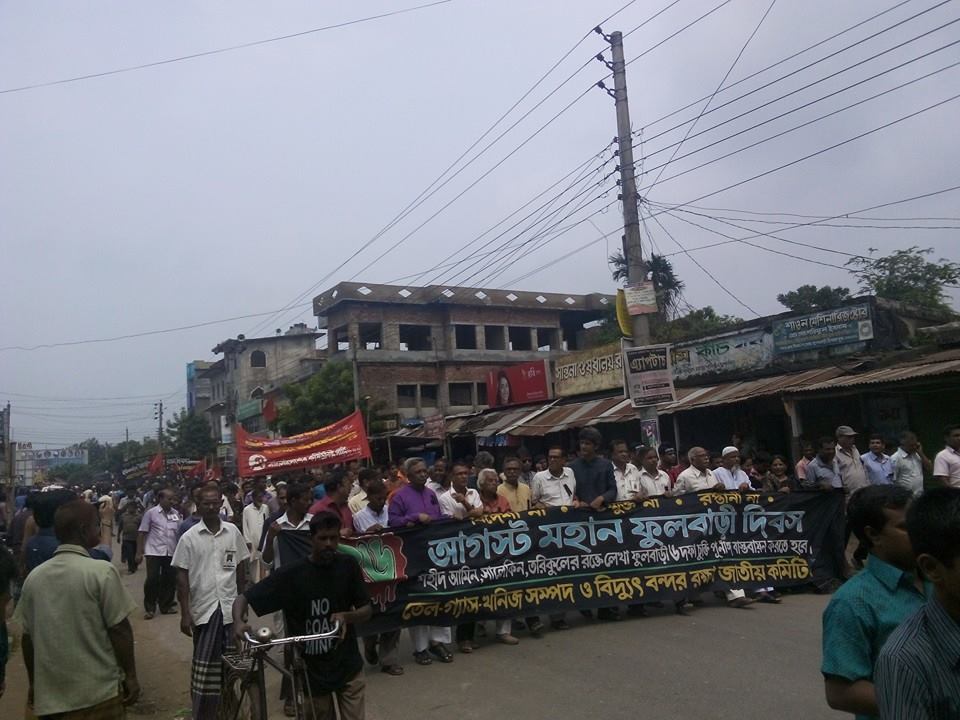
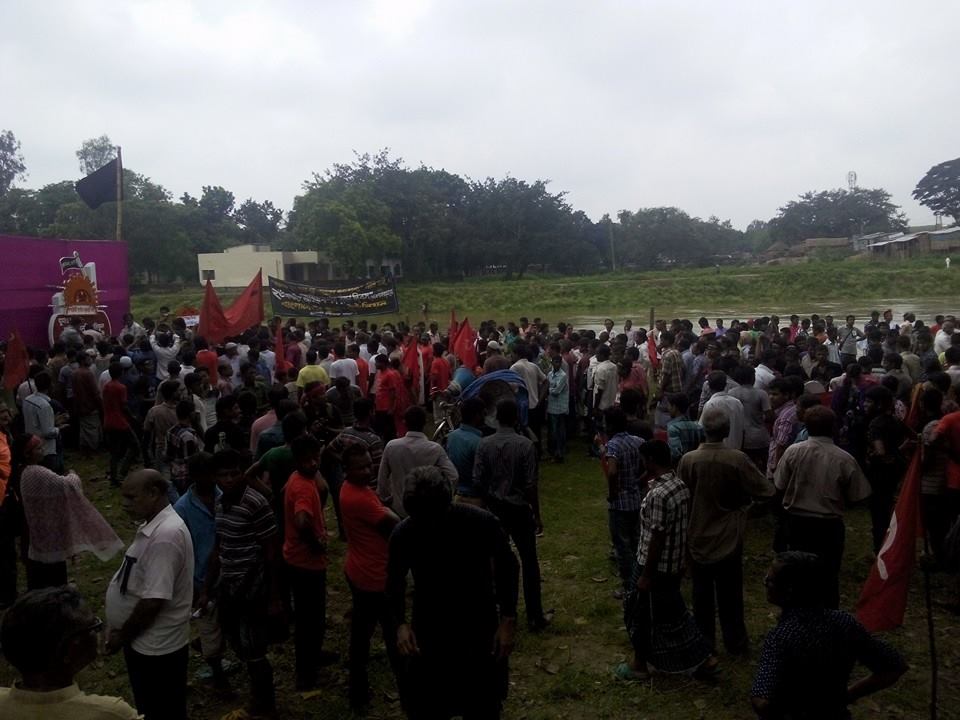
On 26th August 2014, the 8th anniversary of the Phulbari Mass uprising has been observed countrywide with the following slogan: ‘There is no place for the betrayers on the streets of Phulbari drenched with the blood of our martyrs’. Daylong programmes were observed in Phulbari that included mourning procession, wearing black badge, hoisting black flag, rally and cultural activities of resistance.  Phulbari 3

The day’s programme started at 7 am with placing respect to the Martyrs and wearing of black badges. In remembrance of the martyrs and their sacrifice all shops and businesses were closed that day. Black flags were hoisted in many places.

The Central National committee organized the Mourning procession, and at the end, a minutes’ silence for the fallen was organised. A at the Neemtoli morh fter this, we had a rally expressing our demands that include;

  1. Full implementation of the Phulbari accord
  2. Moving the office of Asia Energy from their town.
  3. Activities around opening up of Boro Pukuria was condemned.

Member secretary of the National Committee Prof Anu Muhammad delivered the welcome address, convener of national committee Engineer Sheikh Shahidullah spoke about the demands, and Saiful Islam Jewel presided the meeting.

Leaders of Jatyo Ganofront, Bangladesh Communist Party, Bangladesh Socialist Party, Bangladesh Workers party, Revolutionary workers’ party, BaSoD convention preparation committee, Democratic Revolutionary party, Gano Shonghoti Andolon, United Communist League, leaders of Phulbari Branch of the national committee spoke in the occasion. Many other local, regional political organization, individuals including Bablu Roy (person injured by the Rana plaza disaster) and university teacher were also present in the program.

In the rally, the speakers remembered the day in 2006 to emphasize how remarkably people of Phulbari defied law enforcers, attended the rally in thousands aPhulbari142nd after the murder of the three, people here mounted one of the greatest resistance in Bangladesh against the company. As a result, on the 30 August 2006, the then government was forced to sign an accord with the protestors of the company that said there will be no open pit mine and Asia Energy would have to leave. The current Prime minister promised Phulbari people that she would never let this mine start. However, surprisingly, with the same person now as the head of State, we have not seen a transparent step to ban Asia energy.

The rally demanded the full implementation of The Phulbari accord by the 30th November. Failure to do so will incur a huge rally of people on the 1st December. In the afternoon, resistance songs and plays were performed. In the evening, film shows titled, ‘We don’t want a mine’, ‘Fulbari – a Blood flag’ and Indian documentary named ‘Fulbari debona’ were screened.


‘Prime Minister Sheikh Hasina has directed the energy ministry to wait for ‘new technology’ before going for coal extraction’

‘Prime Minister Sheikh Hasina has directed the energy ministry to wait for ‘new technology’ before going for coal extraction’

Wait for ‘new technology’: PM

Stressing the need to protect arable land, Prime Minister Sheikh Hasina has directed the energy ministry to wait for ‘new technology’ before going for coal extraction.

She also outlined the ministry’s future challenges and ways to tackle them.

State Minister Nasrul Hamid Bipu briefed journalists on Thursday after her first visit to the ministry in two-and-a-half-years.

“The Prime Minister told ministry officials that new technology to extract coal may become available soon. We will wait for it,” he said quoting the Prime Minister.

Hasina’s directive comes amid controversies on whether Bangladesh should go for open-pit mining along with importing coal to meet increasing power demands.

Hamid was, however, silent on coal extraction issues. He also did not explain how thermal power production could be raised while waiting for ‘new technology’.

He said the Prime Minister wanted protection of farmers’ land first and coal extraction to be left to the future.

Hamid said Hasina, who also holds the energy portfolio, had ordered the stepping up of coal extraction research.

State-run oil, gas and mineral resources corporation Petrobangla claims Bangladesh has five coal mines with an estimated combined reserve of 3.1 billion tonnes.

Currently, an estimated 1.65 million tonnes of coal is produced annually from one of the mines through underground mining.

A group of experts, environmentalists, various Leftist fronts oppose open-pit mining which pollutes the environment, lays waste to arable land and displaces the habitants.

Despite a matter of high priority, the government has failed to formulate a coal policy in the past decade.

About 75 percent of Bangladesh’s power comes from gas while coal is used to produce less than 3 percent.

The government claims electricity generation increased nearly 5,000MW over the past five years. A ‘Festival of Light’ was held in Dhaka last year to mark the production of 10,000MW, hitting a new milestone in the country. It also plans to raise power production to 30,000MW by 2030, half of which would come from coal.

However, according to information presented in Parliament last June, around 40 percent people still do not have access to electricity.

Bipu said the Prime Minister had directed the setting up of a coal-fired power plant near the Paira Port in southern Patuakhali.

The government recently faced a wave of protests when it decided to go ahead with a 1,320MW thermal power plant at Rampal, near the Sunderbans.

Full article – bdnews24.com/bangladesh/2014/02/06/wait-for-new-technology-pm


PM’s strategy on coal: Asia Energy’s future with Phulbari bleak

Reported by: UNBconnect
Reported on: February 8th, 2014 12:02:55 am

Dhaka, Feb 7 (UNB) – The future of Phulbari coal mine project of UK-based Asia Energy, since renamed as Global Coal Management (GCM), has become bleak following the Prime Minister’s recent distinct statement on coal mining in the country.


While holding meeting with Power and Energy Ministry’s top officials on Thursday (February 6), Prime Minister Sheikh Hasina said: “Right now, we want to leave the issue of coal extraction to the future technology as food security and protecting the land of the farmers is the first priority.”


The Asia Energy entered Bangladesh in 2003 buying a contract from Australian company BHP to explore coal in Phulbari of Dinajour district. But when Asia Energy moved to execute its project as an open-pit mining, it faced tremendous opposition from local community and environmentalists.


The major protests took place on August 30 in 2006, where six protesters were shot dead, allegedly by paramilitary forces, and 300 were injured when a crowd of 30,000 people stormed the local offices of Asia Energy in Dinajpur.


The incident forced the government to announce postponement of the operation of Asia Energy’s Phulbari project. The Asia Energy was renamed as Global Coal Management (GCM) in 2007.


Recently, different activities of Asia Energy or GCM have been suggesting that the company is planning to come back in a new way to implement its project. Particularly, the GCM, a listed company with London Stock Exchange showing Phulbari coal mine as its project, became active in the country’s northern region where it recently launched some campaigns to garner local public support in its favour.


The GCM’s campaign raised serious concern among the anti-Phulbari activists who also threaten to reactivate their protest to resist the UK-company’s move.


Meantime, GCM reconstituted its board of directors and brought major changes in its Dhaka as well as London office by putting some new directors and staffs which also suggests the company is really coming up with new enthusiasm.


Sources said the company also recast its strategy to win the deal for exploration of the proposed Phulbari coal mine.


As part of the new strategy, the company has inducted a young Malaysian tycoon as a Non-Executive Director, removing a Briton from the Board of Directors.


With the announcement, Malaysian tycoon Dato’ Md Wira Dani Bin Abdul Daim has replaced British entrepreneur Neil Lindsey Herbert from the board of directors of GCM.


“Under the leadership of Malaysian business tycoon, the GCM was eyeing to rearrange its strategy in winning a deal for commercial exploration of the proposed Phulbari coalmine district,” said a source.


The GCM appointed Mettiz, an investment company with significant corporate and financial experience in natural resources, power generation, manufacturing and real estate, a lobbyist in Bangladesh last year to get approval of the government for commercial exploration of the Phulbari coalmine.


But, energy industry insiders thought the Prime Minister’s statement has made it clear that the project is unlikely to be executed in near future.


Quoting the Prime Minister, State Minister for Power and Energy Nasrul Hamid said she has given us a directive regarding coal extraction saying that “first of all we need” food security and land use.


“Only after ensuring food security and protecting farmers’ land, we’ll decide which technology we’ll use to extract coal,” he told reporters following the PM’s meeting.


Asia Energy Bangladesh’s CEO Gary Lye, however, said Phulbari Coal Project uses the land for mining temporarily. Land is immediately rehabilitated and returned to agriculture after extracting the coal which is a far greater benefit for the country.


He said Asia Energy is concerned to ensure food security and the company’s agriculture improvement plan will increase the food production from the area as well as allow coal extraction and jobs.


“We (will) welcome the opportunity to brief the Prime Minister on these plans and show how she can deliver for the people and country coal, major power and food security. People from the area want the coal mining and development benefits it’ll bring to them and their region which is one of the Bangladesh poorest regions.”   


Bangladesh has five coal fields with an estimated reserve of some 3.0 billion tonnes, industry insiders said. Of the five coal fields, only one in Barapukuria is now in operation.

– See more at: http://unbconnect.com/pm-coal-ld/#&panel1-2

PM’s strategy on coal: Asia Energy’s future with Phulbari bleak

Reported by: UNBconnect
Reported on: February 8th, 2014 12:02:55 am

Dhaka, Feb 7 (UNB) – The future of Phulbari coal mine project of UK-based Asia Energy, since renamed as Global Coal Management (GCM), has become bleak following the Prime Minister’s recent distinct statement on coal mining in the country.


While holding meeting with Power and Energy Ministry’s top officials on Thursday (February 6), Prime Minister Sheikh Hasina said: “Right now, we want to leave the issue of coal extraction to the future technology as food security and protecting the land of the farmers is the first priority.”


The Asia Energy entered Bangladesh in 2003 buying a contract from Australian company BHP to explore coal in Phulbari of Dinajour district. But when Asia Energy moved to execute its project as an open-pit mining, it faced tremendous opposition from local community and environmentalists.


The major protests took place on August 30 in 2006, where six protesters were shot dead, allegedly by paramilitary forces, and 300 were injured when a crowd of 30,000 people stormed the local offices of Asia Energy in Dinajpur.


The incident forced the government to announce postponement of the operation of Asia Energy’s Phulbari project. The Asia Energy was renamed as Global Coal Management (GCM) in 2007.


Recently, different activities of Asia Energy or GCM have been suggesting that the company is planning to come back in a new way to implement its project. Particularly, the GCM, a listed company with London Stock Exchange showing Phulbari coal mine as its project, became active in the country’s northern region where it recently launched some campaigns to garner local public support in its favour.


The GCM’s campaign raised serious concern among the anti-Phulbari activists who also threaten to reactivate their protest to resist the UK-company’s move.


Meantime, GCM reconstituted its board of directors and brought major changes in its Dhaka as well as London office by putting some new directors and staffs which also suggests the company is really coming up with new enthusiasm.


Sources said the company also recast its strategy to win the deal for exploration of the proposed Phulbari coal mine.


As part of the new strategy, the company has inducted a young Malaysian tycoon as a Non-Executive Director, removing a Briton from the Board of Directors.


With the announcement, Malaysian tycoon Dato’ Md Wira Dani Bin Abdul Daim has replaced British entrepreneur Neil Lindsey Herbert from the board of directors of GCM.


“Under the leadership of Malaysian business tycoon, the GCM was eyeing to rearrange its strategy in winning a deal for commercial exploration of the proposed Phulbari coalmine district,” said a source.


The GCM appointed Mettiz, an investment company with significant corporate and financial experience in natural resources, power generation, manufacturing and real estate, a lobbyist in Bangladesh last year to get approval of the government for commercial exploration of the Phulbari coalmine.


But, energy industry insiders thought the Prime Minister’s statement has made it clear that the project is unlikely to be executed in near future.


Quoting the Prime Minister, State Minister for Power and Energy Nasrul Hamid said she has given us a directive regarding coal extraction saying that “first of all we need” food security and land use.


“Only after ensuring food security and protecting farmers’ land, we’ll decide which technology we’ll use to extract coal,” he told reporters following the PM’s meeting.


Asia Energy Bangladesh’s CEO Gary Lye, however, said Phulbari Coal Project uses the land for mining temporarily. Land is immediately rehabilitated and returned to agriculture after extracting the coal which is a far greater benefit for the country.


He said Asia Energy is concerned to ensure food security and the company’s agriculture improvement plan will increase the food production from the area as well as allow coal extraction and jobs.


“We (will) welcome the opportunity to brief the Prime Minister on these plans and show how she can deliver for the people and country coal, major power and food security. People from the area want the coal mining and development benefits it’ll bring to them and their region which is one of the Bangladesh poorest regions.”   


Bangladesh has five coal fields with an estimated reserve of some 3.0 billion tonnes, industry insiders said. Of the five coal fields, only one in Barapukuria is now in operation.

– See more at: http://unbconnect.com/pm-coal-ld/#&panel1-2