Govt says ‘no’ to open-pit mine in Bangladesh

Another day of victory for Phulbari, another day of loss for Global Coal Management

On Sunday, 23 August, 2015 Bangladesh’s state minister for energy and mineral resources stated that there is no hope for any mining company to extract coal from the coal deposits of Northwest Bangladesh in Phulbari. In a published report yesterday, the country’s national daily newspapers reported the news widely. We have reproduced a detailed report by the staff correspondent of New Age below.

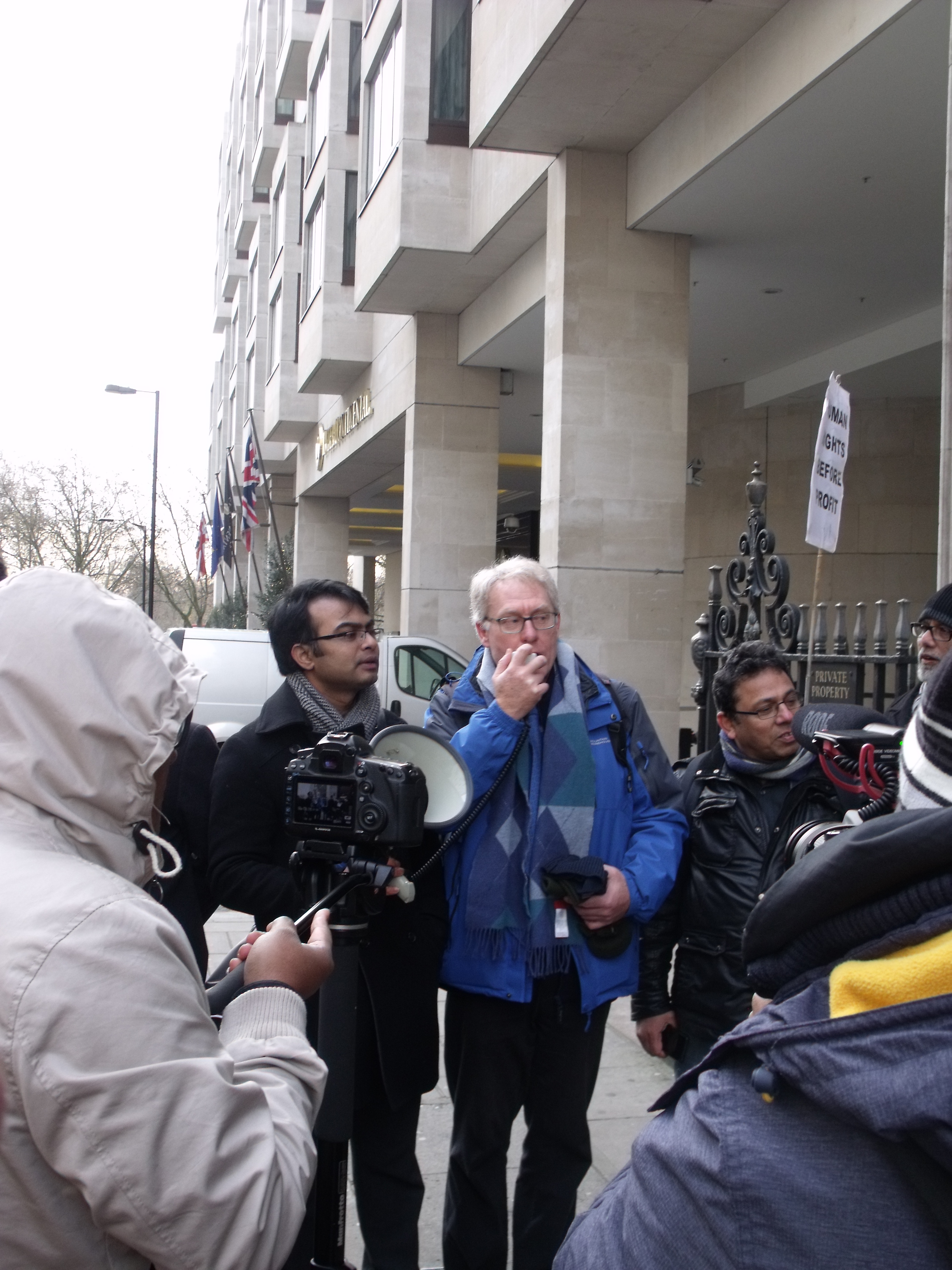
DSCF7409

The state minister for power, energy and mineral resources, Nasrul Hamid, on Sunday said that the government was not interested to extract coal from the deposits in the north Bengal region using open-pit method.
‘We have decided not to extract coal right now… We must consider high density of population and the agro-based economy of the mining area,’ he said while addressing as the chief guest a seminar on ‘Energy Challenges to Vision 2030.’ The discussion was organized by weekly Energy and Power magazine.
Instead, the government is planning to use imported coal to run large power plants to be installed with a combined generation capacity of about 20,000 MW by 2030, he said. Nasrul’s remark came three days ahead of August 26, the 9th anniversary of the killing of protesters who had opposed in 2006 a move for open pit mining by London-based Asia Energy company at Phulbari of Dinajpur.
The then Bangladesh Rifles men had opened fire on a peaceful rally and killed at least three people. On that day, police, RAB and BDR indiscriminately had beaten people, injuring over 200 children, men and women who attended that peaceful rally and demanded cancellation of the project.
The inhabitants feared it could destroy the underground water aquifer, biodiversity, and agriculture of the region.
The government, under the Power System Master Plan-2010, had contemplated to exploit coal through open-pit method from two coal deposits located at Phulbari and Barapukuria of Dinajpur to run power plants with total capacities of 11,000 MW. The plan, however, was dropped from the revised PSMP in 2015.
Energy expert and a professor at Geology Department of Dhaka University Badrul Imam said that it would not be fair to compare the socio-economic and geological realities of Dinajpur with any location in Australia, Germany or even in West Bengal while mining coal, using open-pit method.
He said that the top two leaders of Awami League and BNP had made a commitment to the people of Phulbari that they would not allow such method in future. At the seminar, a number of open-pit campaigners, however, spoke in favour of open-pit method to ensure supply of primary fuel.
Energy expert Khandkar Saleque Sufi and M Tamim presented two papers addressing the potential crisis of energy sector, particularly while ensuring supply of primary fuels to power stations, industries, households and transport sector.
At the seminar, speakers along with Sufi and Tamim argued that the country was going to be entirely dependent on imports of primary fuel as the reserve of natural gas was depleting. Tamim also said that there was a huge disparity in electricity consumption by the rural and urban people.
Tamim showed that the rural people, who constitute 66 per cent of the total population, consume 31 per cent of electricity with only one per cent growth while the urban people, who represent 34 per cent of the population, consume 69 per cent of electricity with four per cent yearly growth.

See more at: http://newagebd.net/150774/govt-says-no-to-open-pit-mine/#sthash.3l1YnBcw.3tVplMM4.dpuf

Or visit: http://newagebd.net/150774/govt-says-no-to-open-pit-mine/#sthash.3l1YnBcw.3tVplMM4.dpbs

The Global System for Holding Corporations to Account Is in Need of Serious Reform

Christine Haigh wrote about how UK’s National Contact Point failed to hold corporations responsible for unethical business in Bangladesh and elsewhere

Article is Reproduced from The Guardian Global Development Professional Network 
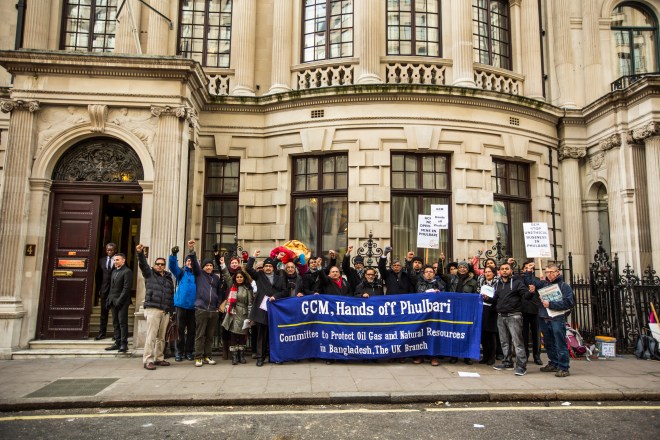
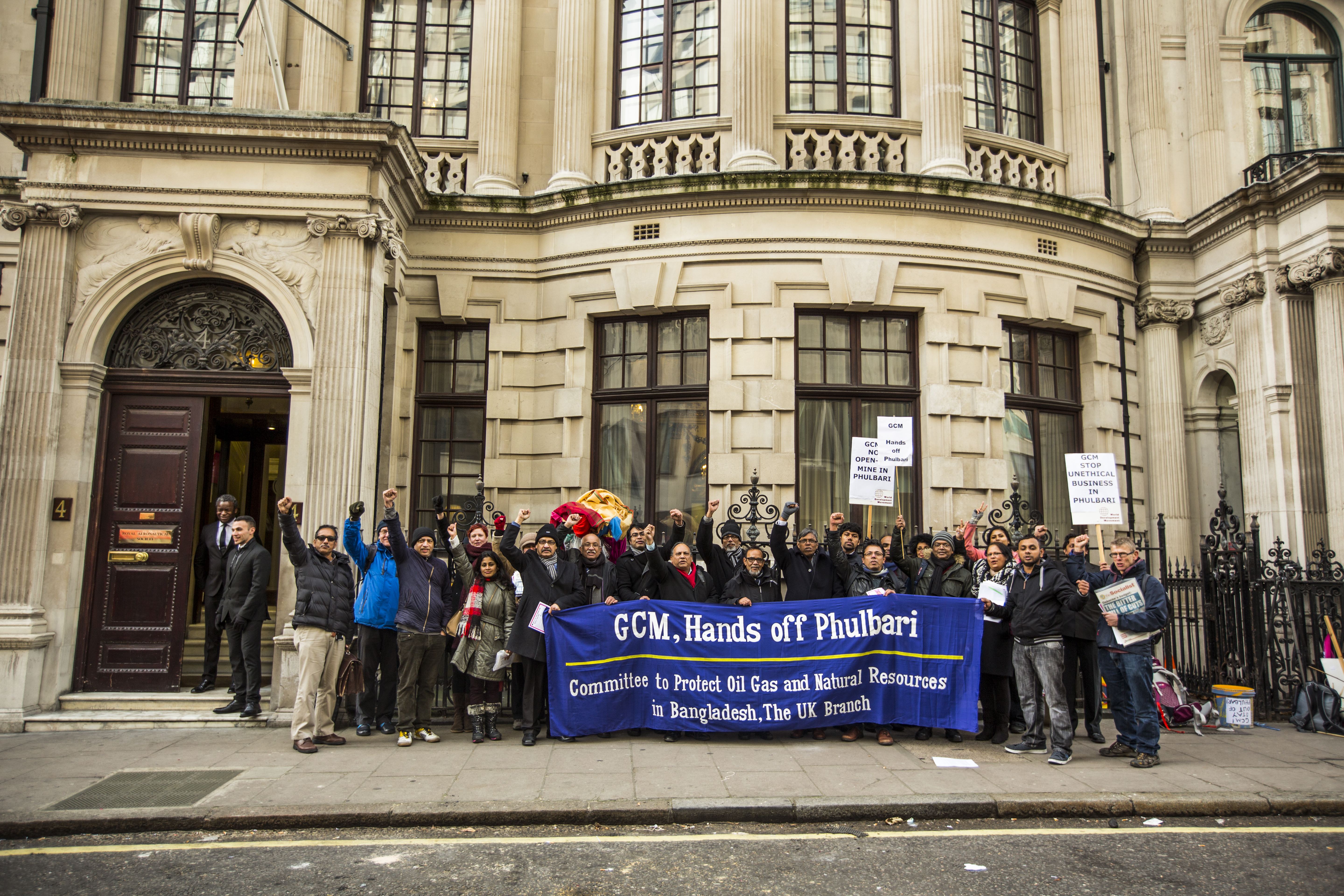
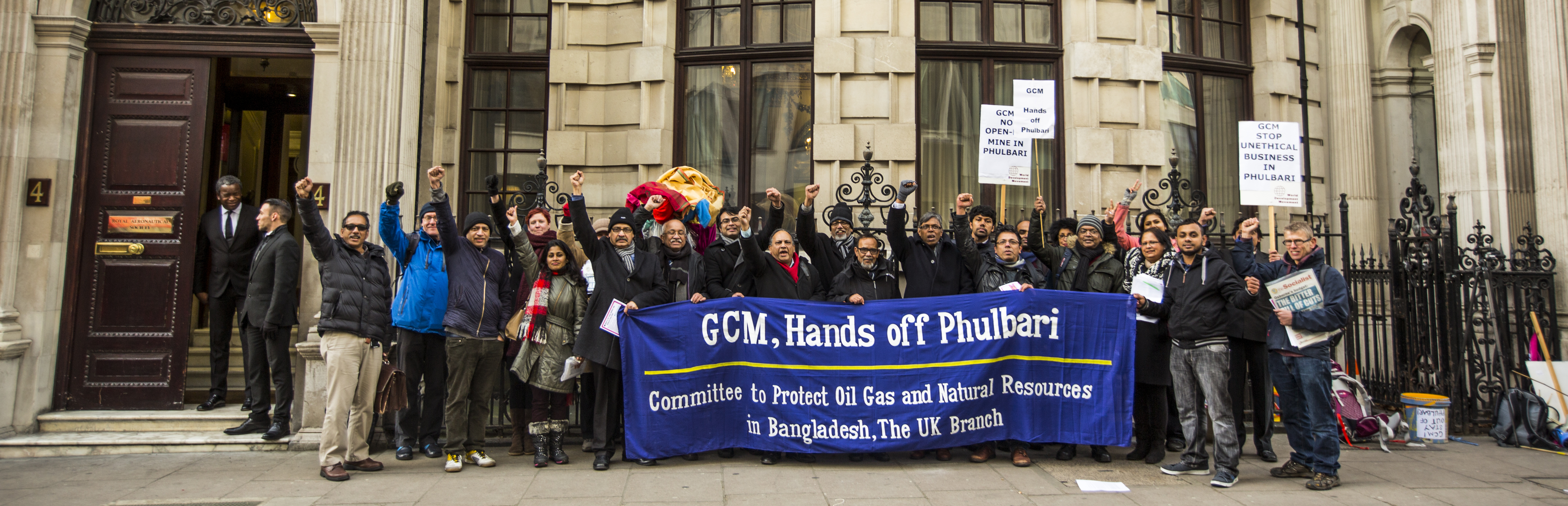
    Bangladeshi community and climate change activists protest against the outcome of OECD complaint about Phulbari coal mine. Blockade and action outside GCM's AGM in December 2014. Photo: Golam Rabbani

Bangladeshi community and climate change activists protest against the outcome of OECD complaint about Phulbari coal mine. Blockade and action outside GCM’s AGM in December 2014. Photo: Golam Rabbani

A British company plans to build a huge coal mine, stating in its plans that it says will displace more than 40,000 people. It will destroy over 14,000 acres of land in Bangladesh’s most fertile agricultural region Phulbari in the north west, where most people have land-based livelihoods. Unsurprisingly, local people oppose the plans to destroy the landscape and homes. For over a decade now they have tried in their thousands to prevent the coming of the mine. Three have died when the Bangladeshi paramilitary were sent into confront protesters, and many more have been injured.

To date, these protests, supported by international condemnation from UN human rights experts and NGOs such as International Accountability Project (IAP) and Global Justice Now (GJN), have prevented the mine being built. But London-listed mining company GCM Resources continues to push for their mine.

And so, in 2012, concerned at renewed efforts by GCM to progress the project, IAP and GJN decided to make use of one of the very few mechanisms available to hold corporations to account for their activities overseas by filing a complaint against the company to the National Contact Point (NCP) under the OECD guidelines for multinational enterprises.

Read the story in detail here : http://www.theguardian.com/global-development-professionals-network/2015/feb/10/the-global-system-for-holding-corporations-to-account-is-in-need-of-serious-reform
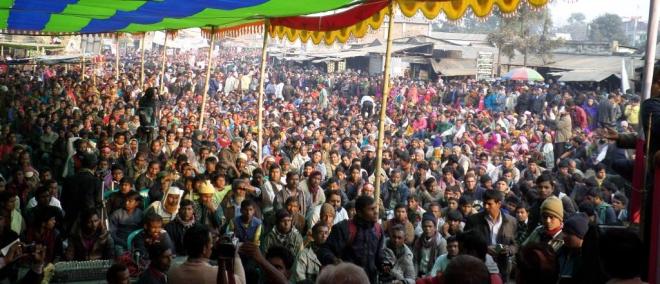
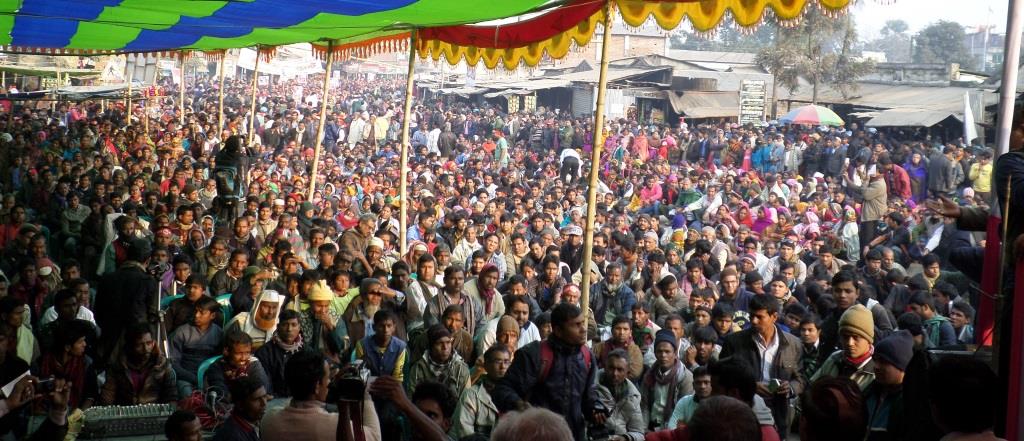
Grand rally  of locals in Phulbari town on 27 December 2014. Photo credit: Kallol Mustafa

Grand rally of locals in Phulbari town on 27 December 2014. Photo credit: Kallol Mustafa

Failing to hold their businessman to account, Rolf Nieuwenkamp, the chair of the OECD working party on responsible business conduct, has done a response piece to Christine Haigh‘s above article about the failure of the OECD process.

The partial and dodgy response can be accessed from: http://www.theguardian.com/business/2015/feb/24/from-land-grabs-to-anti-union-behaviour-businesses-are-increasingly-being-held-accountable

Phulbari Activists have responded to Rolf Nieuwenkamp’s article in their comments as embedded below .
    Phulbai actvists and protesters against OECD assessment pledged that GCM will be de-listed from London AIM soon. Photo: Stephen Vince

Phulbai actvists and protesters against OECD assessment pledged that GCM will be de-listed from London AIM soon. Photo: Stephen Vince

Read Comments on Rolf Nieuwenkamp’s response:

ritasueandbob

24 Feb 2015 14:54

  • 1 2

When are going to make western companies liable for labour abuses of their suppliers? And directors of western companies personally responsible that certain standards are maintained by their supplier chain?

If directors face prison for a negligent factory fire killing hundreds that should encourage a better commitment to supplier standards.

OneTop

25 Feb 2015 1:26

  • 2 3

From land grabs to anti union behaviour, businesses are increasingly being held accountable

That’s a hilarious joke given that the parties to the TPP and TTIP are about to grant corporations sovereignty, placing their activities above the law. Not to mention the massive frauds and illegal activities carried out by the largest banks.

Trans-Pacific Partnership is a “neoliberal assault”


Critics score against extreme corporate rights in TTIP, but must not be fooled by the Commission’s tricks

hugin1

25 Feb 2015 9:09

  • 0 1

So there are progress in the developing countries; great…. cause for celebration even if big business hardly act exemplary just yet. But in Europe and the US big business increasingly do as they please. There’s no accountability as the political level has been bought through lobbying and financing of career politicians. Only the concern (I wouldn’t even call it fear) that whistle-blowers can trigger the occasional headline acts as a mild deterrent. It’s not like big business has suddenly acquired a moral compass……. the massive, institutionalized tax evasion we know they are all engaged in is evidence to the contrary.

ID8041069

27 Feb 2015 8:58

  • 0 1

Okay, Mr Professor Rolf Nieuwenkamp, as you make me laugh out so loud by reading your hilarious rumbling to Christine Haigh’s polite opinion piece, I think that it is necessary to make a few comments in my own language to your rumbling – what I found not only a poor response but utter lies about the ill process of your NCP. I am sure you are aware that you rumbling failed to respond to the ever constructive article by Christine Haigh, who kindly wrote about us- the people from Phulbari. I wish to add my few comments for other readers who may not know what a hypocritical response it is, and who may not know how inhuman the UK NCP could appear to certain communities and groups of people in the far south who are seen as uncivilized to many Professors like you who serve organisations like the Global Coal Resources Plc.

Note that I am one of those survivors who was nearly killed by your poisonous corporations, those ill-motivated and corrupted businessmen of Britain whom you and your hypocrite board have encouraged to go back to Phulbari to ruin my homeland. You and your colleagues have given a self contradictory assessment to the killer company who killed three people in Phulbari in front of my eyes. Instead of holding them to account, your NCP has decided to publish an ill-assessment, clearly suggesting that the company should go back to Phulbari to consult the local people so that they could destroy our people’s houses, pollute our water sources, and damage our greens and environment in the name of development and fossil fuel. The report which you have published on 20 November 2014, overlapping the OECD process and denying the fact that GCM has already violated human rights in Phulbari, is not only a failure but denial to humanity. Your report has led to fresh violence in a town what was known as Bangladesh’s most peaceful locality. I am the woman who have witnessed both the killing of our people in Phulbari and the betrayal of the NCP to us throughout the OECD process. So please bear with me I have much to say about your failures and inhumanity.

ID8041069

27 Feb 2015 9:45

  • 0 1

In your rumbling, you have failed to reference to the cases brought up in 10 February piece by Christine Haigh, and this indeed side-steps the particular concerns raised about them, in particular the Phulbari case. Several of your points are misleading, Mr Professor, what kind of Professor are you that couldn’t get the point after reading a whole 1000 words delivered by a climate activist?

I have no time to correct you and I believe that it is your responsibility to produce ‘good knowledge’ as a Professor. I am going to speak about just one case, and it is our case – the Phulbari case that you have failed badly to address. Before explaining what harms you did to us let me give you a few facts and self-contradictory statements that your NCP has made about our Phulbari OECD complaint:

The UK NCP’s Final Report on the complaint submitted against GCM Resources notes that:

  • GCM has responded in writing to concerns from seven of the United Nations most senior human rights experts, who have called for an immediate halt to the company’s mine citing threats to the human rights of tens of thousands of people, and has advised the UN’s experts that “it would undertaken a Human Rights Impact Assessment (HRIA) before proceeding with the project.” The company, the Final Statement also notes, “has re-iterated this commitment to the NCP” (paragraph 67 of the NCP Final Report); But then the NCP suggests that GCM has not violated human rights in Phulbari!
    • The NCP states that in order to meet its obligations under the OECD Guidelines on human rights, GCM will need to make and publish the Human Rights Impact Assessment it has committed to “before it begins work to acquire land for and develop the mine” (paragraph 71, emphasis added);
    • Subject to any decision from the Government of Bangladesh on the project’s future, the UK NCP recommends that GCM continues to update its plans in line with current international best practice standards, and in particular to pursue and publish the Human Rights Impact Assessment it has advised the NCP it will include in this (paragraph 80). Yet, the NCP ends up giving a free license for overseas business to the corrupted businessmen who are unable to produce a valid contract with Bangladesh government.

The findings and recommendations of the UK NCP’s Steering Committee, created to carry out the internal review of the NCP’s handling of the complaint which notes that GCM’s project “has aroused considerable opposition in Bangladesh, leading to violent protests, and an even more violent response by the authorities there.” But the internal review has left unpublished, just as the JCHR has left my report about GCM to the Parliament unpublished in 2009. I was told that my report was unpublished to save printing cost (as if the UK Parliament had been facing undescribable financial hardship) at that time, but what was your problem Prof. Rolf to publish your Internal Review online?

The NCP’s Final Assessment stated that GCM has failed to ‘foster mutual trust and communications with locals’ and that they must re-evaluate the impacts of this project before going ahead for implementation. But then it asks the company to carry on with their business in Bangladesh, it approves the company’s attempts to re-enter Phulbari for further public consultation so that Phulbari people cannot sleep in peace.

Please stay with me, I haven’t finished yet.

ID8041069

27 Feb 2015 9:59

  • 0 1

“The NCP finds that GCM partly breached its obligations under Chapter II, Paragraph 7, which provides that enterprises should develop self-regulatory practices and management systems that foster confidence and trust in the societies they operate in.

The finding is repeated in paragraph 50 of the NCP’s Final Statement: “The NCP therefore considers that GCM’s communications did not apply practices or systems that foster confidence and mutual trust with the [local] society in which it [seeks to] operate”, and in this limited respect the company breached Chapter II, Paragraph 7 of the Guidelines for a period beginning after August 2006 and continuing until 2012 when the Bangladeshi government authorized the resumption of activities locally and increased re-engagement began.

As the NCP repeats this conclusion a 3rd time in paragraph 77, it is exceedingly difficult to understand on what ground did the NCP stated that “The NCP finds that GCM did not breach its obligations” under Chapter II, Paragraph 2, and did not breach its obligations under Chapter IV. Could you see Mr Professor that your Paragraphs 1 and Paragraph 5 are those ambiguous findings which created a ground for a judicial review of the OECD? That these mislead many of us including the company themselves, so that the company’s Chief Executive rushed to Phulbari and provoked for fresh violence in our Phulbari?

Mind you, I am not an expert in OECD matter though even I could see the idiotic ambiguity in NCP’s final assessment of Phulbari case. Please beer with me I have much more to say about your failures and the harms your NCP has done to us in Phulbari.

ID8041069

27 Feb 2015 10:07

  • 0 1

The fact that the 2011 OECD guidelines do “clearly” apply to “prospective” or potential human rights abuses was affirmed in an internal review of the NCP’s handling of the complaint. This is documented in paragraph 6 of the Recommendations of the NCP Steering Board Review Committee formed to carry out this internal review.

In paragraphs 20 & 28, the Committee instructed the NCP to re-evaluate the complaint in light of its concern that the NCP made an error (paragraph 15) in not applying the 2011 Guidelines – which clearly include potential impacts – and revise it’s Final Statement in the complaint accordingly. However, the NCP proceeded to publish the Final Statement with no change other than a footnote stating the review had taken place. I have quoted in our press release to your worthless review of our case that the framework within which the UK NCP has assessed our case is extremely narrow, and the issues which were overlooked by the NCP was ill-motivated.

Examination of our Review Request finding of procedural error by the NCP & recommendation to re-evaluate our complaint and issue a new Final Statement:

We formally requested a review of the NCP’s handling of our complaint (on 15 May 2014), and our request was accepted. A Steering Board Committee was appointed to carry out the assessment, and its report (received 30 Oct) is attached. Three important points to note:

  1. The Committee recognized and affirmed that the 2011 Guidelines do clearly apply to “prospective impacts” (para 6): “it is clear from the 2011 Guidelines that the obligation of an enterprise to respect human rights includes the rights of those prospectively affected by its conduct, including planned conduct”;
    2. The Committee upheld our position that the NCP had “misdirected itself” (made an error) in not applying the 2011version of the OECD Guidelines to our complaint (paras 15 & 19);
    3. It recommended that the NCP re-examine the Complaint in light of this concern, and “issue a new Final Statement reflecting this re-examination.” (para 20)

ID8041069

27 Feb 2015 10:16

  • 0 1

We were found badly played out by your colleague and an ever bias woman, Liz Napier. After what you guys (at UK NCP) have done to us by publishing one of world’s most unethical and bias report of our complaint, I had no wish to even write a column about your rubbish failure. We have rather chosen to take to streets to protest and asked our government to close business with your unethical businessmen. I write now as you have made yourself such a deaf by your vague response to the failures that our friend Christine Haigh has noted in her article. You know that you have talked about success by sidestepping, and you didn’t have the courage to challenge any of the cases that we have watched being failed and let down by the UK NCP.

Please take your time to read the Summary of the NCP’s pathetic response to the recommendation of its Steering Committee Review

The NCP wrote us to notify it “believed” it could to this quickly, denied our requests for the usual period granted for comment on the Final Statement, and also refused our requests for a delay in publication to allow its Steering Board to consider our concerns. Literally the only change made in response to the recommendations of the Steering Committee Review was to add a one-paragraph footnote to its existing Final Statement stating that it has carried out a re-examination. Other that this footnote, it did not alter a word of the Final Statement now published to its website (and attached here). It then proceeded to publish virtually unchanged.

This may be seem detail to some readers but we do have two concerns about the review findings:
1. The Committee erred in its findings that our Complaint deals only with “prospective” human rights abuses that have not yet occurred (see paras 5 & 6). For one important example, see comments below regarding ongoing violations of the rights of indigenous people.
2. Para 25 seems to give the NCP far too much leeway in deciding what it can exclude from its investigation of a complaint.

Stay with me please I am showing you how failed you and your board are!

ID8041069

27 Feb 2015 10:29

  • 0 1

To summarize some three of the most serious breaches of human rights by Global Coal Management Resources never adequately addressed by the NCP:

  1. Ongoing violation of the rights to self-determination and to free prior and informed consent (affirmed in the United Nations Declaration of the Rights of Indignenous Peeople) extending back to 2006.

Both the NCP and the Steering Board Committee have erred in saying that all concerns raised in our complaint are about “prospective” or “potential” rights. This is factually untrue as indigenous people have been fighting this project for over eight years. The NCP has incontrovertible evidence of this, including: its written notes from an interview with an indigenous leader who told her that indigenous people were willing to go to war to halt the project; Rabindranath Soren’s letter to the UN Forum on Indigenous Issues (attached); and the 2008 community letter to the ADB signed by several indigenous leaders. The former UN Special Rapportuer on the Rights of Indigenous Peoples, James Aanaya, has twice conveyed his concerns about this in his official communications in the record of the UN (one is attached), and you will find detail on this in our letter of 3/12/14 as well.

  1. Forced eviction of tens of thousands of people (over 40,000 by GCM’s count, far more by others). Important: these are “forced evictions” as defined in international law and in the UN Basic Principles and Guidelines on Development-based Evictions and Displacement authored by Miloon Kothari in his former capacity as the UN Special Rapporteur on the Right to Adequate Housing. International law recognizes that forced evictions are a gross violation of human rights in themselves. You can find content on this on in the attached letter from Miloon Kothari.

The NCP said it was limited the scope of its investigation to exclude any consideration of potential impacts and would only consider inevitable or unavoidable impacts. This is an outrage in itself, because the language of the 2011 OED Guidelines is very clear that they apply to “potential” impacts and impacts that “may” happen.

Even if we agree to this limit to the NCP’s assessment – which we most definitely do not – these forced evictions are unavoidable or inevitable if the project goes forward. Even GCM does not take the position that these the eviction of tens of thousands of people in order to implement its project.

  1. The restrictions on civil and political rights of people opposing the project and high potential for further violence if GCM persists in its efforts to force the project forward despite massive opposition in communities threatened by its project, including the state-backed use of lethal force already seen in 2006.

As you are aware Professor, the Final report of an Expert Committee formed in 2006 and tasked with assessing the proposed project warned of the high risk of social conflict and unrest if as many as a million people (their estimate) are displaced and numerous international organizations, including IAP and the World Organization against Torture have repeatedly expressed grave concerns about the high potential for further violence and loss of life. The NCP is also aware the RAB, denounced as a “death squad” by Human Rights Watch, has repeatedly been deployed to demonstrations against the mine and is also aware of the bloodshed and loss of life in 2006.

The NCP dismissed the findings of the attached submission of the Essex Business and Human Rights Project as being “commissioned” by the complainants. The study finds that GCM failed to meet its due diligence requirements to avoid further human rights violations associated with this project.

ID8041069

27 Feb 2015 10:55

  • 0 1

There are so much more to expose your ill-process and ill-motivated assessment to our Phulbari case Professor that I couldn’t finish in commenting here. I think that I will better go for a proper response by one another powerful article in a social media who may not reduce our response to comments only. I want to elaborate how badly I felt being played out by your colleague Liz Napier. I was meant to be an eye witness, and I have given two hours long account/interview to Liz Napier at a moment when my dearest mother was at the Intensive Care Unit, when she was dying at home. But neither she nor any of you did cite one line from my eye witness. You simply didn’t recognise the significance of our accounts. Indeed, you failed to cite any of the first hand accounts from Phulbari where people said that they would die but would not give their land. You did not think that these comments demonstrate the severity of the concerns and the risks (possibility for further human rights violation).

The NCP’s carelessness, irresponsibility and unethical attitude were obvious in a comment by your colleague Liz Napier. In October 2013, when I have emailed her informing that I was receiving malicious calls and harassment on telephone at mid night which were similar to 2010 (when my house was burnt down), and I requested that the NCP UK shouldn’t share my contact details with any third party, Liz Napier replied -in one line-that ‘we have no reason to share your contact details with anybody’!

I saved that email of Napier. This response was not only callous but also intentional because Napier failed to assure the interviewee that the NCP would never share her contact details to anybody by any means. I wondered and wondered why was this so difficult for a communication officer at NCP to say something reassuring to the interviewee, rather than reactionary? Why is it that the affected communities and individuals representing communities have to flatter you guys for our moral rights?

ID8041069

27 Feb 2015 11:28

0 1

And my friend Dr Samina Luthfa, and a community researcher who completed her PhD and explored narratives of the tremendous resistance to open pit mine in Bangladesh, dedicated her valuable time to interpret the interviews from Phulbari. She was dumbfounded by the way your colleague Liz Napier and your NCP board have misinterpreted some of the affected individuals’ accounts. Samina wrote to Liz Napier in June 2014 that the UK NCP has no right to change the original version of the accounts that she has interpreted from Bangla to English. Napier told that she was going to find out the original accounts and would have looked at those accounts which we found as corrupted by the UK NCP board. As usual, shamefully, this has never happened and Napier has never returned to any of us with our original accounts.

I felt really sick, Professor! I am sick of talking about the way our Phulbari case has been handled by the UK NCP. You couldn’t please me by your article about success. It made me rather frustrated and angry so as to expose your corrupted process of OECD. The only one point which makes a little sense to me is that of your bit of realisation, that you realised that your system needs improvement. It is also good to know that you are aware of the fact that there are powerful criticisms: “Yes, there have been serious criticisms”.

But then you spoil your own realisation by the next comment: “but many NCPs are working to improve their structure and also find new ways to deal with challenging cases through both mediation and proactive prevention.” Please can you give us some appropriate examples of those processes and new ways to deal with our challenging cases?

Most hilarious was your last comment: “I agree with Christine Haigh that improvements are needed. But it is important to stress that there are also positive outcomes in OECD’s NCP system. The glass is definitely not full. Rather, it is half full, or half empty, depending on where you stand.”

A friend of mine have asked : Is it a truly satisfactory measurement of the NCP system to be either ‘half-full’ or ‘half-empty’? Regardless of one’s perspective is it a 50 / 50 proposition?

Please answer. In the meantime, I can write my own article which will expose that your whole system needs serious treatment.

 

In defence of national and environmental interest

By Samina Luthfa, 18 January 2015

Phulbari is not a controversy. It is the name and symbol of a successful resistance by community people threatened with displacement by a proposed open-pit coal mine by GCM Resources in 5,600 hectares of land (including arable land with high cropping intensity) in four thanas of Dinajpur. Open mining requires stripping off the soil over the deposit that lies at least 150 meter or deeper (upto270 meters) under the earth. The mining company has changed its names twice after a community protest rally against the Phulbari project was attacked and protestors shot at, killing three young protestors in 2006.

Grand rally  of locals in Phulbari town on 27 December. Photo credit: Kallol Mustafa

Grand rally of locals in Phulbari town on 27 December. Photo credit: Kallol Mustafa

Although the company’s revised documents say that the stripping will be done in phases, two highly placed government-led expert committees were not convinced in favour of the mine that will directly affect the lives and livelihoods of at least 1,00,000 people (2006). Foreign environmental experts extensively criticised the company’s Environmental Impact Assessment for being incomplete and vague. The human displacement and environmental costs are so high that United Nations’ rapporteurs also made statements expressing opposition to the proposed mine.

‘Self-proclaimed’ or not, local communities and environmental justice platforms like the National Committee to Protect Oil, Gas, Mineral Resources, Power and Port must have had logical objections against the proposed project; why else would international financiers like the Asian Development Bank and Barclays Capital feel compelled to withdraw their financial support from the project since 2008? Long before the incident of November 24, 2014, the project based in London Stock Exchange’s Alternative Investment Market had been termed ‘risky’ by industry experts like Rosie Carr in 2006 (Identify the Risks, The Investors’ Chronicle, the Financial Times).

My own doctoral research from the University of Oxford quantitatively compared incidences of community-based protests against 398 open-pit mines in South Asia. Factors like density of population, proportion of area under forest cover, and ownership by a multinational company predicted the highest probability of protest in the proposed Phulbari deposit. This research result was formally conveyed to the shareholders of GCM in their Annual General Meeting of 2011. This means that the investors are well aware of the financial risks they are taking by investing in the Phulbari project.

When such a volatile project with a high degree of environmental, political and social risks and very strong local-national-transnational opposition is supported by a quarter, what I see is unfettered greed of profiteering by some people with no environmental, social and cultural conscience at all. No matter how strongly the locals protest it, or how persuasively the experts explain that the mine would be devastating for the water aquifers, for example, they will not stop. Because they do not care about Bangladesh or its FDI rates; they are only worried about their profit, with every pence increasing their share value in the AIM. The ranting of these ‘investors’ about our country and our politicians in their discussion forums clearly show that all they care about is profiteering through stock manipulation in London that is independent of what the marginalised protestors at Phulbari do or do not do.

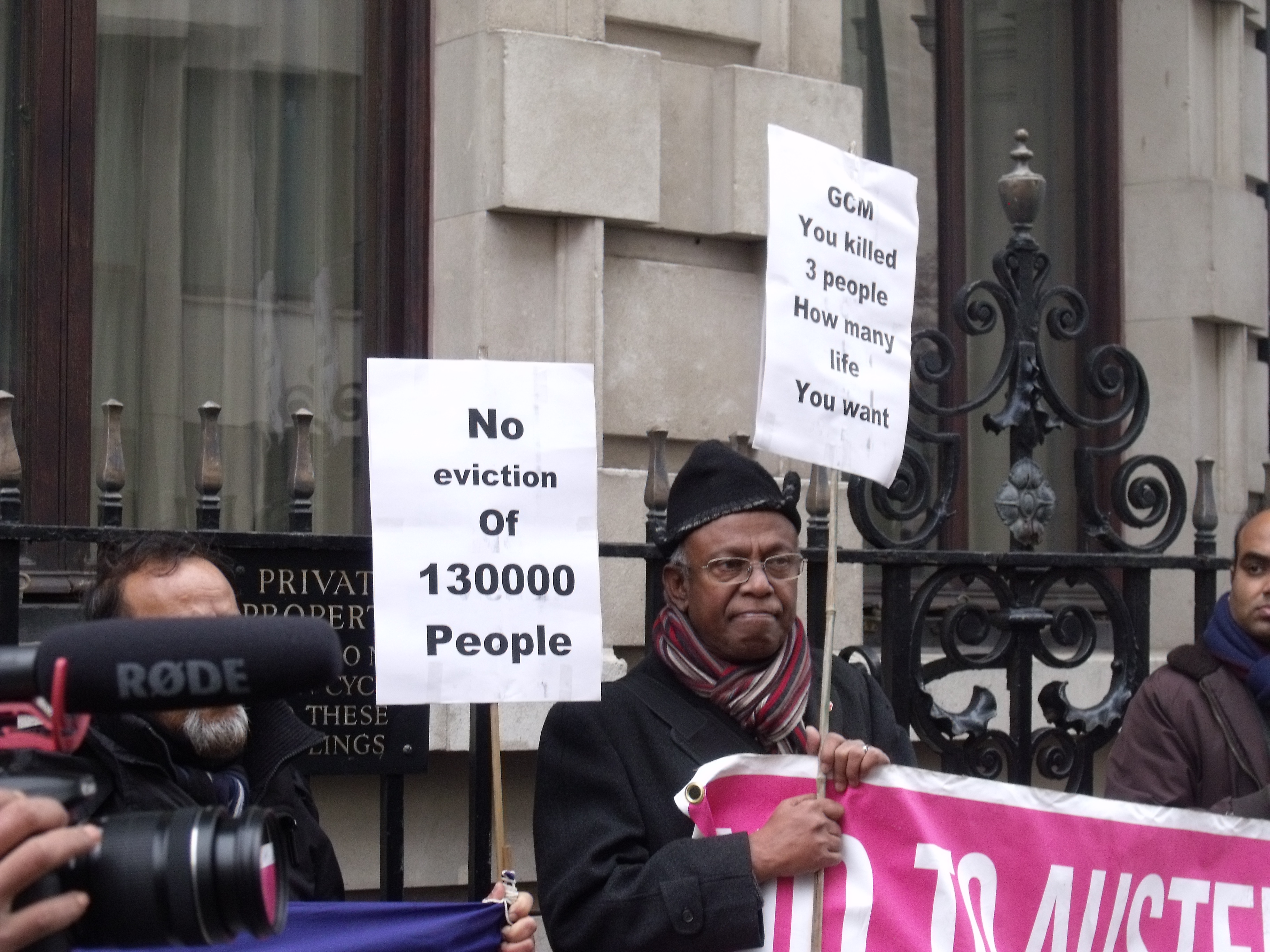
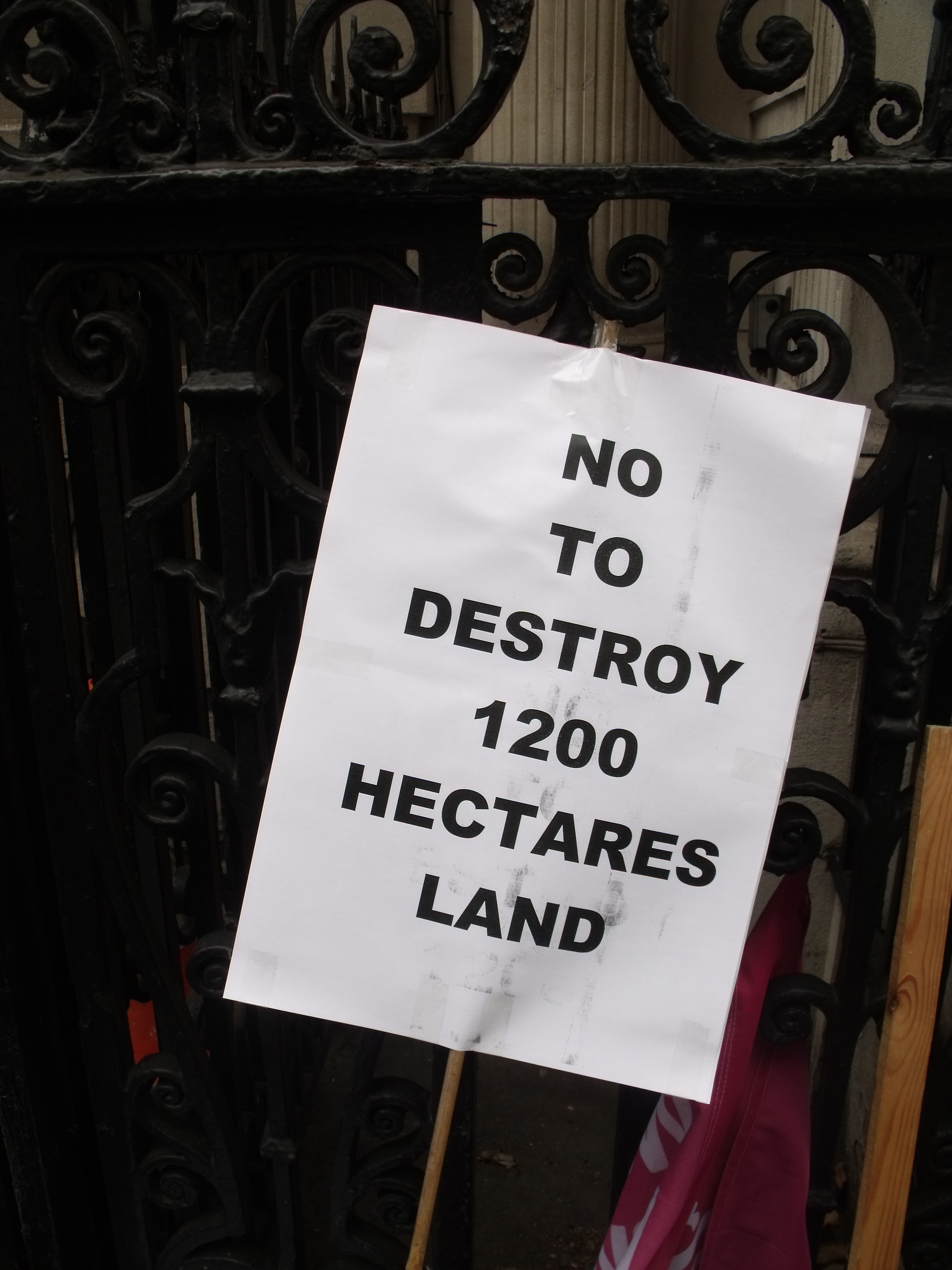
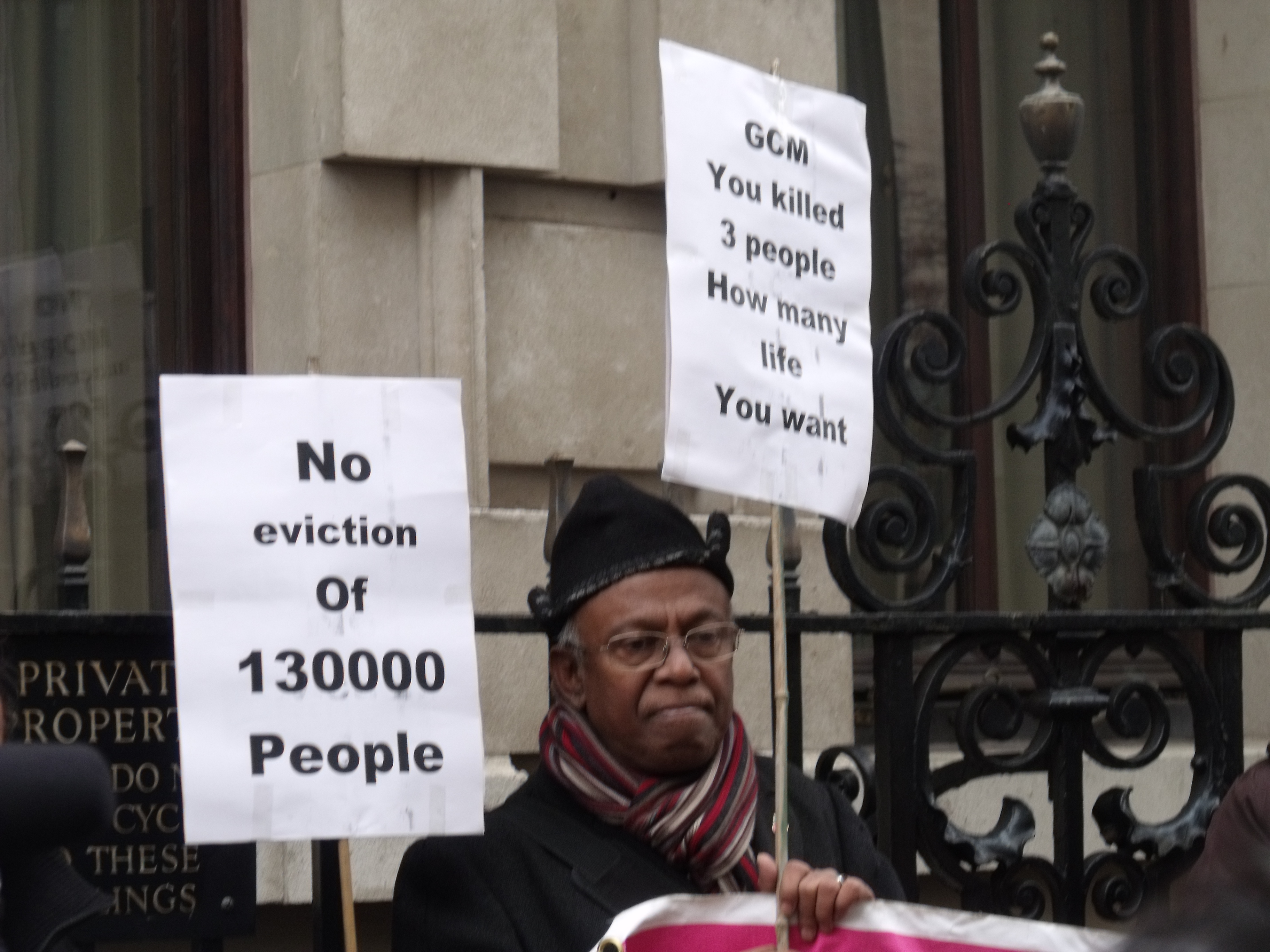
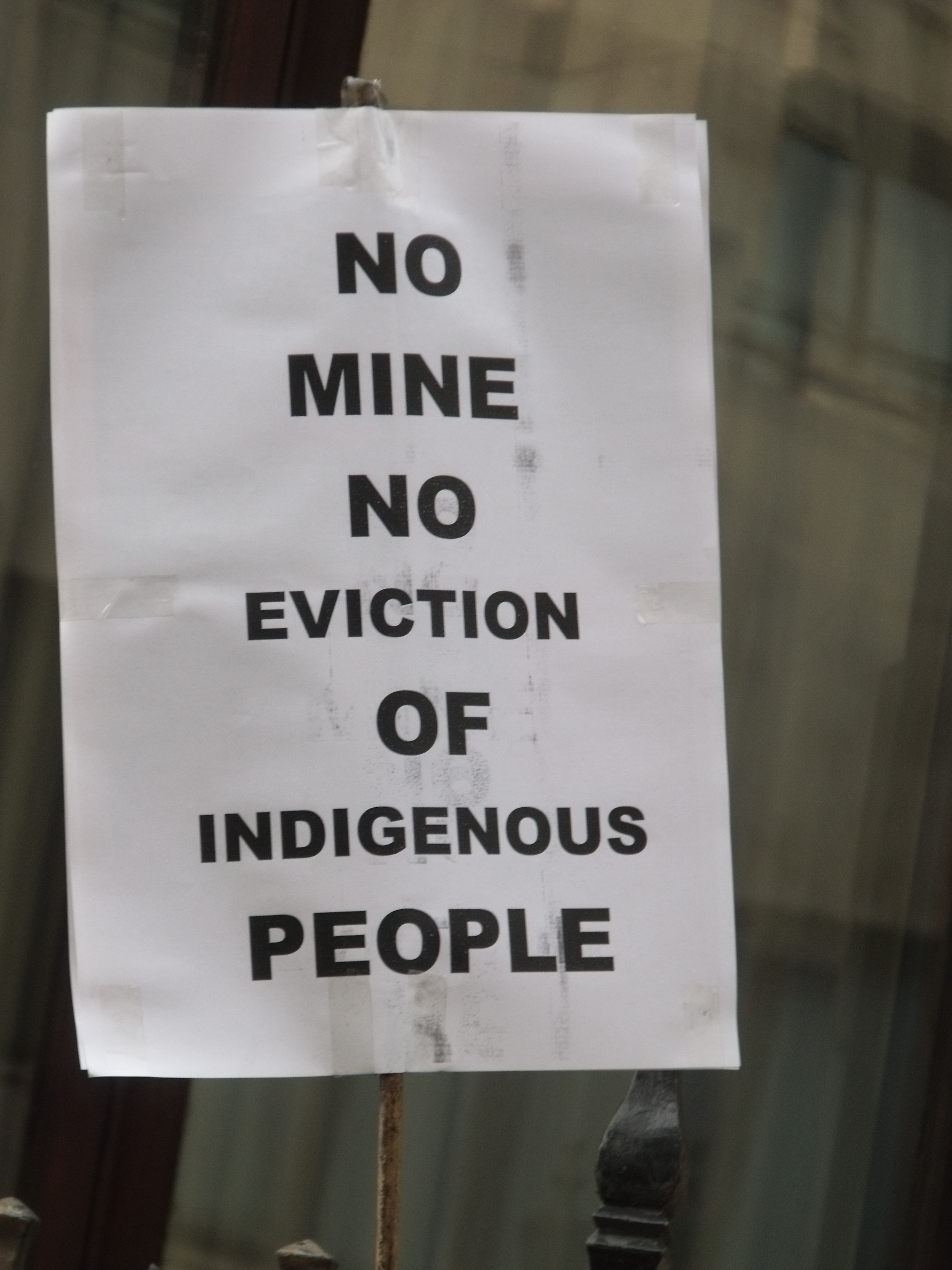
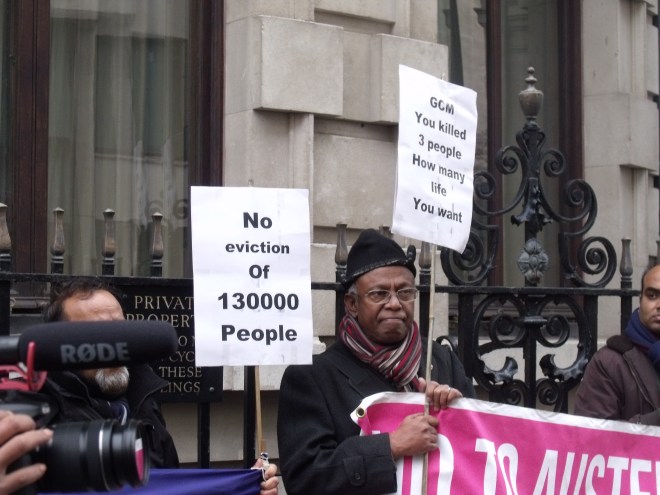
Placard used in a protest against the exploitative British company. Photo: Golam Rabbani

Placard used in a protest against the exploitative British company. Photo: Golam Rabbani

The company, as erroneously suggested by some, does NOT have a ‘permission for mining’ yet from the government. A letter from the government that is often used as an evidence of contract clearly states that the permission to mine is dependent on the following: “on receipt of the Feasibility Study Report, the technical aspects of the project will be examined and evaluated by experts and on the basis of this government will take final decision regarding real mining operation…Within this time, the lessee will not conduct any commercial activities of the mine.” On one hand, the expert committee formed after this letter expressed opposition to the project, and on the other, the Phulbari Chukti that said ‘no open mine anywhere in the country’ was signed by the BNP-led government representatives in 2006 and was supported by the then opposition leader Sheikh Hasina. It is an obligation for any incumbent politician to uphold these.

The local resistance started in 2005, gathered momentum and peaked in 2006. National committee joined the locals later to support their resistance. The locals successfully showed how the mine was not only threatening for them but also for our national interest. It wouldonly benefit the company as it would have owned all the coal, giving a small amount of royalty to Bangladesh (much lower than the convention) and some supply of coal for our power generation. 80% of the coal produced was earmarked for export to India through a very vulnerable eco-system in Southern Bangladesh — the Sundarbans. The far-reaching probable effect of this on the mangrove forest is probably clearer now after the oil tanker spill in Shela river in December 2014.

There exist several doctoral and post-graduate dissertation-based research from well-reputed western universities like Chicago, Sussex, Amsterdam, and faculty and NGO level research in Bangladesh, UK and USA, that show how strong the opposition against the mining project is and why it is the case: too costly for communities due to huge displacement, high environmental risk in a riverine area like Bangladesh where any seepage or extraction of water table has a far reaching environmental impact and increase in food insecurity with the loss of highly active arable land to the mine. All these for whose benefit: to produce electricity to export to India! Farewell to national interest, eh?

Last but not the least, FDI inflow increased 98% over the last fiscal year according to the Board of

Bangladeshi activist protests against the company outside the AGM. Photo: Paul V Dudman

Bangladeshi activist protests against the company outside the AGM. Photo: Paul V Dudman

Investments’ own records, which proves that although Phulbari is in stalemate for the last 8 years, the national investment scenario looks pretty good. I am no economist but my common sense suggests that first, foreign investment depends on global trends and is therefore dependent more on global crises than one single project. Second, GCM’s investment is not that big given the country’s whole investment scenario. Third, there are other more profitable sectors in the country where foreign investment is less risky and better-suited for investors who care for long-term returns rather than the short term return required by GCM’s short-sighted investors, whom I closely observed for one year in 2010-11. Finally, increase in FDI in power sector without a concern for sustainable growth often is responsible for creating a ‘resource curse.’ Experiences of countries like Nigeria, Sudan, Columbia and Afghanistan tell us how an increase in FDI in the energy sector negatively trapped the countries into poverty and dependence. Are we to welcome any investment that intends to export our resources at high financial, environmental and social cost and benefit only a few investors and some corrupt government officials? Or are we to bid farewell to the bad investments and welcome those that propose to extract responsibly keeping in mind the prospect of future generations to come?

**The above article is reproduced, with thanks to the Daily Star

The writer is Assistant Professor of Sociology, University of Dhaka. She earned her doctorate from the University of Oxford, UK, in 2013 on the Phulbari Resistance. The research was funded by the Commonwealth Commission.

Challenging the Invisible and Invalid Contract

Response to ‘Farewell to FDI?’ Reproduced op-ed from the Daily Star  

By Kallol Mustafa, 20 January, 2015

The op-ed piece (‘Farewell to FDI?’,The Daily Star, Jan 13, 2015) is based on some misleading and partial information regarding Asia Energy’s (GCM) Phulbari Coal Project and the peoples’ protest against it. The writer termed the peoples’ protest against Asia Energy chief’s visit to Phulbari as ‘vandalism’ but did not mention how, for a long time, Asia Energy has been trying to bribe the local youth, provide them with drugs and destabilise the local situation. He blamed the government and local administration for not taking action against the protesters and warned that this might harm foreign investment, without even mentioning the responsibility of the government to implement the Phulbari agreement signed with the local people and honour expert opinion against open pit mining on different occasions.

The writer declared the government official’s denial of existence of mining contract with Asia Energy as “erroneous,” as he completely relied on Asia Energy propaganda published in Energy & Power, but failed to present the correct picture based on original documents and experts’ opinion already submitted to the government.

Based on the article ‘Records Need making Straight’, published in Energy & Power, widely known as lobbyist of Asia Energy, the writer states that Asia Energy has valid contract for mining with the government of Bangladesh and it obtained ‘mining lease’ in April 2004.  But the April 2004 letter, which the Energy & Power article referred to as evidence of Asia Energy’s mining contract, was indeed issued “…in the interest of preparing feasibility report and submitting to the government” and in no way can be used as a valid contract for mining operation. It was very clear in its following statement:

“(c) On receipt of the Feasibility Study Report, the technical aspects of the project will be examined and evaluated by experts and on the basis of this government will take final decision regarding real mining operation.

(d) Within this time, the lessee will not conduct any commercial activities of the mine.” (Emphasis added)

He also missed the evaluation and recommendation of the expert committee (formed by the government and headed by Prof. Nurul Islam) on the development plan submitted by Asia Energy. The expert committee in its report rejected the development plan of Asia Energy saying that:

According to the Mines and Minerals Rules prepared in 1968 under East Pakistan Mines & Minerals act 1967 (Regulation & Development) and amended in 1987 and 1989, royalty rate was fixed at 20% of the price of produced coal at the mine mouth. Accordingly, the Bureau of Mineral Development (BMD) signed an agreement for Boropukuria coalmine on 10/07/1994 at 20% royalty rate. Yet, on 20/08/1994, only a month and ten days after having signed this agreement, the BMD signed another agreement with BHP for coal mining in Dinajpur and Rangpur areas at only 6% royalty rate. This agreement with BHP is illegal as per the then existing mining law. In this situation, this illegal contract may be declared invalid and steps should be taken against concerned persons according to Article 5 of Mines and Mineral Act 1992.

According to Article 32 of Mines and Mineral rules 1968, which was in effect during the signing of the contract, as 3 years had already passed after first issuance of the license, the authorities did not have any right to extend the license period beyond 15/01/1998. For that reason the license renewal order on 26/01/98 for Area ‘B’ was illegal. During handover of the license for Area ‘B’ under the Assignment Contract [the transfer of contract from BHP to Asia Energy], BHP did not have any valid license to transfer as the license was already expired. That’s why all actions taken by the Asia Energy in that block are illegal. BHP lost permission for all kind of activities in Block ‘B’ on 15/01/98 in consequence of which Asia Energy did not have any valid permission to work in that block. So Asia Energy never had any right to apply for mining lease.

For the above two reasons, the Assignment contract signed with Asia Energy on 11/02/1998 has no legal basis. Alternatively, if it is considered that the application for the mining lease will be operated under Mining Rules amended in 1995, the government still cannot consider the Mining Lease Application because 3% of the estimated cost of the scheme has not been deposited with the application as Bank Guaranty as required by the Rules. It is to be noted that 3% of the total estimated cost — $12,460 million (capital cost $2090 million + operating cost $10,370) is $373.8 million, i.e Tk. 2, 616 crore.

(Source: Article 5.2, Report of the Expert Committee (REC) to Evaluate Feasibility Study Report and Scheme of Development of the Phulbari Coal Project, submitted by Messieurs Asia Energy Corporation, (Bangladesh) Pvt. Ltd. (AEC), 20 September 2006 [Author’s translation])

In brief, according to the expert committee, the contract and exploration license which Asia Energy received from BHP have no legal basis and the so-called mining lease (without permission of mining!) granted to Asia Energy under this contract is also legally invalid. That’s why there was nothing wrong or erroneous when Energy and Mineral Resources Division Secretary Abu Bakar Siddique said: “Asia Energy has no valid licenses to develop Phulbari coal mine” (Daily Sun, 8 Dec 2014).

Therefore, the government of Bangladesh (GOB) has no legally binding obligation to allow Asia Energy to do open pit mining and mining related activities in Phulbari, and there is no question of damage payment to Asia Energy for scrapping the Phulbari project as feared by Mr. Syed Mansur Hashim. Rather, the GOB can easily reject its Feasibility Study and Mine Development Scheme for open pit mining following the recommendations of the expert committee.

In fact, the GOB has legal and moral obligation to scrap Phulbari coal project according to the agreement signed between the government of Bangladesh and the people (National Committee to Protect Oil Gas Mineral Resources Port and Power represented the people) on August 30, 2006. The agreement was fully supported by the then opposition leader and current Prime Minister Sheikh Hasina. The main point of the agreement was: “Phulbari coal project will be scrapped and Asia energy will be ousted from the country.” It is now the duty of the GOB to implement its legal and moral obligation to the people by taking action against illegal activities of Asia Energy.

Read this article on the Daily Star (20/01/15): Response to ‘Farewell to FDI?’

Demo raged in London at British coal company GCM

  • Noise-Demo, Drumming, Coal Play and Interrogation at GCM’s AGM
  • AGM Disrupted by Protesters’ Interrogation
  • Protesters Demand Arrest of Gary Lye and De-listing of GCM from London AIM

by Raaj Manik, 10 December  2014

Protesters pledge GCM will be de-listed from London AIM soon. Photo: P V Dudman

Protesters pledge GCM will be de-listed from London AIM soon. Photo: Paul V Dudman

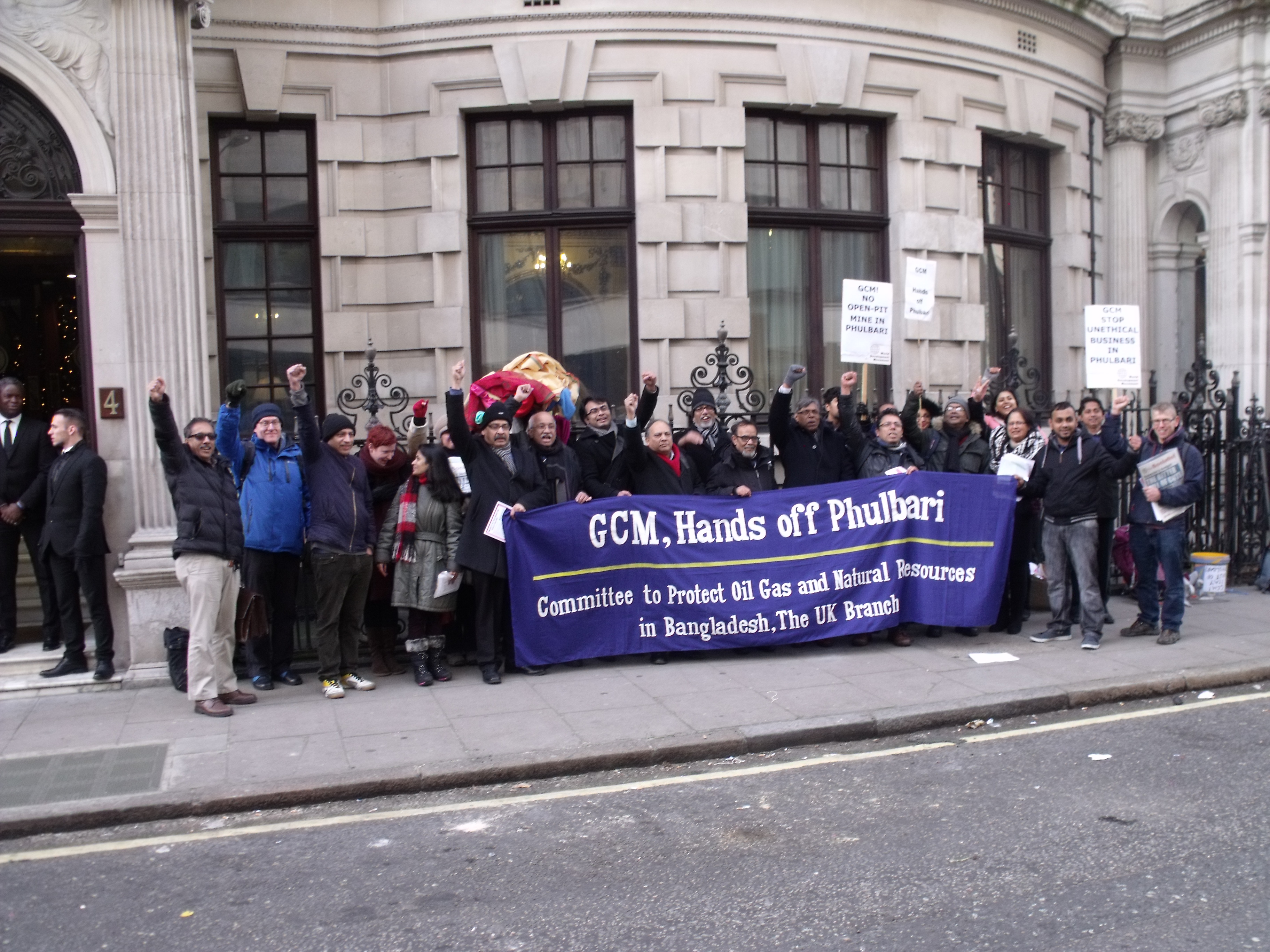
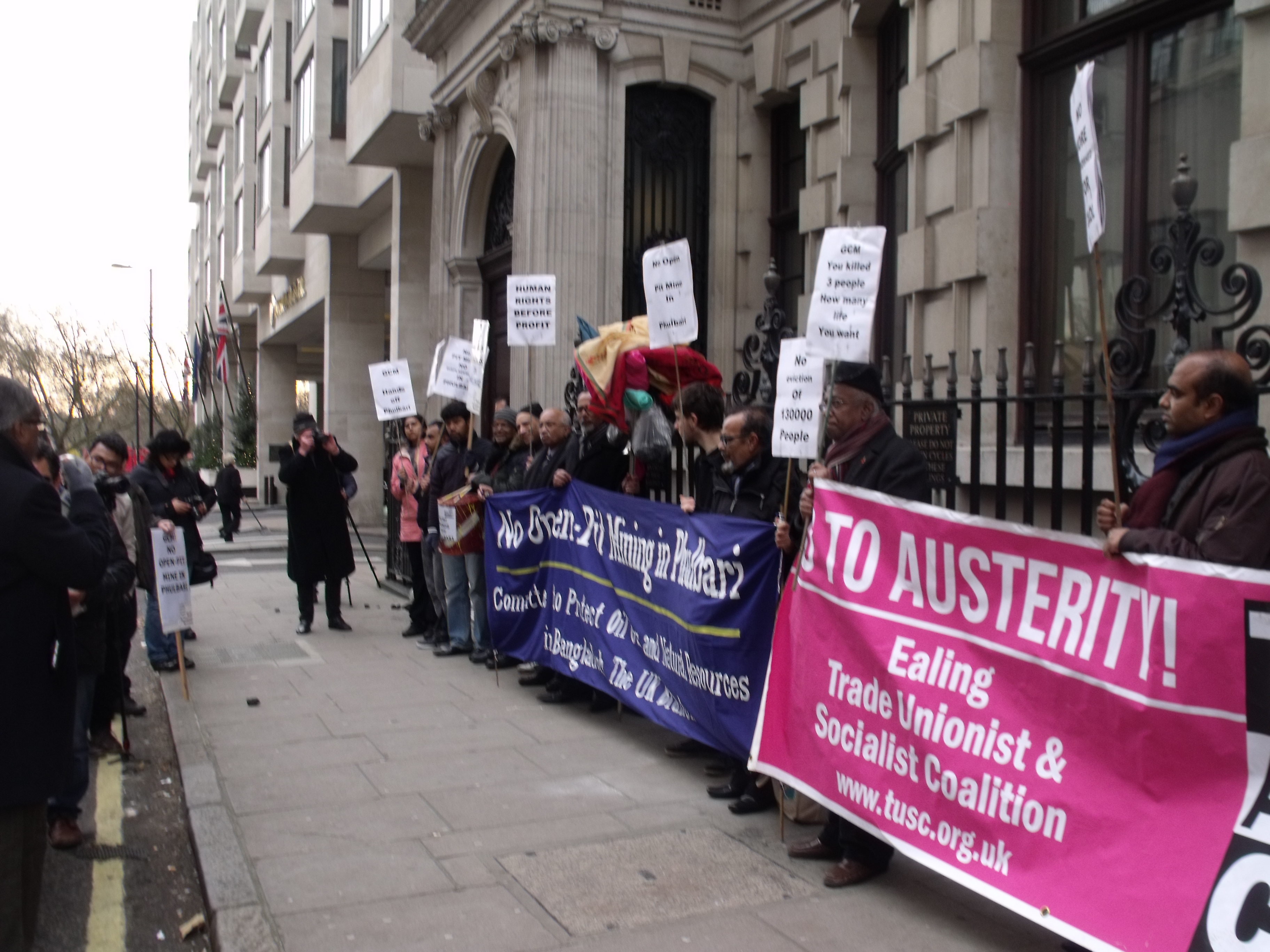
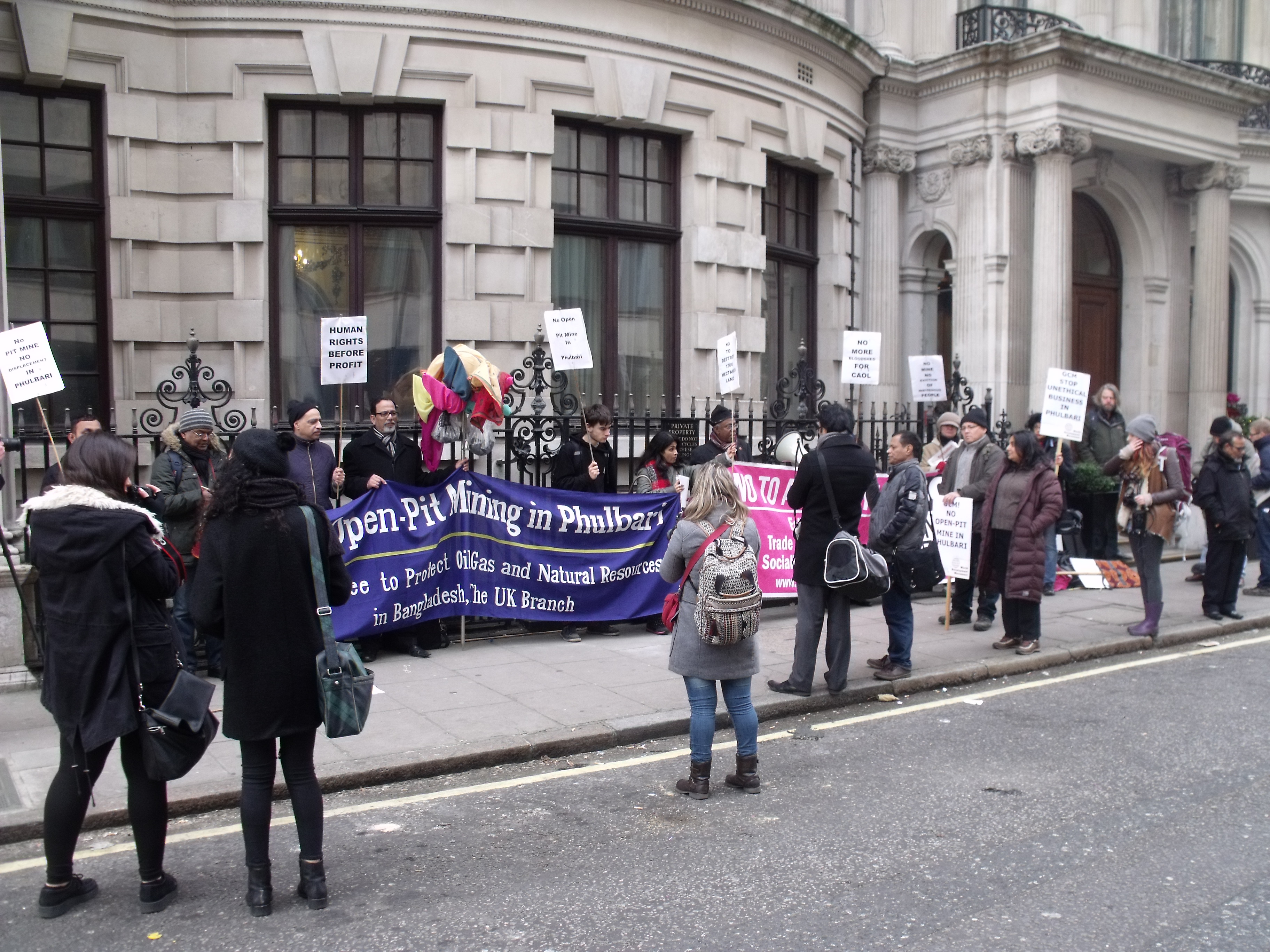
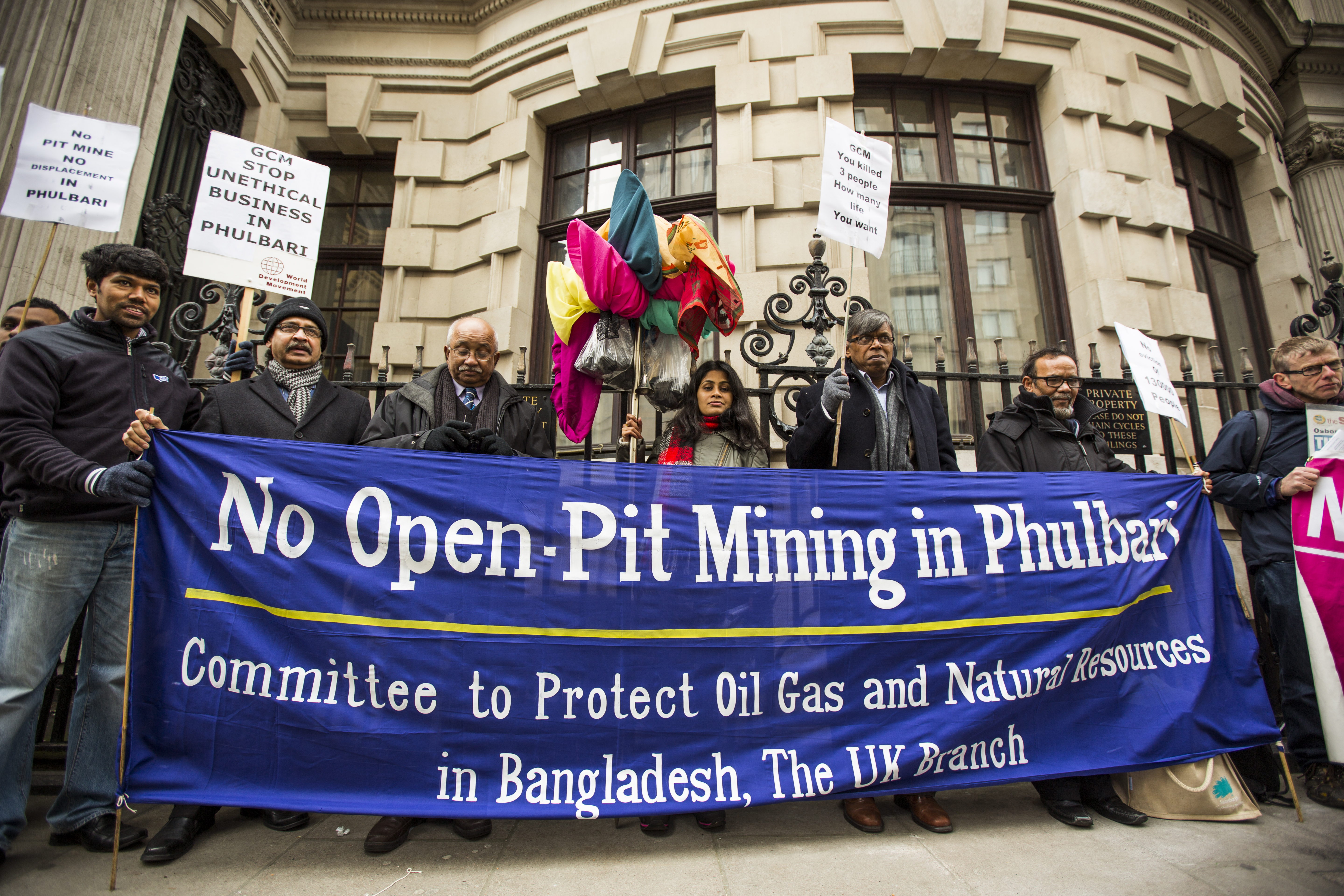
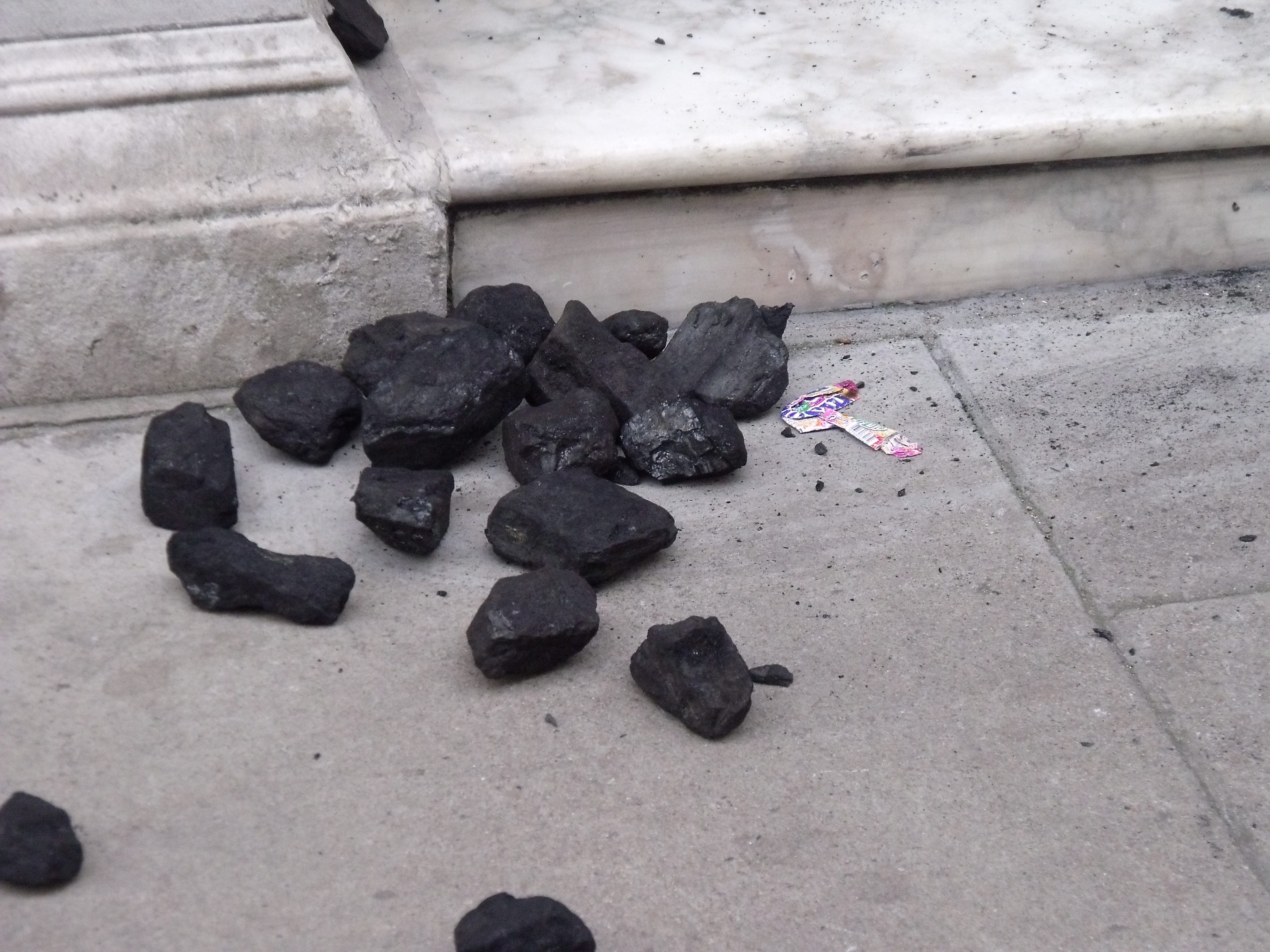
Yesterday, Bangladeshi activists in conjunction with a diverse group of environmental and left political activists in London, heckled the investors of Global Coal Management Resources by their noise demo and coal play. Activists blocked the entrance to the Aeronautical Society by dumping coal in the doorway. They surrounded GCMs’ CEO Gary Lye and his fellows who are aggressively moving ahead to implement a massive open-pit mine in Phulbari, the northwest region of Bangladesh.

At the same time a delegation of protesters disrupted the AGM of GCM by questioning the investors inside the AGM about their fraudulent business in London’s Alternative Share Market (AIM).

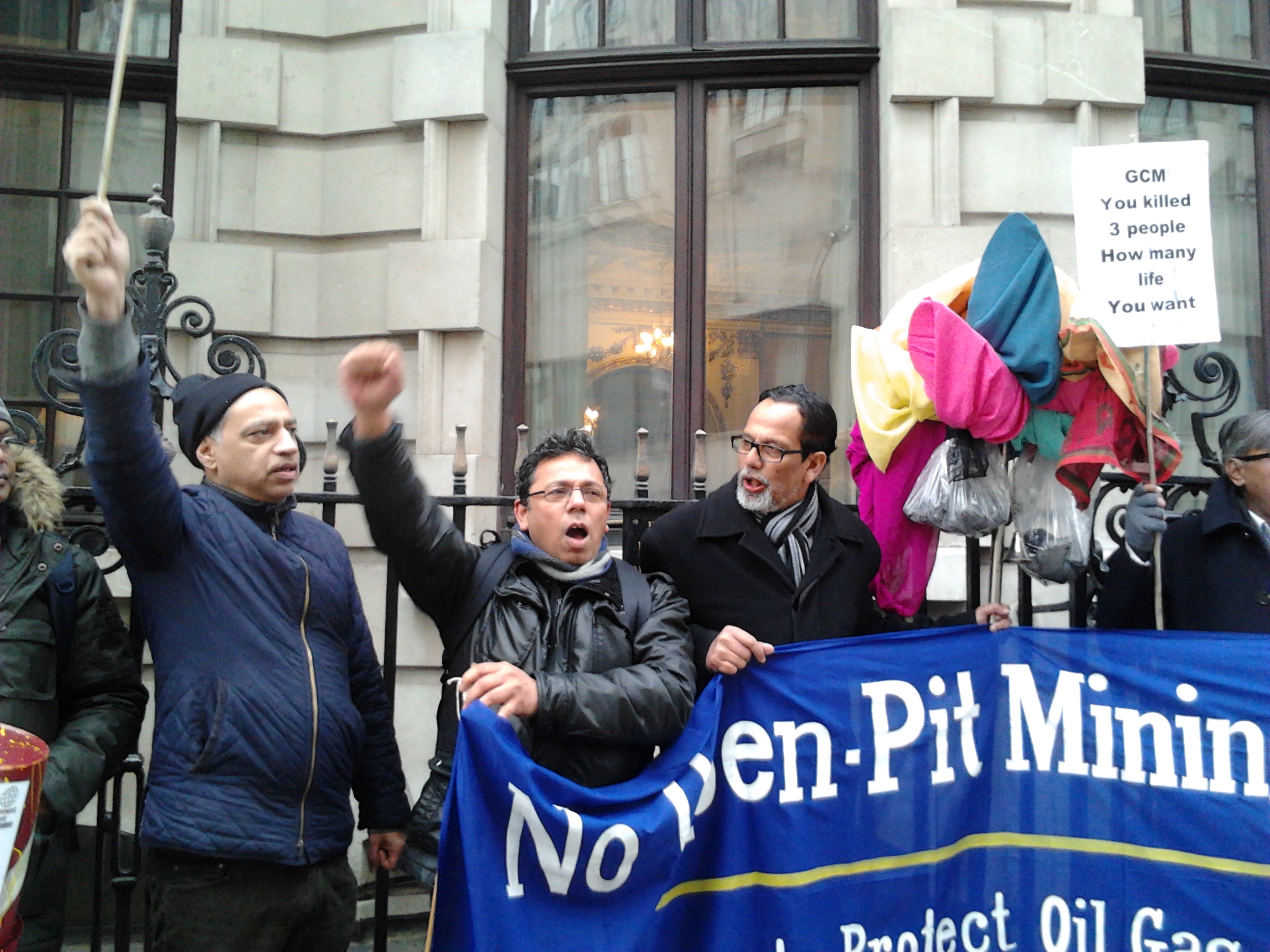
Community activists (from left) of Swadhinota Trust, the UK branch of National Committee and Bangladesh Workers Party (UK branch) chanted slogans defying the company's CEO Gary Lye's pervasive propaganda about the protesters in Phulbari. Photo: P V. Dudman

Community activists (from left) of Swadhinota Trust, Bangladesh Workers Party (UK branch), and the UK branch of National Committee chanted slogans defying the company’s CEO Gary Lye’s pervasive propaganda about the protesters in Phulbari. Photo: Paul V. Dudman

The demo was organised by Phulbari Solidarity Group and the UK branch of the National Committee to Protect Oil- Gas-Mineral Resources and Port-Power in Bangladesh, in conjunction with other community groups and London Mining Network.

The event was endorsed by Socialist Party of England and Wales, World Development Movement, Occupy London, Foil Vedanta, European Action Group of Climate Change in Bangladesh, Trade Unionist and Socialist Coalition, UK, and several community organisations including Nari Diganta, Swadhinota Trust, Udichi Shilpi Gosthi, Jubo Union, Friends of Chatro Union, Bangladesh Workers Party (UK branch), Bangladesh Communist Party (UK branch), and Bangladesh Socialist Party (UK branch).

The Sculpture in Tangail and Silk Sari, held three sacks of coals, symbolising the livelihood, culture, struggle, and resistance of Phulbari people. Photo: Stephen Vince

The event kicks in with the launch of artist Stephen Vince’s beautiful sculpture, symbolising the protest against the miners and the livelihood, culture, struggle, and resistance of Phulbari people. The sculpture, wearing a Tangail and Silk Sari, held three sacks of coals to symbolise the significance of the number three and a tribute to the three people who were killed in the dirty coal game of GCM in Phulbari.

Bangladeshi activists, carrying the sculpture and holding a banner saying – GCM hands off Phulbari, No open pit mine in Bangladesh- started to chant slogans and sing ‘tomar bari amar bari, Phulbari Phulbari’.  Some protesters played drum and samba when Rumana Hashem and Shahriar Ali gave vocals, deriving slogans from Phulbari in Bangla basat vita dhongsho kore koila khoni hobena [destroying homes and land, no mine no mine]. Others attempted to enter the block calling the investors to come out of AGM and to apologise for their misdeeds and abuse in Bangladesh. Loud protesters were repeatedly warned about potential arrest by the authorities of Aeronautical Society (AS) who did not call police but appeared as racist.

Coal dumped on the front door and stairs of Aeronautical Society. Photo: Ansar Ahmed Ullah

Angry protesters dumped coal on the front door and stairs of AS, as they were prevented from taking out Gary Lye. Protesters said that they would not leave the venue before the interrogation of Gary Lye and his fellows was over. Meanwhile, a group of protesters went to check the investors’ vehicles and took over the car park as part of the blockade against Gary Lye, the company’s manipulative CEO, who was expelled from Phulnari for a 3rd time this year, on 26 November, but still continues to abuse Bangladesh government and Phulbari people.

When protesters outside the AGM were checking investor’s vehicles, a delegation of dissident climate justice activists attending the AGM challenged Gary Lye and the board inside the AGM about GCM’s unethical business in London and abusive activities in Bangladesh. Bangladeshi activists rattled the investors to an extent that the Chair was “fade up” and it was Gary Lye who ended up facing the questions about the paperless contract and propaganda of GCM. Phulbari activists challenged that GCM does not have valid contract with Bangladesh.

Diverse group of climate activists and protesters holding placards and listening to speeches by community leaders. Photo: Paul V Dudman

Climate activists of World Development Movement and London Mining Network supported Phulbari Solidarity activists, and asked numerous questions about the highly contentious Phulbari project, its huge human rights impacts and the OECD Guidelines as GCM has breached 2011 Guidelines, which do apply to the planned conduct of an enterprise in terms of prospective impacts on human rights. Activists said that ‘the company was illegitimate, the project illegitimate and the annual general meeting of GCM was illegitimate’.

The meeting broke up unceremoniously and the shareholders broken up into two groups.

Richard Solly of London Mining Network is briefing the demonstrators about the interrogation inside the AGM and the failure of GCM board to answer the questions of Bangladeshi activists. Photo: P V Dudman

Richard Solly of London Mining Network is briefing the demonstrators about the interrogation inside the AGM and the failure of GCM board to answer the questions of Bangladeshi activists. Photo: P V Dudman

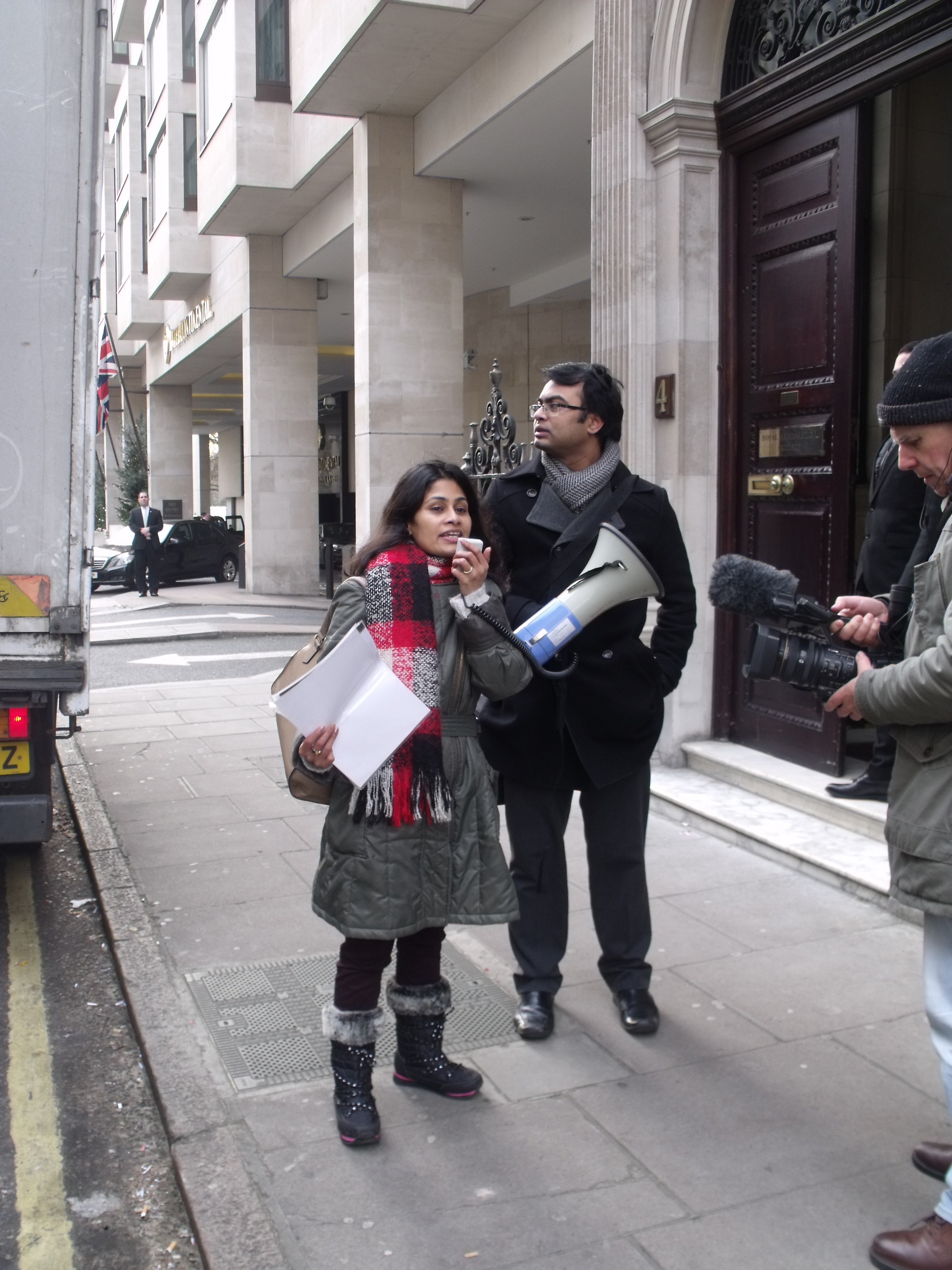
The delegation of climate activists came out of the AGM and joined the protesters outside where Golam Mostofa, Richard Solly, Zahanara Rahman and Sam Sender updated the demonstrators that Gary Lye and his fellows have failed to answer the questions of Bangladeshi activists. ‘They are even lying about national media and the government in Bangladesh’, said Mrs Zahanara.

Protesters chanted slogans ‘Gary Lye is a Lier, Shame on Gary Lye’, GCM and Asia Energy, hushiar sabdhan [be aware of peoples’ power]’. One angry protester attempted to walk into the building with a sack of coal to dump on Gary Lye’s chair, but was prevented from entering the meeting room by the AS’s equally racist authority who received the coal on behalf of the investors.

Speakers in the demo asserted that there is no hope for Asia Energy and GCM in relation to coal business in Bangladesh when the government including the Prime Minister, Energy Minister and Energy Secretary of the country have reaffirmed that Bangladesh will not go for open pit mine in Phulbari. Speakers include  Akhter Sobhan Khan, Abed Ali, Ahmed Zaman, Ansar Ahmed Ullah,  Effie Jordan, Ishak Kajol, Mostofa Farook, Nurul Islam,  Peter Mason, Syed Enam, Shah Enam, Julie Begum, and many more.

The Masters of the event were Shahriar Ali and Rumana Hashem. The event was volunteered by a number of left activists and professional photographers including artist Stephen Vince, Golam Rabbani of Diamond Studios, Nicole Meedrum, Patrick, Chris and many more. The chairperson of National Committee’s UK branch, Dr Mokhlesur Rahman, thanked everybody for coming along and for taking on important theatrical roles.

D

Diverse group of climate activists kept coming and joining the demo which they found extraordinary in London. Photo: Paul V Dudman

The demo ended with a manifesto calling out GCM for an end of GCM’s dodgy deals on Phulbari coal project, and by criticising the UK NCP’s controversial recommendations to the company. The founder and coordinator of Phulbari Solidarity Group, Rumana Hashem, read out the manifesto of the demo and called the London’s AIM to de-list GCM.

The manifesto concludes by expressing full solidarity with the Phulbari people’s struggle and by condemning the UK government for failing to hold the UK-based company accountable.

Dr Hashem reads the statement of the demo. Photo: P V Dudman

Dr Rumana Hashem reads out the statement of the demo. Photo: Paul V Dudman

Miners GCM Resources is the subject of a complaint to the Organisation for Co-operation and Development over the controversial coal mine. They have only one active project, the Phulbari coal project, which awaits permission from the Government of Bangladesh to go ahead. But the people in Phulbari want to put the company out of Bangladesh, ban the Phulbari project and to take the company and its investors to public court for their abusive and fraudulent activities.

Phulbari, the town in upheaval in northwest Bangladesh where three people were shot dead during the protest against immense open pit mine in 2006, has become volatile again since, the Chief Executive Officer (CEO) of the AIM-listed British company, Gary N Lye, attempted to conduct consultation with locals in the town centre. There were two days long blockade in Dinajpur-Dhaka highway, and over a thousand people braved cold to raise their protest at Gary Lye’s visit last month.

Phulbari demo and protest in London ends with a pledge that there will be no mine in Phulbari. Photo: Paul V Dudman

On 26 November, locals in Phulbari surrounded Lye and GCM’s Bangladesh subsidiary Asia Energy‘s local office, and the CEO had to leave Phulbari and Dinajpur in police protection. Violent protests erupted where 2 were injured. Protesters have demanded Gary Lye’s immediate arrest and expulsion from Bangladesh. A month-long programme including nation-wide protests have followed. Protesters will not go back home until their demands are full-filled.

Read also report of LMN about the AGM of GCM here

Watch demo video by Socialist Party of England and Wales  http://youtu.be/pI2_jfGA5wA

Watch News by Channel24 http://youtu.be/srx80GbFQPs

Check out the Photo gallery here

Read also Foil Vedanta report here

Read Campaigners keep up fight to stop Bangladesh coal

More news can be found here on GB News24.com

Read Bangla news about Phulbari demo in London: Prothom Alo news

More news: http://www.m.banglanews24.com/detailnews.php?nid=348121&cid=1018

More Bangla news can be accessed from Protect Resources of Bangladesh

Read News about GCM’s/Gary Lye’s paperless business in Bangladesh here

Read how Asia energy’s day are ending in Bangladesh

News about Bangladesh government’s latest position about Asia Energy/GCM

News about volatile Phulbari can be accessed here

Surround GCM! Surround the Dirty Coal Miners!

Manifesto of the Demo against the Dirty Coal Miners of Asia Energy/GCM 2014

Tuesday, 9 December, 2014. London

DSCF7379 DSCF7384
Today we, the activists from Bangladesh,  East London, the Borough of Tower Hamlets, and London’s environmental organisations, have gathered to call upon the AIM-listed London-based multinational company, GCM Resources Plc, to end its unethical business. The company, GCM Resources, is desperately moving to implement an immense open pit coal mine in northwest Bangladesh, forcibly displacing an estimated 130, 000 people and destroying the homes, lands, and water sources of as many as 220,000 people. If the project is implemented, it will destroy over 14,660 acres of fertile agricultural land that produce three food crops annually, threatening to increase hunger in a country in which over a third of all children and nearly 17 percent of the entire population are undernourished.

GCM’s planned Phulbari coal mine has provoked repeated protests by local people. Three people were killed and over 200 injured when paramilitary officers opened fire on a protest against the project in August 2006. Protests in 2013 forced the company’s CEO, Gary Lye, to abandon a visit to the area.


The project has generated grave concern at national and international levels including the United Nations. On 28 February, 2012, seven UN human rights experts have called for an immediate halt to the project, citing threats to fundamental human rights, including the rights to water, food, adequate housing, freedom from extreme poverty and the rights of indigenous peoples. But GCM is aggressively moving ahead to implement this project.They are selling fraudulent shares in London’s Alternative Investors Market (AIM) without any valid contract with Bangladesh Government.


The situation in Phulbari has become tense and volatile again since Tuesday the 25th November, when the company’s Chief Executive Officer (CEO), Gary N Lye, attempted to visit Phulbari. Gary Lye is the man who called the protesters outsiders in 2006, and commented, after the death of three people shot by police at a demonstration, that “I am a businessman, [ …] I will continue my business in Phulbari’ regardless of whether there was a bloodshed or not. Therefore, people in Phulbari braved cold to raise their protest at Gary Lye’s attempted visit. Over a thousand people blocked the Dinajpur-Dhaka highway for five hours, demanding Lye’s arrest and expulsion from Bangladesh. In Phulbari there were two days long protests outside GCM’s Bangladesh subsidiary Asia Energy’s local office. Violent protests erupted where 2 were injured.


On Wednesday, 26 November, the company’s CEO, Gary Lye, attempted to conduct consultation with locals in Phulbari following advice of the UK government which was released on Thursday, 20 November. The UK government’s statement follows an investigation into GCM’s activities in Phulbari, and it concluded that the company had breached the OECD Guidelines on Multinational Enterprises by failing to “foster confidence and mutual trust” with the people who would be affected by the mine. We welcome the Board’s affirmation that the 2011 Guidelines on human rights do apply to the planned conduct of an enterprise and its prospective impacts on human rights (para 6).  We welcome also the finding that the 2011 Guidelines would apply if GCM “continued to be “actively involved in the project” (para 19).

 
But we are hurt by the ambiguous conclusion of the investigation. The investigation does not ask the company to pull off from the devastating project. Its recommendations are reduced to re-evaluation of the risks and impact. It asked the company to foster communication with the locals following a narrow approach. The final-published investigation failed to consider how the mine would affect the people of Phulbari if it were built, and its conclusions were limited to GCM’s record in the planning phase of the project to date. Although an internal review of the investigation affirmed that the OECD guidelines do apply to human rights abuses that would occur if the project went ahead, the final report failed to address the concerns of the internal review and did not correct the decision to exclude all potential impacts of the project from the investigation. We condemn the UK government for failing to hold their businessmen to account. We condemn the UK National Contact Point for failing to cite the extremely important first-hand accounts from Phulbari. We believe that it is the chair of the NCP, Liz Napier, who played a dirty game in this whole OECD investigation.


Liz Napier and her team at the Department for Business, Innovation and Skills have overlooked many of our first-hand accounts, allowing the dirty coal miners of GCM Resources, Gary Lye, to go back to Phulbari for an unexpected re-evaluation of the situation. The visit of dirty miner, Gary Lye, has sparked protests leading to fresh violence in one of Bangladesh’s most peaceful town, Phulbari. We demand that Liz Napier and her team at UK National Contact Point must take the responsibility for the recent turmoil in Phulbari. We call for a suspension of Liz Napier from her current post at UK’s Department for Business, Innovation and Skills.


The OECD investigation followed a complaint submitted by the World Development Movement and International Accountability Project. We appreciate the initiative of International Accountability Project and World Development Movement (thereafter Global Justice Now) in support of the people in Phulbari. Although the UK government has failed to hold this UK-based company to account, it is clear that the people of Phulbari will resist GCM’s project going ahead. Phulbari people have made it clear by declaring their month long programme in demand of GCM’s CEO’s arrest and expulsion from Bangladesh. We extend our full solidarity to the people in Phulbari.


We will continue to call upon the London AIM to delist the dirty miners, GCM Resources, from London’s Alternative Share Market. Our Secretary of Energy and Mineral Resources Division,  Abu Bakar Siddique, reaffirmed that Asia Energy has no valid licence to develop Phulbari coal mine. Miner GCM must stop the propaganda about Phulbari coalmine. Our people do not want to leave their homes and land. Phulbari people will not work in a coal mine. GCM’s propaganda to create 17,000 new jobs in coal mine cannot ensure livelihood for 130,000 people feared to be affected during exploration in open pit method over the next 35 years. We will not let our people to die and our environment to de destroyed by dirty miners of GCM.


The UK Committee (National Committee) to Protect Oil- Gas-Mineral Resources and Port-Power in Bangladesh, in conjunction with Phulbari Solidarity Group, London Mining Network, World Development Movement, Foil Vedanta, Socialist Party of England and Wales, Occupy London, European Action Group of Climate Change in Bangladesh, the Trade Unionist and Socialist Coalition in UK and all our co-worker organisations, will continue to call for the company to be de-listed from the London Alternative Investors Market. We declare, on behalf of the people in Phulbari, this UK based company will never go back to Bangladesh. Asia Energy’s Chief Executive Officer, Gary Lye, and investors of GCM Resources were ousted from Phulbari.  They will be resisted and the company will be uprooted from London soon.

_S_L4007 DSCF7409

‘Prime Minister Sheikh Hasina has directed the energy ministry to wait for ‘new technology’ before going for coal extraction’

‘Prime Minister Sheikh Hasina has directed the energy ministry to wait for ‘new technology’ before going for coal extraction’

Wait for ‘new technology’: PM

Stressing the need to protect arable land, Prime Minister Sheikh Hasina has directed the energy ministry to wait for ‘new technology’ before going for coal extraction.

She also outlined the ministry’s future challenges and ways to tackle them.

State Minister Nasrul Hamid Bipu briefed journalists on Thursday after her first visit to the ministry in two-and-a-half-years.

“The Prime Minister told ministry officials that new technology to extract coal may become available soon. We will wait for it,” he said quoting the Prime Minister.

Hasina’s directive comes amid controversies on whether Bangladesh should go for open-pit mining along with importing coal to meet increasing power demands.

Hamid was, however, silent on coal extraction issues. He also did not explain how thermal power production could be raised while waiting for ‘new technology’.

He said the Prime Minister wanted protection of farmers’ land first and coal extraction to be left to the future.

Hamid said Hasina, who also holds the energy portfolio, had ordered the stepping up of coal extraction research.

State-run oil, gas and mineral resources corporation Petrobangla claims Bangladesh has five coal mines with an estimated combined reserve of 3.1 billion tonnes.

Currently, an estimated 1.65 million tonnes of coal is produced annually from one of the mines through underground mining.

A group of experts, environmentalists, various Leftist fronts oppose open-pit mining which pollutes the environment, lays waste to arable land and displaces the habitants.

Despite a matter of high priority, the government has failed to formulate a coal policy in the past decade.

About 75 percent of Bangladesh’s power comes from gas while coal is used to produce less than 3 percent.

The government claims electricity generation increased nearly 5,000MW over the past five years. A ‘Festival of Light’ was held in Dhaka last year to mark the production of 10,000MW, hitting a new milestone in the country. It also plans to raise power production to 30,000MW by 2030, half of which would come from coal.

However, according to information presented in Parliament last June, around 40 percent people still do not have access to electricity.

Bipu said the Prime Minister had directed the setting up of a coal-fired power plant near the Paira Port in southern Patuakhali.

The government recently faced a wave of protests when it decided to go ahead with a 1,320MW thermal power plant at Rampal, near the Sunderbans.

Full article – bdnews24.com/bangladesh/2014/02/06/wait-for-new-technology-pm


PM’s strategy on coal: Asia Energy’s future with Phulbari bleak

Reported by: UNBconnect
Reported on: February 8th, 2014 12:02:55 am

Dhaka, Feb 7 (UNB) – The future of Phulbari coal mine project of UK-based Asia Energy, since renamed as Global Coal Management (GCM), has become bleak following the Prime Minister’s recent distinct statement on coal mining in the country.


While holding meeting with Power and Energy Ministry’s top officials on Thursday (February 6), Prime Minister Sheikh Hasina said: “Right now, we want to leave the issue of coal extraction to the future technology as food security and protecting the land of the farmers is the first priority.”


The Asia Energy entered Bangladesh in 2003 buying a contract from Australian company BHP to explore coal in Phulbari of Dinajour district. But when Asia Energy moved to execute its project as an open-pit mining, it faced tremendous opposition from local community and environmentalists.


The major protests took place on August 30 in 2006, where six protesters were shot dead, allegedly by paramilitary forces, and 300 were injured when a crowd of 30,000 people stormed the local offices of Asia Energy in Dinajpur.


The incident forced the government to announce postponement of the operation of Asia Energy’s Phulbari project. The Asia Energy was renamed as Global Coal Management (GCM) in 2007.


Recently, different activities of Asia Energy or GCM have been suggesting that the company is planning to come back in a new way to implement its project. Particularly, the GCM, a listed company with London Stock Exchange showing Phulbari coal mine as its project, became active in the country’s northern region where it recently launched some campaigns to garner local public support in its favour.


The GCM’s campaign raised serious concern among the anti-Phulbari activists who also threaten to reactivate their protest to resist the UK-company’s move.


Meantime, GCM reconstituted its board of directors and brought major changes in its Dhaka as well as London office by putting some new directors and staffs which also suggests the company is really coming up with new enthusiasm.


Sources said the company also recast its strategy to win the deal for exploration of the proposed Phulbari coal mine.


As part of the new strategy, the company has inducted a young Malaysian tycoon as a Non-Executive Director, removing a Briton from the Board of Directors.


With the announcement, Malaysian tycoon Dato’ Md Wira Dani Bin Abdul Daim has replaced British entrepreneur Neil Lindsey Herbert from the board of directors of GCM.


“Under the leadership of Malaysian business tycoon, the GCM was eyeing to rearrange its strategy in winning a deal for commercial exploration of the proposed Phulbari coalmine district,” said a source.


The GCM appointed Mettiz, an investment company with significant corporate and financial experience in natural resources, power generation, manufacturing and real estate, a lobbyist in Bangladesh last year to get approval of the government for commercial exploration of the Phulbari coalmine.


But, energy industry insiders thought the Prime Minister’s statement has made it clear that the project is unlikely to be executed in near future.


Quoting the Prime Minister, State Minister for Power and Energy Nasrul Hamid said she has given us a directive regarding coal extraction saying that “first of all we need” food security and land use.


“Only after ensuring food security and protecting farmers’ land, we’ll decide which technology we’ll use to extract coal,” he told reporters following the PM’s meeting.


Asia Energy Bangladesh’s CEO Gary Lye, however, said Phulbari Coal Project uses the land for mining temporarily. Land is immediately rehabilitated and returned to agriculture after extracting the coal which is a far greater benefit for the country.


He said Asia Energy is concerned to ensure food security and the company’s agriculture improvement plan will increase the food production from the area as well as allow coal extraction and jobs.


“We (will) welcome the opportunity to brief the Prime Minister on these plans and show how she can deliver for the people and country coal, major power and food security. People from the area want the coal mining and development benefits it’ll bring to them and their region which is one of the Bangladesh poorest regions.”   


Bangladesh has five coal fields with an estimated reserve of some 3.0 billion tonnes, industry insiders said. Of the five coal fields, only one in Barapukuria is now in operation.

– See more at: http://unbconnect.com/pm-coal-ld/#&panel1-2

PM’s strategy on coal: Asia Energy’s future with Phulbari bleak

Reported by: UNBconnect
Reported on: February 8th, 2014 12:02:55 am

Dhaka, Feb 7 (UNB) – The future of Phulbari coal mine project of UK-based Asia Energy, since renamed as Global Coal Management (GCM), has become bleak following the Prime Minister’s recent distinct statement on coal mining in the country.


While holding meeting with Power and Energy Ministry’s top officials on Thursday (February 6), Prime Minister Sheikh Hasina said: “Right now, we want to leave the issue of coal extraction to the future technology as food security and protecting the land of the farmers is the first priority.”


The Asia Energy entered Bangladesh in 2003 buying a contract from Australian company BHP to explore coal in Phulbari of Dinajour district. But when Asia Energy moved to execute its project as an open-pit mining, it faced tremendous opposition from local community and environmentalists.


The major protests took place on August 30 in 2006, where six protesters were shot dead, allegedly by paramilitary forces, and 300 were injured when a crowd of 30,000 people stormed the local offices of Asia Energy in Dinajpur.


The incident forced the government to announce postponement of the operation of Asia Energy’s Phulbari project. The Asia Energy was renamed as Global Coal Management (GCM) in 2007.


Recently, different activities of Asia Energy or GCM have been suggesting that the company is planning to come back in a new way to implement its project. Particularly, the GCM, a listed company with London Stock Exchange showing Phulbari coal mine as its project, became active in the country’s northern region where it recently launched some campaigns to garner local public support in its favour.


The GCM’s campaign raised serious concern among the anti-Phulbari activists who also threaten to reactivate their protest to resist the UK-company’s move.


Meantime, GCM reconstituted its board of directors and brought major changes in its Dhaka as well as London office by putting some new directors and staffs which also suggests the company is really coming up with new enthusiasm.


Sources said the company also recast its strategy to win the deal for exploration of the proposed Phulbari coal mine.


As part of the new strategy, the company has inducted a young Malaysian tycoon as a Non-Executive Director, removing a Briton from the Board of Directors.


With the announcement, Malaysian tycoon Dato’ Md Wira Dani Bin Abdul Daim has replaced British entrepreneur Neil Lindsey Herbert from the board of directors of GCM.


“Under the leadership of Malaysian business tycoon, the GCM was eyeing to rearrange its strategy in winning a deal for commercial exploration of the proposed Phulbari coalmine district,” said a source.


The GCM appointed Mettiz, an investment company with significant corporate and financial experience in natural resources, power generation, manufacturing and real estate, a lobbyist in Bangladesh last year to get approval of the government for commercial exploration of the Phulbari coalmine.


But, energy industry insiders thought the Prime Minister’s statement has made it clear that the project is unlikely to be executed in near future.


Quoting the Prime Minister, State Minister for Power and Energy Nasrul Hamid said she has given us a directive regarding coal extraction saying that “first of all we need” food security and land use.


“Only after ensuring food security and protecting farmers’ land, we’ll decide which technology we’ll use to extract coal,” he told reporters following the PM’s meeting.


Asia Energy Bangladesh’s CEO Gary Lye, however, said Phulbari Coal Project uses the land for mining temporarily. Land is immediately rehabilitated and returned to agriculture after extracting the coal which is a far greater benefit for the country.


He said Asia Energy is concerned to ensure food security and the company’s agriculture improvement plan will increase the food production from the area as well as allow coal extraction and jobs.


“We (will) welcome the opportunity to brief the Prime Minister on these plans and show how she can deliver for the people and country coal, major power and food security. People from the area want the coal mining and development benefits it’ll bring to them and their region which is one of the Bangladesh poorest regions.”   


Bangladesh has five coal fields with an estimated reserve of some 3.0 billion tonnes, industry insiders said. Of the five coal fields, only one in Barapukuria is now in operation.

– See more at: http://unbconnect.com/pm-coal-ld/#&panel1-2