Protesters Call To DE-LIST Global Coal Management PLC.From London Stock Exchange

Commemoration and celebration go together at London Stock Exchange 26 August 2016 Photocredit Peter Marshall

Commemoration and celebration go together at London Stock Exchange 26 August 2016 Photo credit: Peter Marshall

PHULBARI DAY VIGIL TURNS INTO HEATED DEMO

By Paul Dudman

Friday the 26th August, marked a decade of halt to plans by an AIM-listed British company, Global Coal Resources Management (GCM), who want to build a massive open cast coal mine by forcibly displacing 130,000 people in Phulbari, northwest Bangladesh. A four day long Commemoration for victims of Phulbari outburst, where three protesters were shot dead by police in 2006, was held in Dkaka, Dinajpur, Phulbari, London and Germany.

On the final day of remembrance, on 30th August, the National Committee to Protect Oil, Gas, Mineral Resources, Power and Ports in Bangladesh has declared a fresh programme in Phulbari to kick GCM out of Bangladesh as the CEO of the company has recently filed multiple arbitrary charges against indigenous farmers, small businessmen and local leaders who opposed the mine.


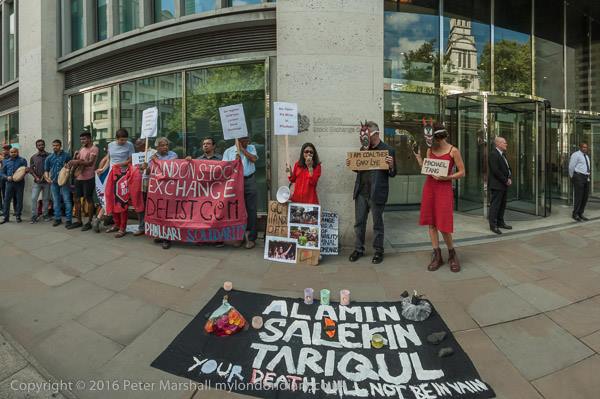
In London Bangladeshi and South Asian community activists under the banner of Phulbari Solidarity Group held a colourful and powerful commemoration rally outside the London Stock Exchange , calling for the de-listing of the company from London’ share market. Despite heavy securitization and repeated attempts of interruptions by British police, angry protesters blocked the pavement of the entrance of London Stock Exchange for two hours and demanded immediate de-registration of GCM for its unethical business, deceitful marketing of Phullbari project, and for human rights abuse in Dinajpur and Phulbari.

Of what was meant to be a Red Vigil for Victims of Phulbari has turned into a commemoration come noise demo as the CEO of London Stock Exchange, Xavier Rolet KBE, failed to respond to the protesters’ call for de-listing of GCM.  Priorhand, the Phulbari Solidarity Group has contacted the CEO of London Stock Exchange and submitted evidence of unethical business of the company. But the CEO did not respond to their request for an appointment, said Rumana Hashem of Phulbari Solidarity Group. 
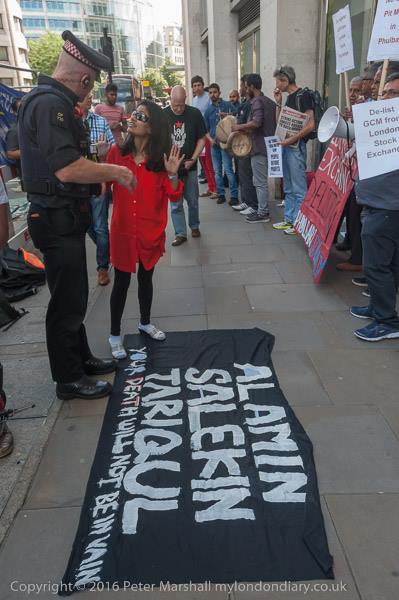
 

Police objects to PSG Founder Rumana Hashem to remove the banner from the pavement copyright Peter Marshall

Police objects to the blockade of LSE pavement but  PSG Founder Rumana Hashem says:” the banner for the victims will not be removed.” Photo credit: Peter Marshall

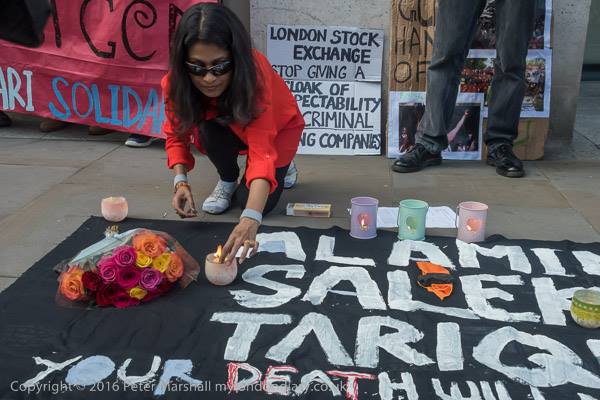
A remembrance vigil was held, followed by an angry demo with Santal and Tamil drumming, and ended with tribute being paid by laying wreaths, flowers and lighting candles for the three people who were killed by paramilitary force, allegedly paid by the company, in Phulbari on 26 August in 2006.

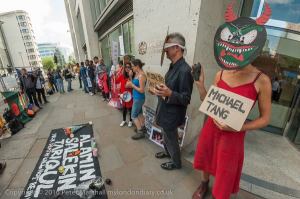
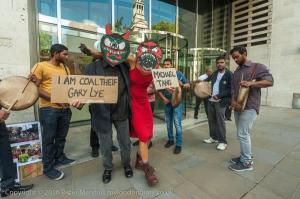
Wearing masks of Gary Lye (CEO of GCM) and Michael Tang (the Chairman of the company), the protesters sang Phulbari jingles against coal mine. The protest observed a three-minute silence for the three victims, Al Amin, Mohammad Salekin, and Tarikul Islam, who died in the Phulbari shooting. Dressed in red, blue and black, protesters laid down a banner for victims, stating “YOUR DEATH WILL NOT BE IN VAIN”, on the pavement of the London Stock Exchange.

Protesters from Bangladesh were joined by international and British environmental campaigners, and advocates for human rights, anti-mining movement and workers rights.
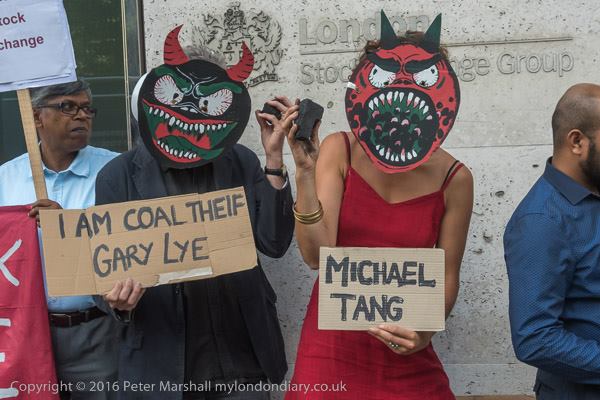
Shameless Gary Lye and Blatant lyer Michael Tang dance with coal over deadbodies Photocredit Peter Marshall

GCM CEO Gary Lye and company Chairman Michael Tang stood as numb and blatant guilty copyright Peter Marhsall

GCM CEO Gary Lye and company Chairman Michael Tang stood as numb and blatant guilty. Photocredit: Peter Marhsall

Dressed in red, blue and black protesters outside the London Stock Exchange paid a two-hour homage to the victims. A banner, stating “YOUR DEATH WILL NOT BE IN VAIN” was laid on the pavement of the London Stock Exchange Group’s Headquarter for International Trading.
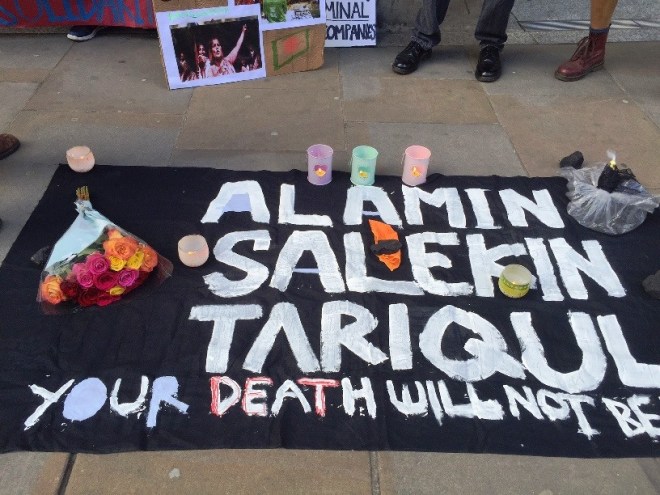
Hand-painted banner for victims of Phulbari shooting. Photocredit: Peter Marshall

Hand-painted banner for victims of Phulbari shooting. Photocredit: Peter Marshall

Protesters from Bangladesh were joined by international and British environmental campaigners, and advocates for human rights, anti-mining and workers rights. Among others, Foil Vedanta, European Action for Climate, London Mining Network, Global Justice Campaign, the Socialist Party of England and Wales, Tamil Solidarity, UK Commitee to Protect Resources of Bangladesh, and Voice of Freedom have made it explicit that they will stand with Phulbari people in their struggle.

The sound of compassion, sadness, empowerment and resistance echoed in the protest, and the firm speeches by passionate activists and outrageous crimes by British multinational companies overseas was heard by the entire Paternoster Square on Friday – although none from London Stock Exchange seemed concerned about these crimes.

Simultaneously, tributes were paid to the victims of Phulbari at National Martyrs Monument in Dhaka, and red vigil and cultural events took place in Phulbari under the banner of National Committee to Protect Oil, Gas, Mineral Resources, Power and Port in Bangladesh (NCBD in short). In the four-day commemoration events (26-30 August) and celebration of the halt, they demanded the ban of the company in Bangladesh for its ongoing abuse of activists in Phulbari and increasing corruption in Bangladesh.
 

Christine Hague of Global Justice told how partially OECD complaint agaisnt GCM was treated by UK NCP Photocredit Peter Marshall

Christine Hague of Global Justice Now told about how partially OECD complaint against GCM was treated by UK NCP. Photo credit: Peter Marshall

The company has been allegedly involved in various forms of abuse and harassment of local activists and opponents of the proposed Phulbari mine. Media report on the brutal death of Nasrin Huq , the former executive director of Action Aid in Dhaka, revealed that in 2005 Huq was killed brutally in her car park for her opposition to the project. A report to which the company was unable to respond was published in the Observer.[i]  Later in 2006 three people were shot dead and two hundred injured in a demonstration of 80,000 people who marched against plans by the company. Local organisers have reported that the company has bribed the paramilitary personnel and forced them to open fire against the decision of the Police Magistrate on duty who stated that there was no permission for shooting on people. There were over 200 people injured and many abused on the same day. The day has been called Phulbari Day since, and powerful resistance in the aftermath of the shooting against open-cast mine in Phulbari has put a decade long halt to the project. Government has cancelled the company’s license. But the company has been pushing the government to give them a go ahead.
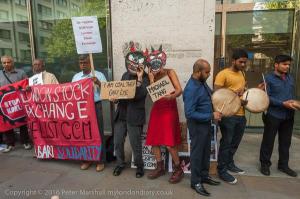
Shameless Gary Lye and Michael Tang dance with coal over deadbodies Photocredit Peter MarshallThe company’s CEO, Gary N Lye, has been allegedly harassing opponents of the project and the company has been extremely abusive to indigenous farmers, local organisers of Phulbari outburst, and small business entrepreneurs who demanded the company’s ban in Phulbari. After the shooting and deaths of three people on 26 August in 2006, Gary Lye stated that he is businessman and he understands nothing but coal. In a live interview with Farzana Rupa on ATN Bangla TV, Lye said: “I am a businessman , my business is to extract coal. It is not my business to know who dies and who cries” (ATN Bangla News, 26 August 2006).  Locals have declared that this CEO is unwanted in Phulbari and when he attempted to re-enter Phulbari town he was resisted by locals in November 2014.

Background

Last month, a day before the International Mangrove Action Day when Bangladeshis was focused on the controversial deal on Rampal power plant, the company has filed multiple cases against 26 key indigenous organisers and local leaders, farmers, small scale business entrepreneurs, and students who opposed the mine in Phulbari. The arbitrary charges formed on 25 July, 2016, at Dinajpur Magistrate Court appeared as extremely abusive and the next hearing on 7 September will be a crucial day for all those fighting the fraught.

The NCBD has declared a fresh programme on Phulbari Day to fight GCM and ban the Phulbari project. This includes rally demanding a ban of the company in Phulbari on 25 October, blockade of the Dinajpur District Commissioner’s Office on 21 November and half-day strike in Phulbari on 21 December. If demands are unfulfilled by December, intense and unending strike would start. Phulbari Solidarity Group believes that that this will not be needed as activists in London will hold the company to account and will ensure a ban of GCM from London Stock Exchange before the end of this year.
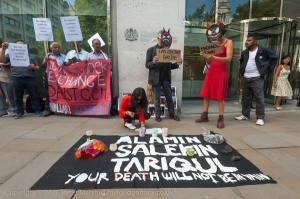
Paying tribute to the victms of Phulbari with flowers and by lighting candles on 26 Aug 2006 at London Stock Exchange

 Protesters is paying tribute to the victms of Phulbari with flowers and by lighting candles on 26 Aug 2006 at London Stock Exchange. Photo credit: Kerima Mohiuddin

Although GCM does not have a valid contract with Bangladesh, they are selling shares in the name of Phulbari project. The company has changed its name from Asia Energy to Global Coal Management in 2010, and continued lobbying for Phulbari coal mine in Bangladesh. If the mine is built, 130,000 families of farmers in Phulbari would be forcibly displaced. It would destroy 14,600 hectares of highly cultivable land, would pose threats to clean water resources and would leave devastative impact on one of the world’s largest mangrove forests and UNESCO heritage site, the Sunderbans.  Despite grave concerns at national and international level, and declaration made by seven UN rapporteurs, GCM is pushing the government to give it a go ahead.
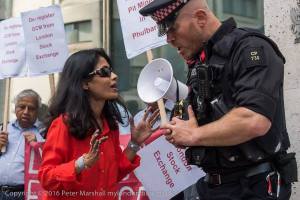
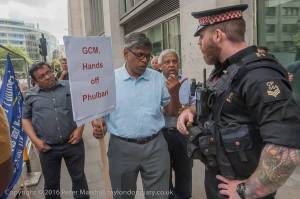
Arguments with Police who prohibited Rumana Hashem to display the banner for the victims on the pavement Copyright Peter Marshall Gary Lye and Michael Tang shamelessly danced with coal over deadbodies Photocredit Peter Marshall

Arguments with Police - a community leader tells Police not to interfere with demonstrators. Photocredit: Peter Marshall

Arguments with Police – a community leader tells Police not to interfere with demonstrators. Photo credit: Peter Marshall

Phulbari Solidairty Group Founder and an eye witness to the shooting in 2006 lights a cnadle for the victims of Phulbari on 26 August 2006 at London Stock Exchange. Photocredit : Peter Marshall

Phulbari Solidairty Group’s Founder and an eye witness to the shooting in 2006, Dr Rumana Hashem, lights a candle for the victims of Phulbari at the entrance of London Stock Exchange. Photo credit : Peter Marshall

Contact for further information:  07714288221, 07956260791.

Further news, photos and videos:

Ten years of Resistance to Phulbari Open Cast Mine: Peter Marshall’s Mylondondiary.co.uk

A video of the noise-demo to de-list GCM from London Stock Exchange (by Pete Mason of Socialist Party of England and Wales): https://youtu.be/-_cKiRWt9NI

London Stock Exchange targeted by Bangladeshi activists: Foil Vedanta report

Phulbari Day protest outside London Stock Exchange: Begum24.com by Ansar Ahemd Ullah

[i]  The mystery death of Nasrin Huq –a report to which the company was not able to respond to, was derived from http://www.guardian.co.uk/world/2006/sep/03/bangladesh, last cited on 01. 01. 2013

An Eye Witness of the shooting and outburst in Phulbari: Keeping Coal Resources under the Ground with Blood, A Different Revolution

New Programme to Kick GCM out of Bangladesh declared on Phulbari Day: BNP is Not our Friend 

Mark the Decade of Resistance, Mark Phulbari Day!

Celebrating 10 years of Halt to Open Cast Mining, Commemorating the lives of brave Villagers

What? RED Vigil at London Stock Exchange

 When? 11am to 1pm on Friday, 26 August 2016

Where? London Stock Exchange HQ for International Trading , 10 Paternoster Square, London EC4M 7LS  (nearest tube station: St Paul’s)

Find Map

Phulbari 2014


Friday, the 26th of August marks a decade of the Phulbari outburst. In 2006 three people were shot dead and two hundred injured in a demonstration of 80,000 people who marched against plans by an AIM-listed British company, Global Coal Resources Management , who wants to build a massive open cast coal mine in Phulbari, a location in northwest Bangladesh. The day has been called Phulbari Day since, and powerful resistance in the aftermath of the shooting against open-cast mine in Phulbari has put a decade long halt to the project. Government has cancelled the company’s license. Although GCM does not have a valid contract with Bangladesh, they are selling shares in the name of Phulbari project. The company has changed its name from Asia Energy to Global Coal Management in 2010, and continued its dodgy deals and lobbying for Phulbari coal mine in Bangladesh.

If the mine is built, 130,000 families of farmers in Phulbari would be forcibly displaced. It would destroy 14,600 hectares of highly cultivable land, would pose threats to clean water resources and would leave devastative impact on one of the world’s largest mangrove forests and UNESCO heritage site, the Sunderbans.  Despite grave concerns at national and international level, and declaration made by seven UN rapporteurs, GCM is pushing the government to give it a go ahead.
The National Committee to Protect Oil, Gas, Port-Power and Mineral Resources in Bangladesh has called upon national and global environmentalists to observe 10th anniversary of Phulbari outburst and to protest against GCM’s dodgy business and to mark the decade of Phulbari Resistance.  In conjunction with the Committee to Protect Oil, Gas, Port-Power and Mineral Resources, we will celebrate the decade-long struggle in London.

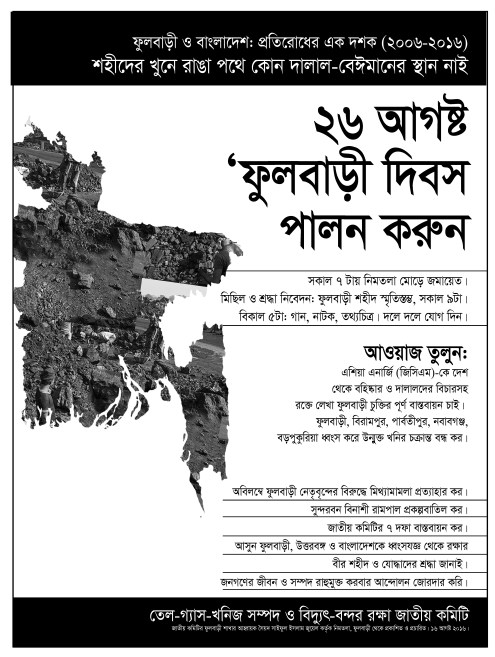
Phulbari Day POster by NCBD 2016

We will hold a Red Vigil for Victims of Phulbari outside the London Stock Exchange at 11am next Friday. We will ask London Stock Exchange to De-list GCM Plc and to show cause Gary Lye’s gang for selling fake shares. We will commemorate for the lost lives by rallying against GCM. We will celebrate our decade-long resistance by turning the commemoration event into a powerful rally against dark coal business.

JOIN US at London Stock Exchange (nearest tube station: St Paul’s).

Bring your organisation’s banner, noisy/music instruments and flowers for the victims if you can. Wear Red, Black or Blue as symbols of Resistance, Anguish and Celebration of struggle!

Please confirm participation via Facebook: https://www.facebook.com/events/641147849383562/

Contact for further information:  07714288221, 07956260791, 07861686036

Email: nationalcommittee.uk@gmail.com , phulbarisolidaritygroup@gmail.com

Committee to Protect Resources of Bangladesh, UK branch     Phulbari Solidarity Group

Download Mark the Decade of Halt, Observe Phulbari Day Flyer August 2016

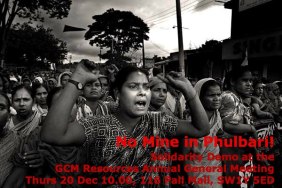
LMN call out for Phulbari Solidarity demo in London on 19 dec 2012

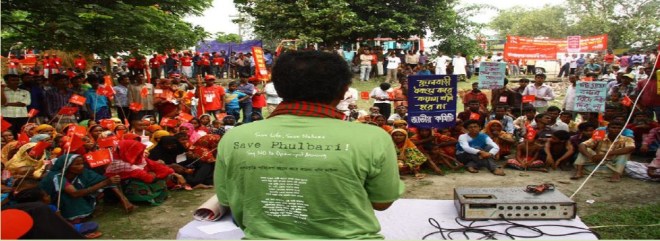
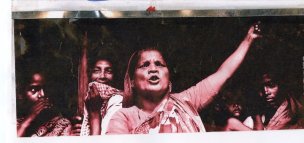
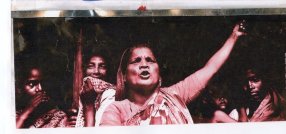
Local women, men and children cried out to save their homes, lands and lives in Phulbari in the aftermath of the GCM-provoked shooting in Phulbari. Photo: 28 August 2006

Mothers, sisters, wives and all the effected women vowed to protect  Phulbari through outburst after the shooting on 26 August 2006. Copyright: PSG


Be There! We Are Coming to Your Door This Saturday!

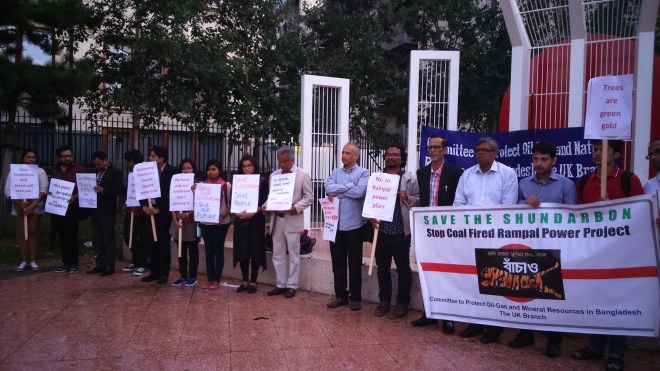
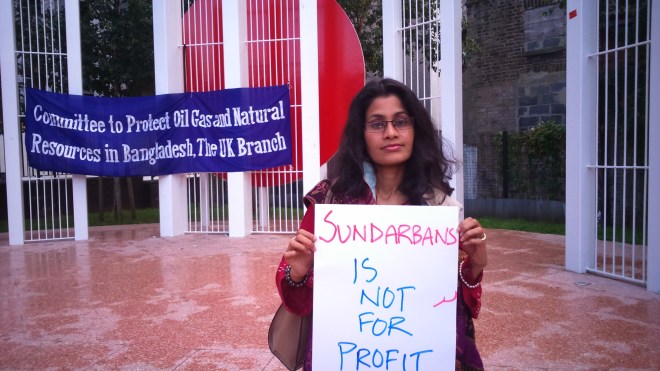
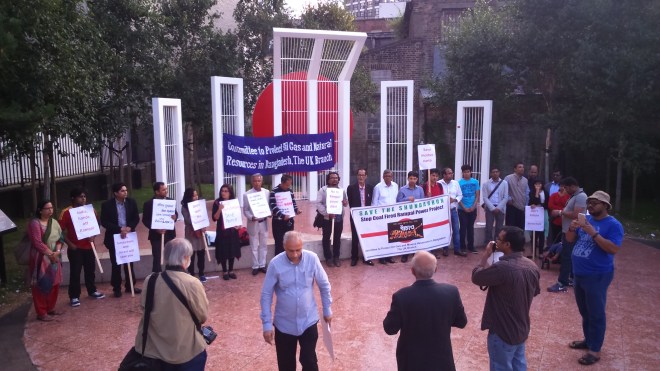
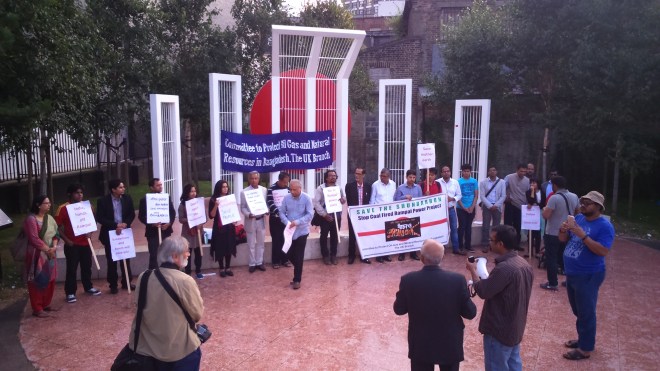
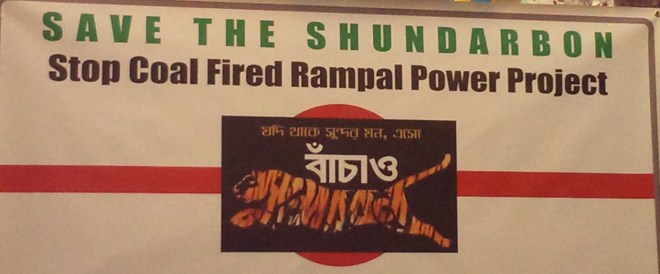
Sundarbans, the World’s Largest Mangrove Forest is Under Attack. Save the Sundarbans and Stop Coal Fired Rampal Power Plant.

Recently, the Government of Bangladesh has signed an agreement with India’s state run Bharat Heavy Electrical Ltd to set up a coal fired 1320 MW power plant on the edge of the world’s biggest heritage-listed mangrove forest, the Sundarbans. Rampal power plant will emit huge amount of carbon, sulphur, toxic gases, smoke and ashes which will destroy the forest.

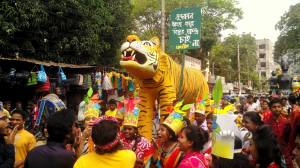
Pollution from Ash and Smoke: – Annually, around 0.94 million tons of ash will be generated from the plant, of which 80% will be dry fly ash and the rest of the 20% will be bottom ash. This ash will contain many heavy metals, including arsenic, lead, mercury, nickel, vanadium, beryllium, barium, cadmigreen cultural activists at samageet brought in a a procession with a royal bengal tiget on Bangla New year 2016um, chromium, selenium and, radium, which are dangerous if released into environment. Toxic ash and smoke from burnt coal will pollute the air, land and water bodies and will endanger plant and wildlife.


Water Contamination: Water will be contaminated due to toxic ash, oil and coal spillage from the coal carrying vessels and other waste discharge.


Noise Pollution: There will be a lot of noise pollution from coal power plant itself, from transportation of coal carrying vessels and loading and unloading of coal.  Noise pollution will endanger wildlife.


Destruction of the Forest:

All the above mentioned disadvantages will results in destruction of Sundarbans, wildlife, flora and fauna, ecology and the environment.

Friends, please join us to stop this poisonous coal fired Rampal power plant and save Sundarbans!

Say NO to DESTRUCTIVE #RAMPALCOALPOWERPLANT

National Committee to Protect Oil Gas and Mineral Resources in Bangladesh, The UK branch

Contact 07714288221/ 07956260791/ 07506709691. Email: nationalcommittee.uk@gmail.com


Fascist attack on peaceful march in Bangladesh, Solidarity from London and across the earth to save the Sunderbans

  • 200 mangrove marchers brutally charged by police in Dhaka
  • 16 unarmed protesters seriously injured
  • Six frontline defenders and NCBD leaders imprisoned
  • Cops foiled public statement to cancel dark deal over world’s largest mangrove

By Rumana Hashem and Raj Manik

As you might have awaited update from Thursday’s public march against the destructive Rampal coal-power plant, we are in the process of doing a detailed and analytical report on the attack on peaceful marchers and the fascism of Bangladeshi police. For now, note that the Dhaka protest was attacked by state law enforcement force, and the Prime Minister shamefully denied to meet with the concerned citizens of Bangladesh who wanted to handover a statement to their Prime Minister.

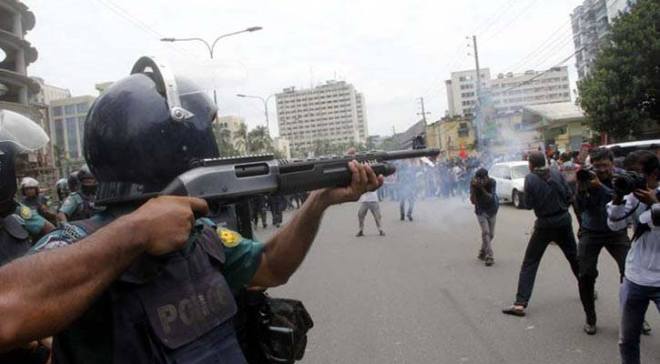
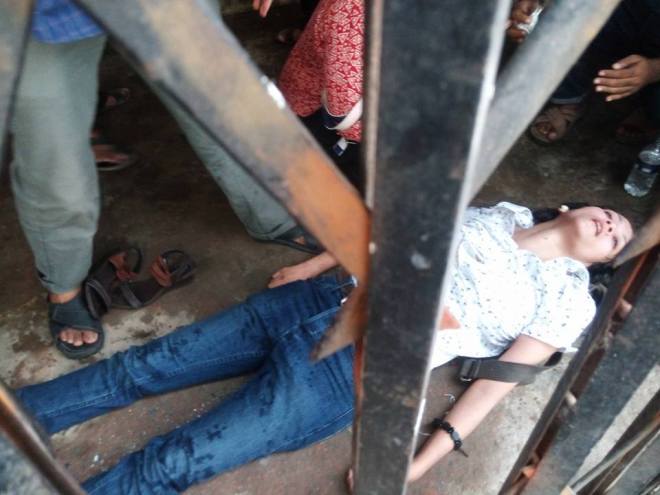
Police opens fire on NCBD marchers in Dhaka 28 July 2016 The masculine male police beaten her so badly the female left activist went unconcious on 28 July 2016 NCBD march against Rampal deal to handover statement to PM of Bangladesh in Dhaka 28 July 2016 Dhaka March to Save the Sunderbans on 28 July 2016. copy right @NCBD Dhaka

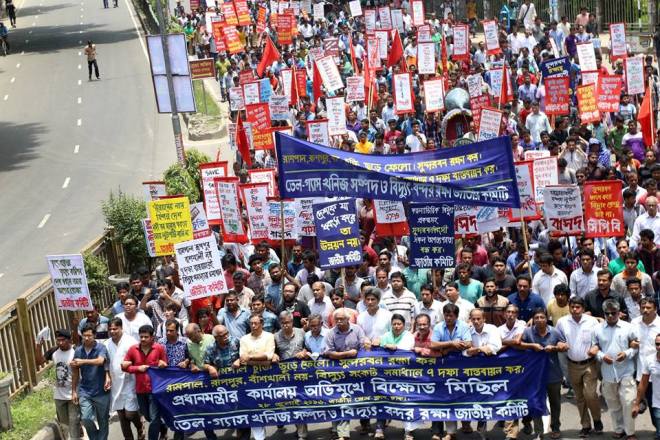
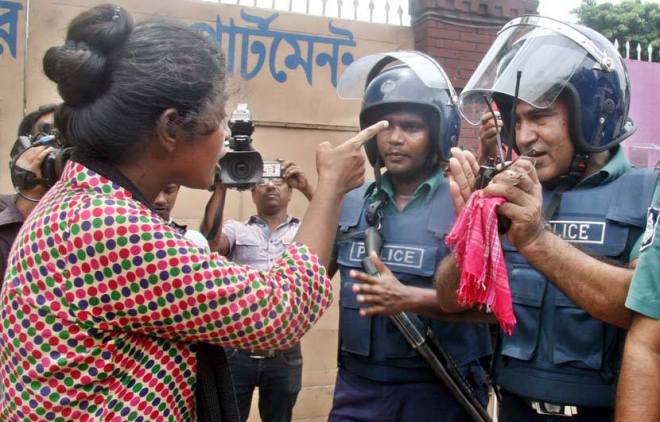
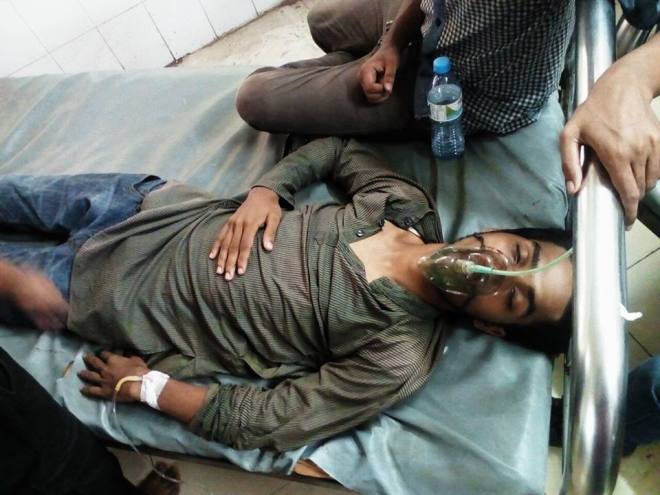
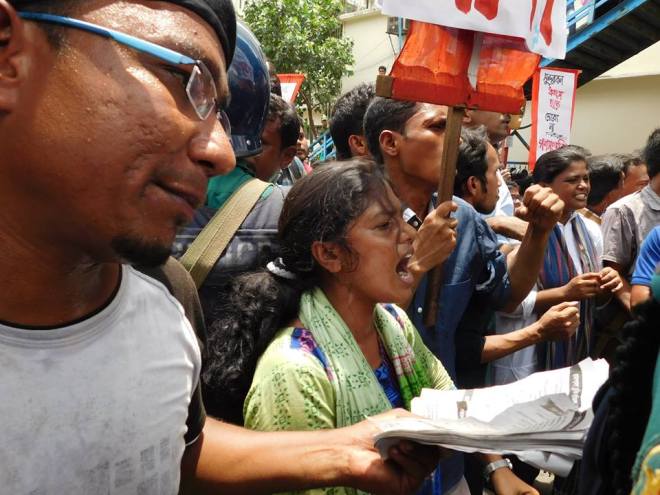
When the marchers walked towards the Prime Minister’s office to submit a statement to save the Sunderbans, police unleashed violence on peaceful marchers, threw tear shells over a march of 200 protesters who sought to handover a public statement against the dark Rampal deal that would destroy the world’s largest mangrove, the Sunderbans. Many of our activists, including the Member Secretary of NCBD, Professor Anu Muhammad, were severely injured as beaten up by fascist police force who acted on behalf of a fascist government.  Students and women-environmentalists were beaten to such that several of them were taken to hospital in critical condition.

The leaders of National Committee and frontline organisers of the march were abused and six front-line protesters, including Anu Muhammad, were detained on arbitrary charges. Police did not only abuse and charge activists but also foiled the well-written public statement, which demanded the immediate cancellation of the destructive Rampal coal-fired plant, to symbolise that commons and citizens do not have the right to express opinion on natural and national resources in Bangladesh.

In a nutshell, we have seen a fascist face of the government of Bangladesh in the month of Mangrove Action. We have witnessed how a so called pro-independence government deployed fascist police to dismiss people’s urge to preserve national sovereignty. The state-law enforcement force had foiled demands to conserve the world’s largest mangrove forest just a day after the International Mangrove Action Day. This is shocking and sickening.

So proud of our women activists taking on frontline to defend environment and mangrove in Bangladesh 28 July 2016 environmental activist tortured by facist police in Dhaka on 28 July 2016

Dhaka March to PM office on 28 July 2016

Dhaka March to PM office on 28 July 2016. Copyright @NCBD

Although media coverage of this heinous attack on peaceful marchers was poor, we have heard the sound of angers, condemnation and protests across the earth on Thursday.  In London, the Bangladeshi community rallied under the banner of protect resources of Bangladesh, the UK branch, and unreservedly condemned the attacked on environmentalists and progressive activists in Dhaka.

protest against rampal in london on 28 July 2016 PROTEST at Altabl Ali Park on 28 July 2016 protest at altabl ali park in london on 28 july 2016

London protest against destructive Rampal power plant on 28 July 2016

London protest against destructive Rampal power plant on 28 July 2016. Photo credit: Shefa Ahmed and Rumana Hashem

Despite miserable weather and a week day afternoon, there was a great turn up of saddened Bengalese at Altab Ali Park at Aldgate East. Speakers include Bangladesh Socialist Party leader, Mostofa Kamal, European-Bangladesh Climate Change, Ansar Ahmed Ullah, Communist party leader, Dr Mohammad Ali Khan Jinnah, Photo journalist Peter Marshall, Worker’s party leader Ishaque Kajole, Dr Mokhlesur Rahman of NCBD UK , Dr Rumana Hashem of PSG and other community organisers. We were, of course, present at the rally from Phulbari Solidairty Group. But the question is: does the Bangladesh government care for what we think and say about our national environment and national resources?

We will be updating you on further development on this via twitter, blog and mailing lists.

What you can do to help us:

  • We would appreciate it if you can re-tweet our news and if you can tweet @PSG-BD
  • Please do your own outreach by using hashtag #Rampal and #SavetheSunderbans
  • We would appreciate it if you can avoid asking for money/donation from people for this mangrove action. Any sort of donation based campaign can undermine our cause and would let down the movement to save the Sunderbans.
  • If you need help, please do contact us for connecting on how to organise in your own locality and how to express solidarity with the protesters back home. You can email us: phulbarisolidaritygroup@gmail.com and rabbani.enpolicy@gmail.com

#SavetheSunderbans #StopRampalCoalFiredPlant

Further news:

Police foiled march: The daily Star report http://www.thedailystar.net/city/demo-sundarbans-foiled-10-held-1260748


Protest against Destructive Rampal Power Plant this Thursday

By Rumana Hashem

Despite nationwide protests and international campaigns against the controversial coal power plant in Rampal, Bangladeshi government has approved India‘s NTPC proposed Rampal power plant which, if implemented, will destroy the world’s largest mangrove, the Sundarbans. Bangladeshi and Indian governments have signed a destructive deal in July, the month of International Mangrove Action, when the world is supposed to celebrate International Mangrove Day.

On 13 July, Bangladesh and India have signed an agreement which enables India’s state run Bharat Heavy Electrical Ltd. to implement the Rampal thermal power plant. The proposed plant would be built in 14 kilometres to the Sundarbans, a treasured ecosystem along Bangladesh’s coast.

It is outrageous that the governments of the two neighbouring states, Bangladesh and India, have disregarded the global calls and conspired to abandon people’s urge to prevent the construction of disparaging coal-power plant in Rampal from happening. They let Bangladesh’s only mangrove forest, Sundarbans, to be destroyed for self-interests. This deal has been signed at a time when Bangladesh has been undergoing political turmoil and religious genocide. The nation was focused on Gulshan attack when the two governments have approved the destructive deal.

The National Committee to Protect Oil, Gas, Port-Power and Mineral Resources in Bangladesh (NCBD) will march to the Prime Minister’s Office this Thursday, 28th July, to protest against the deal.


2

In solidarity with the protesters in Bangladesh, the UK branch of NCBD will rally against the destructive deal at 6.30pm on the same day at Altab Ali Park in East London.

Please join us along with your friends and raise your voice against this destructive project. Our outcry can protect the world’s largest mangrove forest, the local environment in Bangladesh, its ecology and species. #SavetheSundarbans


Read further news here:

A new power plant could devastate the world’s largest mangrove forest

Bangladesh, India sign Rampal power plant construction agreement

Additional information and news:

1.“Bangladesh Sticks With Coal Power Plant Project Despite Major Backlash,” Mongabay, February 16, 2016,
http://news.mongabay.com/2016/02/bangladesh-sticks-with-coal-power-plant-project-despite-major-backlash/

2. Anu Muhammad & Sheikh Muhammad Shaheedullah, “Manipulating Rampal,” Dhaka Tribune, March 31, 2016,
http://www.dhakatribune.com/op-ed/2016/mar/31/manipulating-rampal

  1. Dr. Abdullah Harun Chowdhury, “Environmental Impact of Coal Based Power Plant of Rampal on the Sundarbans and Surrounding Areas,” Khulna University, http://bagerhatsociety.com/apanel/admin/download/tdwn2573136.pdf
  2. “Ganges River Dolphin,” World Wildlife Foundation,http://www.worldwildlife.org/species/ganges-river-dolphin
  3. “Orion Signs Deals for Generators for its 660MW Power Plant,” The Daily Star, May 11, 2014, http://www.thedailystar.net/orion-signs-deals-for-generators-for-its-660mw-power-plant-23556
  4. Sönke Kreft, David Eckstein, Lukas Dorsch, and Livia Fischer, “Global Climate Risk Index 2016,” GermanWatch, November 2015, http://germanwatch.org/fr/download/13503.pdf

It is time for Global Day of Action against Vedanta

Phulbari Solidarity Group extends unconditional solidarity with Foil Vedanta in their fight against notorious Vedanta. Foil Vedanta, a campaign group against extractive corporation, has produced invaluable reports on mining effected areas in India and Afrika, and global trade of metals by notorious multinational company, Vedanta. We will join Foil Vedanta on their annual Global Day of Action at Vedanta’s AGM again this year. Like previous years, we will join activists to bring the defiant energy of communities fighting and winning against Vedanta around the world to London on Friday, 5 August.

The main event will be held on Friday 5 August 2016, 14:00 – 16:00 at Ironmongers Hall, Barbican, EC2Y 8AA (nearest tube Barbican).

Foil Vedanta AGM 2016 poster. Source: Foil Vedanta campaign letter 6 July 2016

Foil Vedanta AGM 2016 poster. Source: Foil Vedanta campaign letter 6 July 2016


This year, pollution affected communities of Zambia won their nine years battle in their Supreme Court, and now won the right to have their case heard in Britain. In India, the Dongria Kond of Niyamgiri in Odisha are now demanding to dismantle Vedanta’s aluminium refinery in Lanjigarh, after winning their case in the Supreme Court of India.

Parallel demonstrations are already planned in Zambia and India on the 4th August and questions raised by the communities will be asked inside the AGM meeting.


We encourage our supporters and readers to join Foil Vedanta on Friday the 5th of August to tell Vedanta to stop its notorious activities overseas.
For more information please follow the link:
http://www.foilvedanta.org/actions/global-day-of-action-against-vedanta-5th-august/

Mining is in Rapid Fall

People, climate change and future of the industry

By Raaj Manik

An international workshop on mining in South Asia was organised by Activists and Academia Network, called, the Centre for World Environmental History (CWEH) at University of Sussex in which Phulbari Solidarity Group made a robust contribution. On Wednesday 11 May 2016, a remarkable delegation of activists from the global South has shared their anti-mining community activism, and engaged with experienced colleagues in the global North working to expose the brutality of northern extractive companies in the South.

Speakers included Gladson Dungdung, who was offloaded from the Air India flight on his way to the workshop, was due to report on threats to Saranda Forest in Jharkhand, human rights abuses and the destruction of the environment by iron ore mining companies. Also front-line environmentalists and researchers from Bangladesh and India, including Malvika Gupta from University of Delhi, Rumana Hashem of Phulbari Solidarity Group, Roger Moody of Nostromo Research, and Miriam Rose of Foil Vedanta delivered insightful work and narratives of excellent grassroots struggles against mining and corporations.

Vedanta demo London 2015

Vedanta demo London 2015

Phulbari outburst on 26 August 2006.

Phulbari outburst on 26 August 2006.


PSG founder and eye-witness to Phulbari carnage in 2006, Rumana Hashem, has delivered a talk,titled “Translating Phulbari Resistance and anti-coal struggles in Bangladesh: A bottom up approach to social movement to protect environment and indigenous rights from corporate excess”. Hashem advocates for and showed how a bottom up, informal and non-bureaucratic approach to anti-mining and environmental movement have become tremendously powerful and successful in north-Bangladesh.   

The drastic increase of privatisation and multinational corporations has not only caused environmental damage and energy injustice but also induced forced-displacement, destitution of indigenous people and farmers in southern countries, such as, Bangladesh. But resistance to extractive corporations and dodgy deals involving government sponsored companies across the South is in the rise. While Bangladesh has been taken hostage for oil, gas and coal by US, China, Indian, Russian and UK corporations, grassroots activism and people’s resistance across the country are remarkable, notes Hashem.

On 26 August in 2006, three people were shot dead at an anti-open cast coal mining outburst of 80, 000 people in northwest Bangladesh but locals were able to form powerful resistance to fight back the miners for decades. Hashem’s talk analyse anti-coal power struggles and social movements for environment and agriculture-based livelihood in Phulbari, and argued that a bottom up approach to environmental and anti-imperialist struggle has been successful in the northwest of Bangladesh.

Hashem illustrated a three-level socio-political movement, called the Phulbari Resistance, against an UK-listed company GCM Resources, formerly known as Asia Energy, that prevented the implementation of a massive open-cast coal mine in the town of Phulbari which would be destroyed by greedy corporate plans. If the mine is built, it would lead to forced-displacement of up to 230, 000 people over the course (30 years) of the project. It would increase poverty and crisis of food production in a country which struggled to provide food supply to nearly one third of its population in 2006-2010. The project would further cause water pollution and would plunder 94 percent of agricultural land in the region.  It would leave devastating impact on environment.

Hashem’s talk revealed how local farmers and indigenous people formed powerful resistance in Phulbari under the umbrella of an open platform of left-environmentalists, called the National Committee of Bangladesh, and fought a dirty extractive company, GCM Resources, in Bangladesh.  Her report exhibited that the impact of Phulbari resistance on grassroots mobilisation across Bangladesh is so that it led several other social and political movements including Save the Sundarbans, Bashkhali anti-coal plant outburst, and movement against onshore and offshore gas blocks.

Hashem insists that “it is possible to prevent forced-displacement and livelihood from increasing corporate excess only if we followed a bottom up approach to balance power at local, national and international levels, and only if a true solidarity and consensus between the northern and southern grassroots activism has been formed.”

The illuminating talk by Hashem was followed by a researcher and advocate for indigenous rights, Malvika Gupta from University of Delhi, who illustrated how indigenous kids are manipulated and re-colonised by the colonial language and English education in India. The narratives of oppression of indigenous communities by British corporation in India and Zambia were explored and discussed by Miriam Rose of Foil Vedanta, and Roger Moody of Mines and Communities and Nostromo Research, UK.

All speakers have robustly argued that mining is in rapid fall. Despite pernicious oppression and abuse by multinational corporations in the global south, extractive companies and mining across the world have been facing their downfall.

The day-long conference at the Centre for World Environmental History (CWEH) has ended with a hope that mining will continue to fall. The director of the centre, Dr Vinita Damodaran  given a vote of thanks to the superb speakers and activists who brought in new hopes to the conference room that extractive companies are likely to be vanished in near future so long as we continue to fight consistently.

The event was facilitated by Zuky Serper, an Activist and Artist in Residence, and chaired by Dr Vinita Damodaran at CWEH at University of Sussex.

Bashkhali Tragedy: Loopholes behind the story of Coal Shooting

FILED VISIT and REPORT BY A BANGLADESHI FEMINIST-ANTHROPOLOGIST AND FILM MAKER  REPRODUCED FROM NewsBangladesh.com

By Nasrin Siraj

A team of 13 leaders and activists of Chittagong chapter of the National Committee to Protect Oil, Gas, Mineral Resources, Power and Port visited, on April 6, Gondamara union under Bashkhali upazila in Chittagong district where four unarmed villagers were killed allegedly in police firing on April 4. I was a member of the team. A schoolteacher from Gondamara union was our guide during the visit.

Gondamara is a shoal area between Jolkodor canal and a seaside embankment. Salt, shrimp and rice are produced here. Crossing the bridge over the Jolkodor canal, we found a group of villagers of different ages sitting at small tea stalls. No sooner had we descended from our vehicles, they surrounded us and started talking altogether, narrating the harrowing details of the immediate past tragic killings.

From there, we started on foot for the nearby village. We met a huge crowd of villagers at a place where a live programme of Jamuna TV was being telecast. A teenage boy of 16/17 years joined us on the way, a scratched scar glowing on his cheek. This is his story:

“(Indicating at the motorcycle of one of our team members) they came by motorcycles like this, wearing helmets like this…those who shot us that day…the hired goons of S Alam…they were accompanied by police.”

Question: How did you know that they were S Alam’s hired goons?

The teenage boy: “They wore police uniform and covered their faces with masks…but we are the local people…don’t we know S Alam’s goons? They come here all the time.”

“(One standing beside him added) haven’t you seen the S Alam office on the way coming here? There are at least 2,000 police uniforms at that office. Wearing those uniforms, the goons came here on that day riding motorcycles. They came from that office.”

The teenage boy: “The local police station has only 20/25 policemen, but on that day about 200 policemen came here.” Another from the villagers, standing beside the boy, added: The OC, UNO, MP Sahib all are sold to them (to S Alam)…

The people surrounding us altogether were trying to describe the horrific incident that took place only two days ago. They were also inquiring about our identities and purpose of visit. Listening to their gory details, suddenly I remembered the first wounded person I met the previous day at Chittagong Medical College and Hospital, during a visit in search of Bashkhali victims. I asked, “Was not a shopkeeper shot here?”

All of them answered at a time, “Yes, yes…this is his shop…this Medina…shooting on his leg from point blank range, they took him to that bridge from here, dragging him all the way…he suffered severely and painfully, you see, the road is pitched…even the soldiers of Pakistani occupation army were not so brutal…we were not tortured so much even during the liberation war…”

We were still a little away from the spot where the shootings took place. Meanwhile, National Committee leaders and activists had completed their procession and rally, expressing solidarity with their movement. Someone then proposed that we should visit the wounded villagers. It may be mentioned here that the National Committee organised the visit without any prior preparations. The visit was organised all of a sudden. The leaders and activists of the committee are not well familiar with this locality and people. That’s why they did not have any particular plan. The villagers then took us to Moriom and Kulsum. Here is the story in short they told us:

“Police on that day not only killed four people firing indiscriminately, but also entered home to home and shot women. Kulsum was breastfeeding her child, and Moriom was peeping through the window to see what had been happening outside when the police entered their homes and shot them. The main problem regarding the bullet-wounded ones was to take them to hospitals as, after filing cases against 3,000 unnamed accused, police have been arresting all the wounded persons whoever had gone to any Chittagong hospitals from Godamara. So, apprehending detention, wounded people are not going to the CMCH, or concealing their names and addresses if anybody is going.”

Moriom showed us her terribly shaking bullet-ridden hand. With tearful eyes, she told us, “Kulsum conceived four months ago. She has five children also. Who will take care of them now? Who’ll take care of those motherless children?”

The women present there then oragnised Kulsum’s children and father so that we can take a family photo.

Kulsum’s children with their father

I asked Kulsum’s husband, “How is your patient now?”

Kulsum’s husband: “Being afraid of arrest, I didn’t accompany her to the hospital. Police is waiting there to arrest us if we come out on the street (meaning the road leading outside the village)…her brothers are there, they are taking care of everything.”

Mentionable, most of these villagers surrounding us are day labourers, involved either in farming or fishing, or in salt production. Some of them took us inside their homes to show the place where, under what situation, they were shot, to show us bullet scars on mud walls.

From there the team brought out a procession, accompanied by the guide as well as the villagers, and marched towards the school field where the shooting spree took place. Instead of taking part in the procession, I was loitering slowly. Kulsum’s husband and other 5/6 villagers accompanied me and there started a conversation.

I asked, “What happened here? Why police shot the villagers indiscriminately?”

Again I was bombarded by a bunch of answers delivered simultaneously. I am trying to tell the story in short what I understood from their answers:

“At the wee hours of April 3 (another interrupted to clarify that after 12pm, new date starts), police arrested some villagers who were sleeping on the seaside embankment. Protesting the arrests, we were holding a meeting presided by Liakat Chairman, president of Vumi Rokkha Committee, meaning land protection committee. Police reached the spot after the meeting started and without any warning started shooting us indiscriminately.”

Q: But why police arrested those villagers?

A: Someone or other vandalised a car of the power project. Not a single journalist writes the truth. Three to four journalists have come so far, but taking S Alam’s bribe they all published fake stories. They wrote about that car-vandalising, but forgot to mention that we don’t want any coal-based power plant in our locality.

Q: But what is your problem with setting up power plant?

A: Hey, coal-based plant has many problems…aren’t they trying to set up another coal-fired power plant at the Sunderbans? If it becomes reality, the trees and tigers will surely die…nothing will remain on the ground…the same will happen here. Our trees, our plantations nothing will remain in place. We will have to abandon our forefathers’ land. A rivalry has erupted and is going on centering the issue since many days. The rivalry reached its peak for the last 2/3 months.

“(Another one ads from aside) you are not being able to tell Apa anything. Listen, Apa, the whole clash erupted over sharing of the money. Just a few days ago, a clash took place between two groups of people of our locality over sharing of money at the home of the local MP Sahib. In between their rivalries these innocent four died. I am an Awami League activist for the last 40 years. None of the Awami Leaguers knew this new MP before he was nominated. This MP only knows money.”

The topic of the conversation then changed, and all of them started showing me bullet scars on walls and tins beside the village road. It is obvious that bullets were fired literally indiscriminately. Were the police afraid that they would be attacked by the villagers, I thought. Or else, why such indiscriminate firings? But before I could ask the question, we reached the school field where the National Committee had already started a spontaneous meeting. Villagers continued showing me bullet scars…

“look here”, “This way, come here…”

Again I tried to listen to their stories coming from all sides. I tried to understand—why the police started shooting on a visibly unarmed meeting. How many police personnel were there? How many rounds of bullet were shot at public on that day?

At one time I understood that the villagers were not at all aware that a Section 144 had been imposed. That’s why they were dumbfounded by the police action. Public interpretation of the incident is like this: “We were not armed at all (javelin or spear is household weaponry in this locality). We heard that a meeting had been called and we went to join the meeting. Had we joined the meeting readily, not a single police would be spared alive on that day.”

I noticed one thing; the villagers repeatedly alleged that on the fateful day of April 4, a number of hired goons wearing uniforms accompanied the police. They engaged in an argument right in front of me over the number of goons and police. Some said there were 200 police, some said 50 while a third group said 70 were real police and the rest were hired S Alam goons. “At first they fired at the sky. They fired at least 20 rounds of bullet per second and over all 1000 rounds of bullet were fired,” said these witnesses.

Mortuza nana was eating this bread at my tea stall. He could not finish it. They shot him on the chest from point blank range

“They wore masks (because they were firing tear shells)…they shot Murtaza and Ankur from point blank range just because they identified them…they (Murtaza, Ankur) tore up their masks…We are locals…we know them all…They started from the S Alam office riding motorcycles (I have heard the same allegation earlier from another one just a while ago)…they started from there. They live there.”

“Phew…those were all polices…UNO, OC all were present…

I said, “Maybe, they all were policemen…”

”They (police and local administration) are acting on behalf of Mafia Don S Alam…taking S Alam’s money police fired on the public…”

This is not the first time I am experiencing Bangladeshi people’s anger, rage, fury and lack of confidence on police. I had heard the same terrible allegations against police, administration and government while doing my research work with the activists of Phulbari anti-coalmine movement.

Meanwhile, National Committee had completed their rally. Liakot Chairman was present there, but, I think National Committee activists were not interested to talk to him, rather they were interested to meet the relatives of the deceased ones. So, we went to meet them.

Our motorcade started for the relatives of the deceased, stopping here and there to inquire about the direction. We had to stop at one place where a group of villagers wanted to talk to us. A number of women were present there beside the males. As I advanced towards the women, they altogether started talking expressing anger and fury and objection over and to the coal-fired power plant.

My two maternal uncles and one of my cousin’s husband have been killed. Let them kill us if they want, not even then will we agree to set up coal power plant. They are oppressing us like the Pakistani occupation army. Our fathers-mothers-brothers can’t stay at home to sleep apprehending detention, they sleep at fields. And in the name of arresting the accused they are entering our homes wearing police uniforms to snatch away our ornaments, valuables and mobile phone sets. We cannot sleep at night in fear.

This is the moment when I came to know that three of same family had been killed on that day. I understood that late Anowarul Islam and late Mortuza Ali were two siblings and late Zakir Hosain was the son-in-law of Mortuza Ali. With tears rolling down on their cheeks, the women were telling their plight and I was thinking, “So many deaths in a single family…how are the living members of the family bearing the grief…administration, government and businessmen are considering these people as a hindrance to development…we are recognising them as protestors, but are we at all identifying them as humans? If my father, mother, sister, brother, husband or son dies normally instead of being killed by police, won’t I grieve equally like them…at the end of the day we are all humans…all are same, and our capacity to face and tackle grief are also equal…”

Reaching late Anwarul Islam, Mortuza Ali and Zakir Hossain’s home, National Committee leaders-activists started talking to the male members of the family. Women of the family took me inside the home. In between the waves of sobbing and whimpering, the eldest daughter-in-law of the family asked me about all the members of my family, entertained me with juice, orange and biscuits. A teenage girl from the family refilled my water bottle as she noticed that it was empty. We were informed that in an attempt to save his father, Anwar’s son Arafat was also hit by spray bullets. His uncle would take him to doctor after our departure.

What is going on inside this youngster’s mind, my attempts to understand how he is surviving the trauma reminded me of my sister’s daughter…so much caring, so many insisting all through the day addressing ‘baba baba’…

Gondamara has 500 acres of land. S Alam Group already has bought 1700 kani of land (as I am weak in land measurement, I am not going into details). But the villagers repeatedly clarified me that the problem is not with land purchasing procedure, because S Alam Group has already finished purchasing land. Those who had sold their lands have already received their dues. Those who are protesting at present are not land owners or anything, almost all of them are day labourers. And their demand is very simple —  entire population of Gondamara will not be able to continue living in the union due to the effect a coal-based power plant will make on its adjacent arable land, water and plantations. But where will they go? How will they live by? They don’t have anything else for survival save their own two hands.

My demand is very simple also—1) The allegation local people of Gondamara is raising that police killed innocent people must be investigated fairly and the criminals must be punished. 2) Were they really hired goons under police uniform? Is the administration really acting as a private force of S Alam Group? As a citizen I want this allegation to be investigated also, and if proved, I want the public servants acting as accomplices of criminals to be punished. 3) This harassment of the villagers, filing cases against unnamed 3000 and detaining the villagers indiscriminately, must be stopped.

I am ending this reportage citing a dialogue of the son of a killed one. The National Committee activists were trying to console and pacify him stressing on the necessity of law-abiding movement.

In reply to the consolations of the Committee activists, the boy said, “If my father had been taken to hospital, he might have survived. But the Police did not allow us to do so. We have shown enough respect to the law enforcers; no more.”


Translated by Tariq Al Banna from the Bangla version of the reportage.

newsbangladesh.com/tab

Read original report here: http://www.newsbangladesh.com/english/Banshkhali–Loopholes-behind-the-story/13361#.VwlPVOhvxs0.facebook

Five killed at anti-China power plant protest in Bangladesh: Rally against Coal-Murders at Dhaka and Chittagong Press Club on Tuesday

By Raaj Manik

At least five innocent protesters were killed after police opened fire on a protest of 1500 villagers who were protesting against two China-backed power plants at Bashkhali in Chittagong, a location in southeastern Bangladesh on Monday, the 4th April.


“This is a terrible tragedy and major news. It is the largest loss of life at an anti-coal protest in Bangladesh since the tragic deaths in the August 26, 2006 killings at Phulbari, Bangladesh, where three people were killed and 200 injured by paramilitaries. It is the worst overall loss of life in anti-coal protests worldwide since the killings of six people in Jharkhand, India, at two protests in April 2011” , noted Ted Nace, the editor of Coal Swarm.


Professor Anu Muhammd, the Member Secretary of the National Committee to Protect Oil, Gas, Mineral Resources, Power and Port in Bangladesh, noted: “the villagers in Bashkhali have been loud against the destructive plans of S. Alam Group for months because the company wants to build two coal-fired power plants in the area by evicting thousands of villagers and land owners. The coal-businessmen of S. Alam Group, financed by two Chinese firms — SEPCOIII Electric Power and HTG, were fully aware of the strong opposition to the coal-power plant.”


The shooting on villagers started dramatically. Around 1500 villagers had gathered in Gandamara, a remote coastal town, to protest against the construction of two coal-fired power plants that they say will evict thousands from the area. Local authorities had banned the demonstration from taking place and the police opened fire on the crowd when the protesters needed support of police as they were demonstrating against a greedy company.


District police chief Hafiz Akter told AFP that ‘Four people died, including a pair of brothers’ while informal sources and witnesses said, at least five were dead. More than 100 were injured. The causality initiated by the state security forces caused injury of 11 policemen. One officer was shot in the head also.


The state administrators are fabricating information. M. Mesbahuddin, a government administrator in Chittagong district, told: “The clashes erupted when police came under attack by local villagers protesting against the move to install the power plant by S. Alam group with finance from China”. This statement has been challenged by the survivors and eye witnesses.

According to AFP, Abu Ahmed, a member of the village committee that staged the protest told: “Police opened fire as we brought out a procession against the power plants. They even chased the villagers to their homes”.

Abu Ahmed was shot in his leg. He said that the villagers had been holding peaceful protests for days after S. Alam, the local conglomerate behind the project, started purchasing land for the plants in the village, which lies on the edge of the Bay of Bengal. But government did not pay attention to the village-protests and the district administration remained silent for months. This led the villagers to stage a mass-protest which turned into the worst tragedy in the history of coal-killings in Bangladesh.

A Doctor at Chittagong Medical College Hospital, Saiful Islam, said that seven people, including four who were shot by live rounds, were brought to his clinic. The condition of each of them were critical.

Rumana Hashem, the founder of Phulbari Solidarity Group and an eye witness to Phulbari tragedy in 2006, noted in an email update:

“Only less than half of the information came out of the affected villages.  Mainstream media is unwilling to cover the news of coal-murders in detail.  This has always been the case in Bangladesh. I remember that night on 26 August in 2006, police acted as industrial security force and raided our house in Phulbari, broke into housewife’s bedroom and warned us (without written warrant) that they would arrest us all. Nobody had known how badly police were used by Asia Energy, a London-listed extractive company now known as the Global Coal Management Resources Plc. Only few media had covered the raiding in Phulbari.  Likewise, there have been arbitrary raids and harassment of villagers by police in Gandamara about which common people are being kept in the dark. Very little news has come out of the villages. Many villages are under attack of coal-traders.”


Chittagong-based S. Alam Group, as the Bangladesh developer,  plans to build two coal-fired power plants in the area, which will have the capacity to produce 1,224 megawatts of electricity. Two Chinese firms — SEPCOIII Electric Power and HTG — are financing $1.75 billion of the the plants’ estimated $2.4 billion cost. This attack in the port city has been a simultaneous attack by coal criminals when the nation has been protesting the coal-fired power plant in Rampal, a close vicinity of the country’s largest mangrove forest, the Sundarbans.


The National Committee to Protect Oil, Gas, Mineral Resources, Power and Port in Bangladesh has extended its support and full solidarity with the protesters in Bashkhali, Gandamara in Chittagong. There are two solidarity demonstrations to be held, simultaneously,  at Dhaka Press Club and Chittagong Press Club this afternoon.


Further news and updates:

Bangladesh coal plant protest continues after demonstrators killed:  The Guardian http://www.theguardian.com/environment/2016/apr/06/bangladesh-coal-plant-protests-continue-after-demonstrators-killed

Bashkhali: loopholes behind the shooting: http://www.newsbangladesh.com/english/Banshkhali–Loopholes-behind-the-story/13361#.VwlPVOhvxs0.facebook

Of Deception and Development: article by Any Muhammad  http://www.dhakatribune.com/op-ed/2016/apr/11/deception-and-development

Scrap deals of destruction: The Daily Star op-ed http://www.thedailystar.net/op-ed/politics/scrap-projects-destruction-1207177

Bashkhali Coal Power Plant: Propaganda and Reality: by Kallol Mostofa

http://www.thepeninsulaqatar.com/news/asia/377197/four-killed-at-anti-china-power-plant-protest-in-bangladesh

http://www.breitbart.com/news/four-killed-at-anti-china-power-plant-protest-in-bangladesh/

‘The Sundarbans Declaration 2016’ by the National Committee of Bangladesh

Translated By Tanmoy Karmokar


Following a three-day nationwide long march to the Sundarbans, held between 10th to 13th March, 2016 by demanding a capping of all breeds of devastative – mischeivious activities surrounding the Sundarbans, including the Rampal and Orion coal-based power projects, the National Committee to Protect Oil, Gas, Mineral resources, Port and Power in Bangladesh has declared the following ‘Sundarbans Declaration 2016’. The declaration is a demand for the enactment of 7-points programmes in order to resolve the country’s power crisis. The declaration was agreed by the protesters and marchers who joined the three-day long march to protest the coal based Rampal power plant. It was signed by the central leaders of National Committee and was read out at Kantakhali on 13th March, 2016.

banner Sundarbans 2016 2

We, the people on the march, have reached Katakhali, adjacent to the Sundarbans, on 13th March noon, by crossing 400 kilometers in 4 days after the long march has started on the 10th March. Starting on 10th March, 2016 at the Press Club in Dhaka, we have marched to Katakhali via Manikganj, Rajbari, Faridpur, Magura, Jhinaidaha, Kaliganj, Jessore, Nowapara, Fultola, Doulatpur, Khulna and Bagherhat. Hundreds of thousands of community folks have expressed their solidarity with us in the course of progression of this long march and during the time of preparation focusing the 7-point demands and to protect the Sundarbans. People of Bangladesh from all walks of life have participated here. Some of the many organisations are: leftist progressive democratic political parties, farmers-day labours-women-students-youth-science organisations, music groups, theater groups, film organisations, study circle groups, little magazine groups and many more. Along with the political activists and leaders, there are participants from academics, school and college teachers, students, scientists, engineers, professionals, artists, writers, journalists, filmmakers, farmers, workers, housewives, and community women and men. During the long march, several solidarity demonstrations and public meetings were also held in London, Amsterdam and Paris.

During our long march in Bangladesh, we had been faced with administrative threats and harassment by Police when our long march tried to enter the district of Jessore. They attempted to downfall the long march by rescinding approval of a pre-scheduled demonstration in the final phase. Not only revocation but also had they tried to obstruct the program by menacing when entering Jessore and during our stay inside the city. But the Sundarbans long march had entered the district of Jessore by passing all the stumbling blocks, and successfully completed its journey by organising protest-rallies and processions. From today’s meeting, we, once again, strongly protest the odious conspiracy of the government and administration.

This long march has been organized with a view to voicing the ‘7-point demands’ to mitigate energy crisis, including immediate annulment of the  Rampal and Orion power projects, and to avert destruction of the Sundarbans. While the government is leading the violent invasion of the profiteers on the Sundarbans by wreck, ravage and appropriation in the name of power generation and development, people at the same time by virtue of their sovereign rights are forming a domain of resistance. This long march is part of that long-term resistance.

The Sundarbans is not just some flora and faunas but a splendid mangrove forest that offers much more than one sees. It is the noble sum of myriad lives, a peerless ecosystem and natural safety net as an extraordinary resorvour of biodiversity and a renowned world heritage. This mangrove forest does not only provide the livelihood of millions of inhabitants but also saves the life and belongings of about 40 million people from natural catastrophes like Sidr and Aila. The vast coastline area alongside the country’s geographical border and outside the border is in effect allied with the existence of the Sundarbans.

The agreement signed between the National Thermal Power Corporation  of India and the Power Development Board of Bangladesh is totally unequal, one-sided and against the national interest of Bangladesh. Likewise the Orion Company of Bangladesh- it was given permission to set up coal-based power plant by turning a blind eye to all kinds of laws and rules. Apart from the irreplaceable destruction of mankind and nature, Bangladesh will suffer from huge financial loss if this project is executed. Earlier land acquisition by abnegating the codes of environmental assessment, persecution and eviction of local inhabitants, rejection of the High Court ruling and late formulation of a self-contradictory, flawed, incomplete, and preposterous environmental assessment – all emphasised that the local and international groups are frenzied to establish these power plants. However, independent studies on and investigations about the Sundanbans implied that our forest will face a catastrophe once the power plants are established and the entire Bangladesh will be susceptible.

Long-term research by the environmental and climate scientists show that the Rampal coal-based power plant will annually generate 52 thousand tons of toxic Sulfur dioxide, 30 thousand tons of Nitrogen dioxide, 0.75 million tons of fly ash and 2 hundred thousands of bottom ash. Further, water withdrawal from the River of Pashur at a rate of 9150 cubic meter per hour, subsequent colossal discharge of the polluted water into the river, and temperature of the discharged water and various toxic elements dissolved in the water will damage the natural water flow of the river, its ability to carry sediment and the life cycle of fishes, plants and other living beings. Indeed, what we see is that ultimately aquatic ecology of the Sundarbans will be destroyed by those coal based projects. Coal transportation through the Sundarbans, liquid and solid toxic wastes from the ships, oil spillage, flood lights will be devastative for normal life cycle and biodiversity of the Sundarbans. In addition, the pollution will take on its worst form if the 565 MW Orion plant and another 1320 MW unit in Rampal will be established.

As it seems now all arrangements to assassin the Sundarbans are in full swing. The massive shelter of life by establishing Rampal and Orion power projects on the one hand, by ignoring all forms of protests from the people and rejecting expert opinions on the dire consequences, and on the other hand, various projects in the name of power plant are being undertaken for the interests of land-grabbers. The forest is getting damaged everyday by the aggression of the profiteers. Various commercial and illicit activities like shipyards, silos and cement factories are on the rise. While the country, especially the coastal areas, are facing climate change threats, many indiscreet projects along the coastal line, such as, Rampal and Madarbari are simply worsening the situation and posing new dangers to our climate and livelihood. A nuclear power plant in Rooppur is also under process of construction, posing grave threats to our environment and communities.

We want to declare firmly that sustainable solution to country’s power crisis can only be found in the implementation of the 7-point programmes of the National Committee. Sustainable development or solution to energy crisis cannot be found in destructive projects like Rampal, Rooppur or Moheshkhali power plants.

For the last one and a half decades, one of the leading issues that National Committee has been working on is how to ensure a sustainable system of constant power supply. We said:

  • If the primary fuel for energy production remains under national ownership,
  • if a ban on export of mineral resources can be legally adopted,
  • if the renewable and non-renewable fuel-based segments of power generation can be expanded,
  • if the growth of national capability can be prioritized in all these aspects, Bangladesh can very soon attain its level of self-dependency.
  • It is very much possible to deliver power in every household and a major change is agro-economy is also probable. But the power sector remains with crises and it has become increasingly expensive and aid-dependent for the government is engaged in nourishing the local and foreign plunderers instead of adopting the right path as per continuation of the previous governments. What the government has adopted in the name of energy-crisis mitigation is actually serving the local and international looters. Terrible burdens of aid along with newer threats of environmental dangers are being imposed upon people. This is why this public-march is strongly demanding the execution of the 7-point demands of the National Committee, including immediate annulment of PSC agreement, immediate cessation of handing of oil and gas resources of the Bay of Bengal over to the foreign companies without any tender process, and complete enactment of Phulbari agreement and legal ban on export of mineral resources.

We have been constantly illustrating examples that there are many choices for power generation, but there is no substitute to the Sundarbans. This mangrove forest along with the country is now bearing the bruises due to adoption of wrong governmental policies, corruptions and invasions slanted towards profits, over and over. We showed with evidence that the Rampal and Orion power plants will be the death blow. We will not let the Sundarbans, the part of our existence to be destroyed for the sake of span-less profit of some Indian Company. We will not let the local land grabbers go uninterrupted. We cannot allow our Bangladesh go in the hands of occupant pillagers – regardless of whether it is India, China, the USA or Russia. We cannot let our Bangladesh emerging from the freedom fight drag into some imperial ploy.

In order to save the Sundarbans, situated alongside both the borders of Bangladesh and India,  and to prevent our existence from being destroyed by a coal-based project, this is a timely call to join our hands with our Indian activists and community people. We are demanding the Indian government to repeal this project and also urging the people of India to join the fight. It is also a juncture when we need to interconnect the fight of the people across the world. Many have already expressed their solidarity with us, whom we would like to thank and congratulate as timely comrades.

We demand the Bangladesh government to immediately stop all kinds of vindictive activities against the Sundarbans. We also demand an immediate constitution and implementation of ‘The Sundarbans Policy’ to help the forest develop in a healthy and regenerative way. We are demanding from the long march that, Rampal, Orion and all other harmful projects around the vicinity of the Sundanbans must be turned around within 15th of May. If necessary, we urge the government to come to an open discussion or debate with us. And if the government fails to abandon this cataclysmic project within this time line, we with the rank and file of the country will be compelled to declare Dhaka going long march, sit-in, besiege, strike, blockade and other programs to trigger a larger movement.

We urge scientists, engineers, academics, writers, artists, day-workers, farmers, students, teachers and community women and men at all levels of the society to strengthen the national defense by collective and active participation. It is this Sundarbans that protected us from dangers in many ways. To protect these beautiful and kind forests is our national obligation. We all have to come forward with this obligation. We shall in no way let our noble and motherly icon Sundarbans be a victim to profits of the local and international extortionists.


Kantakhali. 13th March, 2016

#SAVEtheSUNDARBANS   #StopRAMPALPowerPlant  #NOCOALbasedPOWERPLANT