Honouring the dead by continuing to demand justice

17th Phulbari Day Statement

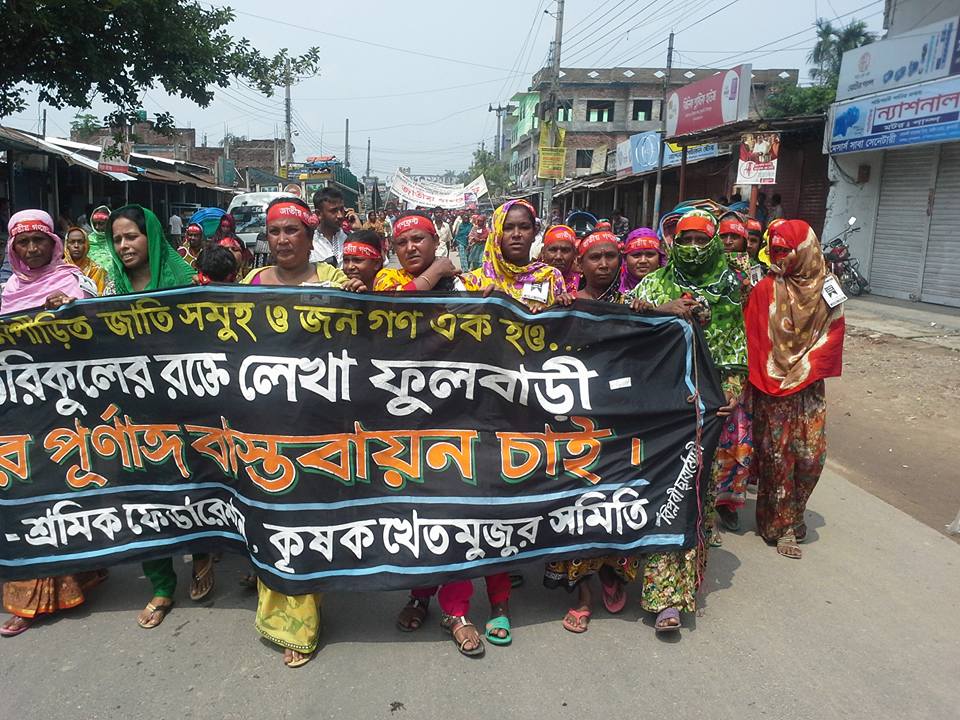
Yesterday marked 17th Phulbari Massacre Day. On 26 August 2006 three children were shot dead by paramilitary force and more than 200 people were injured during a protest against plans by a London-listed mining company (then Asia Energy, now renamed GCM Resources) for a huge opencast coal mine which would forcefully displace 130, 000 people from the area. The three murdered children are namely Al Amin, Mohammad Saleqin and Tarikul Islam. The children are aged 11,13 and 18 respectively. The day is nationally known as Phulbari Day. People of Phulbari are still waiting for justice in Bangladesh. Hundreds of people in Phulbari, Dinajpur, and Dhaka have honoured the dead by commemorating and rallying in Phulbari martyrs’ monument and at Dhaka Shahid Minar earlier today. The organisers of the events have called upon Bangladesh government to oust GCM from Bangladesh and ban open cast coal mine.  
We, Phulbari Solidarity Group and London Mining Network, stand in solidarity with the families of the victims and the protesters in Phulbari as ever. Echoing Phulbari protesters, we call on both the Bangladesh and the UK government to take immediate action to ban coal mining, take legal action against GCM Resources, demand justice for Phulbari people. We have organised protests and commemoration rally in London Stock Exchange and Bangladesh High Commission in the past. Our demand are yet to be implemented. This year we did not hold in person event but we want to reaffirm our original demand.  Phulbari Solidarity Group together with London Mining Network, XR Youth Solidarity,  Christian Climate Action and others have many times rallied to commemorate the event and called for GCM to be delisted from the London Stock Exchange and abandon its Phulbari project in the past . But the government in Bangladesh and the UK are yet to take action to ensure justice for victims in Phulbari.    

a

On 26 August in 2021 and 2022, transnational and Bangladeshi climate justice activists gathered outside the Bangladesh High Commission in London to pay tribute to the victims of the Phulbari Massacre in 2006. Anti-mining activists held Remembrance rallies to mark the 15th and 16th anniversary of the Phulbari Massacre, and we have called on the High Commissioner to push for the delisting of GCM Resources from the London Stock Exchange and the banning of new coal projects in Bangladesh. The High Commissioner did not meet us and did not receive our memorandum.  Likewise, we have held  three vigils to commemorate the Phulbari victims in front of London Stock Exchange on 10th, 13th and 14th anniversary of Phulbari Massacre, and handed over three memorandums to the CEOs of London Stock Exchange. But they did no take action.  Shame on them.

Bangladesh High Commission is fully aware that the London Stock Exchange is hosting a company that is responsible for gross human rights violations and that does not have a valid license for business in Bangladesh. But they are not taking action to prevent this crime. 17 years on, the company GCM Resources, continues to grab money by selling deceitful shares on Phulbari’s name. The company does not hold any valid asset to operate in Phulbari and does not have permission for mining anywhere in the world. Bangladesh’s state minister stated in 2019 that the government will take legal action against GCM. Its’ been four years since. We have written to LSE’s Chief Financial Officer and Chief Executive Officers three times, and submitted evidence showing that GCM is involved in fraudulent business at LSE. The London Stock Exchange did not de-list GCM. The Bangladesh government is yet to take legal action against the company.
We are outraged by the delay in banning coal mining in Bangladesh, and we are enraged by the inaction of London Stock Exchange, Financial Conduct Authority, and Alternative Investment Market who failed to de-list GCM from London Stock Exchange.

The Phulbari Solidarity Group’s Founder and Co-ordinator, Rumana Hashem, said:

“We remember and respect Al Amin, Mohammad Saleqin and Tarikul Islam. These three children were killed on 26 August 2006 when a paramilitary force opened fire, in favour of the British mining company, during a nonviolent demonstration of an estimated 80,000 people against the eviction of 130,000 people in Phulbari to make for a 572-million ton open cast coal mine. We will continue to call on the UK government and Bangladesh government to take legal action against GCM Resources, to de-list GCM from London Stock Exchange, and ban mining in Bangladesh.”

Of the campaign to de-list GCM, Richard Solly (Network Coordinator of London Mining Network) said:

“Since LMN was launched in 2007, we have supported the struggle against the Phulbari project. It is utter madness for GCM to keep pressing on with a new opencast coal project which would displace tens of thousands of people dependent on rural occupations, with no guarantee that they could find alternative work, and at a time when we know we have to stop burning coal anyway. UK authorities should not allow London share markets to be used to finance this kind of destructive project. GCM should be delisted.”

Extinction Rebellion Youth Solidarity spokesperson, Sara Cordovez, said:

As XR Youth Solidarity, we stand with the Phulbari Solidarity Group in marking the 15th anniversary of the Phulbari Day shooting. For us at XR Youth Solidarity, Phulbari Day represents the undeniable link between people and planet: our global fossil-fuel addicted economy is killing people, directly and indirectly, and driving us towards the ecological and climate collapse, while leaving communities like Phulbari to mourn for the youth that stood against this fate. We stand united against GCM and emphatically condemn their continued listing in the London Stock Exchange.”

Speaking from Bangladesh, Professor Anu Muhammad , Member Secretary of the central National Committee to Protect Natural Resources said:

This is unbelievable that a fraud company like GCM which has no credibility even as a business house, rather it has blood in its hands, lies in their leaps, falsehood in their papers, poison in their activities- still enjoying support from British establishment to continue with these. This company has been cheating people in share business to make money in the name of Phulbari where they were behind killing people, on which they have no valid license, where they tried to implement a disastrous project, from where they were driven out in 2006 by a mass uprising and never allowed to enter.

Since 2006, in all these years they have been trying to incite violence in the area, tried to mobilize criminals against community leaders, made false cases against them, but could not enter into the area. People’s resistance remains strong. These frauds should also be driven out by British institutions including LSE. We are looking forward to seeing the trial of these criminals in Dhaka and London .”

Sara Caldwell of Women of Colour GWS & International Global Women’s Strike (UK, India, Ireland, Peru, Thailand, USA), said:

“The determined resistance of women in particular halted plans for a devastating coal mine. People of Phulbari — women, men and children, are acting also for us and we must act with them. Our thoughts are with the families of the children shot dead by paramilitaries, and those injured. These brutal attacks did not to stop protests. Women, as often happens, were central — on marches, road blocks, and even courageously chasing away paramilitaries with brooms and cooking utensils to protect lives. Your strength is an inspiration to us all. We will publicise your struggle especially during the weeks of climate action to end polluters – we must abolish multi-national polluters to save the planet and ourselves. Grassroots women are the carers everywhere. They and all carers for people and planet deserve a income to strengthen our struggle and win. Power to Phulbari, India’s farmers, Haiti, Burma, Marikana and all organising for justice and to save our planet!”

Contact Information

Phulbari Solidarity Group is a collective of anti-mining and climate justice activists from Bangladesh and Europe. We work to prevent coal mine and challenge multi-national extractive companies in Bangladesh and the UK.

London Mining Network (LMN) is an alliance of human rights, environmental and solidarity groups. We work together to support communities harmed by London-based and financed mining companies.
GCM Resources Must Be Brought to Justice and Delisted from London Stock Exchange

Joint Statement by Phulbari Solidarity, London Mining Network, and Women of Colour

Today Friday 26 August marks the 16th anniversary of Phulbari Massacre where three young people Al Amin (11), Mohammad Saleqin (13), and Tarikul Islam (18) were shot dead for protesting against an open cast coal mine in 2006. More than two hundred people were injured in a non-violent demonstration of 80,000 people who marched against a London-listed mining company, Asia Energy, now known as GCM Resources Plc. GCM Resources wants to extract 572million tons coal to build a 600MW coal mine by forcibly displacing 130,000 people. Coal would be extracted for 30 years from Bangladesh’s only flood protected location in Phulbari, Dinajpur. The day is nationally known as Phulbari Day since the murders of Amin, Saleqin and Tarikul.

File photo: Phulbari outburst after the shooting in August 2006 . Photo credit: Anonymous, Phulbari Solidarity,

We remember Phulbari Day. We should call out the London-listed company GCM Resources plc, which inflicted violence in pursuit of coal in Phulbari. Powerful resistance by the communities in the aftermath of the shooting have put a 16-year long halt to the mining project. The Bangladesh government has declined all contracts with GCM since 2007. But the company is still selling shares in the London share market in the name of the Phulbari coal mine. Despite having no valid contract with Bangladesh, they are moving ahead with their devastating plans together with Polo Resources, another British corporation which bought into GCM in 2010. GCM and Polo Resources are hosted by the London Stock Exchange’s Alternative Investment Market (AIM). They recruited a local agency called the DG Infratech Pte Ltd, a Bangladesh based agency, to lobby the government. We should call out them, and the London Stock Exchange (LSE), too. We should also call on the UK and Bangladesh governments to take legal action against GCM Resources and Polo Resources.   

GCM’s CEO Gary Lye continues to harass anti-mining community activists on the ground. Lye filed two cases against 19 community leaders who are facing trial in Dinajpur Magistrate court because of their leading roles in the resistance movement.  Gary Lye demand £1billion from the community leaders for damaging his company’s reputation through their resistance movement. Earlier in August the 19 Phulbari community leaders had their hearing in the Dinajpur court, where Lye’s lawyer appeared “aggressive”. During the delayed hearing on 4 August 2022, the plaintiff’s witness Saydur Rahman was asked by the defendants’ lawyer whether he knew the defendants, who are all respected community representatives. The plaintiff’s witness got angry with the lawyer and said, “no”. He was asked again how did he file cases against the defendants then? The plaintiff refused to answer the question, and instead argued with the defendants’ advocate and replied aggressively: “why are you bringing in history of the case in the court? This is an old case. These are old questions. I am not here to answer your questions about the past.”  The court was shocked by the plaintiffs, a GCM staff member, raising his voice in the court. The Judge warned him to “not be aggressive” and to engage with the simple questions of the lawyers.

The 19 defendants are innocent community members who deserve state protection from harassment and aggression by GCM and its CEO Gary Lye.  We ask the Bangladesh government to take legal action against GCM and the London Stock Exchange to de-list GCM Resources immediately. The London Stock Exchange has the power to suspend or expel a company from AIM for breach of the AIM rules. Despite our repeated calls to investigate GCM’s right to do business, the LSE is reluctant to do so. Likewise, the Bangladesh government has the authority to take legal action against GCM and asking LSE to de-list GCM. Neither of them have done anything to de-list GCM so far.

The London-listed coal mining company, GCM Resources plc, formerly known as Asia Energy, held its AGM behind closed doors earlier this year on 20 January.  They did not put a notice online on their website despite the fact that most such activities across the world were being held online. At a time of high Omicron infection rates in the UK, they sent the notice of AGM to their shareholders by post only 13 days before the AGM. This restricted access to information by shareholders, and made it impossible for critics to raise issues in the AGM or to hold protests. Holding an AGM without an online announcement seemed a cowardly policy to avoid protests.

In 2021 GCM held a closed doors AGM, after three postponements. That excluded their own shareholders. GCM are pressing forward with a pernicious policy that excludes their own shareholders and prevents people from attending the AGM. GCM said that ‘due to the ongoing COVID-19 pandemic, the AGM will be held virtually as a closed meeting with a minimum number of directors and shareholders present, such that the legal requirement to hold a quorate meeting will be satisfied; and no other shareholders will be permitted to access, attend or participate either in person or virtually.’ They have not given a justification for such a policy.

We believe GCM Resources to be a toxic company, causing human rights violations across Phulbari and Dinajpur. They should be delisted without delay. We are calling on the London Stock Exchange to de-list GCM on this Phulbari Day. AIM has been silent on this matter. The last time we have heard from AIM was in September 2020. The email from AIM addressed to Phulbari Solidarity Group’s Founder, Dr Rumana Hashem, said that AIM would take action if GCM is breaching the law. AIM requested evidence that GCM does not have any license to conduct business in Bangladesh. Phulbari Solidarity Group has sent adequate evidence twice through email and through Royal Mail posts in 2019 and 2020. AIM is yet to acknowledge the receipt of Rumana’s emails. We have not heard from AIM since 2 September 2020. Two years since there is no progress in the investigation.

We call upon the London Stock Exchange and the UK government to de-list GCM Resources plc immediately. In adding our voices to those of the communities in resistance in Phulbari and Bangladesh, we also call upon the Bangladesh government to take legal action against GCM and to implement the 5-point Phulbari Verdict, which the government signed with community representatives on 30 August, 2006. It is the government’s responsibility to investigate what the London Stock Exchange is doing to stop GCM from selling shares on the London share market.  It is also the government’s responsibility to ensure that the 19 community leaders in Phulbari are protected from GCM’s CEO, Gary Lye. It is GCM and Gary Lye who should go on trial and be compelled to pay compensation to the affected communities for their loss.

We Call on the Bangladesh Government to Implement Phulbari Verdict, Take Legal Actions Against GCM Resources, and End Coal Power Now!

Memorandum of 15th Phulbari Day Remembrance Rally, 26 August 2021

Bangladesh High Commission, London

28 Queens Gate, SW7 5JA.

We are here as transnational climate justice campaigners, representatives of Phulbari communities from Northwest Bangladesh, and anti-racist and anti-mining activists, to express our concern about the delay in implementation of the Phulbari Verdict, the banning of coal mining and coal-power in Bangladesh.

This 26th August marks the 15th anniversary of the Phulbari killings when three young people were shot dead and more than two hundred injured during a non-violent demonstration of 80,000 people who marched against coal mining in Phulbari and the displacement of 130,000 people from the region by London-listed Asia Energy, thereafter GCM Resources. The day has nationally been called Phulbari Day since. Powerful resistance in the aftermath of the shooting in Phulbari has put a 15-year long halt to the project. Following the killing of the three young people the Bangladesh government signed a contract with the people in Phulbari on 30th August, 2006. The contract, nationally known as the Phulbari Verdict, suggested that the government would ban coal mining in Bangladesh. The government thus overturned GCM’s right to operate in Bangladesh.

Despite lacking a valid contract for mining, GCM Resources plc (GCM) is selling shares on the UK’s share market. The company is currently listed as a mining company on the London Stock Exchange’s Alternative Investment Market (AIM). They have extended mining contracts with two China based companies and they are selling shares in London in the name of a “Phulbari coal project”, a project which does not exist. This is an insult to the affected communities who lost their children in the violence in Phulbari. Selling these shares is also unfair to all Bangladeshi and transnational climate justice campaigners.  

GCM does not hold any valid licence to operate in Phulbari and does not have permission for mining anywhere else in the world. The Bangladesh government is fully aware of GCM’s fraudulent activities. Speaking in August 2019 to the Prothom Alo newspaper, Nasrul Hamid, the Deputy State Minister for Power, Energy and Mineral Resources in Bangladesh said:

Even in the absence of an agreement, GCM or Asia Energy is trading shares in London by providing information that coal would be extracted from Phulbari, which is false. The government has taken this into notice. The government is proceeding to take legal action against them.”

We have previously written about this to the Chief Executive of London Stock Exchange and we proposed a meeting to discuss the matter in 2016, 2019, and 2020. The London Stock Exchange wrote to Phulbari Solidarity Group on 1 September 2020 that AIM was looking into the matter. But there has been no progress since.

It is time for the Bangladesh High Commission to act on this. The High Commissioner of Bangladesh in the UK should take action and write to the London Stock Exchange, telling them to de-list GCM immediately. The government of Bangladesh overturned GCM’s right to operate in Bangladesh more than a decade ago, and wanted to take legal action in August 2019. It has been two years since. Government delay in taking legal action against the company allows GCM to sell shares on the basis of a fake project, Phulbari coal mine, in London’s share market. The Bangladesh government should take urgent action to prevent this from happening. The government should implement the Phulbari Day Verdict urgently.

Instead of implementing the Phulbari Verdict, the government is implementing four destructive coal-fired projects across the country. Despite nationwide and international outrages and outreach to the government to save the Sundarbans, the government is moving ahead with the 1,320 MW Rampal coalpowerplant planned for construction near the Sundarbans in Bangladesh. We understand that Bangladesh-India Friendship Power Company Ltd (BIFPCL) is planning this project and a joint venture between National Thermal Power Company (NTPC) of India and the Bangladesh Power Development Board (BPDB) is going ahead, enabling an additional 154 industrial constructions to be built in southwest Bangladesh near the Sundarbans.

Likewise, the government is failing people across Cox’s Bazar coastal area in Southeast Bangladesh. The plans for the construction of a Japan-financed coal-power-plant, Matarbari Phase 2, in Matarbari will ruin livelihoods of communities, destroy three-cops land, pollute water resources, and harm ecosystems essential for farmers and fishermen and women in villages across the Cox’s Bazar. The government is also letting another China-funded coal-power-plant, a 1,224 MW coal-power-plant (currently under construction), in Bashkhali in Chittagong near Cox’s Bazar where seven plant workers were killed for protesting to receive their due wages earlier this year. Two Chinese firms – SEPCOIII Electric Power and HTG – are financing US$1.75 billion of the plants’ estimated $2.4 billion cost. This is happening via a US$1.739 billion loan from the Exim Bank of China. Previously five more people were killed for protesting against the same coal-power-plant in 2016 and 2017. Several companies are involved in the Bashkhali coal-power-plant constructions and killings. These include S Alam Group, PowerChina, and S.S. Power I Ltd. The latest incident of violence and murders on the premises of S.S. Power I Ltd. happened on 17 April. This cannot go on.

The government is also looking into other coal mining options in other regions in Bangladesh. In between, the government has allowed police to torture people in Parbatipur, for protesting against the Barapukuria shaft mining, within the neighbourhood of Phulbari. The mine workers in Barapukuria were protesting a pay gap by a Chinese company in 2011. Currently the government is looking into options for reopening Barapukuria mine through open cast mining. This is a complete violation of the Phulbari Verdict 2006.

We demand the Bangladesh government implement the Phulbari Verdict fully, immediately,  take legal action against GCM, and ban coal-power.

We call on the Bangladeshi government to urgently:

1.  Ban coal mining and fully implement the Phulbari Verdict.

2.  Take legal action against GCM Resources, urgently.

3.  Write to London Stock Exchange Plc. and the UK government informing them that the Phulbari coal project does not exist, and that GCM is cheating on the share market.

4.   Withdraw from the move to build coal-power plants near the Sundarbans and Bashkhali, and all coal projects in Matarbari and anywhere in Bangladesh.

5.  Stop plans to build Barapukuria open cast coal mine, stop the Barapukuria Coal Mine Company Ltd.  Corporate, and compensate Barapukuria coal mine workers who were tortured in  2013 and 2014.

6.  Consult the Alternative Power and Energy Plan for Bangladesh as a way forward for meeting energy needs of the country.

We ask the High Commissioner to convey our demand to the Prime Minister of Bangladesh, and demand that the government respond to our call immediately.

Sincerely,

We the undersigned:*

1.   Rumana Hashem, Coordinator, Phulbari Solidarity Group.

2.   Richard Solly, Coordinator, London Mining Network.

3.   Kofi Mawuli Klu, External Coordinator, Extinction Rebellion Internationalist Solidarity Network.

4.   Sanjit Prasad Jitu, Spokesman, Phulbari Chapter of National Committee of Bangladesh.

5.   Mafizur Rahman Laltu, Coordinator, Biborton, Dhaka.

6.   Sumana Nandi, International Coordinator, XR Affinity Network of Asia (XRANA).

7.   Aminul Haque, Spokesperson, Phulbari Krishak Mukti Songram.

8.   Abdul Razzak, Convenor, National Democratic Workers Federation.

9.   Alfredo Quarto, Program & Policy Director/ Co-founder, Mangrove Action Project, USA.

10.  Alauddin, President, Phulbari Construction Workers Union.

11.  Alejandra Piazzolla, Spokesperson, Extinction Rebellion Youth.

12.   Angela Ditchfield, Director, Christian Climate Action.

13.  Anne Harris, Campaigner, Coal Action Network (UK).

14.  Alex Burton, Spokesperson, Global Justice Bloc.

15.  Baccu Islam, President,  Phulbari Upazilla Garments Workers Union.

16.  Bappy Das, Tabla Teacher of Surobani Songgit School.

17.  Danielle DeLuca, Advocacy and Development Manager, Gerente,  Recaudación de Fondos y Programa de Defensa, Cultural Survival, USA.

18.  Dr Samina Luthfa, Spokesperson, Sarbajan Katha, Dhaka.

19.  Esther Stanford-Xosei, Coordinator General,  Stop the Maangamizi: We Charge Genocide/Ecocide

20.  Fe Haslam, Co-Principal Organising Secretary, Global Justice Forum.

21.  Hamidul Haque, President, Phulbari Kuli (day Labourers) Workers Union.

22.  Hasan Mehedi, Member Secretary, Bangladesh Working Group on External Debt (BWGED).

23.  Himel Mondal, Coordinator, National Gonofront.

24.  Jargis Ahamed, President, Cable Operators Association, Phulbari.

25.  Joy Prokash Gupta, Phulbari Kali Mondir Committee.

26.  Julie Begum, Chair, Swadhinata Trust, UK.

27.  Mahamud Alam Liton, Mayor of Phulbari Municipal. Dinajpur.

28.  Manik Sarkar, Mayor of Municipal (Former), Phulbari Municipal.

29.  Nils Agger, Co-founder, Extinction Rebellion

30.  Nicholas Garica, Coordinator, Extinction Rebellion Slough.

31.  Nurul Islam Fokir, General Secretary,  Phulbari Rickshaw Van Workers Union.

32.  Peter Burgess, PhD Candidate, King’s College London.

33. Rowan McLaughlin, South Tees Green Party, UK.

34.  Sara Callaway, Coordinator, Women of Colour and Global Women Strike.

35.  Sara Cordovez, Co-founder, Extinction Rebellion Youth Solidarity.

36.  Samarendra Das, Chair, Foil Vedanta.

37. Saiful Islam Jewel, Convenor, Phulbari Chapter of National Committee of Bangladesh.

38.  Shakoat Hossain, General Secretary, Phulbari Dokam Employees Union (Local Business and Entrepreneurs Association in Phulbari).

39.  Shafiul Islam, President, Phulbari  Upazilla Decorator Workers Union.

40.  SM Nuruzzaman, General Secretary, Trade Union Center Of Dinajpur.

41.  Syed Samiul Islam Shohel, Councillor of Phulbari Municipal.

42. Syed Enamul Islam, Co-ordinator, European Action Group on Climate Change in Bangladesh.

*Note: Names of signatories do not follow alphabetical order. Signatures are added as and when signatories signed the letter online.

Press Release: Protest Held at Bangladesh High Commission on 15th Phulbari Day

Protest outside of Bangladesh High Commission in London on 26 August 2021. Photocredit: Fe Haslam

41 Climate Justice Organisations Called on the Bangladesh Government to Implement Phulbari Verdict, Take Legal Actions Against GCM Resources, and End Coal Power.

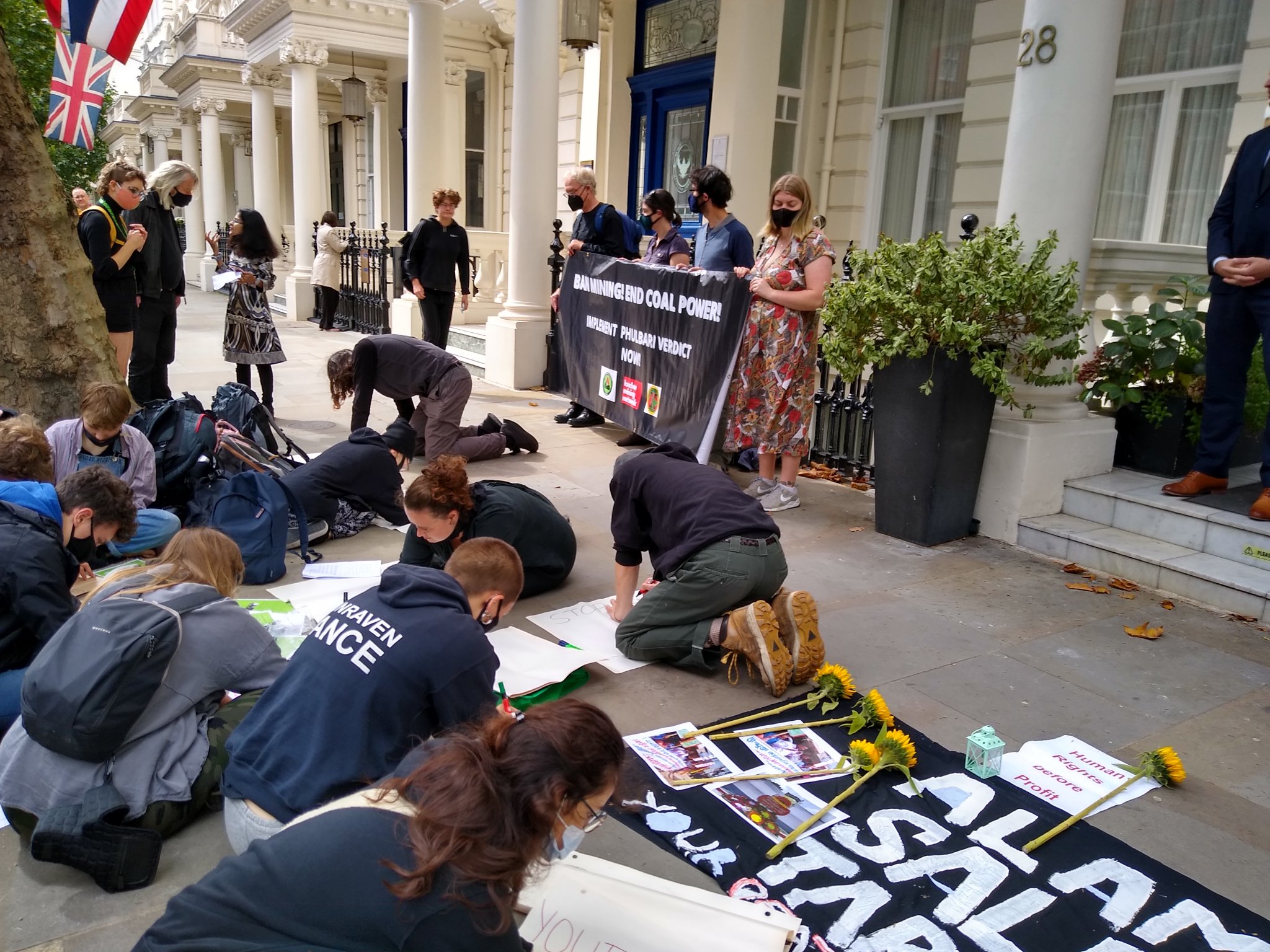
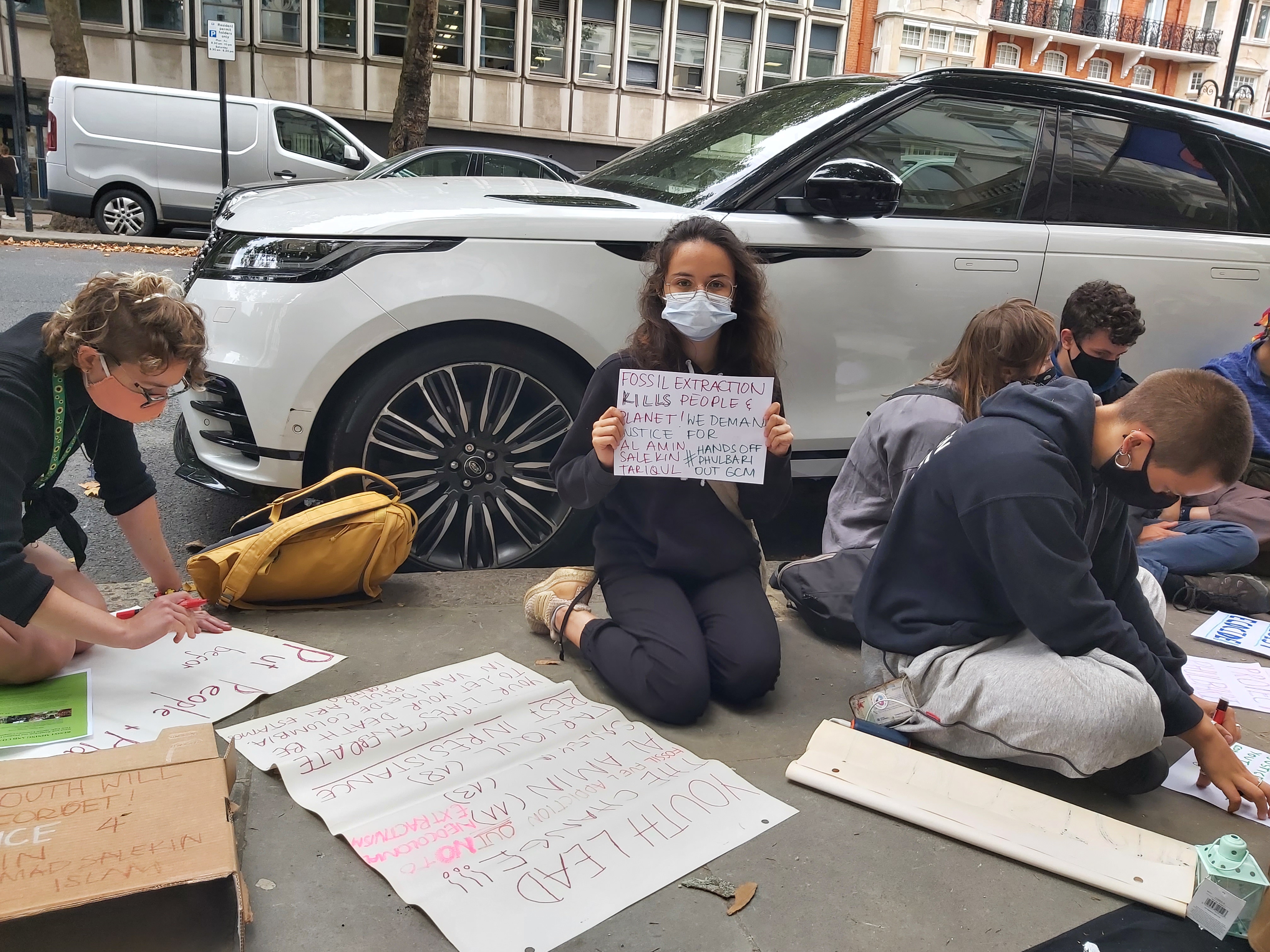
Some XR Youth Solidarity activists make placards outside the Bangladesh High Commission for Phulbari Solidarity. Photo credit: London Mining Network

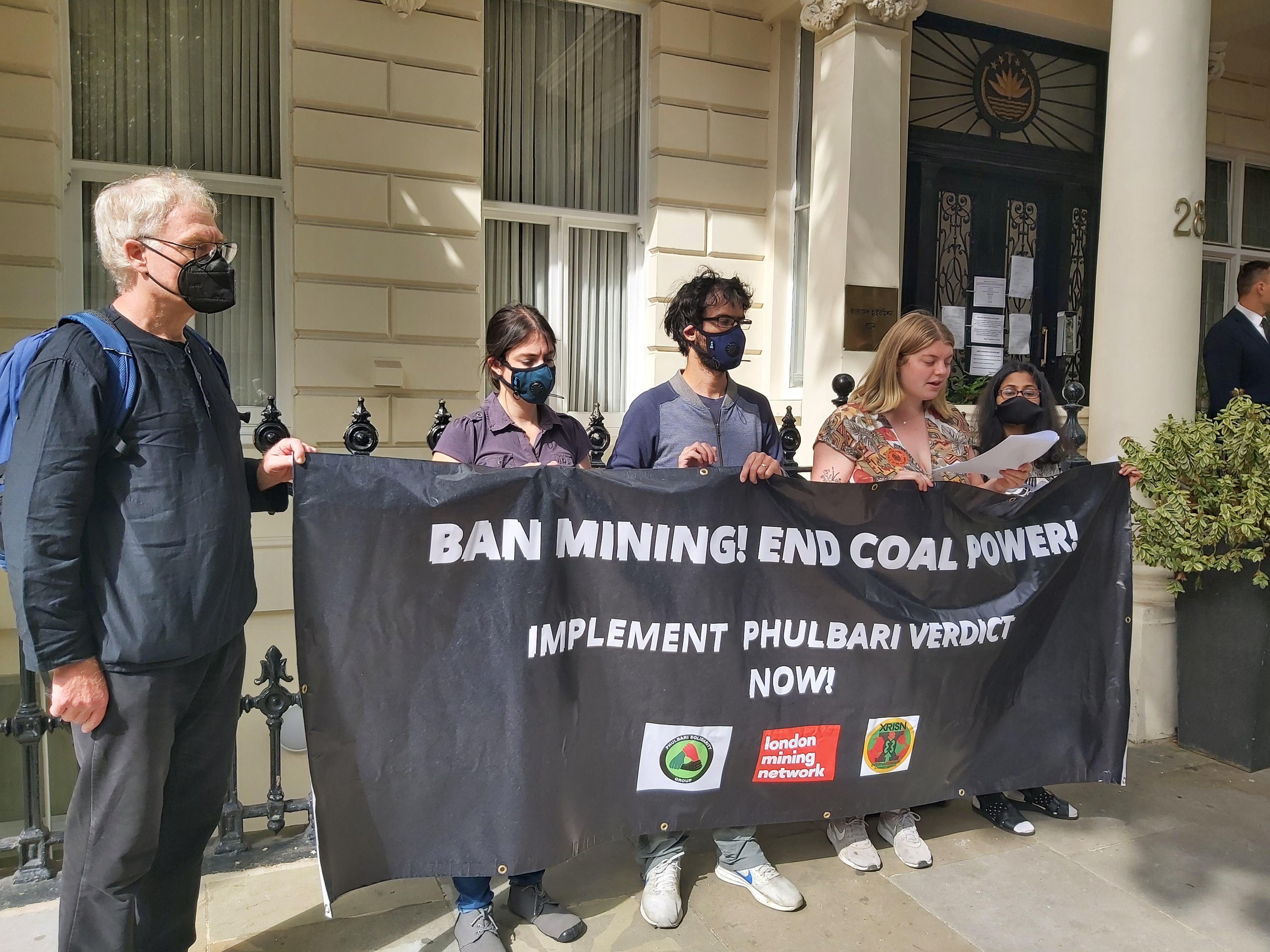
On Thursday 26 August, a large number of transnational anti-mining and climate justice campaigners held a 2-hour long protest outside the Bangladesh High Commission in London, where they honoured the victims of the Phulbari Massacre, where three young people were killed and hundreds injured protesting British financed coal mine. From the Remembrance rally, marking the 15th anniversary of the Phulbari Day, 41 climate justice organisations called on the High Commissioner to push for the delisting of GCM Resources from the London Stock Exchange and the banning of new coal projects in Bangladesh.  Despite advance email request for an appointment with the High Commissioner, the High Commissioner refused to meet the London Mining Network, Phulbari Solidarity Group and Extinction Rebellion Internationalist Network activists.

The rally in London was organised by the Phulbari Solidarity Group and London Mining Network, with support from Foil Vedanta, Fossil Free London, Bibortan, Extinction Rebellion Internationalist Solidarity Network, Global Justice Bloc, Extinction Rebellion Youth Solidarity,  and Women of Colour in the Global Women’s Strike.

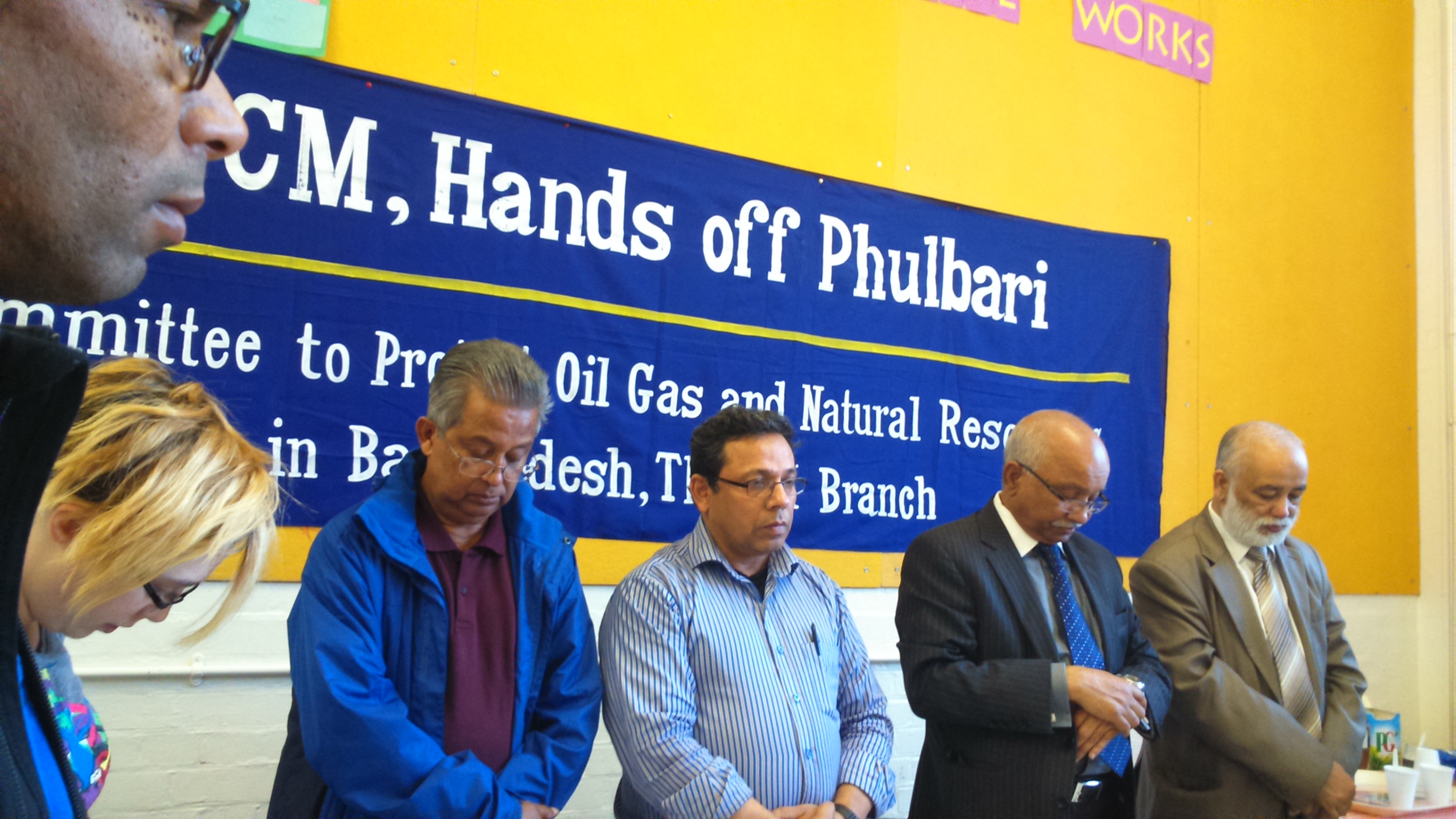
Activists from XR Youth UK, Global Justice Bloc, and Fossil Free London joined the Phulbari Solidarity Group and London Mining Network, and occupied the entrance of the Bangladesh High Commission for two hours from 10:30AM to 12:35PM. The rally marked the 15th anniversary of the Phulbari Massacre. The gathered activists laid sunflowers, candles, and held banners outside the High Commission, accompanied by mournful cello music by XR Youth Solidarity artist, Clary. The memorandum to Bangladesh High Commissioner was shared and read out loudly by seven activists, led by Rumana Hashem, the coordinator of the Phulbari Solidarity Group and eyewitness to the 2006 massacre. A three minute silence was held in memory of  Al Amin, Mohammad Saleqin and Tarikul Islam. These three, aged 11,13 and 18 respectively were killed on 26 August 2006 when a paramilitary force opened fire during a  nonviolent demonstration of an estimated 80,000 people against the eviction of 130,000 people in Phulbari  to make way for a 572-million ton open cast coal mine. More than 200 other demonstrators were injured.

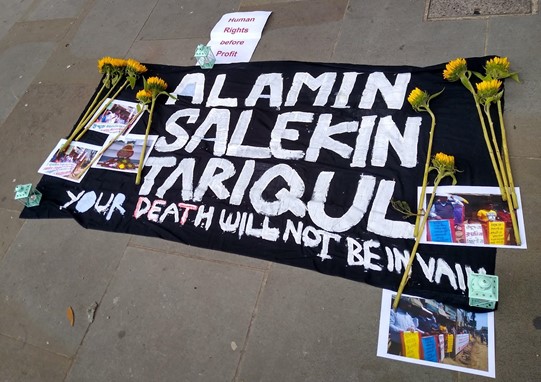
A handpainted balck banner with sunflowers and candles on either side laid on the ground outside the Bangladesh High Commission by PSGBD in memory of Al Amin, Salekin and Tariqul, who were killed in 2006. Photocredit: Saul Jones.

Extinction Rebellion Youth Solidarity activists held a placard making session outside the High Commission building, stressing the link between young activists and climate justice struggles. A delegation of 5 organisers of the rally requested to meet with MS Saida Muna Tasneem, the High Commissioner for Bangladesh, in order to deliver a memorandum signed by 41 climate justice organisations. This memorandum demand that the High Commissioner put pressure on the London Stock Exchange to de-list GCM Resources, and stress the importance of implementing the Phulbari Verdict, which would ban new coal projects in Bangladesh, to the Bangladeshi Prime Minister. The delegation was denied access to the building as the High Commissioner refused to meet.

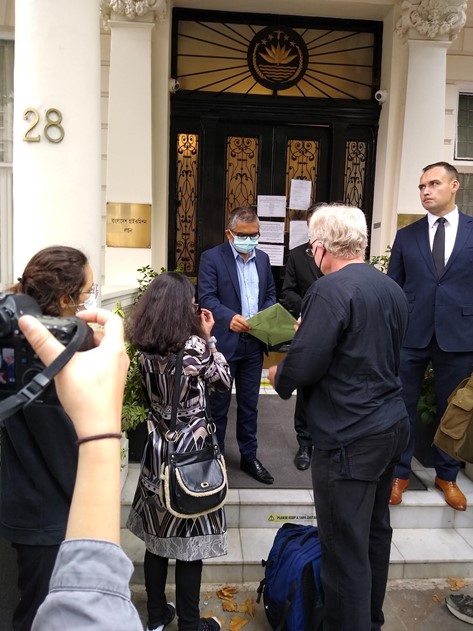
First Officer to the High Commissioner receives the memorandum from the protesters. Photocredit: Saul Jones

While activists were disappointed that the High Commissioner did not have time to meet with them, her First Officer has come to the steps of the office to accept the letter on behalf of Ms Tasneem. The First Officer appeared apologetic and repeatedly emphasised that he will make sure a meeting with the representatives of the organising groups and the High Commissioner will be arranged at a later date. Activists said that they were hurt by the fact that High Commissioner did not have interest in meeting with global climate activists on Phulbari Day. Short speeches were given by Richard Solly, network coordinator of London Mining Network, Sara Cordovez of Extinction Rebellion Youth Solidarity, and placards were read loudly by XR YouthUK activists. Activists said that they will come back to this venue until the day the Phulbari Verdict is implemented.

 Rumana Hashem , the co-ordinator of Phulbari Solidarity Group  and an

eye-witness to Phulbari shooting said:

I am sad that the High Commissioner did not make time for us on  a sensitive issue on Phulbari Day. Bangladesh High Commission is fully aware that the London Stock Exchange is hosting a company that is responsible for gross human rights violations and that does not have a valid license for business in Bangladesh. But they are not taking action to prevent this crime. I have witnessed GCM’s violence in Phulbari. 15 years on, the company continues to grab money by selling deceitful shares on Phulbari’s name. The company does not hold any valid asset to operate in Phulbari and does not have permission for mining anywhere in the world. The Bangladesh’s state minister stated that the government will take legal action against GCM. That was in 2019. Its’ been two years since.  We have written to LSE’s Chief Financial Officer and Chief Executive Officers twice, and submitted evidence showing that GCM is involved in fraudulent business at LSE. It is now the High Commission and Bangladesh Government who should take action.”

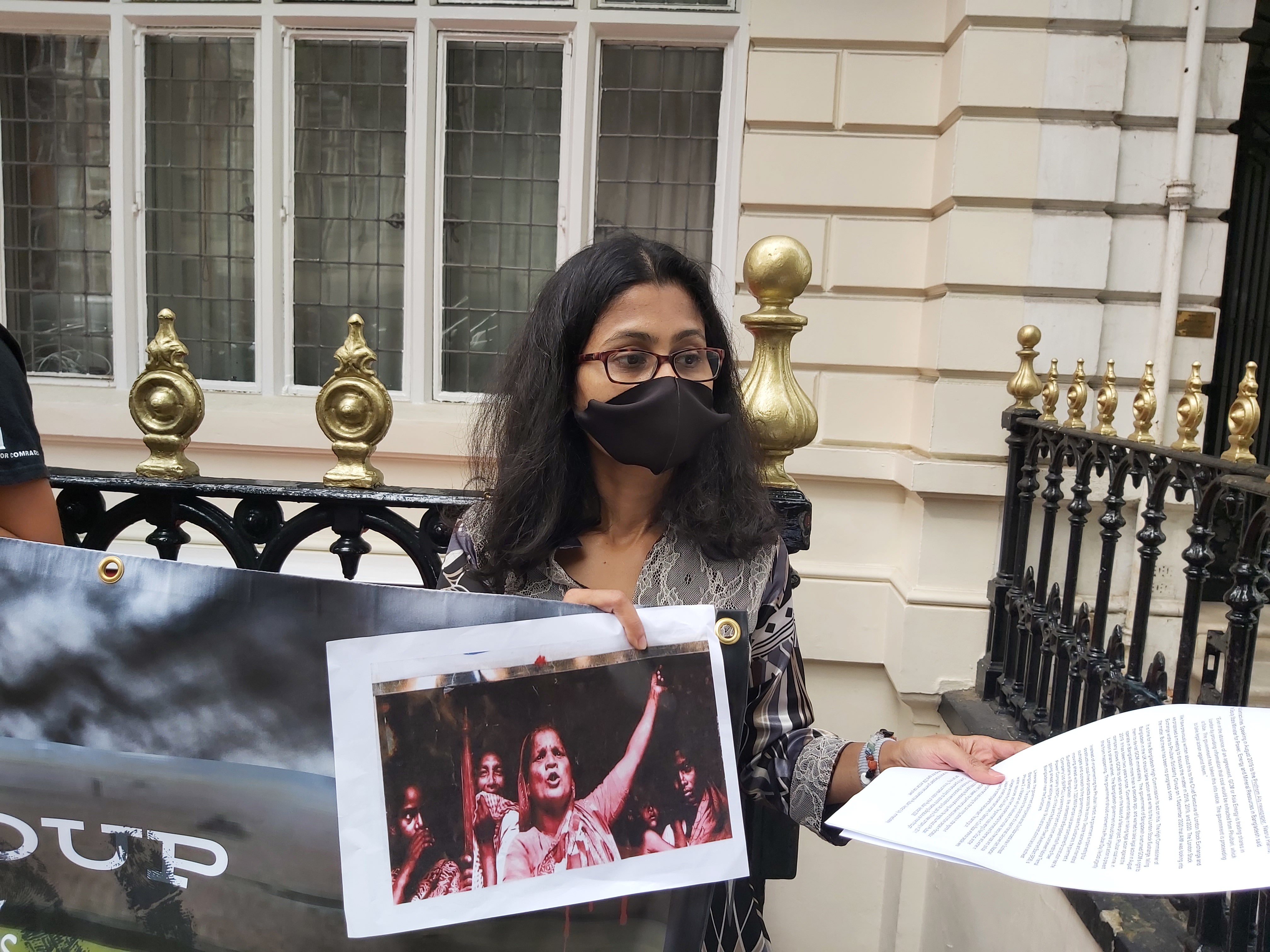
Rumana Hashem of PSGBD holds a poster made by the Youths of Phulbari Public Library showing women are shouting at para-military men during curfew after the shooting in the evening of 26 August 2006. Photocredit: Fe Haslam.

Of the campaign to de-list GCM, Richard Solly, Network Coordinator of London Mining Network, said:

“Since LMN was launched in 2007, we have supported the struggle against the Phulbari project. It is utter madness for GCM to keep pressing on with a new opencast coal project which would displace tens of thousands of people dependent on rural occupations, with no guarantee that they could find alternative work, and at a time when we know we have to stop burning coal anyway. UK authorities should not allow London share markets to be used to finance this kind of destructive project. GCM should be delisted.”

In the afternoon, 200 protesters from across the world joined the campaigners at a Live streamed witness and solidarity event hosted by the Phulbari Solidarity Group, Bibortan Cultural Group, and London Mining Network on zoom, where speakers from Phulbari communities and Bangladesh National Committee were joined by Women of Colour, Foil Vedanta and London Mining Network. Artists and eco-feminists from Bibortan cultural group performed Bengali songs and music for Phulbari resistance, save the Sunderbans and ecological struggles. The event ended by reading the Phulbari Verdict 2006, the original agreement with the government and the communities in resistance, which was signed by Anu Muhammad and the Mayor of Dinajpur, Mizanur Rahman Minu on 30 August, 2006. Rumana Hashem read the agreement.

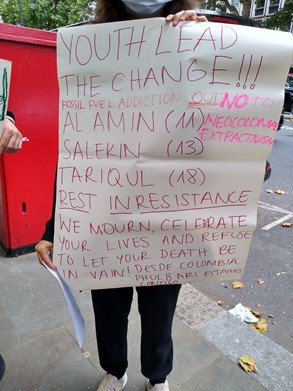
Placard made by XR Youth Solidarity activist in solidarity with Phulbari communities in resistance. Photocredit: Saul Jones

Sara Calaway, Co-founder of Women of Colour, said:

The determined resistance of women in particular halted plans for a devastating coal mine. People of Phulbari — women, men and children, are acting also for us and we must act with them.  Our thoughts are with the families of the children shot dead by paramilitaries, and those injured. These brutal attacks did not to stop protests.  Women, as often happens, were central — on marches, road blocks, and even courageously chasing away paramilitaries with brooms and cooking utensils to protect lives.  Your strength is an inspiration to us all.  We will publicise your struggle especially during the weeks of climate action to end polluters – we must abolish multi-national polluters to save the planet and ourselves. 

Grassroots women are the carers everywhere. They and all carers for people and planet deserve a income to strengthen our struggle and win.  Power to Phulbari, India’s farmers, Haiti, Burma, Marikana and all organising for justice and to save our planet! From Women of Colour GWS & International Global Women’s Strike: UK, India, Ireland, Peru, Thailand, USA.

Sara Cordovez of Extinction Rebellion Youth Solidarity said:

As XR Youth Solidarity, we stand with the Phulbari Solidarity Group in marking the 15th anniversary of the Phulbari Day shooting. For us at XR Youth Solidarity, Phulbari Day represents the undeniable link between people and planet: our global fossil-fuel addicted economy is killing people, directly and indirectly, and driving us towards the ecological and climate collapse, while leaving communities like Phulbari to mourn for the youth that stood against this fate. We stand united against GCM and emphatically condemn their continued listing in the London Stock Exchange.”

Colombian mining activist Sara Cordovez of XR Youth Solidarity holds her third hand written placard outside of Bangladesh High Commission London on 26 August 2021. Photocredit: Rumana Hashem, PSG.

Speaking from Bangladesh, Professor Anu Muhammad , Member Secretary of the  central National Committee to Protect Natural Resources said:

This is unbelievable that a fraud company like GCM which has no credibility even as a business house, rather it has blood in its hands, lies in their leaps, falsehood in their papers, poison in their activities- still enjoying support from British establishment to continue with these. This company has been cheating people in share business to make money in the name of Phulbari where they were behind killing people, on which they have no valid license, where they tried to implement a disastrous project, from where they were driven out in 2006 by a mass uprising and never allowed to enter.

Since 2006, in all these years they have been trying to  incite violence in the area, tried to mobilize criminals against community leaders, made false cases against them, but could not enter into the area. Peoples resistance remains strong. These frauds should also be driven out by British institutions including LSE. We are looking forward to seeing the trial of these criminals in Dhaka and London .”

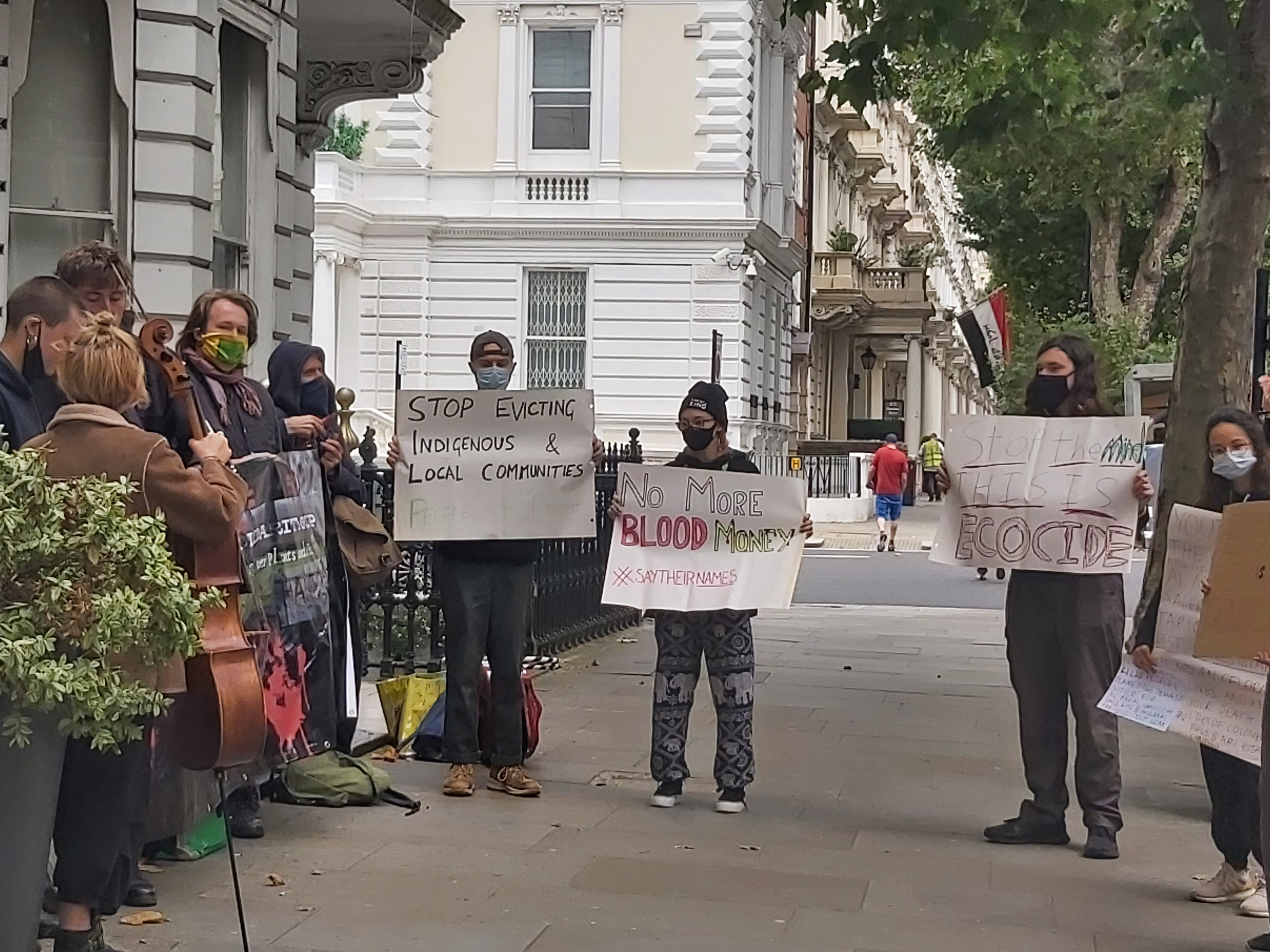
Extinction Rebellion Youth Solidarity activists hold their hadwritten placards wtih cello outside of Bangladesh High Commission in London on Phulbari Day on 26 August. Photocredit: Rumana Hashem

Join Remembrance Rally Mark the 15th anniversary of the Phulbari Massacre

Join Remembrance Rally Mark the 15th anniversary of the Phulbari Massacre

Today, Thursday 26 August, marks the 15th anniversary of coal murders in Phulbari where three young people Al Amin (11), Mohammad Saleqin (13), and Tarikul Islam (18) were shot dead for protesting against a 600MW open cast coal mine in 2006. More than two hundred people were injured in a non-violent demonstration of 80,000 people who marched against London-listed mining company, GCM Resources Plc. GCM wants to build a massive open cast coal mine by forcibly displacing 130,000 people, to extract coals for 30 years from Bangladesh’s only flood protected location, Phulbari. The day is nationally known as Phulbari Day since the murders of Al Amin, Saleqin and Tarikul.

Powerful resistance by women, children, indigenous men, farmers, workers and teachers and students against the coal project has put 15-year long halt to the mining project in the aftermath of the shooting. The Bangladesh government has declined all contracts with GCM in 2007. But the company is selling shares in London share market in the name of Phulbari coal mine. Despite having no valid contract with Bangladesh, they are moving ahead with their devastating plans. GCM continues its dodgy deals for 15 years. They announced extensions of a joint venture agreement with PowerChina and the MoU with NFC by 12 months, and recruited a local agency called the DG Infratech Pte Ltd, a Bangladesh based agency to lobby with the government. GCM is hosted by the London Stock Exchange’s Alternative Investors Market (AIM).

Today we are going to the Bangladesh High Commission in London to report this and to pay tribute to the victims of Phulbari Day. We demand that the Bangladesh High Commissioner should tell the London Stock Exchange to de-list GCM immediately. The LSE has the power to suspend or expel a company from AIM for breach of the AIM rules. Despite our repeated calls to investigate GCM’s rights to business, the LSE is reluctant to do so.


JOIN US at 10:30AM on Thursday 26 August!

Wear A BLACK Mask!

Wear BLACK  clothes!

Bring along your own HAND WRITTEN placards!

The rally is organised by the Phulbari Solidarity Group and London Mining Network with support from Foil Vedanta, Fossil Free London, Extinction Rebellion Internationalist Solidarity Network UK, Global Justice Bloc, Women of Colour, and XR Affinity Network of Asia. In this Black August, we will pay tribute to Amin, Saleqin and Tarikul with sun flowers, candles, music. We will read our joint statement together to de-list GCM.


Join us!

If the mine is built, 130,000 families of farmers in Phulbari would be displaced, 14,600 hectares of highly cultivable land would be destroyed (1 hectare =2.58 acres). Clean water resources be threatened. One of the world’s largest mangrove forests, the Sunderbans, would be damaged. In return GCM offers only 6 percent tax to the government. They plan to export 94 percent of 572 million tons high quality coal. They would enjoy 9-year tax holiday. After extracting coal for 36+ years, all of the remainder coal would be owned by the company and be exported.


Communities in Phulbari are holding silent vigils and commemorative rallies across the region. Civil societies in Dhaka, Dinajpur and Phulbari will be joined by the Phulbari Solidarity Group and London Mining Network in online protests and witness sessions, demanding the government bans coal mining and take legal action against GCM. We stand in solidarity with the affected communities in Phulbari and demand the London Stock Exchange must de-list GCM. We also demand that the Bangladesh Government bans mining and all coal power plant constructions, and takes urgent legal action against GCM.

Come with your friends and family to pay tribute together to the victims of the Phulbari massacre.


Contact for further information: +44 7309 555950, +447767757645.
Email: contact@londonminingnetwork.org, phulbarisolidaritygroup@gmail.com.

Mark the Decade of Resistance, Mark Phulbari Day!

Celebrating 10 years of Halt to Open Cast Mining, Commemorating the lives of brave Villagers

What? RED Vigil at London Stock Exchange

 When? 11am to 1pm on Friday, 26 August 2016

Where? London Stock Exchange HQ for International Trading , 10 Paternoster Square, London EC4M 7LS  (nearest tube station: St Paul’s)

Find Map

Phulbari 2014


Friday, the 26th of August marks a decade of the Phulbari outburst. In 2006 three people were shot dead and two hundred injured in a demonstration of 80,000 people who marched against plans by an AIM-listed British company, Global Coal Resources Management , who wants to build a massive open cast coal mine in Phulbari, a location in northwest Bangladesh. The day has been called Phulbari Day since, and powerful resistance in the aftermath of the shooting against open-cast mine in Phulbari has put a decade long halt to the project. Government has cancelled the company’s license. Although GCM does not have a valid contract with Bangladesh, they are selling shares in the name of Phulbari project. The company has changed its name from Asia Energy to Global Coal Management in 2010, and continued its dodgy deals and lobbying for Phulbari coal mine in Bangladesh.

If the mine is built, 130,000 families of farmers in Phulbari would be forcibly displaced. It would destroy 14,600 hectares of highly cultivable land, would pose threats to clean water resources and would leave devastative impact on one of the world’s largest mangrove forests and UNESCO heritage site, the Sunderbans.  Despite grave concerns at national and international level, and declaration made by seven UN rapporteurs, GCM is pushing the government to give it a go ahead.

The National Committee to Protect Oil, Gas, Port-Power and Mineral Resources in Bangladesh has called upon national and global environmentalists to observe 10th anniversary of Phulbari outburst and to protest against GCM’s dodgy business and to mark the decade of Phulbari Resistance.  In conjunction with the Committee to Protect Oil, Gas, Port-Power and Mineral Resources, we will celebrate the decade-long struggle in London.

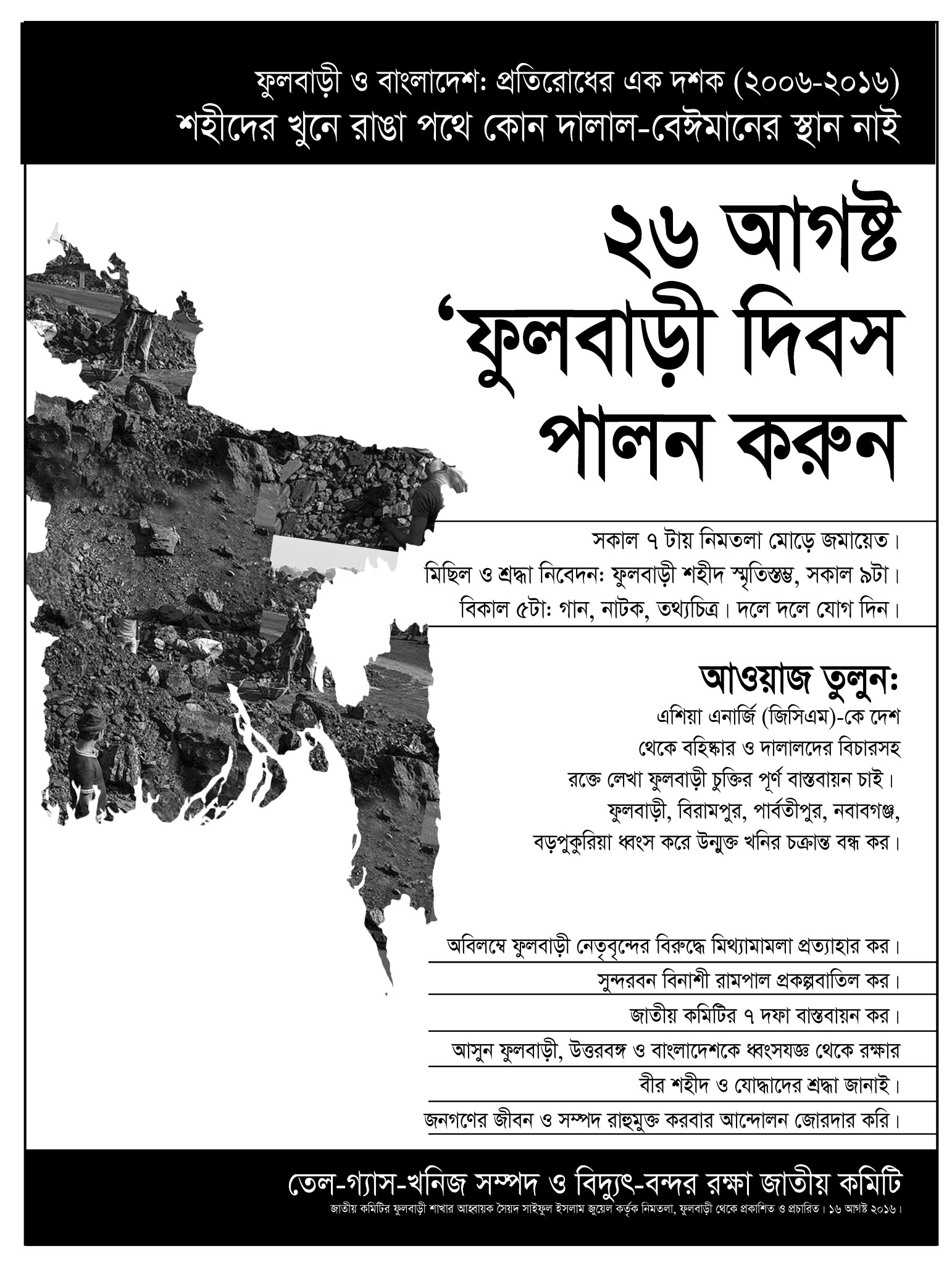
Phulbari Day POster by NCBD 2016

We will hold a Red Vigil for Victims of Phulbari outside the London Stock Exchange at 11am next Friday. We will ask London Stock Exchange to De-list GCM Plc and to show cause Gary Lye’s gang for selling fake shares. We will commemorate for the lost lives by rallying against GCM. We will celebrate our decade-long resistance by turning the commemoration event into a powerful rally against dark coal business.

JOIN US at London Stock Exchange (nearest tube station: St Paul’s).

Bring your organisation’s banner, noisy/music instruments and flowers for the victims if you can. Wear Red, Black or Blue as symbols of Resistance, Anguish and Celebration of struggle!

Please confirm participation via Facebook: https://www.facebook.com/events/641147849383562/

Contact for further information:  07714288221, 07956260791, 07861686036

Email: nationalcommittee.uk@gmail.com , phulbarisolidaritygroup@gmail.com

Committee to Protect Resources of Bangladesh, UK branch     Phulbari Solidarity Group

Download Mark the Decade of Halt, Observe Phulbari Day Flyer August 2016

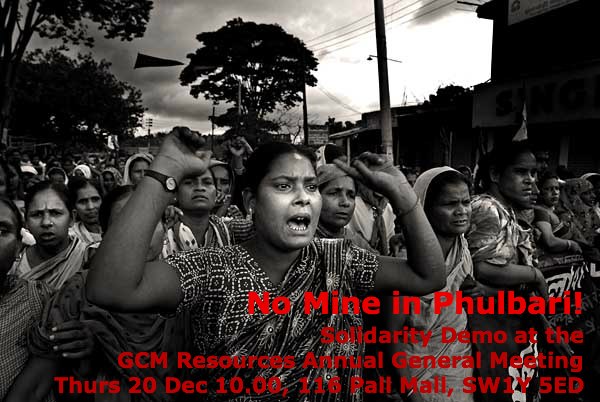
LMN call out for Phulbari Solidarity demo in London on 19 dec 2012

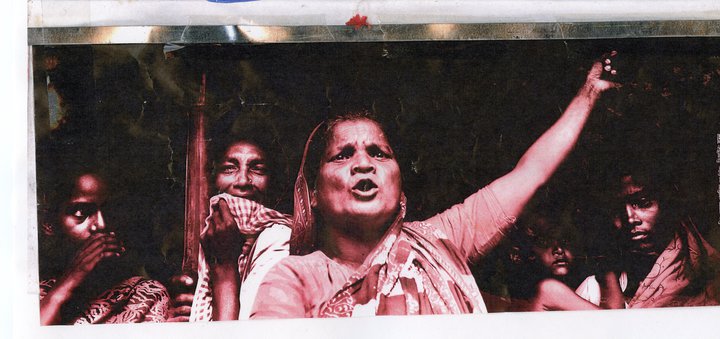
Local women, men and children cried out to save their homes, lands and lives in Phulbari in the aftermath of the GCM-provoked shooting in Phulbari. Photo: 28 August 2006

Mothers, sisters, wives and all the effected women vowed to protect  Phulbari through outburst after the shooting on 26 August 2006. Copyright: PSG


UK Government Highlights Powerful Opposition to GCM’s Destructive Plan for Bangladesh Coal Mine

Victory of Phulbari Once Again!

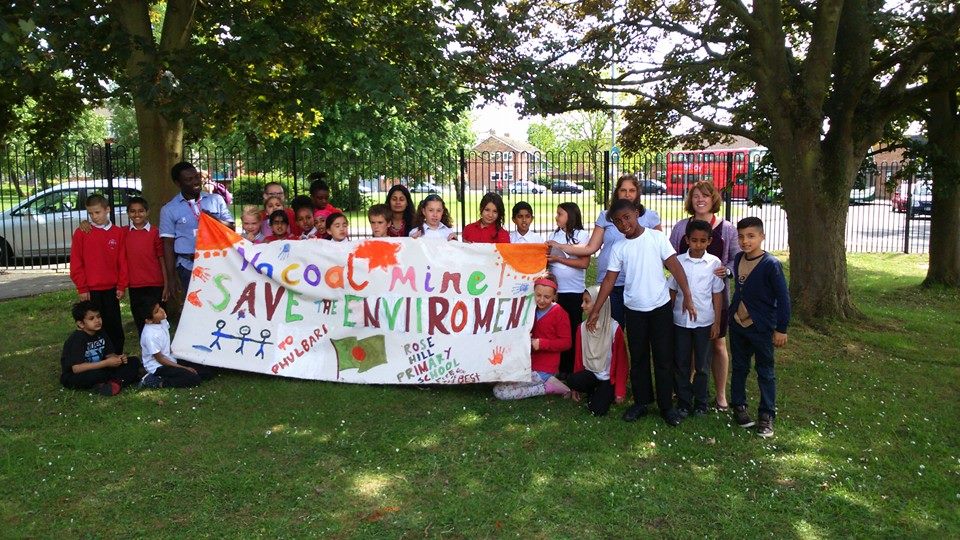
Pupils at Oxford's Rose Hill Primary School painted banner against open cast mine to express solidarity with Phulbari people . 18 June 2015. Photo: Andy Edwards

Pupils at Oxford’s Rose Hill Primary School painted banner against open cast mine to express solidarity with Phulbari people . 18 June 2015. Photo: Andy Edwards

The UK government has published a statement yesterday that highlights the fierce opposition to British company GCM Resources’ plans for a massive open cast coal mine in Phulbari, north-west Bangladesh. The statement notes that protestors are “calling strikes, blockading roads and occupying the company’s local offices”.

The statement by the UK National Contact Point also expresses “regret” that the company had failed to update its plans or produce a human rights impact assessment for the project, as recommended in the findings of its investigation under the OECD Guidelines on Multinational Enterprises in November 2014.

The AIM-listed British corporation GCM Resources Plc.’s planned coal mine in Phulbari has provoked repeated protests by local people and communities for nearly a decade. Three people were killed and more than 200 were injured when paramilitary officers opened fire on a demonstration against the project in 2006. Even so, powerful protests by resilient communities in 2013 and 2014 forced the company’s notorious CEO, Gary Lye, to abandon visits to the area.

Campaigners in Bangladesh are clear that any moves by the company to enter Phulbari would provoke further protests.

The UK government’s investigation has followed a complaint submitted by the Global Justice Now and International Accountability Project in 2012. It has condemned the company for breaching international guidelines on ethical corporate behaviour, stating that the project “has aroused considerable opposition in Bangladesh, leading to violent protests, and an even more violent response by the authorities there”.

Yesterday’s statement also notes recent statements from ministers and officials at the Bangladesh Government’s Power, Energy and Mineral Resources Division that GCM does not have a valid contract with the Government of Bangladesh, and that the Government of Bangladesh has no intention for open cast coal extraction to take place in the region, which includes some of the country’s best agricultural land. These statements follow demands made by protesters against the project that the Bangladesh government should ban open cast mining and remove GCM from the country.

Christine Haigh, campaigner at the Global Justice Now, said:

Today’s statement is further evidence that the Phulbari coal mine cannot go ahead. If it does, it will be a human rights disaster. Local people have repeatedly made it clear that they don’t want it and any moves by GCM to move this project forward will be met by further resistance.”

She added: While GCM are claiming this report vindicates them, in reality it does anything but. The main problem is the inability of the British government to enforce human rights standards on companies like GCM, leaving people affected by British companies around the world with no right to legal redress for the injustices they face. This must change.

Rumana Hashem, the founder of Phulbari Solidarity Group and an eye witness to the 2006 shooting in Phulbari, stated:

It is good that the UK government has eventually recognised that GCM has failed to develop appropriate communication with the communities in Phulbari. It was a mistake for the NCP to take this long to understand the power of people. They have previously undermined the powerful opposition that exists and that has made possible a halt to the detrimental project of the British company.

Rumana added: I have seen how resilient the movement is in Phulbari. Bangladesh government has expressed solidarity with the community’s view and said ‘no to GCM’. GCM must forget this project. It is reassuring that UK government has recognised that local people will not give in. They will fight for their land until last breath.

The mine would force up to 220,000 people from their land, destroying their homes and livelihoods, and would threaten the Sundarbans – one of the world’s largest remaining mangrove forests and a UNESCO World Heritage site.

The UK government states that GCM must take into account the UN Declaration on the Rights of Indigenous Peoples, which stipulates that no developments can take place on indigenous peoples’ land without their ‘free, prior and informed consent’. Bangladesh’s National Indigenous Union says the mine would displace or impoverish 50,000 indigenous people from 23 villages

Seven UN human rights experts have called for an immediate halt to the project, citing threats to fundamental human rights, including the rights to water, food, adequate housing, freedom from extreme poverty and the rights of indigenous peoples.

Read Press Release by Global Justice Now here: http://www.globaljustice.org.uk/news/2015/sep/10/uk-government-highlights-community-opposition-gcm-resources-plan-bangladesh-coal

Homage paid to Brave Protesters in Phulbari

By Raaj Manik

It was Phulbari Day on Thursday. It was the day to commemorate mass protests that prevented a UK-based mining company, Global Coal Management PLC, from building a large-scale open-pit coal mine in Phulbari in north-west Bangladesh. Nine years ago, on 26th August in 2006, three brave protesters were shot dead in the mass protest that took place in opposition to plans by GCM, a London based AIM-listed corporation, who wanted to forcefully displace 130,000 people from their homes by grabbing 14,600 hectares of highly cultivable land in Bangladesh. The powerful demonstration in 2006 ended in tragedy when paramilitary force opened fire on a rally of 80,000, people, leaving three people killed and two hundred injured.

The 26th August has been marked as a day for commemorating the protesters in Phulbari since then. On the ninth anniversary on 26 August 2015, the day was remembered with respect, as ever, and people’s resistance was celebrated by diverse groups and rights-activists across Bangladesh and in London. In Bangladesh, campaigners of National Committee at Phulbari, Dhaka, Narayanganj, and several other regions were joined by many other human rights and art groups who paid homage to Phulbari protesters.

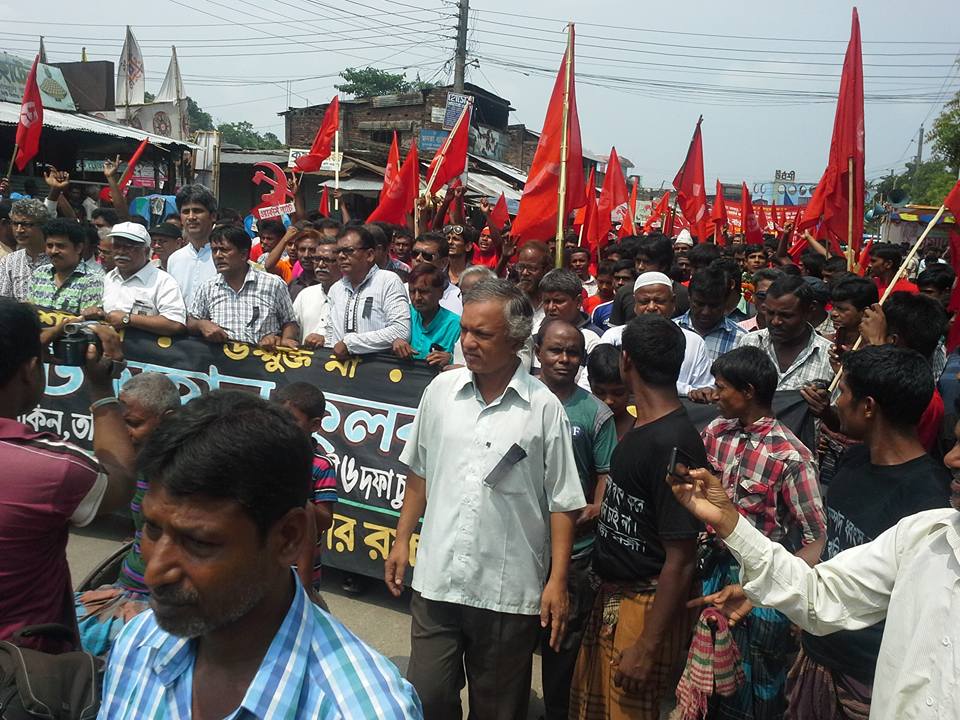
Rally in Phulbari on 26 August 2015 . Photo credit: Anonymous

Rally in Phulbari on 26 August 2015 . Photo credit: Anonymous

In Phulbari, nearly ten thousands of people have paid tribute to Al-Amin, Salekin and Tariqul – the three innocent civilians killed by GCM-provoked shooting in 2006. People have started to gather in the town as early as seven o’clock in the morning to pay homage to those who died that day and to celebrate the people-powered resistance that has prevented the massive mine being built for almost a decade. Schools, colleges, shops and business enterprises were shut for all day in tribute to those brave protesters who forced the British coal miners to leave Bangladesh. The procession of homage, initiated by the Phulbari branch of National Committee, was joined by farmers, agricultural workers, rickshaw-drivers, van-store employees, school teachers, doctors, medical students, professionals, art-activists, business entrepreneurs, and of course local leaders of political parties. Parents of the dead, Al-Amin and Salekin, and the injured men including Bablu Roy and Pradip attended the rally in the town centre.

Families of the victims and women protesters march towards Shahid Minar in Phulbari to pay tribute. 26 August 2015. Photo: Anonymous

Families of the victims and women protesters march towards Shahid Minar in Phulbari to pay tribute. 26 August 2015. Photo: Anonymous

Locals in Phulbari called upon the government to remove fabricated cases against leaders of the Phulbari movement. They demanded for an immediate implementation of the Phulbari deal and called upon a permanent expulsion of Asia Energy, the Bangladesh subsidiary of GCM , from Bangladesh. Activists have also asked government to compensate the affected people in Borapukuria mine. Leaders of National Committee announced fresh programme to be held later this year against government’s destructive policy of coal-powered plant in other parts of the country. The rally called upon the government to implement the 7-point demands of the National Committee and to prevent Rampal coal-fired power project from happening which would destroy the countries only mangrove forest and a UNESCO heritage, the Sundarbans. They demanded that Orion coal-fired plant must be resisted and suspended immediately.

The same demands were projected in the tribute to Phulbari resistance in other parts of the country, and in East London. In London, members of the UK branch of the Bangladesh National Committee to Protect Oil, Gas, Mineral Resources, Power and Ports, and activists of Phulbari Solidarity Group were joined by transnational campaigners and environmentalists from Global Justice Now, UNISON, and the Socialist Party of England and Wales. Messages of support and solidarity were delivered by representatives from Tamil Solidarity, National Trade Union and London Mining Network, also.

In the meeting at the Montefiore Centre in East London transnational activists have taken a pledge to resist all sorts of conspiracy for coal-fired power in Bangladesh. The member secretary of the committee in the UK, Dr Akhter Sobhan Khan, has updated the forum about development in Bangladesh. That Bangladeshi government has eventually recognised that due to the high population density and the fact that much of the local economy is based on agriculture and other land-based livelihoods, open cast mining is not a viable project for Bangladesh. The forum welcomed this news of a recent statement by Bangladesh’s state minister for power, energy and mineral resources, Nasrul Hamid that the government does not want to use open pit mining in the region.

Tribute to Phulbari protesters paid in London by following silence. Photo credit: Rumana Hashem

Tribute to Phulbari protesters paid in London by following silence. 26 August 2015. Photo credit: Rumana Hashem

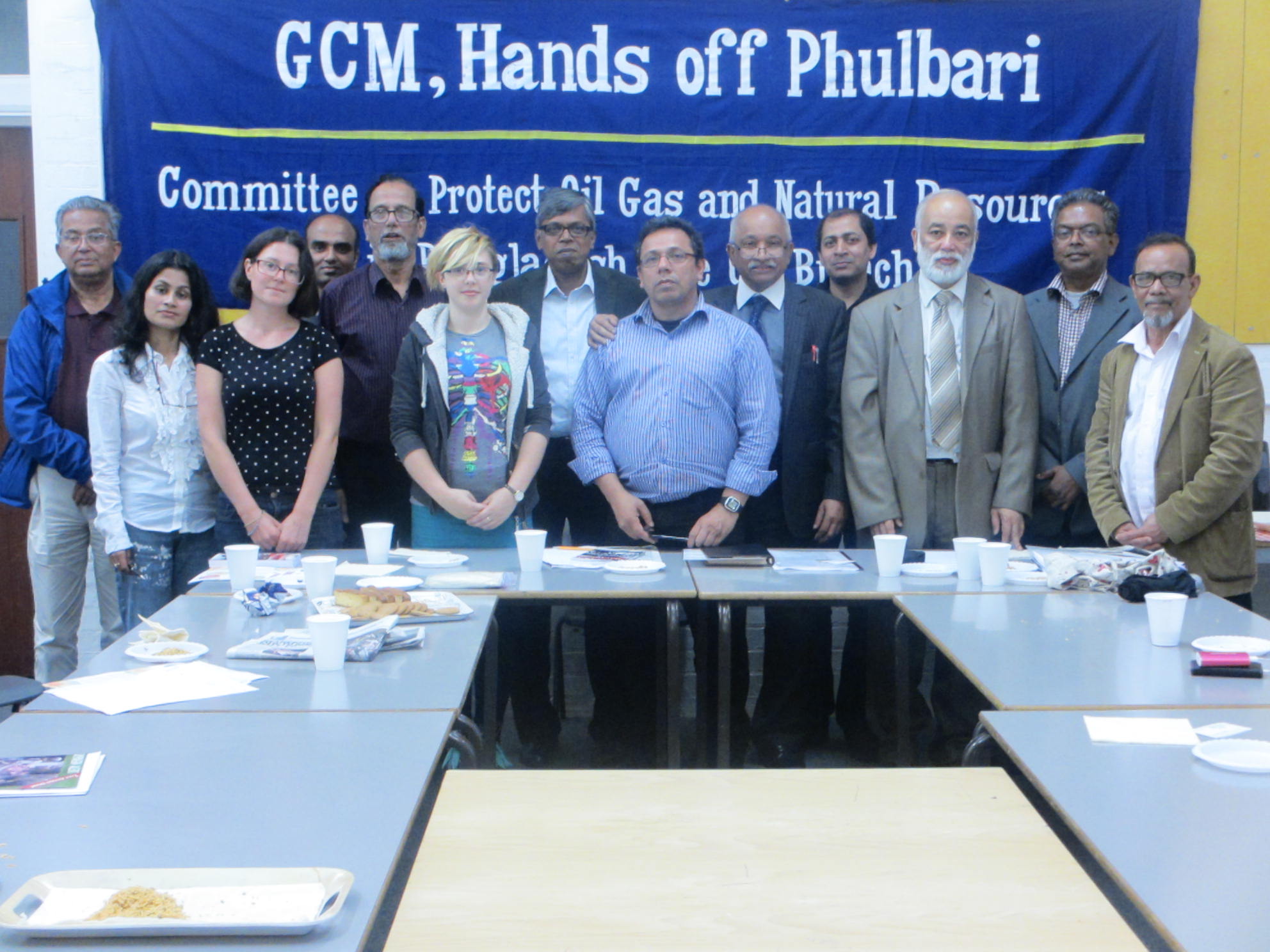
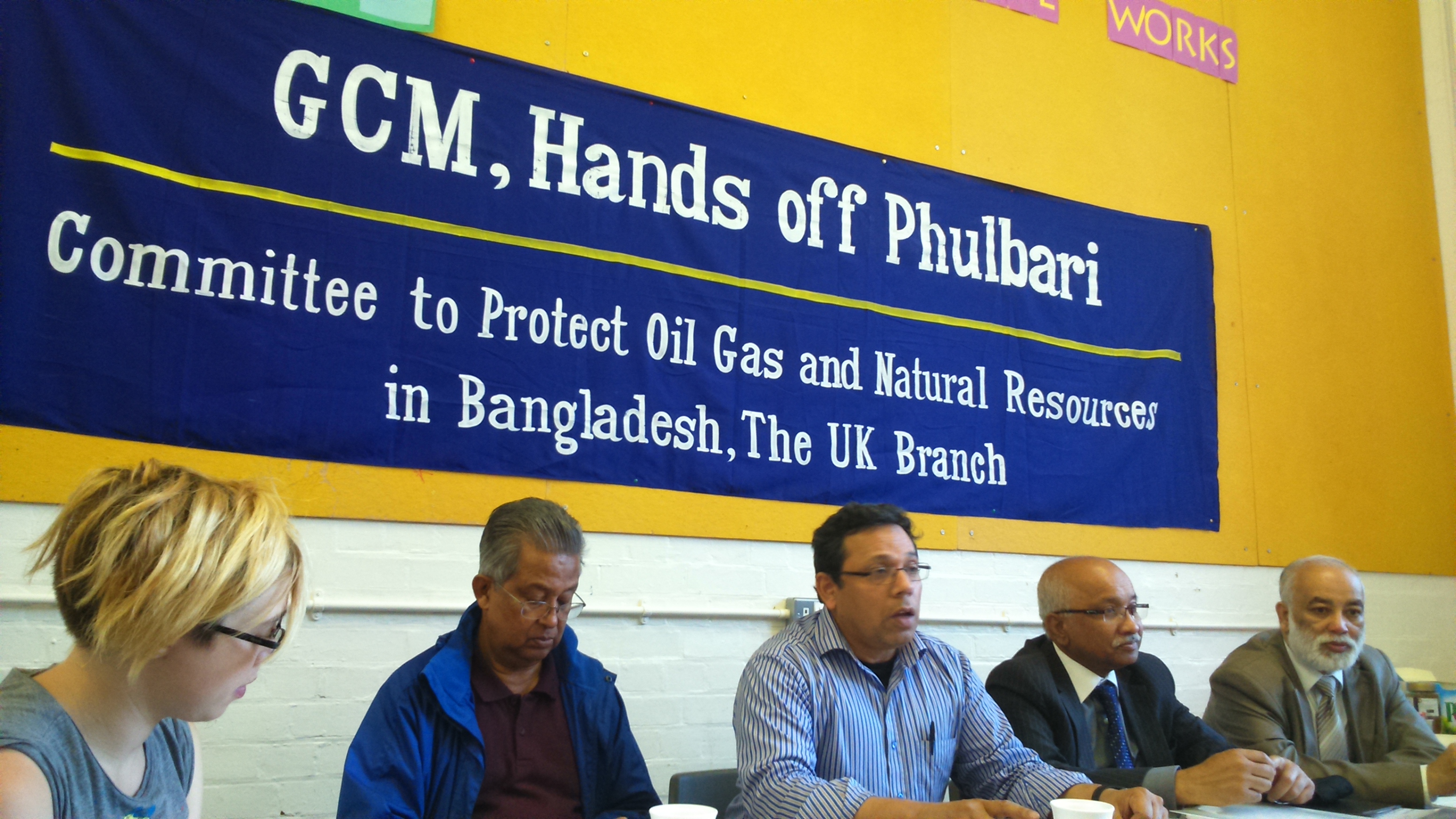
The meeting, presided by Dr Mukhlesur Rahman, has started by following one minute silence in the honour of Al-Amin, Salekin and Tariqul. Participants have discussed recent developments in the campaign against the mine. The Chair of the meeting has updated the forum about the invalid contract between the government and the company.

The founder of Phulbari Solidarity Group and an eye witness to the shooting in Phulbari, Dr Rumana Hashem, gave her eye witness to the tragic event and the deadly shootings. She described how local women and men had made the company to leave the area. She noted that locals are still vocal against the mine as they recognised that the mine, if built, would cause mass evictions and destroy thousands of hecters of farmland in an area that forms part of the country’s breadbasket. Rumana’s statement was followed by speeches by comrades such as Dr Jinnah, comrade Moktar, Mostofa Kamal, Ishak Kajol and several others.

Christine Hague, who joined the meeting to represent Global Justice UK, then delivered a message of solidarity from Global Justice Now, in which she said that Global Justice Now has been supporting the campaign against the mine since 2008. They have been putting pressure on investors, which saw Barclays and RBS withdraw their support, exposing the UK government’s support for GCM and joining protests at the company’s AGM each year. They have also supported US-based International Accountability Project to submit a complaint to the UK National Contact Point for the OECD Guidelines on Multinational Enterprises, in the hope of using this mechanism to hold GCM to account.

Although the complaint was accepted for investigation, the UK NCP failed shamefully to consider the impacts of the project should it go ahead, focusing only on the company’s actions in the planning stage to date. GCM was still found to have failed to “foster confidence and trust” in the local community though it was otherwise let off the hook with a recommendation that it update its plans and carry out a human rights impact assessment. This is, as colleagues in Bangladesh noted, likely to lead further unrest. In fact, within four days of the publication of the final statement on the complaint, a visit by GCM’s CEO, Gary Lye, to the area triggered three days of protests and strikes, including an occupation of GCM’s offices in Phulbari.

Part of the London gathering on 26 August 2015. Photo credit Zahanara Rahman

Part of the London gathering on 26 August 2015. Photo credit Zahanara Rahman

But the failure of high level international mechanisms like this made Thursday’s gatherings in recognition of the mass resistance to the project of Phulbari ever more important. A representative from UNISON, Hugo Piere, told the forum that UNISON would be proud to be part of any campaign or action that the community takes against GCM in future. A full-solidarity has been expressed by both UNISON and the Socialist Party of England and Wales.

Likewise, Isai Pryia from National Trade Union and Tamili Solidarity has sent message of solidarity. The message which Helen Pattison of Socialist Party delivered to the gathering states: ‘Although, unfortunately, Tamil Solidarity couldn’t make the meeting today we stand in solidarity with you. We remember the dead and fight for the living. We hope that we will be able to work more closely together in the future’.

Activists take pledge to stand with Phulbari people. 26 August 2015. Photo credit: Rumana Hashem

Activists take pledge to stand with Phulbari people. 26 August 2015. Photo credit: Rumana Hashem

The meeting has ended with a pledge that any attempt to implement coal-fired plant in Bangladesh will be resisted and solar energy should be promoted. People in both Bangladesh and London have acknowledged that despite the tragedy, people in Phulbari have made an example by preventing the devastating project from happening for almost a decade. It is solid people power. And that’s definitely worth celebrating.

But sadly, the news of celebration and commemoration in Phulbari remains under-covered in mainstream media. Professor Anu Muhammad, the member secretary of National Committee and a leading economist in Bangladesh stated: ‘while the significance of Phulbari resistance has been recognised by national and international environmentalists, with the exception of a few newspapers mainstream media has ignored the news of Phulbari Day.’

The fight for people’s right, nature and environment must move forward. Activists in London have now decided to hold a symbolic protest this September when the Bangladesh’s Energy Advisor Toufiq Elahi visits London.

Govt says ‘no’ to open-pit mine in Bangladesh

Another day of victory for Phulbari, another day of loss for Global Coal Management

On Sunday, 23 August, 2015 Bangladesh’s state minister for energy and mineral resources stated that there is no hope for any mining company to extract coal from the coal deposits of Northwest Bangladesh in Phulbari. In a published report yesterday, the country’s national daily newspapers reported the news widely. We have reproduced a detailed report by the staff correspondent of New Age below.

DSCF7409

The state minister for power, energy and mineral resources, Nasrul Hamid, on Sunday said that the government was not interested to extract coal from the deposits in the north Bengal region using open-pit method.
‘We have decided not to extract coal right now… We must consider high density of population and the agro-based economy of the mining area,’ he said while addressing as the chief guest a seminar on ‘Energy Challenges to Vision 2030.’ The discussion was organized by weekly Energy and Power magazine.
Instead, the government is planning to use imported coal to run large power plants to be installed with a combined generation capacity of about 20,000 MW by 2030, he said. Nasrul’s remark came three days ahead of August 26, the 9th anniversary of the killing of protesters who had opposed in 2006 a move for open pit mining by London-based Asia Energy company at Phulbari of Dinajpur.
The then Bangladesh Rifles men had opened fire on a peaceful rally and killed at least three people. On that day, police, RAB and BDR indiscriminately had beaten people, injuring over 200 children, men and women who attended that peaceful rally and demanded cancellation of the project.
The inhabitants feared it could destroy the underground water aquifer, biodiversity, and agriculture of the region.
The government, under the Power System Master Plan-2010, had contemplated to exploit coal through open-pit method from two coal deposits located at Phulbari and Barapukuria of Dinajpur to run power plants with total capacities of 11,000 MW. The plan, however, was dropped from the revised PSMP in 2015.
Energy expert and a professor at Geology Department of Dhaka University Badrul Imam said that it would not be fair to compare the socio-economic and geological realities of Dinajpur with any location in Australia, Germany or even in West Bengal while mining coal, using open-pit method.
He said that the top two leaders of Awami League and BNP had made a commitment to the people of Phulbari that they would not allow such method in future. At the seminar, a number of open-pit campaigners, however, spoke in favour of open-pit method to ensure supply of primary fuel.
Energy expert Khandkar Saleque Sufi and M Tamim presented two papers addressing the potential crisis of energy sector, particularly while ensuring supply of primary fuels to power stations, industries, households and transport sector.
At the seminar, speakers along with Sufi and Tamim argued that the country was going to be entirely dependent on imports of primary fuel as the reserve of natural gas was depleting. Tamim also said that there was a huge disparity in electricity consumption by the rural and urban people.
Tamim showed that the rural people, who constitute 66 per cent of the total population, consume 31 per cent of electricity with only one per cent growth while the urban people, who represent 34 per cent of the population, consume 69 per cent of electricity with four per cent yearly growth.

See more at: http://newagebd.net/150774/govt-says-no-to-open-pit-mine/#sthash.3l1YnBcw.3tVplMM4.dpuf

Or visit: http://newagebd.net/150774/govt-says-no-to-open-pit-mine/#sthash.3l1YnBcw.3tVplMM4.dpbs

Massive human chain against open-pit mine, GCM’s consultant , RWE, in Germany

On Saturday, 25 April, A mass action held in Germany, with over 6000 people coming together to create a 7.5 km human chain that passed through deserted villages in western Germany’s Rhineland to the open cast Garzweiler coal mine owned by  the German utility company RWE.

The chain is to protest RWE’s planned expansion of the mine and passed through  “almost deserted villages” that “have gradually become ghost villages as residents have been bought out and communities broken down by utility company RWE.”

RWE was Contracted by GCM as an advisor for the Phulbari Coal Mine throughout project implementation? This very same RWE mine has been promoted in Bangladesh as a model for how open pit mining can purportedly be done in a socially and environmentally responsible way, and there was some controversy generated by sponsored trips for key decision-makers in Bangladesh to travel to Germany and visit the mine.  At the time, we noted that claims promoting the mine and RWE as “models” for Bangladesh were contradicted by protests against the impacts of the company’s mining operations in Germany and Belgium.

Read detailed report with photos and video clip here: http://350.org/humanchain/

DSCF7409